Cotton Robes Long
- Why a Long Cotton Robe Changes Your Daily Ritual
- Terry vs Waffle Weave and How Cotton Construction Drives Performance
- How to Get the Right Length and Fit for Your Body
- Long Cotton Robes vs Shorter Lengths and Alternative Fabrics
- Matching Your Robe to the Right Use Case
- Care and Maintenance to Keep Your Robe Luxurious
- Choosing Your Perfect Long Cotton Robe with Confidence
You step out of a hot shower, reach for your robe, and discover that “luxurious” can mean very different things. The hem may expose your calves, the sleeves may swallow your hands, or the fabric may feel plush for a moment before becoming heavy and damp. A well-chosen long cotton robe avoids those frustrations by combining coverage, breathable comfort, and fabric construction suited to the way you live.
The difficult part isn't finding a robe described as soft. It's understanding how the weave absorbs moisture, how the length behaves when you're barefoot, and whether the wrap stays secure while you move. The following guide approaches cotton robes as a textile buyer would, focusing on loop geometry, airflow, overlap, sleeve placement, care, and the difference between a robe that looks spa-like and one that performs that way every morning.
Why a Long Cotton Robe Changes Your Daily Ritual
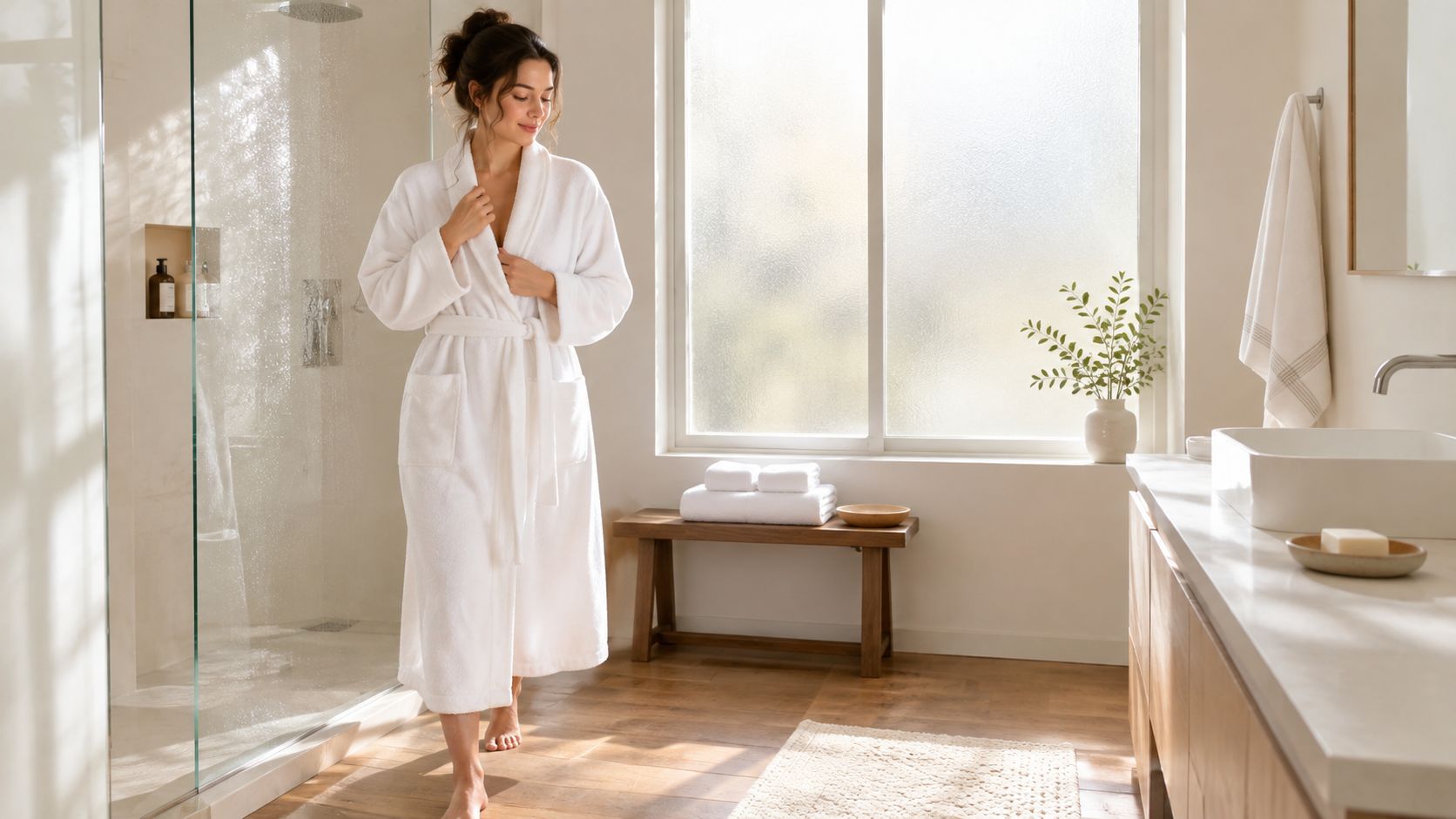
A short robe can get you from the bathroom to the bedroom. A long one can make the entire transition feel calmer. After bathing, a calf-length or ankle-grazing cotton robe covers more of your body, holds warmth around your legs, and gives you enough fabric to sit, stretch, or make coffee without constantly checking whether the front has opened.
That extra length also changes the practical experience of modesty. A robe that reaches the right point on your body lets you bend toward a drawer, answer the door, or walk across a cool floor without exposing more than you intended. The benefit isn't merely visual. Cotton can feel comfortable against damp skin, and the right construction can provide warmth without the sealed-in sensation associated with some heavy synthetic fabrics.
What long means in real use
“Long” isn't a universal measurement. On one person, it may fall around the calf. On another, it may approach the ankle. The same listed robe length can produce very different results depending on height, shoulder placement, sleeve cut, and whether you wear slippers underneath.
A useful robe should support the ritual you want:
- After-shower comfort: Choose a construction that can handle residual moisture without clinging.
- Cold-floor protection: Look for a hem with enough coverage to warm your legs, but not so much that it drags.
- Morning lounging: Prioritize a secure overlap, usable pockets, and sleeves that won't dip into a sink or mug.
- Evening wind-down: A softer drape and generous wrap can feel more relaxing than a rigid, towel-like shape.
Cotton has a long textile history. It has been cultivated in North Africa and the Indian subcontinent for at least 5,000 years, and its modern clothing role expanded when cotton textiles entered England's machine-spinning era in the early 1700s. In 1793, Eli Whitney patented the cotton gin, a machine that, according to the U.S. International Trade Commission's account of cotton processing, allowed one person to clean in a day about as much cotton as roughly 50 people could clean by hand.
That history matters because long cotton robes belong to a textile category shaped by both natural-fiber comfort and industrial-scale availability. Today, the best choice isn't just “100% cotton.” You need to decide whether you want loops for absorbency, a grid for airflow, or a lighter construction for warm conditions. Length, overlap, and care then determine whether the robe remains useful after the novelty wears off.
Terry vs Waffle Weave and How Cotton Construction Drives Performance
Cotton tells you what the fiber is. It doesn't tell you how the fabric will behave. A terry robe and a waffle robe can both be made from cotton, yet they can feel completely different because their structures expose and organize the yarn in different ways.
Terry cloth uses looped pile yarns. Those loops create surface area that can capture water, which is why terry is associated with towels and post-shower robes. Research on 100% cotton terry shows that water absorption changes with fabric weight, thickness, pile-yarn twist, and loop geometry. Higher pile height combined with lower pile density can increase the available surface area for liquid uptake, while excessive density can make the fabric heavier and reduce moisture-management capacity. These construction relationships are described in the research on cotton terry water absorption.
GSM, or grams per square metre, can help describe fabric weight, but it shouldn't be treated as a complete quality score. A very heavy robe may feel substantial while drying slowly. A moderately weighted terry with loftier, well-formed loops can offer a better balance between plushness, absorbency, and wearability.
Why waffle feels different
Waffle weave creates a raised grid rather than a field of dense loops. The recessed squares and raised ridges create air pockets, which support airflow and light insulation. That open structure can help moisture move away from the skin and allow the robe to dry faster than a bulky terry garment.
The trade-off is straightforward. Waffle usually feels lighter and less enveloping, while terry generally offers more plushness and liquid-holding capacity. For humid rooms, warm climates, travel, or layering, waffle can be easier to wear. For a cold morning or a robe intended to function like a wearable towel, terry may feel more satisfying.
If you're still unsure which structure suits your routine, this waffle versus terry cloth robe guide offers another way to frame the decision.
| Attribute | Terry Weave | Waffle Weave |
|---|---|---|
| Surface structure | Looped pile yarns | Raised grid with air pockets |
| Main strength | Plushness and post-shower absorbency | Airflow, lightness, and quicker drying |
| Typical feel | Cushioned and towel-like | Textured, springy, and less bulky |
| Moisture behavior | Holds more liquid, depending on loop design | Wicks and releases moisture with less bulk |
| Best match | Cooler rooms and drying after bathing | Warm conditions, travel, and layering |
| Main trade-off | Can feel heavy or slow to dry if too dense | Usually less plush and less liquid-holding |
Construction rule: Don't choose the thickest robe by default. Choose the structure that matches how much moisture, warmth, and drying speed you need.
How to Get the Right Length and Fit for Your Body
Chest or bust size is only the beginning. A long robe must fit across the shoulders, close securely at the front, end safely above the floor, and leave enough room for the movement you make while wearing it.
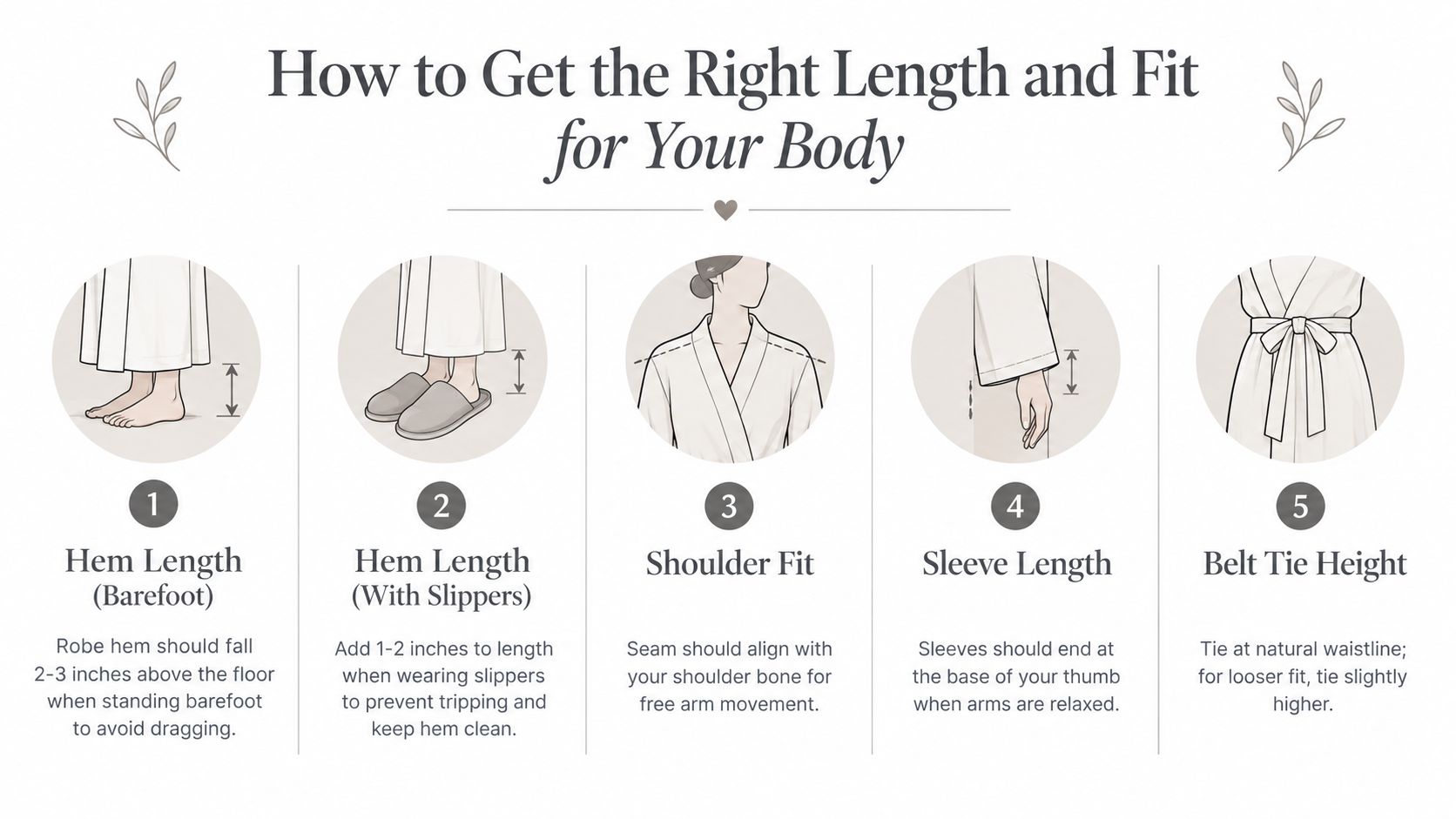
Start with the hem. Stand barefoot on the floor and check where the robe ends. The supplied fit guide recommends keeping the hem 2 to 3 inches above the floor when barefoot, then allowing roughly 1 to 2 inches of additional length when slippers are part of your routine. Those measurements are practical targets for avoiding drag and reducing the chance of catching the hem underfoot, not rigid rules for every body or garment shape.
Check the shoulder and sleeve relationship
The shoulder seam should sit close to your shoulder bone. If it falls far down the upper arm, the robe may feel relaxed but can restrict movement because excess fabric gathers at the underarm. If it sits too high, the garment can pull across the back when you reach forward.
Sleeves require a similar reality check. With your arms relaxed, the cuff should reach approximately the base of the thumb according to the provided fit visualization. That length gives coverage without forcing you to push the cuff up every time you wash your face. If you spend much of your morning cooking or working at a sink, a slightly shorter sleeve may be more practical than a dramatic, oversized drop.
Front overlap deserves more attention than many product pages give it. Close the robe naturally, place the belt at your waist, and move your arms forward. If the front separates across the thighs or abdomen, the robe may need more wrap coverage or a larger size.
Adjust for height and proportions
A robe designed for a tall frame may reach the ankle on one person and the lower calf on another. Petite shoppers should inspect garment length and sleeve measurements rather than relying on “full length.” Tall shoppers should look for enough vertical coverage and a belt position that doesn't sit too high.
Plus-size shoppers may need to prioritize front overlap and sleeve mobility, not only the largest chest measurement. A generous body width doesn't automatically create secure coverage if the front panels are narrow. Before ordering, compare the garment's listed length, body width, sleeve measurement, and belt placement with a robe you already like.
For robe-specific options, review women's full-length robes with the same checklist.
- Barefoot hem: Confirm the robe won't drag.
- Slipper hem: Account for the footwear you use.
- Shoulder seam: Look for alignment that allows reaching.
- Sleeve end: Check wrist coverage against daily tasks.
- Wrap coverage: Test the overlap while walking, sitting, and bending.
Long Cotton Robes vs Shorter Lengths and Alternative Fabrics
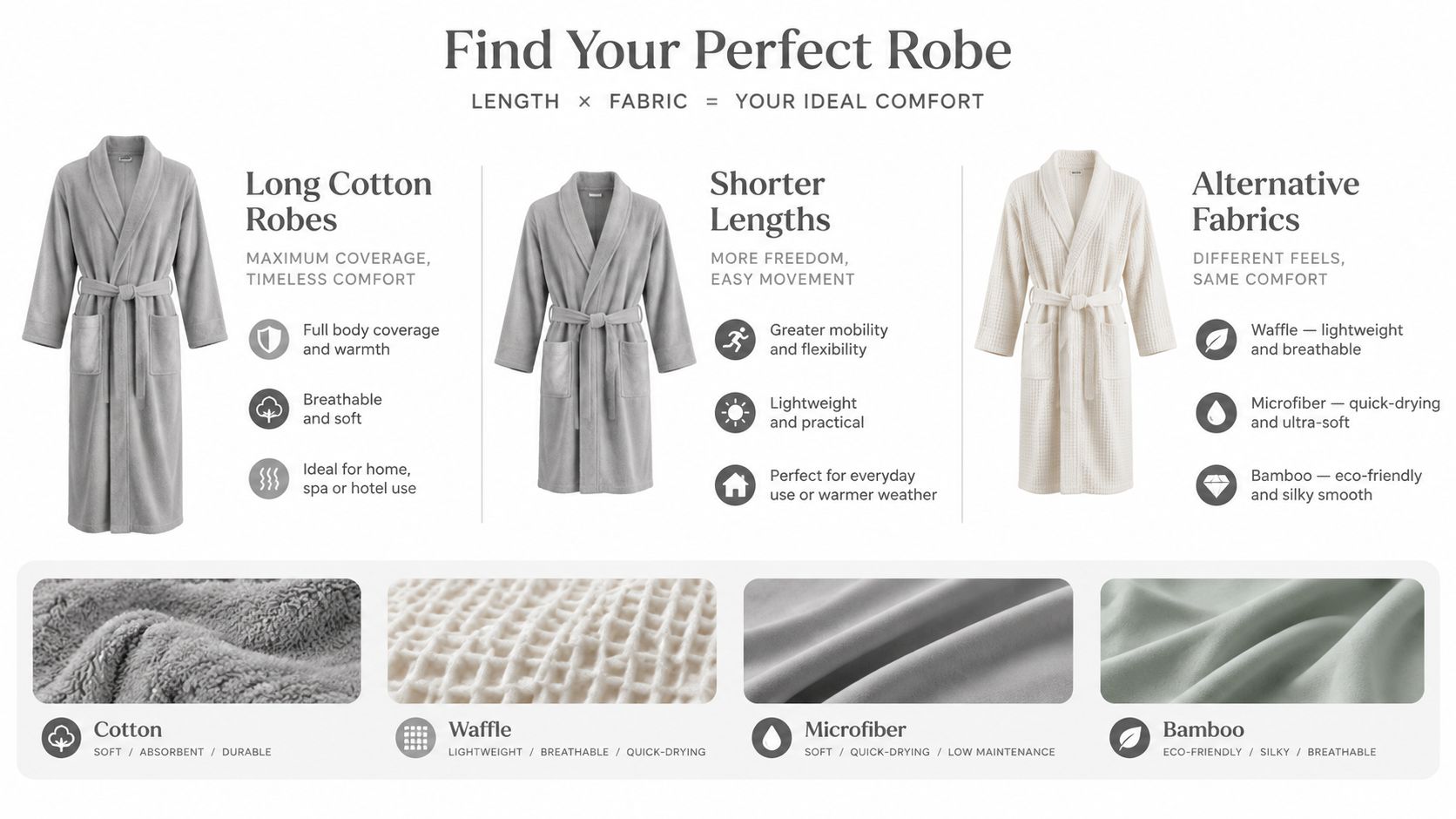
Length determines how much of your body the robe covers, but it also affects movement, weight, and drying. A long cotton robe is useful when warmth and modesty matter more than compactness. A knee-length option can feel easier in a small bathroom or during chores, while a mid-calf design often provides a middle ground between coverage and mobility.
The decision becomes clearer when you match the robe to the moment rather than to a vague idea of luxury.
Compare the common alternatives
Long cotton: Best for post-bath coverage, cool floors, and slow mornings. Terry supplies a towel-like feel, while waffle reduces bulk and supports airflow.
Knee-length cotton: Easier to move in and often more convenient for warm interiors. It exposes more of the legs, so it may not provide the same sense of enclosure after bathing.
Mid-calf cotton: A practical compromise. It can preserve substantial coverage while keeping the hem away from the ankle area during ordinary household movement.
Fleece: Fleece is designed for warmth and insulation, not for absorbing water from freshly washed skin. It can be pleasant on a cold morning, but it may feel too warm or less breathable after a hot shower.
Silk: Silk offers a smooth, elegant surface and works well as a dressing layer. It isn't the practical choice if you want the robe to hold moisture like a towel, and it generally demands more careful handling.
Microfiber: Microfiber can feel light and dry readily, but it provides a different hand feel from natural cotton. Choose it when low bulk and quick drying matter more than a traditional cotton texture.
Cotton remains a major textile material. Its share of the U.S. retail apparel and home furnishings market rose from a historic low of 34% in the early 1970s to more than 60% today, according to Cotton Incorporated's textile use overview. That broad presence doesn't make every cotton robe suitable, but it explains why shoppers can find such a wide range of constructions.
Decision shortcut: Choose long terry for warmth and water absorption, long waffle for breathable coverage, shorter cotton for mobility, and non-cotton alternatives only when their specific behavior solves your main problem.
Matching Your Robe to the Right Use Case
The ideal robe changes with the setting. A garment that feels perfect after a winter bath may be excessive in a warm bedroom, while a lightweight travel robe may not provide the enveloping comfort you want from an evening ritual.
Daily home self-care
For a morning routine built around bathing, choose terry when absorbency and warmth lead your priorities. Look for a secure inner tie or a well-positioned belt, functional pockets, and sleeves that stay clear of water. A long cut works especially well if you move from the bathroom to the kitchen before getting dressed.
For warm-weather lounging, waffle can be the more comfortable choice. Its grid structure creates airflow and reduces the heavy sensation that some dense robes produce. A breathable long robe can still provide coverage while remaining easier to wear for extended periods.
Spa and wellness routines
Spa-style comfort depends on balance. Plush terry can create the familiar hotel-like feeling, but excessive density may make a robe cumbersome and slow to release moisture. A moderately substantial fabric with a stable collar, reinforced seams, and enough overlap tends to feel more polished than a robe that relies only on thickness.
For a home sauna, steam room, or post-workout routine, consider how quickly the robe needs to dry between uses. Waffle is often more convenient when you want a lighter layer that can air out without taking over the bathroom.
Hospitality and guest use
Hospitality buyers should evaluate construction beyond first-touch softness. Check the stability of the pile or waffle grid, seam finishing, belt attachment, pocket reinforcement, and laundering instructions. The robe must remain presentable and comfortable as staff wash and rotate it.
Organic certification can also matter to properties that communicate environmental standards. Don't assume that the word “organic” alone identifies a certification. Ask which certification applies, what fiber it covers, and whether the documentation matches the finished product.
Bridal gifting and coordinated sets
For bridal parties, visual consistency matters, but wearability determines whether the gift remains useful after the event. Coordinated colors, full coverage, and a flattering wrap can work for photographs while still serving as everyday loungewear.
A lightweight waffle robe may be more comfortable during a busy preparation morning, especially when people are moving between hair, makeup, and dressing areas. Terry can feel more substantial as a post-event gift, particularly for recipients who enjoy a traditional bathrobe.
Recent market coverage reports that approximately 48% of bathrobe buyers prefer organic cotton, while 36% want lightweight robes, as documented in this bathrobe market coverage. Those figures point toward a practical preference, shoppers want natural fibers and spa-like comfort without unnecessary bulk.
SEYANTE offers full-length cotton robes in terry and waffle constructions, including options made from organic Turkish cotton, so shoppers can compare absorbent and breathable formats within one category. Use the same criteria whether you're buying one robe for yourself, coordinating gifts, or specifying garments for guests.
Care and Maintenance to Keep Your Robe Luxurious
Cotton rewards consistent care, but it doesn't respond well to guesswork. Start with the garment label because finishing, dye, stitching, and fabric structure can change the recommended method.
Wash the robe separately or with similar cotton items, especially during the first washes. Use a gentle detergent and avoid overloading the machine, which prevents the fabric from rinsing and moving freely. Fabric softener can coat cotton fibers and interfere with the absorbency you chose the robe to provide.
A reliable care routine
- Read the label: Follow the stated temperature and cycle instructions before choosing a wash setting.
- Protect the structure: Turn the robe inside out when appropriate and close belts or ties so they don't catch on other items.
- Use measured detergent: Excess detergent can remain in dense terry and leave the surface less fresh.
- Dry with restraint: Air-drying is gentle. If you use a dryer, choose a lower setting and remove the robe while it's fully dry but not overheated.
- Restore the shape: Shake the robe out before drying and smooth the collar, cuffs, and hem afterward.
- Store with airflow: Hang it where moisture can escape. Avoid leaving a damp robe in a closed hamper.
Handle stains before washing
Body oils, skincare products, and makeup can settle into collars and cuffs. Blot fresh marks, apply a small amount of suitable detergent to the affected area, and test any treatment on an inconspicuous section first. Don't scrub aggressively across terry loops because rough handling can pull them from the base fabric.
Shrinkage risk deserves attention, particularly with longer cotton robes. Heat, moisture, and repeated drying can change the final dimensions, so preserve the original length by using the gentlest method allowed by the care label. A robe that fits perfectly at purchase can feel noticeably less practical if the hem rises or the overlap narrows.
For a more detailed routine covering how to wash, store, and care for your robe, focus on consistency rather than occasional rescue treatments. Proper drying also protects terry loops and the raised structure of waffle fabric from unnecessary stress.
Choosing Your Perfect Long Cotton Robe with Confidence
Begin with the use case, not the color. Decide whether the robe will dry you after bathing, warm you while lounging, serve guests, or act as a lightweight layer in a warm room. That single decision narrows the fabric choice more effectively than broad claims about softness.
Next, select the construction. Terry is the logical starting point for absorbency and plushness, provided the pile isn't so dense that the garment becomes cumbersome. Waffle suits shoppers who value airflow, lower bulk, and faster drying. Neither is universally superior. The better structure is the one that fits your climate, bathroom routine, and tolerance for drying time.
Then check fit in this order:
- Length: Confirm where the hem lands barefoot and with slippers.
- Overlap: Make sure the front remains closed while sitting and moving.
- Shoulders: Look for a seam position that allows comfortable reach.
- Sleeves: Match the cuff to your grooming, cooking, and work habits.
- Care: Verify that the washing and drying instructions fit your routine.
Quality descriptions should provide more than a fiber label. Look for fabric structure, garment measurements, belt construction, inner ties, pocket placement, seam finishing, and any relevant certification. Treat “hotel quality,” “spa weight,” and “ultra-luxurious” as marketing language unless the listing explains the actual construction behind those terms.
Cotton's material share of bathrobes is estimated at 36.2% in 2025, according to the cited cotton textile market information. That figure reinforces cotton's importance in the category, but it doesn't remove the need to evaluate the individual robe.
A premium robe earns its place through repeated usefulness. It should stay closed, move with you, feel appropriate for the temperature, and remain manageable after laundering. If a product page gives you only a chest size and a softness claim, keep looking for the measurements and construction details that answer the questions your body and routine will raise.
SEYANTE offers long cotton robes in 100% Turkish cotton terry and lightweight waffle weaves, including organic options for home self-care, gifting, and hospitality use. Visit SEYANTE to compare full-length constructions, review sizing and material guidance, and choose the robe that fits your preferred balance of coverage, absorbency, airflow, and everyday comfort.