Fleece Hooded Robe: Warmth, Care and Fit
The most common advice about robes gets it backwards. You're told to pick the softest, thickest, most plush robe you can find and wear it straight out of the shower. That sounds logical until you're standing there warm on the surface and damp underneath, wondering why you're not getting dry.
A fleece hooded robe isn't a towel you wear. It's an insulator you put on once you're already dry. Once you separate those two jobs, warmth, fit, washing, and even safety decisions get much clearer. Thick doesn't always mean comfortable, and a hood doesn't always help. Sometimes it traps the exact moisture and heat you wanted to escape.
What a Fleece Hooded Robe Is For
Say you step out of a shower into a cool bathroom, skip the towel, and pull on a plush robe. Your shoulders feel warm right away. Five minutes later your back still feels damp, your hair drips inside the hood, and the robe clings a little at your waist. Nothing's wrong with the robe. You've asked it to do the wrong job.
A fleece hooded robe is a full-coverage lounge garment, usually made from polyester, with a hood and a brushed pile that traps still air around a dry body. Think of that pile as a thin quilt of tiny air pockets. A towel loop is built to grab and hold water. Fleece pile is built to hold air, and air is what insulates you.
The Three Jobs a Robe Can Do
Every robe leans toward one main job, even if the label doesn't say so.
- Soak up water: Looped fabric pulls moisture off skin and holds it.
- Insulate: Raised pile traps your body heat so a cool room feels less sharp.
- Stay breathable for hours: Open construction lets heat and vapor escape during long wear.
Fleece owns the middle job. It's at its best on a cool evening when you're already dry, wearing pajamas or a tee, and you want fast warmth without a heavy blanket over your shoulders. That same logic applies to other cozy layers at home, where playful comfort for everyday lounging works because you're dry and settled, not because it dries you.
The usual build is simple. There's a knitted base, a raised pile described as light, midweight, or heavy plush, plus a hood, a belt or tie, and often patch pockets. None of that turns fleece into a post-bath dryer. If you keep the rule dry body first, fleece second, the comparison, the wash routine, and the fit test that follow will make sense without guesswork.
Fleece, Terry, or Waffle by Situation
Choose by what you'll be doing and how warm the room is. A fleece hooded robe is for dry lounging; terry suits drying off; waffle is often more comfortable for longer wear when you want airflow.
| Situation | Fleece hooded robe | Turkish cotton terry | Cotton waffle |
|---|---|---|---|
| Right after a shower | Weak dryer; best once skin is dry | Best water pickup from looped pile | Light absorbency; suits a warm bathroom |
| Dry lounge in a cool room | Quick warmth from trapped air | Warm, but heavier | More airflow and less insulation |
| Sleep or hours in a warm room | Often too hot with the hood up | Can feel heavy | Better for breathable, extended wear |
| After a workout | Can hold sweat and heat | Absorbs sweat but can feel heavy when damp | More airflow while cooling down |
| Humid climate or hot flashes | Pile and hood can feel too warm | May feel muggy | Open weave allows more airflow |
| Guest robe or mixed-climate gift | Suited to dry, cool lounging | Useful for bathroom and hotel settings | Versatile for everyday wear |
Right After a Shower
Fleece is a poor choice straight out of the shower. For the difference between feeling warm and drying off, see Why Wet Fleece Feels Clammy below.
Looped Turkish cotton terry is the practical post-bath choice because its loops absorb water. Honeycomb waffle absorbs less, but can feel more comfortable than a heavy terry robe in a warm bathroom. If you want fleece afterward, towel off first, including your neck and hairline, then put it on for warmth.
Wet-or-dry rule: If your skin still leaves a damp handprint on a towel, dry off more before putting on fleece.
Dry Lounging in a Cool Room
In a cool room, roughly below 68°F (20°C), fleece provides quick warmth without the weight of a terry robe. Wear it over dry clothes, and the pile helps buffer drafts around your neck and shoulders.
Terry can feel warm when dry, but its water-absorbing loops make it heavier for the same coverage. Waffle allows more airflow, which can suit someone who runs warm, while a cool living room may call for more insulation. For a closer comparison of the two cotton fabrics, read this guide to waffle and terry cloth robes for daily use.
Sleep, Long Wear, and Overheating
For sleep, long stretches on the sofa, humid weather, or hot flashes, fleece can become too warm. The pile and hood hold heat close, so a little perspiration may make you want to throw back the hood, cool down, then pull it up again.
Waffle suits these situations better because its open texture lets heat escape. After a workout, let your skin cool and dry before putting on fleece, or choose a more breathable robe. Terry absorbs sweat, but can feel heavy when damp.
The trade-offs are straightforward:
- Fleece strengths: Soft feel, quick warmth, light when dry.
- Fleece limits: Poor water pickup and a tendency to overheat with the hood up.
- Useful pairing: Keep fleece for dry, cool evenings and choose a breathable robe for warm rooms or post-shower wear.
For example, a household might keep fleece near the sofa for cool evenings and a waffle robe in the bathroom for after showers or warmer mornings. SEYANTE's Women's Lavender Blue Turkish Cotton Waffle Hooded Robe is made from 100% GOTS-certified organic Turkish cotton and described as lightweight and breathable.
Before buying, check three things: whether you'll wear the robe wet or dry, whether the room is usually cool or warm, and whether you need it for a short lounge or all evening. If your answers point to different fabrics, choose two robes for those distinct routines.
How Fleece Is Built and Holds Warmth
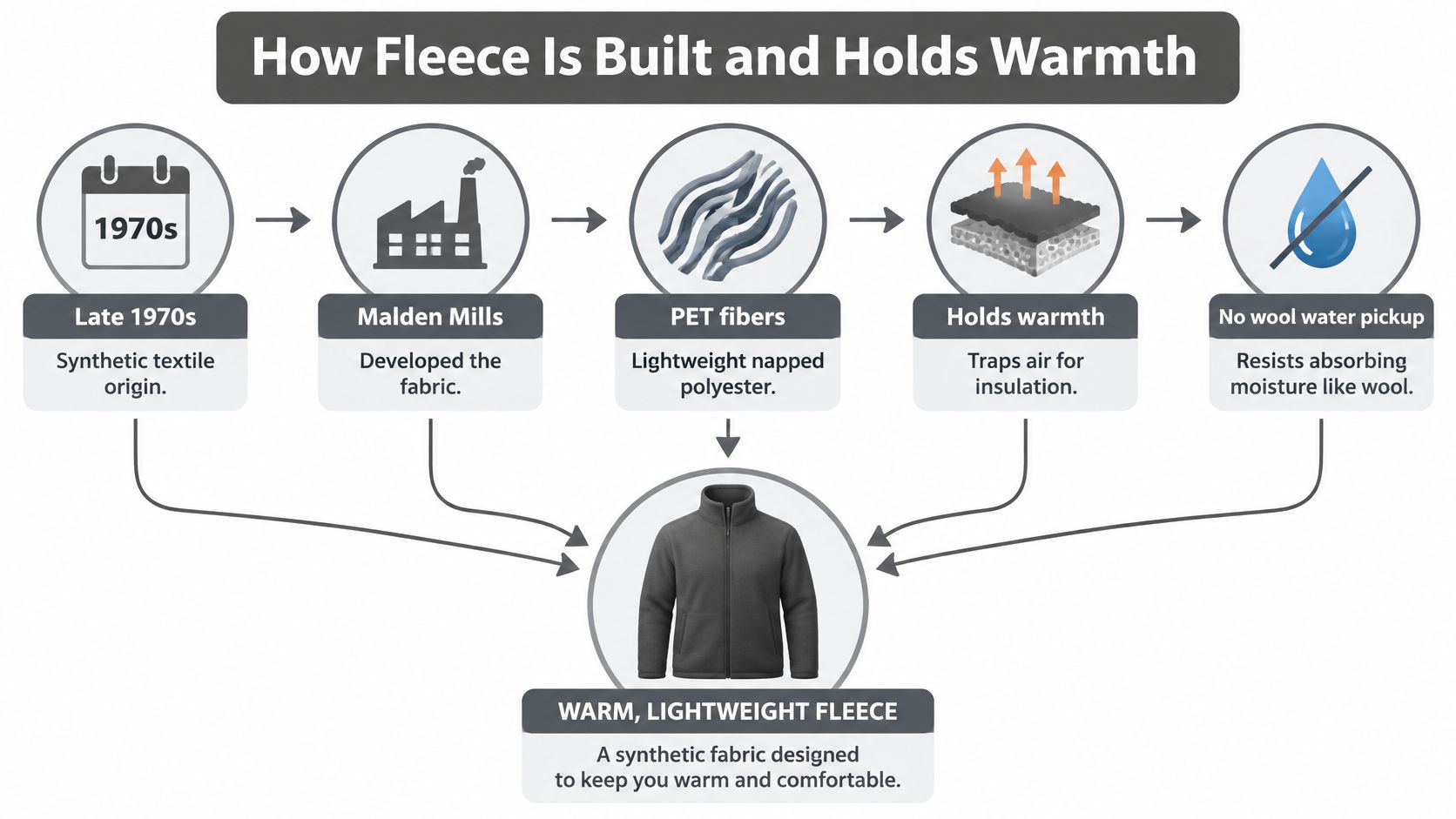
Fleece works by trapping still air in a raised surface. Its history begins in the late 1970s, when U.S. textile manufacturer Malden Mills developed a lightweight, napped fabric made from polyethylene terephthalate (PET), a form of polyester, according to Alliance Chemical's account of polyester and fleece history. Fleece became commercially significant after garments appeared under the Synchilla name in 1981. In 1993, recycled PET bottles were used to produce fleece.
Knit First, Then Brush
Makers knit a base fabric, then mechanically brush its surface to lift a plush pile. That pile traps still air, which provides insulation. The smoother base sits closer to your skin and can help move liquid away from the body, as explained in research on fleece-knitted structures in the Indian Journal of Fibre and Textile Research. The research found that designs using filament yarn on the base side and spun yarn on the fleece side had better moisture-management performance than less differentiated constructions.
For a hooded robe, look for a smooth, low-friction inner face and a stable, lofted outer face, especially around the hood, shoulders, and upper back. These areas collect condensation and perspiration when you sit still with the hood up. Uniform plush inside and out may feel soft to the touch, but the construction can make moisture movement less effective.
Light, midweight, and high-pile fleece differ in how much air they can hold and how readily they may feel too warm. The pile's resilience matters too. If it collapses flat at the shoulders after repeated wear, it will trap less insulating air than it did when new.
Why Wet Fleece Feels Clammy
Water in the pile replaces some of the still air that helps fleece insulate, so a wet robe can feel cooler and damper against your skin despite looking thick. This is why thickness alone doesn't tell you how warm a robe will feel when damp.
Compression also reduces loft. Seating, a tight belt, and repeated hot washing can press the pile flat, especially where you sit or cinch the belt. Those patches hold less air and provide less insulation.
A hood holds warmth around your head. It doesn't make a robe absorb water more effectively; absorbency depends on the fiber and weave.
Recycled PET describes the material's source. It doesn't, by itself, determine how well the fabric dries or how much it sheds. For everyday wear, look for a smooth inside, resilient loft outside, and pile that springs back when you press and release it at the shoulder.
Heat Sources and Fire Safety
A fleece hooded robe is designed to hold warmth close to the body, which makes it a poor choice around open flames and hot surfaces. Long sleeves, a loose hood, and a dangling belt can drift toward candles, fireplaces, stovetops, space heaters, or portable radiators. During candle use, for example, a sleeve or belt end can enter the flame's reach when you lean over a table. Articles that monitor and respond to brand mentions can help explain why candle safety matters in everyday routines.
U.S. 16 CFR Part 1610 classifies clothing textiles into three flammability classes, as set out in the electronic Code of Federal Regulations for clothing textile flammability. Class 1 represents normal flammability, Class 2 intermediate flammability for raised-surface fabrics, and Class 3 rapid, intense burning, which is prohibited for apparel. The standard measures how a textile burns under specified test conditions. A class rating does not make a robe safe to wear close to a flame.
Why the Raised Surface Matters
Brushing, fiber type, fabric mass, and finishing treatments can affect a test result, so two robes with similar softness may receive different classifications. Softness is a comfort cue, not a fire-safety rating.
Three Rules for Home Use
- Keep clear of heat: Keep the robe away from space heaters, stoves, candles, and fireplaces, even during a quick task such as stirring a pot or blowing out a wick.
- Control loose parts: Keep the hood, sleeves, and belt away from flames and hot elements. Tie or remove a dangling belt before cooking.
- Check the spec: Look for a product label or specification stating compliance with the apparel flammability standard. Do not assume plush fabric is safe by default.
Make taking the robe off the first step before cooking, tending a fire, or moving a heater. That simple habit keeps loose fabric away from heat, instead of relying on a test classification to protect you during use.
How to Wash a Fleece Hooded Robe
A fleece hooded robe is an insulator for a dry body, not a substitute for a towel. Wash it when it is soiled or holds odor, then limit friction and heat to help the brushed pile stay soft and springy.
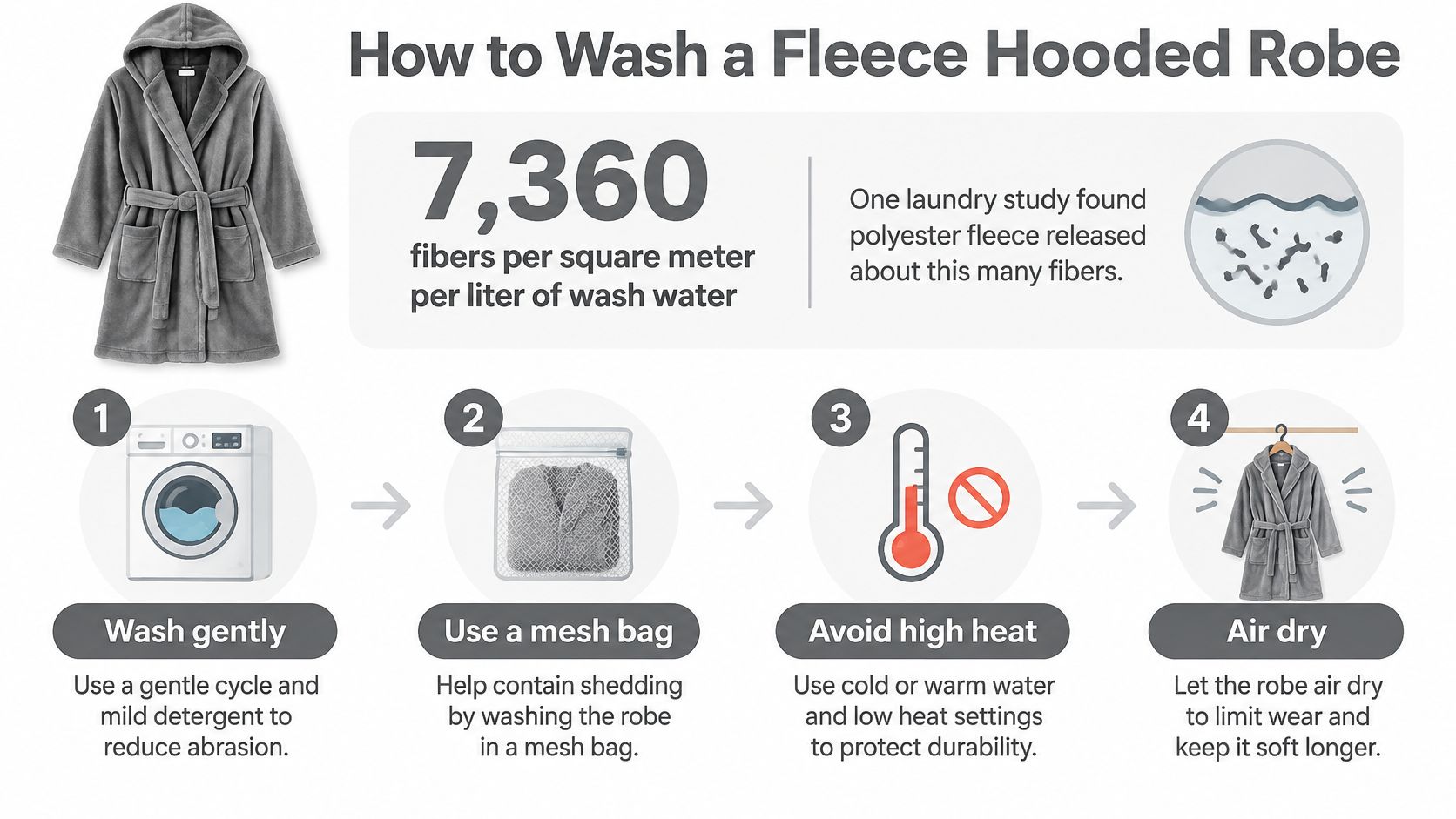
Research reviewed in Textile and Leather Review found that polyester fleece released more fibers in washing than comparable polyester fabrics. In one controlled study, tumble drying produced more microfiber emissions than washing, while detergent and softener did not significantly change emissions. These findings vary by fabric and test conditions, but they point to a practical choice: wash gently and air-dry when possible.
A separate peer-reviewed study on domestic laundry in Environmental Science and Pollution Research estimated substantial fiber release from a PET-fleece garment during washing. Early lint is common with brushed fabric; it does not, by itself, mean the robe is coming apart.
A Routine That Protects the Pile
- Wash only when needed: Wash when the robe smells or looks soiled, rather than after every evening of wear. Between washes, hang it with the hood open so trapped moisture can air out.
- Reduce abrasion: Turn it inside out and use cold water on a gentle cycle, alone or with similar synthetics. A front-loader can be gentler than a machine with a central agitator.
- Use plain detergent: Follow the care label and measure a normal dose. Skip fabric softener and high heat, which can flatten the pile over time.
- Air-dry and reshape: Dry flat or on a wide hanger, away from radiators. Smooth the hood while it is damp so it does not dry in a crease.
- Clear collected lint: Check the machine filter after washing, especially when the robe is new. A lint-catching wash bag or filter can collect some fibers before they reach the drain, but it does not prevent shedding.
For fabric-specific laundering and storage advice, follow this guide to wash, store, and care for your robe.
The care label should guide the wash temperature and drying method. Check it before the first wash, then follow the same gentle routine unless the label says otherwise. If the robe still feels fresh, airing it is a simpler choice than adding another wash cycle.
Fit Hood and Everyday Styling
Fit is a comfort check, not a fashion decision. A fleece hooded robe should close without pulling across your chest or hips, with sleeves that still cover your wrists when your arms reach forward. The hem should stay put while you're sitting, not ride up every time you settle in.
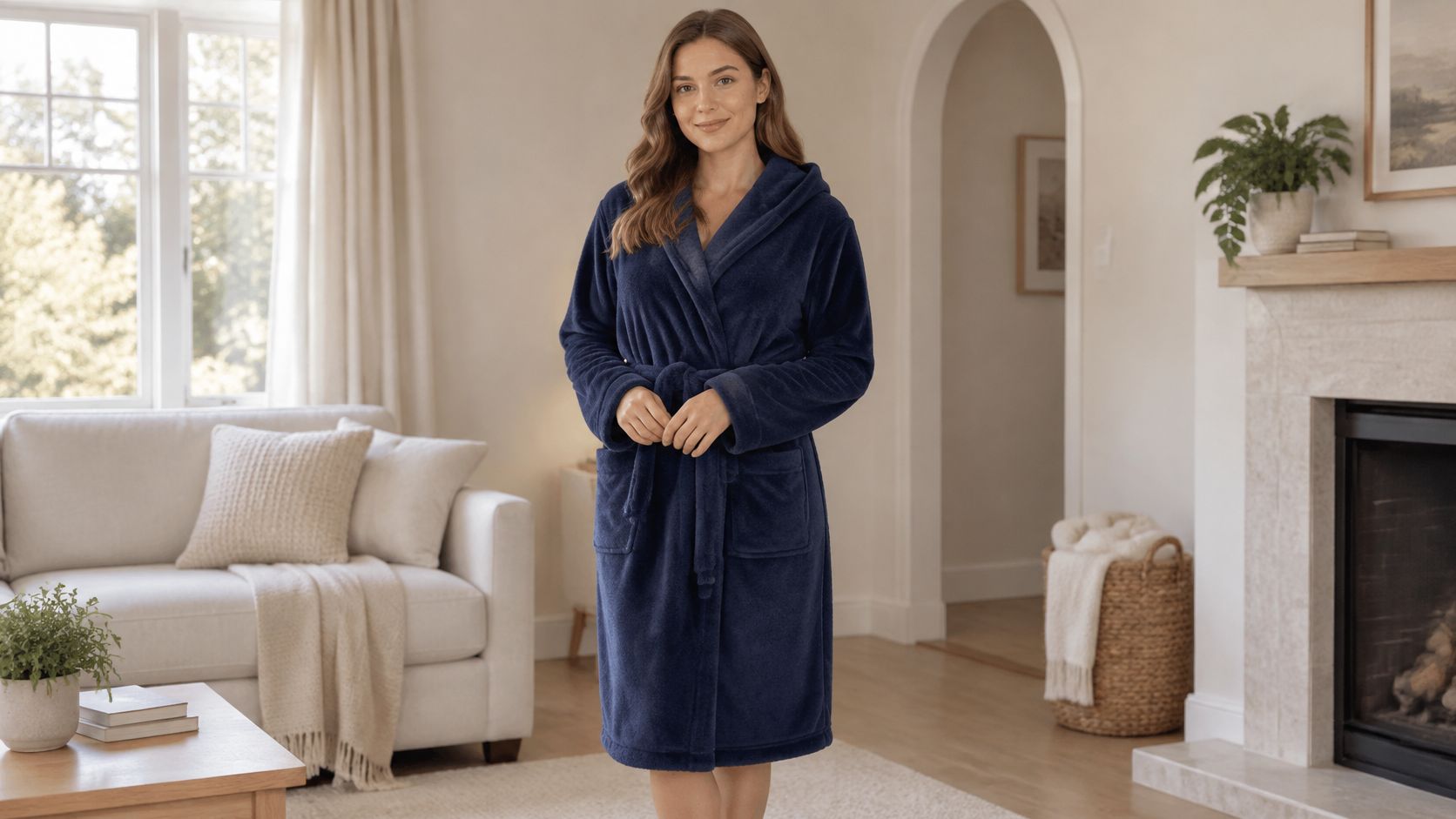
Knee length to mid-calf is the practical range for loungewear. Shorter hems ride up on a sofa and leave your legs cold. Floor length pools around your ankles, picks up bathroom damp, and gets stepped on at stairs. If you're between sizes or unsure how a brand measures length, use the steps in how to use a robe size chart guide and check actual garment length against your own torso and legs.
Hood and Belt Checks
The hood should frame your head without pressing your ears or tipping over your eyes. If the robe only feels right with the hood up, it's probably too warm for long wear, and you'll spend the evening overheating. The belt should cinch over the pile without crushing a wide band of loft flat at your waist, since that flattened band insulates less and wears faster.
Three Everyday Ways to Wear It
- Cool morning at home: Wear the robe over cotton pajamas with the hood down and slippers on. Keep it on until the room warms, then hang it up rather than wearing it into overheating.
- Evening lounge: Use it as the outer layer over a tee. Put the hood up while you're still and chilly, then drop it once you're seated near a lamp or heater and your temperature settles.
- Travel or guest room: Pack a midweight fleece for a chilly bedroom. Keep it off wet hair after an evening shower, and let a towel do the drying first.
Color matters mainly for wearability. Deep indigo, lavender, and neutral tones hide early pilling better than pale brights, which show every fuzz ball and lint speck. Pockets should sit where your hands naturally fall, not so low that you hunch to use them.
Finish with a simple try-on test. Sit down, lift both arms overhead, then walk a hallway. If the pile binds at your shoulders, the front gapes when you sit, or the hood tips forward as you walk, size up rather than forcing a slimmer cut. A robe you'll wear nightly should feel generous on day one, because pile, posture, and layered pajamas all take up room you can't judge while standing still in front of a mirror.
If your evenings split between cool dry lounging and warm post-shower wear, build a small rotation instead of forcing one robe into both jobs, with fleece for insulation and breathable Turkish cotton terry or waffle for drying and long wear. Visit SEYANTE to compare hooded waffle and terry styles by fabric, length, and size, and choose the layer that matches how you'll wear it.