Mens Hooded Spa Robe Buying Guide for 2026
- What a Men's Hooded Spa Robe Is and Why the Hood Matters
- Turkish Cotton Terry Versus Waffle Weave for Men
- Finding the Right Size and Hood Depth
- Choosing the Robe for Home, Spa and Hospitality Use
- Caring for a Hooded Robe So It Stays Absorbent
- What GOTS Certification Proves and Where It Stops
- Confirm Fabric, Fit and Care Before You Buy
A men's hooded spa robe is a wrap-style robe with a built-in hood and belt, usually made from absorbent terry or breathable waffle cotton. You're choosing it for the minutes after a shower, swim, or sauna, so the right pick depends less on how plush it looks in a photo and more on how it handles wet hair, heat, and repeated washing.
What a Men's Hooded Spa Robe Is and Why the Hood Matters
You step out of a warm shower into a cold bathroom and the chill hits your neck first. Your hair's still dripping, a shawl collar sits below it, and water runs down your back while you're trying to dry your front. A hooded robe changes that first minute because the same fabric that wraps your body also covers your head.
A men's hooded spa robe is a wrap-style robe with a built-in hood, a belt, and a body of absorbent terry or breathable waffle cotton, worn after bathing, at a spa, or for lounging. Think of it as a hooded towel you can also wear to make coffee. It has to pull water off skin and hair, then stay comfortable once you're mostly dry.
The Three Parts That Decide How It Feels
The hood covers wet hair and the back of your neck, which a collar can't do. The wrap closure and belt control overlap at your chest and waist, so you can loosen the robe as you warm up or pull it closed in a draft. The fabric sets performance, because loops, weight, and weave decide how much water the robe picks up and how fast it releases that water later in the dryer.
That hood isn't free. It holds heat around your head, adds bulk behind your neck when it's down, and gives moisture another thick panel to sit in. In a cold room with wet hair, that's a fair trade. In a warm, humid bathroom after a workout, it can feel like wearing a damp hat you didn't ask for.
A hood earns its place when wet hair or a cold room is your real problem, not when you just want a robe that looks relaxed.
You're not shopping in a tiny niche, either. According to MarketIntelo's spa robe market report, the global spa robe market was valued at $1.8 billion in 2025, with men's spa robes representing 23.4% of market revenue. That scale means you'll see the same words, luxury, spa, hotel grade, used for very different fabrics and fits.
So answer the hood question first. If you regularly finish a shower with wet hair in a cool room, look for a hood deep enough to stay on without pulling. If you mainly want something light to wear while you shave, make breakfast, or sit outside after a swim, a hood may still suit you, but only in a lighter build. From there, work in order through fabric, fit, use case, care, and what an organic label actually proves.
Turkish Cotton Terry Versus Waffle Weave for Men
Short answer first. Choose terry for fast post-shower drying, and choose waffle for lounging, travel, and warm weather. Most disappointment comes from expecting one fabric to do both jobs equally well.
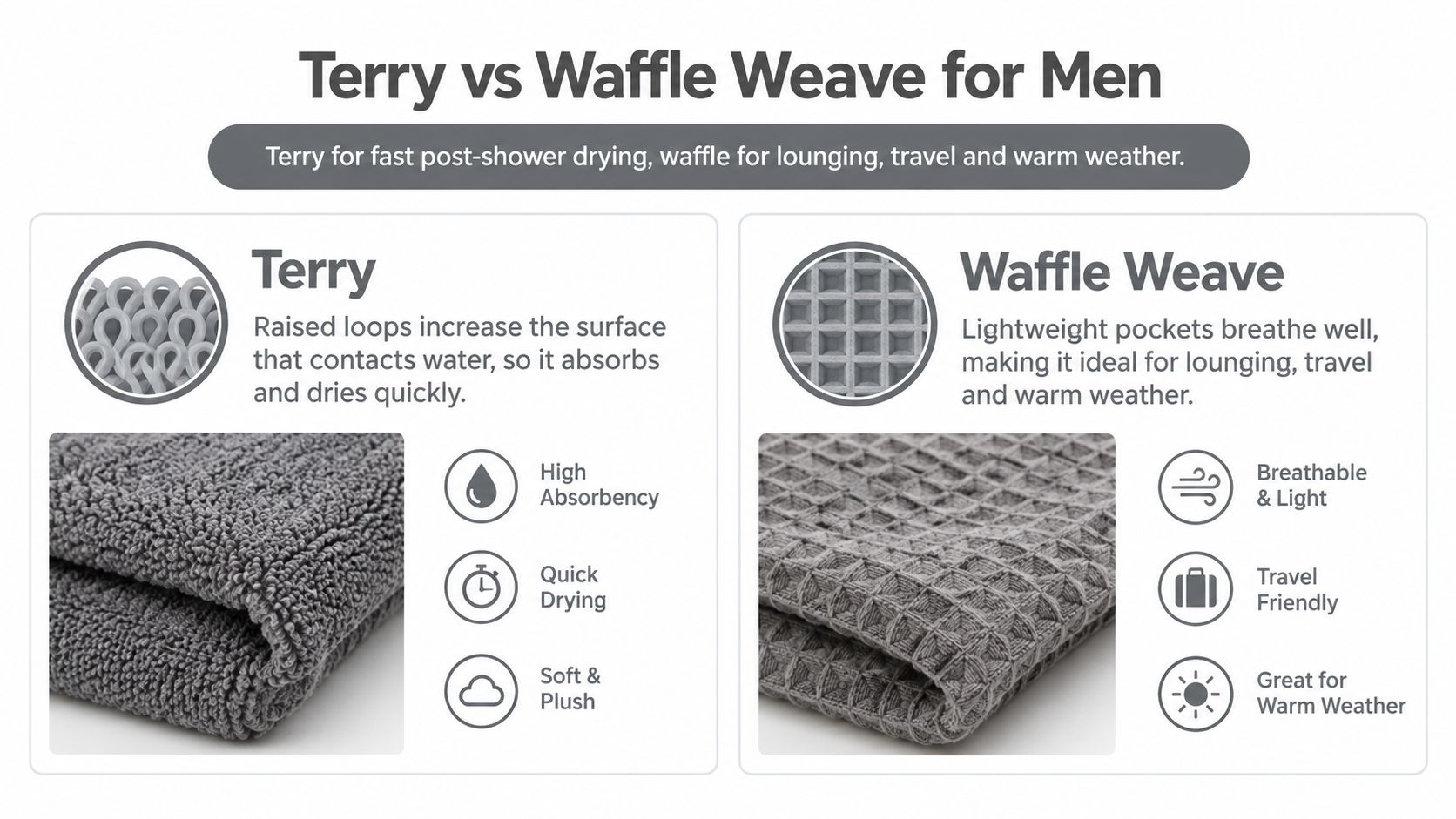
Terry works because of its structure. Raised loops stand up from the base fabric, so far more cotton touches wet skin at once. In comparative testing described in a 2019 textile study on terry absorbency, 100% cotton terry showed better absorbency than cotton blends, and finer fibers improved water uptake. That same work also makes the limit clear. Absorbency depends heavily on loop structure, yarn parameters, and fabric mass, not fiber composition alone.
Waffle works differently. Its grid of recessed pockets traps a little air, weighs less, and lets heat escape more easily. It'll dry damp skin, but it doesn't have terry's loop surface, so it holds less water before it feels saturated. What you give up in pickup, you gain back in breathability, packability, and a shorter trip through the dryer.
Terry and Waffle Robes Compared on the Criteria That Matter
| Criterion | Turkish cotton terry | Cotton waffle weave |
|---|---|---|
| Structure | Raised loops on both faces | Grid of recessed pockets on a flatter face |
| Typical weight | 400 to 600 GSM, heavier feel | 200 to 300 GSM, lighter feel |
| Absorbency | High, best for drying skin and hair | Moderate, dries skin but holds less water |
| Dryer time | Longer, because it holds more moisture | Shorter, sheds moisture quickly |
| Warmth | Insulating, can overheat in warm rooms | Breathable, cooler to wear |
| Best season | Cold months and post-shower use | Warm months and year-round lounging |
| Best use | Post-bath drying, sauna changing, hotel guest use | Daily lounging and travel |
| Handling | Loops can snag, so wash gently | Holds its shape well and snags less |
GSM means grams per square meter. It's useful for comparing two terry robes or two waffle robes, but it doesn't tell the whole story across constructions. A high GSM terry with short, sparse loops can pick up less water than its weight suggests. A waffle robe can feel substantial in the hand and still release water quickly because its pockets expose more surface to air.
What Turkish Cotton Does Not Tell You
Turkish cotton describes fiber origin and quality, not construction. It doesn't tell you loop height, loop density, or whether the inside face against your skin is even terry at all. Some robes use a smooth outer face for looks and terry only inside. That's a legitimate design, but you should know which side is doing the drying before you buy.
Ask for three specs when they're not listed. Ask about loop density, yarn fineness, and fabric weight in GSM. If a seller can't provide any of them, you're buying on photographs and adjectives. For a hooded style, also ask whether the hood is lined with the same fabric as the body, since a thin single layer hood won't dry hair like a terry lined one.
Hybrid builds sit between the two camps. A terry body with waffle panels, or a waffle body with a terry lined hood, gives you pickup where you need it and less bulk elsewhere. That suits men who want a hood for wet hair but overheat in a full heavy terry robe. As a concrete example of the lighter end, the Women's Lavender Blue Turkish Cotton Waffle Hooded Robe is crafted from 100% GOTS-certified organic Turkish cotton and is lightweight and breathable for everyday use, which shows how waffle is positioned for regular wear rather than maximum water pickup.
Absorbency comes from loops, while comfort in warm rooms comes from weight and open structure.
Finding the Right Size and Hood Depth
Start with a size chart, then stop trusting it too early. Brand charts vary, robe cuts vary more, and a wrap garment fits differently from a shirt because overlap, belt position, and fabric thickness all change the usable room inside. The robe you already own, laid flat and measured, is a better reference than the size printed on your favorite tee.
| Size | Height guide |
|---|---|
| S | 5 ft 5 in to 5 ft 8 in |
| M | 5 ft 8 in to 5 ft 10 in |
| L | 5 ft 10 in to 6 ft 0 in |
| XL | 6 ft 0 in to 6 ft 2 in |
| XXL | 6 ft 2 in and over |
Typical men's chest ranges run alongside those heights. Expect roughly 36 to 38 inches for S, 38 to 40 for M, 42 to 44 for L, 46 to 48 for XL, and 50 to 52 for XXL. Use those numbers as a baseline only, and check them against robe length too. A long robe on a shorter frame drags at the stairs, while a short robe on a tall frame leaves calves cold and rides up when you sit.
If you want a fuller walkthrough of chart terms before you measure, this robe size chart guide lays out how to read brand charts against your own measurements. Read it with a tape measure in hand, not from memory. Robe sizing mistakes usually come from guessing, not from bad charts.
What a Chest Number Cannot Tell You
Chest and height say nothing about the hood. You need hood depth from the neck seam to the crown, and the width of the hood opening around your face. A shallow hood perches on wet hair and slides off when you look down. A deep one stays put, but if it's cut too low at the back it bunches at your neck and makes the whole robe feel heavier than it is.
Four quick checks fill the gaps a chart leaves.
- Chest at the underarm: Measure around the fullest part, tape level, breathing normally, so the wrap closes without strain.
- Shoulder width: Measure seam to seam on a robe or jacket that fits, since narrow shoulders pull the hood forward.
- Sleeve length and circumference: Measure from the shoulder seam to where you want the cuff, and leave room to push sleeves up for washing hands.
- Hood opening: Loop the tape loosely around your face at hairline height to judge whether a listed opening will feel open or tight.
Fabric weight changes how a given size wears. Research on terry fabrics reported in a 2018 textile study on terry drying behavior found that surface absorbency depends mainly on structural parameters, while drying time is closely connected to material composition, and adding a more absorbent component can increase drying time. A plush, high loop robe in your usual size can therefore feel snugger and heavier when wet than a waffle robe in the same size. Water adds real weight, and terry holds a lot of it.
Size up when the robe is thick terry, when you'll layer it over pajamas or clothing, or when you have a long torso and need the belt to sit at your natural waist rather than your ribs. Don't size up just to get a deeper hood. A bigger body with the same shallow hood pattern only gives you more fabric in the wrong places, plus sleeves you'll fold back every morning.
Choosing the Robe for Home, Spa and Hospitality Use
At home after a daily shower, your priority is simple. You want water off your skin and hair, fast, and you want the robe dry again by tomorrow. That points to a terry body with a usable hood. The cost shows up in the laundry room, because a robe that holds more water needs longer to dry and can turn musty if it's hung damp in a steamy bathroom.
| Use case | Main priority | Best construction | Trade-off to check |
|---|---|---|---|
| Daily home use after showers | Fast post-bath drying | Terry body with a hood for wet hair | Longer dryer cycles and damp-odor risk |
| Spa and wellness | Consistent absorbency across many uses | Heavier terry with durable loops | Laundering load and turnaround |
| Boutique hotel guest robes | Durability and uniform sizing | Hotel-grade terry or waffle | Energy use and linen throughput |
| Sauna, cold water and outdoor swimming | Quick wrap and rapid drying | Lighter terry or hooded waffle | Heavy robes hold water and can overheat |
| Travel and daily lounging | Packability and fast drying | Waffle weave | Less water pickup after a shower |
Spas and wellness spaces push a robe harder. Guests use it wet, staff wash it constantly, and the next guest expects the same absorbency. Heavier terry with durable loops holds up to that rhythm, but every extra minute in a commercial dryer cuts how many robes are ready for the next booking. If you're planning your own slower version at home or on a break, guides to relaxing spa experiences in Norwich show how much of the experience depends on unhurried time between treatments, which is exactly when a robe stays on longest and overheating starts to matter.
Hotels Buy Throughput as Much as Softness
A boutique hotel buyer isn't only buying a pleasant first touch. They're buying linen turnaround. Slow drying robes raise utility use, tie up machines, and force a property to stock more units per room. Uniform sizing matters too, because housekeeping can't sort five subtle size grades at speed. That's why hotel grade terry or waffle, including the hotel grade and hooded styles SEYANTE offers for boutique guest and personal use, tends to favor constructions that survive commercial laundering and dry predictably over maximum plushness.
Sauna and cold water days reverse the home logic. You're already hot, or you're wrapping up briefly between plunges, so a heavy robe that soaks up water and holds it against you works against the point. Lighter terry or a hooded waffle goes on fast, sheds water faster, and won't feel like a wet blanket on the walk back inside. For outdoor swimming, that lighter build also dries on a hook between swims instead of staying soggy all afternoon.
Travel makes the case plainest. Waffle packs flatter, weighs less in a bag, and dries overnight in a hotel bathroom. You accept less pickup after a shower, and you towel off first. The same robe can be the right answer in one setting and fail in another, so name your main setting before you weigh GSM or color. A robe bought for cold morning showers and then judged as a travel robe will disappoint you for reasons that have nothing to do with quality.
Caring for a Hooded Robe So It Stays Absorbent
The terry loops do the water pickup. When detergent residue or softener coats them, or rough care flattens and wears them down, the robe absorbs less effectively. A simple routine helps keep those loops working: wash gently, use little detergent, and dry the hood fully.
| Care step | Recommended practice | Why it matters |
|---|---|---|
| Wash frequency | Every two to three uses for a daily robe | Oils and skin cells can gradually reduce absorbency |
| Wash temperature | 30 to 40 degrees Celsius, 86 to 104 degrees Fahrenheit | Repeated hot cycles speed fiber wear and loop damage |
| Detergent and softener | Mild detergent, no fabric softener | Softener coats loops and cuts absorbency |
| Bleach | Avoid chlorine bleach | Chlorine weakens cotton fibers over time |
| Drying | Tumble on low or medium, or partly line-dry | High heat stiffens fibers and damages loops |
| Load separation | Wash apart from fleece and other lint-heavy items | Reduces lint transfer and fiber build-up |
Warm water at 30 to 40 degrees Celsius can clean body oils without the extra wear of repeated hot cycles. Reserve hotter washing for genuine hygiene needs rather than making it the default. Washing a daily robe every few uses also helps prevent oils and skin cells from building up between washes.
Use a mild detergent, and start with the lower end of its recommended dose. Too much detergent can leave residue on the loops, while fabric softener leaves a coating that makes fibers feel slick and less able to take up water. If a robe becomes less absorbent, detergent buildup and softener are sensible first things to check. Avoid chlorine bleach, which weakens cotton fibers over time.
Drying is a balance between lifting the pile and limiting heat. A low- or medium-heat tumble can help fluff terry loops; line-drying partway and finishing briefly in the dryer is another option. High heat can stiffen the fibers and leave terry feeling scratchy. Check the hood before putting the robe away, since its thicker fabric may remain damp after the body panels feel dry.
Cotton Sheds Too and Wash Habits Decide How Much
Cotton is a natural fiber, but that does not mean a cotton robe sheds no fibers. A 2025 household study in a textile research journal analyzed laundry effluent from 30 homes and found an average of 5,849,943 microfiber particles per liter across three wash trials. The samples contained fibers from cotton, polyester, elastane, acrylic, and viscose. The study's reported figure makes clear that cotton should not be treated as shed-free.
How much a robe sheds can vary with pile density, yarn quality, age, friction, wash temperature, cycle length, and tumble drying. Fiber release alone does not establish whether a fiber is toxic, and persistence is a separate question. For day-to-day care, wash the robe apart from lint-sensitive garments, avoid aggressive cycles and unnecessary high heat, and consider how it wears over time rather than relying on the fiber name alone.
For storage between washes and guidance on the full routine, see this guide to washing, storing, and caring for your robe. Keeping the loops clean and the hood fully dry helps the robe stay absorbent for longer. Replacing a robe early because its pile has flattened wastes a useful garment; steady, gentle care helps it serve its purpose.
What GOTS Certification Proves and Where It Stops
A cotton label describes the fiber, while an organic claim raises a different question: which standard applies, and does it cover the finished robe or just one component? Checking the label grade and certified scope helps show what has been assessed.
The Global Organic Textile Standard, or GOTS, has two label grades. An International Cotton Advisory Committee presentation on GOTS states that products labeled “organic” must contain at least 95% certified organic fibers, while those labeled “made with organic” must contain at least 70%. The distinction matters: “organic cotton” without a grade does not tell you which threshold applies.
GOTS also covers stages beyond growing the fiber, including manufacturing, wet processing, packaging, labeling, trading, and distribution. For a hooded robe, that means the standard can apply to steps such as dyeing, finishing, sewing, and packing, not only to the cotton itself. The certified scope is the key: a fiber description alone cannot establish that the finished robe is covered.
A Large Audited System Not a Marketing Phrase
GOTS reported 10,388 certified facilities across 72 countries in 2020, compared with 7,765 facilities in 2019, a 34% increase; the same presentation on GOTS also reports 4,220,838 workers and 16 accredited independent certification bodies. Independent certification bodies assess the standard, rather than a brand merely rating its own claim.
The presentation lists facility counts of 3,015 in India, 1,584 in Bangladesh, 1,107 in Turkey, 961 in China, 684 in Germany, 588 in Italy, and 167 in the United States. Turkey's presence gives context for Turkish cotton robes, but a country's certified manufacturing base does not certify a particular robe. The product's own certified scope must cover it.
For a closer explanation of the terminology, read this guide to GOTS-certified organic cotton fabric. Then check three things on the robe's label or product information:
- Label grade: Is it labeled “organic” or “made with organic”? The fiber thresholds differ.
- Certified scope: Which stages are covered, from processing through labeling and distribution?
- Whole garment coverage: Does certification apply to the finished robe, rather than only a component or fabric roll?
Certification can clarify how a textile was produced, but it does not establish how the robe will wear in your bathroom. It does not by itself guarantee that the robe will not shed, last indefinitely, or suit your needs. Construction and care still shape durability. A well-made robe kept in good condition for years can be a better choice than a cheaper one replaced often, regardless of its label. Consider the fiber information, care guidance, certified scope, and construction together.
Confirm Fabric, Fit and Care Before You Buy
A robe can look plush in a product photo and still be awkward for your routine. Before ordering, consider the less visible details that affect everyday use: where you will hang it, how much room it has to dry, whether it is shared, and how often you will pack it. Those practical constraints can settle a close choice between two otherwise suitable robes.
For a partner who showers before work in a drafty house, a heavier terry robe may suit the cold room and wet hair. Check that it wraps comfortably over pajamas and that the hanging space can accommodate a thick robe after use. If two people share one bathroom, drying space matters too: a robe that stays damp between showers can be inconvenient, even when its fabric feels comfortable at first.
For summer evenings and trips, a waffle robe may be easier to pack and manage in a small bathroom. Its hood can serve as a light cover after a swim, rather than carrying the full drying role expected of a deeper, heavier hood. Consider where it will go between uses. A compact robe is less useful for travel if there is nowhere to hang it to dry.
Use this short final check to connect the earlier guidance to your own routine:
- Fabric: Use the terry-versus-waffle comparison in Section 2 to choose by setting and drying needs.
- Size: Revisit Section 3's measurement approach, especially if you expect to layer underneath.
- Hood: Check the listed depth and opening against how you plan to wear it.
- Weight: Match the robe's fabric weight to your bathroom and how much drying time you can allow.
- Certification: Use Section 6's label checks if organic certification is part of your decision.
- Laundry: Compare the care instructions with the washer and drying space you have.
A useful final question is how the robe will move through your home, not only how it feels when new. After a shower, it needs a place to hang with air around it; after washing, a thick hood may need more time to dry than the body. If your routine offers little drying space, a lighter robe may be easier to keep ready for the next use. If warmth and coverage matter more, make sure your setup can handle the extra drying.
Order rule: Choose only after the robe fits your routine, not just the product photo.
For daily showers in a cold bathroom, a heavier hooded terry robe with room for layering is a practical default. For travel or warm rooms, a hooded waffle robe is often the more convenient option. Neither is the luxury option in the abstract. The better choice depends on your mornings, climate, and laundry setup.
Write down what matters most, then compare product pages against those needs. Missing information is a reason to ask before ordering, particularly when it affects how the robe will fit your routine. A men's hooded spa robe is easier to choose when you consider not only the fabric and fit, but also where it will dry and how you will care for it.
Browse hooded terry and waffle robes in Turkish cotton, including GOTS-certified organic options for men, at SEYANTE. Use the sizing and care guides to match fabric weight and fit to your routine, then order with the measurements in front of you.