Luxury Hotel Standards: Insider Guide to 2026 Quality
- What Five-Star Service Actually Feels Like
- The Four Systems That Grade Luxury Hotels
- Room-Level Details That Move the Rating
- Why Service Engineering Beats Lobby Decor
- Textiles, Robes, and the Sensory Layer of Luxury
- Sustainability as a Baseline, Not a Bonus
- A Procurement Checklist for Boutique Buyers
- Frequently Asked Questions From Hospitality Buyers
A guest arrives at your boutique hotel after a long journey. The doorman opens the car door before the guest reaches for it. At reception, the agent uses the guest's name without making the interaction feel rehearsed. Upstairs, the room is quiet, the temperature is comfortable, the lights are set sensibly, and the bathroom glass is free from fingerprints.
That impression looks effortless. It isn't. It comes from purchasing specifications, housekeeping sequences, staff training, room inspections, maintenance routines, and service recovery decisions working together. Luxury hotel standards are an operating system, not a decorative style.
The mistake I see most often is spending heavily on visible luxury while leaving invisible execution to chance. A marble reception desk won't rescue a room with uneven temperature, a slow luggage delivery, or a robe that feels tired after repeated washing. Boutique operators can compete with larger properties, but they need to reverse-engineer what inspectors and discerning guests notice. The practical guest-experience principles outlined in this hospitality trends guide point in the same direction: comfort, relevance, and consistency matter more than theatrical excess.
What Five-Star Service Actually Feels Like
Five-star service begins before the guest asks for anything. The arrival team notices the vehicle, opens the door, handles luggage without confusion, and gives the front desk enough context to make the handoff feel personal. The receptionist doesn't force familiarity, but they recognize the reservation, confirm the important details, and explain the next step clearly.
The room should continue that conversation. Temperature, lighting, curtains, water, and basic amenities need to feel ready rather than left for the guest to configure. A luxury room doesn't make the guest work through a puzzle of switches, hunt for drinking water, or call housekeeping because a bathroom surface was missed.
The experience is built from repeatable decisions
Behind that smooth arrival sits a sequence of standards:
- Arrival control: Someone owns the handoff from vehicle to reception, and luggage doesn't disappear into an undefined back-of-house process.
- Recognition: Staff use available guest information appropriately, without turning personalization into an awkward performance.
- Room readiness: Housekeeping and engineering verify temperature, lighting, fixtures, surfaces, and amenities before release.
- Service recovery: Employees know who can solve a problem and what authority they have to act.
- Follow-through: A request is closed only when the guest receives the outcome, not when an employee records it.
These are not matters of taste. Hotel classification has never operated under one universal global authority. Countries and regions use different systems, while inspection-based programs provide widely recognized international benchmarks. In Europe, the Hotelstars Union was created in 2009 to harmonize classification across borders, using 270 criteria in its criteria-based system, as described in this overview of hotel star ratings.
Practical rule: If a standard can't be observed, trained, and checked, it isn't a standard. It's a preference.
A boutique hotel doesn't need to copy the capital budget of a flagship property. It does need to document the small moments that make the room feel prepared and the service feel intentional. That means writing the arrival sequence, creating a room-release checklist, testing textiles after laundering, and auditing the details guests touch most often.
The guest sees one unified experience. Management must build the many separate systems that produce it.
The Four Systems That Grade Luxury Hotels
A hotel can satisfy one classification framework and still perform differently under another. That's because each system emphasizes a distinct combination of facilities, service behavior, consistency, geography, and guest perception. Buyers should understand the target rubric before they specify products or redesign operating procedures.
| System | Region | Approx. Criteria | Inspection Style |
|---|---|---|---|
| Forbes Travel Guide | International | Up to 900 standards | Anonymous inspection, with properties evaluated through observed guest experiences |
| AAA Five Diamond | Primarily North America | Criteria-based evaluation | Assessment focused on ultimate luxury, personalized service, amenities, and excellence |
| Hotelstars Union | Europe | 270 criteria | Harmonized, criteria-based classification across participating markets |
| Michelin Keys | International | Criteria-based evaluation | Editorial and inspection-led recognition focused on the overall stay |
Forbes Travel Guide is the most technically granular reference in this group. Its inspectors evaluate properties against up to 900 standards, according to the published rating guidance linked above. The focus is not solely whether a hotel owns a luxury amenity. Inspectors observe whether staff deliver the promised experience with consistency, discretion, and care.
AAA Five Diamond uses different language but points toward a similar operating expectation. Its guidance emphasizes “ultimate luxury, sophistication and comfort,” “meticulous personalized service,” extensive amenities, and an “impeccable standard of excellence” in the lodging rating guidelines. For procurement, that means a product specification should support service delivery, not merely photograph well.
Choose the rubric your guests actually use
Hotelstars Union matters most when a property operates in a European market where harmonized classification influences how guests interpret the star scale. Michelin Keys are relevant for properties pursuing editorial recognition and a strong independent identity. Forbes and AAA matter when the target audience actively searches for those badges or expects their service language.
Use this decision filter:
- Geography: Which system carries authority in the market where the hotel operates?
- Channel mix: Do guests arrive through luxury travel advisors, direct booking, destination media, or broad online search?
- Brand position: Is the property selling formal service, design-led individuality, wellness, heritage, or a combination?
- Operational fit: Can the hotel train and audit against the chosen framework throughout the year?
Don't optimize for every rubric at once. Select one primary benchmark, map overlapping requirements into internal checklists, and use the remaining systems as secondary references. The best standard is the one your team can understand, measure, and maintain when occupancy, staffing, and supply conditions become difficult.
Room-Level Details That Move the Rating
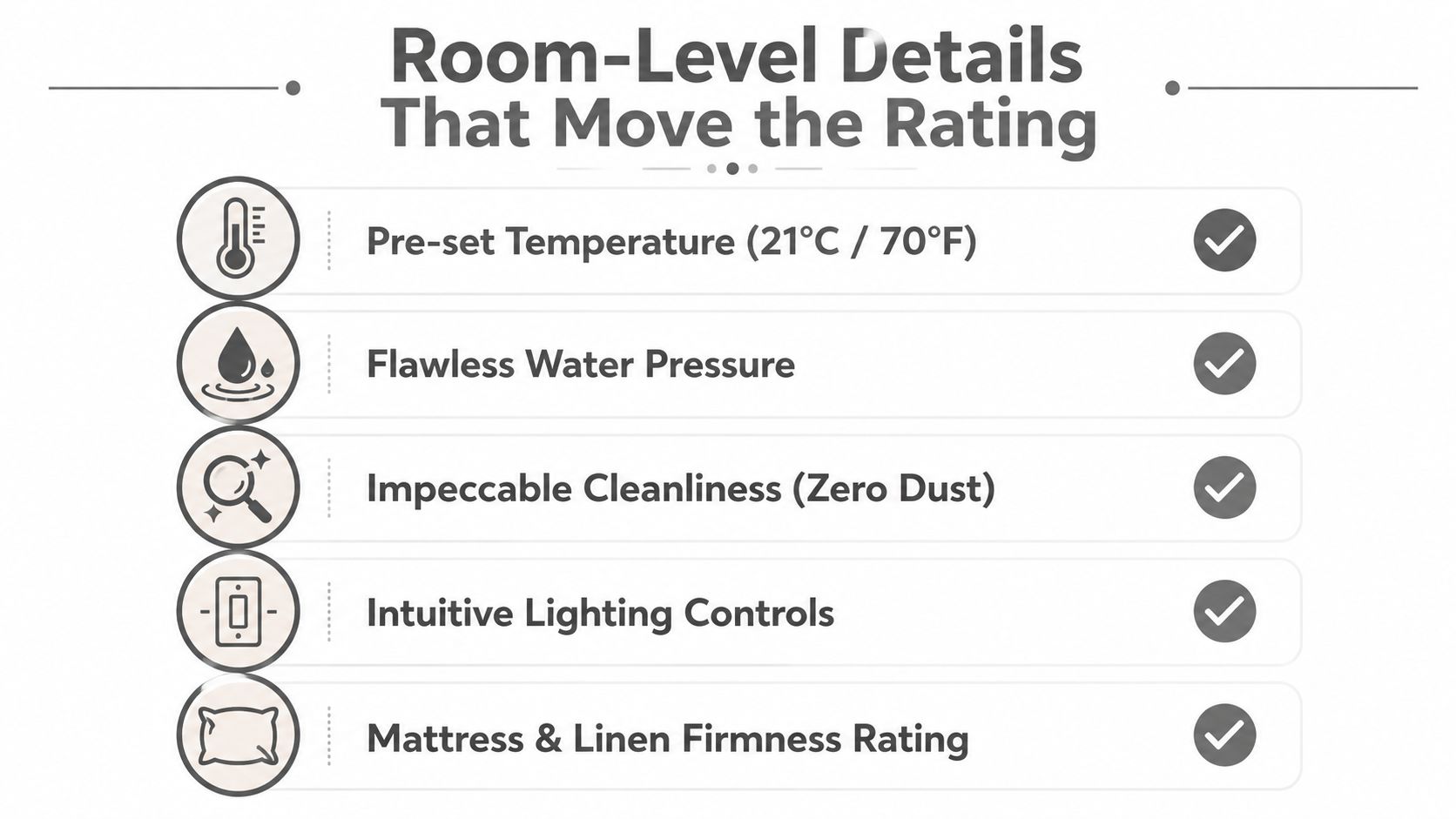
Most room deductions are not dramatic. They're cumulative. A guest notices the room as a chain of tactile and functional judgments: Is the air comfortable? Does the water run properly? Can the guest find the light switch? Does the bathroom look untouched? Will sleep be easy?
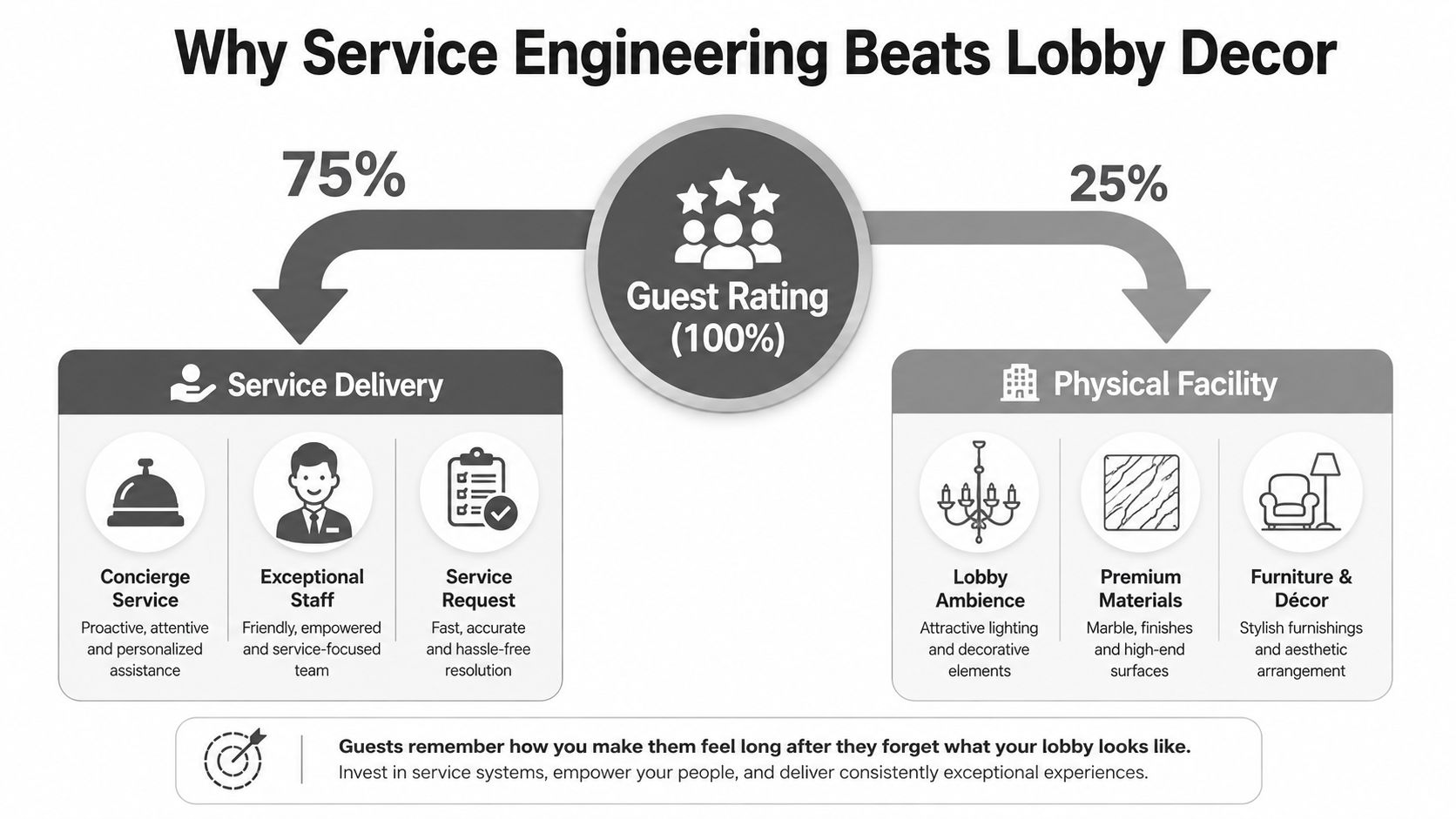
A published summary of Forbes criteria gives service delivery a 75% share of the score and physical facility quality 25%, but the room still matters because physical defects interrupt service. Staff can be warm and attentive, yet a stained grout line or a noisy air-conditioning unit keeps the guest from believing the promise.
Audit the room as a guest uses it
Temperature and lighting come first. A pre-set room should feel comfortable on entry, and the guest should understand the lighting without a tutorial. Test the room at arrival, after housekeeping, and after engineering work. Circadian lighting is increasingly treated as part of the wellness experience, so specify warmth, control location, and bedside usability rather than just counting fixtures.
Water is a utility and a luxury signal. Weak pressure, unstable temperature, or a shower that takes too long to understand damages trust quickly. Check pressure, drainage, hot-water response, seals, and the condition of the shower glass. A room can have beautiful fittings and still feel poor if the guest can't use them confidently.
Cleanliness must survive close inspection. Run a white-cloth check across ledges, switches, headboards, and bathroom corners. Look underneath dispensers and around hinges. Zero visible dust is the operational target, but the procedure matters more than the slogan. Use room-release checks that assign responsibility and require correction before the room enters inventory.
Storage should be intuitive. Guests shouldn't have to search for hangers, luggage space, robes, slippers, or charging points. Open drawers, test doors, and confirm that the closet works for both short and extended stays.
Sleep quality deserves its own audit. Inspect light leakage, corridor noise, door seals, mattress condition, pillow options, and linen feel. Filtered water stations, air-quality attention, and wellness-oriented lighting are moving from novelty toward expected room infrastructure, according to recent coverage of luxury guest expectations.
Run this audit in an occupied room, not only in a staged model room. Guests interact with the space differently once luggage, clothing, toiletries, and sleep routines enter it. Your checklist should measure that lived condition.
Why Service Engineering Beats Lobby Decor
Luxury owners often approve the lobby because it's visible to everyone. I understand the instinct. The lobby photographs well, impresses investors, and gives the property a physical signature. But the service system touches the guest repeatedly, and top-tier evaluation gives that system greater weight.
The published Forbes summary identifies a 75% service delivery and 25% physical facility split, with anonymous inspectors staying a minimum of two nights, as detailed in this explanation of Forbes hotel standards. That changes the investment argument. A lobby renovation affects the first impression. Training, SOPs, and room-turn discipline affect the first impression, the room experience, the request response, the departure, and the recovery after a mistake.
Build the operating sequence before buying the visual upgrade
Start with arrival. Time the handoff from curb to room, then inspect whether each employee knows what information to pass forward. Next, audit room orientation. The colleague who escorts the guest should explain controls without reciting a script, point out the most useful features, and notice whether the guest needs help with luggage or technology.
Housekeeping creates the second major advantage. A strong room-turn standard defines inspection order, replenishment logic, bathroom finishing, linen presentation, and escalation for maintenance defects. It also gives supervisors a consistent way to coach employees. Without a documented sequence, every housekeeper develops a personal interpretation of “ready.”
Measure behavior, not attendance
Training hours don't prove service quality. Observe whether staff:
- Acknowledge guests promptly and naturally.
- Use names appropriately.
- Close requests rather than passing them between departments.
- Explain delays before the guest has to chase an answer.
- Offer room orientation without overwhelming the guest.
- Record preferences that will improve the next interaction.
Owner-level advice: Delay the lobby refresh until you know which service failures your guests experience most often. Fix those failures first.
Physical quality still matters. A broken fixture, damaged surface, or incomplete amenity creates work for staff and frustration for guests. The point is not to ignore the facility. It's to stop treating decor as a substitute for operational precision.
Textiles, Robes, and the Sensory Layer of Luxury
Guests touch hotel textiles constantly. They sleep on the sheets, dry their hands on towels, step onto bath mats, and use robes while moving between bathroom, spa, room service, and bed. That frequency makes textiles one of the clearest signals of whether a property understands luxury as comfort or as visual styling.
A robe can look substantial on a product page and still fail in operation. The buyer needs to examine GSM weight, terry-loop density, weave structure, seam construction, colorfastness, and wash durability. Weight alone doesn't tell you how a robe dries, how it moves, or how it feels after repeated laundering.
Specify the material behavior
Terry robes should feel absorbent without becoming cumbersome. Check loop height and density, sleeve construction, collar stability, belt attachment, and the way the garment hangs after washing. A lightweight waffle weave can support a different brand promise. It tends to suit warm climates, spa transitions, and guests who want breathability rather than maximum plushness.
For towels, inspect edge binding, absorbency, drying time, and resistance to pulled loops. For linens, evaluate crispness, hand feel, mattress fit, seam integrity, and color stability. Don't rely on thread count as a standalone luxury measure. Fiber quality, yarn construction, finishing, and laundering practice shape the guest's actual experience.
The bathroom deserves a coordinated sensory layer. If you're refining the room around tactile details, this resource on how to elevate guest bathroom experiences offers a useful procurement perspective on amenities and presentation.
Test the item after the hotel washes it
Request samples, then send them through the actual laundry process. Record shrinkage, softness, color change, seam behavior, drying time, and the appearance of embroidery or labels. Repeat the test according to the property's normal laundering intensity, because a sample that performs well once may not represent a long operating life.
A buyer should also ask whether the supplier can maintain the same construction and color across replenishment orders. Inconsistent replacement stock creates a patchwork guest experience, particularly in small properties where every room is closely scrutinized.
For boutique operators sourcing guest robes, SEYANTE offers hotel-grade terry and lightweight waffle styles, including options described through its hotel robe collection. The useful question isn't whether a robe looks luxurious in isolation. It's whether the garment supports your room temperature, laundry operation, guest profile, sustainability requirements, and brand tone without forcing an impractical custom production run.
Textiles also carry emotional memory. A guest may forget the exact wall finish, but they'll remember whether the robe felt comfortable after a shower and whether the bed invited sleep. Procurement should treat those moments as core brand decisions.
Sustainability as a Baseline, Not a Bonus
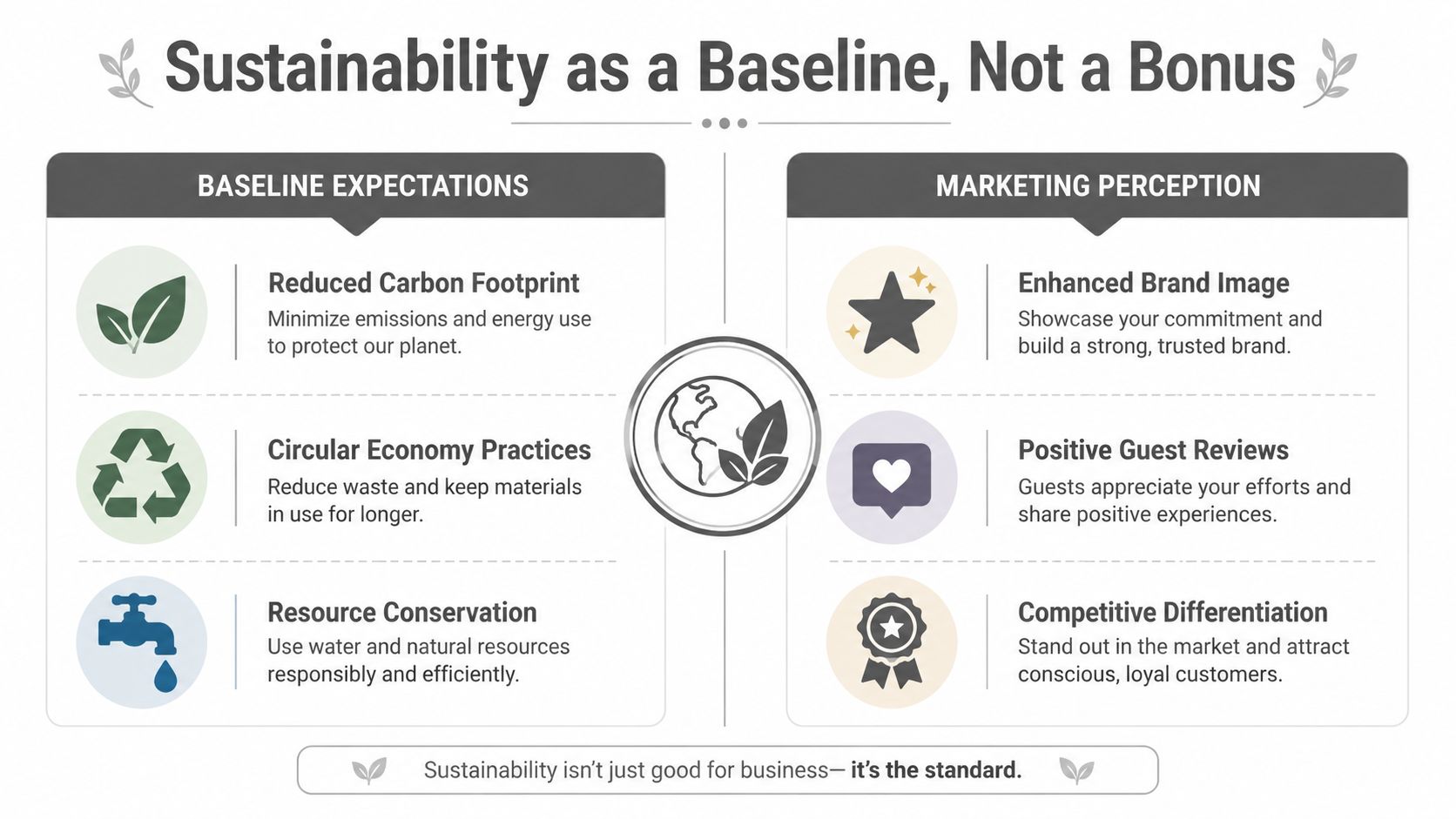
Luxury travelers increasingly expect environmental responsibility alongside privacy, authenticity, and home-like comfort. That expectation changes procurement. Sustainability is no longer a campaign message added after the room has been specified. It belongs in the original product brief.
The distinction is simple. A sustainable choice should reduce waste or resource use while preserving the guest's sense of care. If the guest experiences the change as thinner fabric, missing service, or a lower standard of cleanliness, the hotel has delivered cost reduction, not quiet luxury.
Specify what guests can feel and verify
Refillable bath amenities can reduce packaging without making the bathroom feel sparse, provided dispensers are secure, clean, clearly labeled, and replenished. Organic or GOTS-certified textiles can support a responsible sourcing story, but only if the product still meets softness, absorbency, durability, and presentation requirements. Energy reduction should come through efficient equipment, controls, maintenance, and measured operations, not through an uncomfortable room.
The most useful procurement questions include:
- Material origin: Can the supplier document fiber content and certification?
- Durability: Does the item retain function and appearance after hotel laundering?
- Packaging: Can the supplier reduce unnecessary packaging without compromising hygiene?
- Replacement: Can the hotel reorder the same specification reliably?
- Measurement: What operational change will demonstrate resource conservation?
Buyers who need a practical starting point can review approaches to sourcing sustainable manufacturing, then translate the relevant requirements into supplier questionnaires and purchase orders.
Avoid visible austerity
Reduced housekeeping, thinner linens, empty amenity displays, and limited human service can look like corner-cutting when the hotel hasn't explained the operating model or preserved convenience. Sustainability must remove waste, not remove welcome.
My recommendation is to prioritize changes guests can accept without translating them as deprivation: durable textiles, refillable systems with excellent presentation, efficient lighting, filtered water, responsible packaging, and maintenance that prevents premature replacement. The luxury signal is intentionality. Guests should feel that the hotel has chosen better materials and smarter systems, not that it has taken something away.
A Procurement Checklist for Boutique Buyers
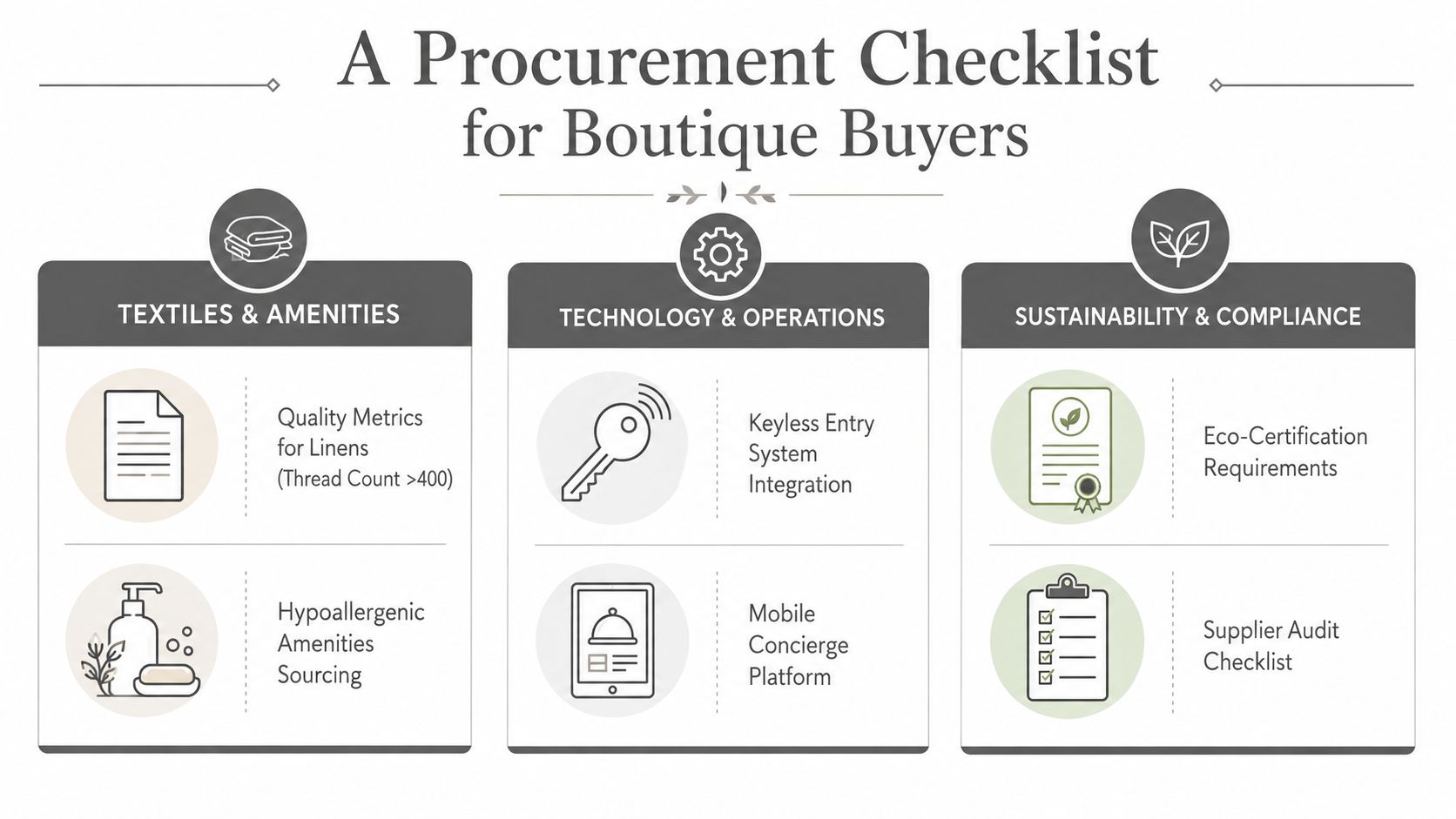
Procurement decisions become expensive when the buyer starts with a mood board instead of a performance brief. Write the brief around the guest's physical experience, the hotel's operating conditions, and the inspection behaviors you need to support.
Luxury economics leave little room for casual specification. One published benchmark reports average luxury-hotel ADR of 726 EUR in 2022 and annual occupancy of 41%, with a reported yearly occupancy range from 30% to 51%, as shown in this luxury hotel market analysis. Those figures are not a reason to overspend on every item. They are a reminder that premium rates require reliable delivery across the room and service journey.
Put the quality metrics on one page
For robes, towels, and linens, include:
- Fiber and construction: State fiber content, weave or terry structure, finishing, and intended use.
- Weight and feel: Request GSM information, but pair it with absorbency, drying behavior, and hand-feel requirements.
- Durability: Specify seam construction, edge binding, colorfastness, shrinkage tolerance, and post-wash appearance.
- Certification: Ask for relevant OEKO-TEX or GOTS documentation where those certifications support the property's sourcing policy.
- Fit and presentation: Define sizes, belt placement, hanger or folding method, embroidery position, and replacement consistency.
Don't copy a retail description into an RFP. A hotel specification must explain how the product will perform in laundry, storage, room turnover, and guest use.
Ask suppliers questions that expose operating risk
Send the same questions to every shortlisted supplier:
- What is the standard production lead time, and what happens when a replenishment order is urgent?
- What is the minimum order quantity for the selected construction and color?
- How does the supplier inspect defects before shipment?
- What documentation accompanies certifications and material claims?
- Can the supplier provide replacement units that match the original specification?
- What is the return or resolution process for defects, shortages, or inconsistent batches?
- Can the supplier support a wash test using the hotel's actual process?
Use a written scorecard. A supplier that answers quickly but avoids technical details isn't low risk. It's untested.
Run the sample through real operations
Approve samples only after a hotel wash test. Inspect seams, labels, loops, color, shrinkage, softness, drying time, and fit. Ask housekeeping and spa staff to handle the product, because they'll identify practical problems that may not appear in a conference-room review.
For a focused guide to evaluating guest robes and related purchasing decisions, use this wholesale bathrobes buyer's guide.
Procurement rule: The cheapest unit price is irrelevant if the product creates replacement work, laundry delays, guest complaints, or inconsistent room presentation.
Avoid approving a product based on thread count, weight, packaging, or photography alone. Also avoid putting every sustainability requirement into a vague paragraph. Turn each requirement into a document, test, or observable condition that the supplier and hotel team can verify.
Frequently Asked Questions From Hospitality Buyers
How often are luxury properties re-inspected? It depends on the framework. Plan for ongoing internal audits, not a last-minute inspection reset.
What's the fastest fix for a four-star property? Audit arrival, room release, cleanliness, and request follow-through before renovating public areas.
How do I test a robe supplier safely? Buy samples, run the hotel wash process, and inspect after use before discussing a larger order.
Can a 12-room boutique pursue a Michelin Key? Yes, if the property can deliver a distinctive, consistently executed stay. Room count alone isn't the strategy.
SEYANTE offers hotel-grade terry and lightweight waffle robes for hospitality buyers who need comfort, durability, and a clear textile specification. Visit SEYANTE to review robe styles and build a guest-room standard around products your team can test, launder, and reorder with confidence.