Bath Towel Absorbency: What Makes a Towel Work
- Why Heavier Towels Are Not Always More Absorbent
- The Science Behind How Towels Pull In Water
- Fiber, Weave, and GSM Variables That Shape Performance
- Three At-Home Tests to Measure Towel Absorbency
- Laundering and Care Habits That Preserve Absorbency
- Choosing the Right Towel for Your Bathroom and Routine
- Common Myths About Towel Absorbency Debunked
Most towel advice starts and ends with one number: GSM. The heavier the towel, the better it must be, or so the usual shopping logic goes. That shortcut misses the detail you notice after a shower: whether the towel pulls water away quickly, whether it can keep absorbing without feeling saturated, and whether it dries before the next person needs it.
Bath towel absorbency has two separate measurements: absorbency rate, which describes how quickly fabric picks up water at first contact, and absorbency capacity, which describes how much water the towel can hold overall. A plush towel may have impressive capacity but perform slowly against wet skin. A lighter towel may move water quickly and dry sooner. The right choice depends on how those qualities work together in your bathroom.
Why Heavier Towels Are Not Always More Absorbent
A thick towel feels substantial in your hand, so it's natural to assume it will dry you better. Yet weight alone doesn't determine bath towel absorbency. Fiber type, loop structure, yarn construction, and finishing all influence how readily water enters the fabric and how long the towel remains usable before saturation. Guidance on absorbent towel construction identifies 100% cotton terry as the benchmark combination, while also explaining that performance depends on structure rather than marketing language.
Think of absorbency as a two-part equation:
- Rate: How quickly does the towel remove water from your skin?
- Capacity: How much liquid can it retain before it feels soaked?
A towel can score well on one measure and poorly on the other. Textile guidance places strong all-around performance commonly in the 500–700 GSM range, while some luxury towels reach 700–900 GSM for greater water retention, as described in the same towel absorbency reference. That doesn't mean the heaviest option will always feel more effective during a rushed morning shower.
Why medium weight can work better
Very dense towels contain more fiber mass per square meter, but thicker yarns and larger loops can change the size and shape of the spaces that draw in water. One textile-testing comparison reported that towels around 450–550 g/m² absorbed 32% more water in 30 seconds than 700 g/m² variants, suggesting that an extremely heavy construction can sacrifice initial capillary pull. The testing guidance links that difference to yarn and loop geometry, not just to the amount of material.
In a humid bathroom, a towel that holds a great deal of water may also remain damp for longer. Shared households face the same practical issue, because repeated use places more value on dependable drying between showers than on maximum plushness.
Practical rule: Choose a towel for the balance between quick pickup, useful capacity, and reasonable drying time, not for GSM in isolation.
The Science Behind How Towels Pull In Water
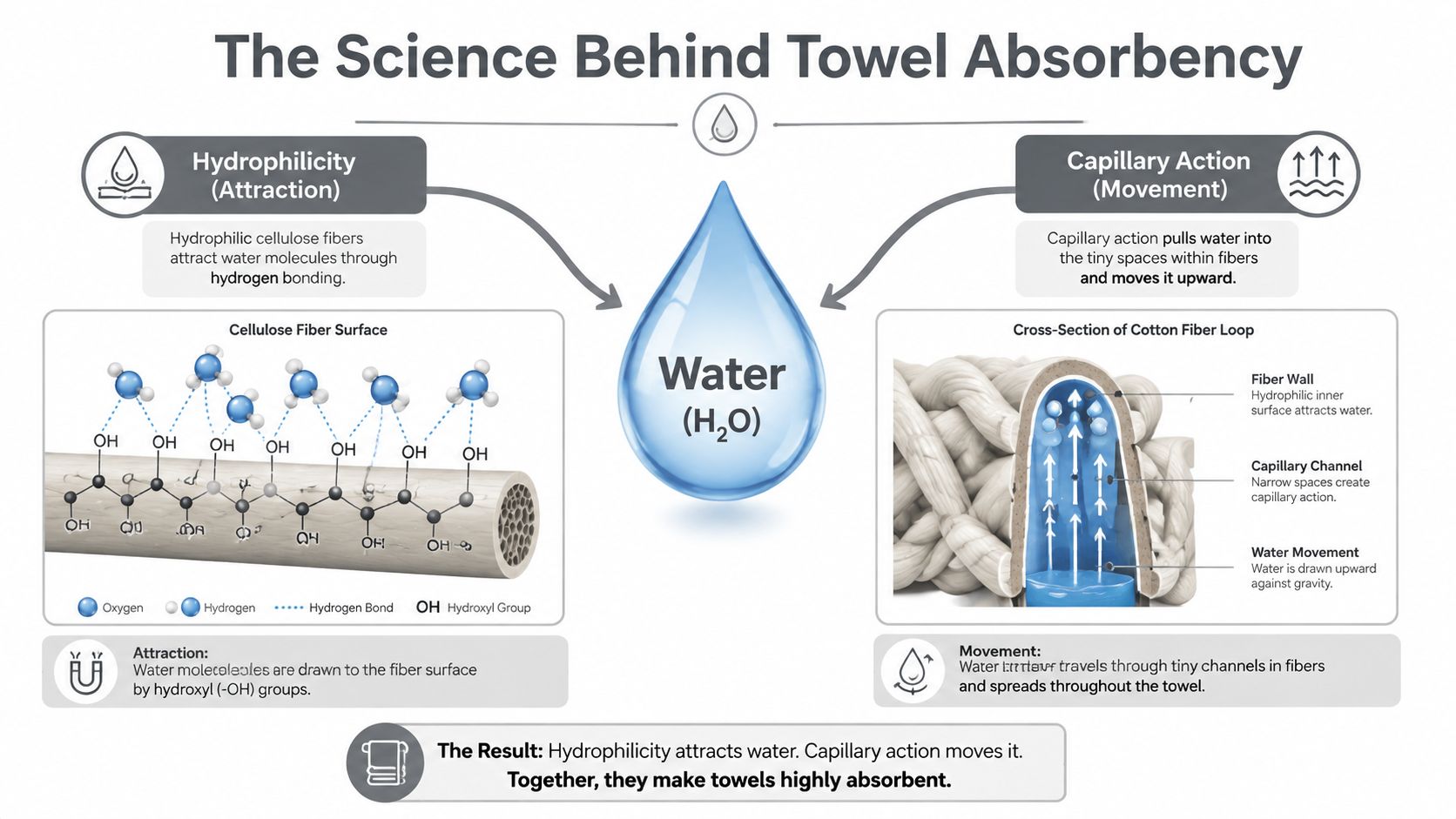
A towel's water performance begins at the fiber surface, not at its weight. Cotton's cellulose is naturally hydrophilic, so it interacts readily with water. Its hydroxyl groups, written as -OH, attract water molecules through hydrogen bonding. In practical terms, the fiber gives water places to cling to and spread through, rather than leaving droplets sitting on the surface.
Terry loops create a second pathway. The raised yarn loops increase contact with wet skin, while the narrow spaces between fibers guide liquid inward through capillary action. The Institute of Making's explanation of towel materials describes terry as a network of tiny capillaries and notes that cotton can absorb up to 27 times its own weight in water. That capacity describes how much water the material can hold. It does not, by itself, show how quickly the towel picks up a wet surface.
Loops act like many small straws
Groups of cotton fibers work like bundles of tiny straws. Hydrophilicity draws water toward the fiber, and capillary action carries it through the looped pile. More exposed surface can improve first contact, but yarn twist, loop height, and the openness between loops decide whether water moves smoothly or meets resistance.
That structure explains why softness and initial absorbency can disagree. Finishing chemicals or laundry residues may coat the surface temporarily, so water beads instead of entering the fiber network. A waffle construction has a more open, lighter structure than dense terry and can provide useful drying performance with less bulk. For example, the Women's White Organic Turkish Cotton Waffle Towel Wrap is described as a lightweight, 100% GOTS-certified waffle towel wrap for an at-home Turkish bath experience.
Rate and capacity can separate even more clearly across materials. A material comparison reports that microfiber absorbed 90% of a measured spill within 5 seconds, while premium cotton terry took about 12 to 18 seconds to reach the same level. High-quality cotton terry can absorb up to 27 times its own weight, compared with about 6 to 8 times for most microfiber towels. The material comparison illustrates the practical distinction: microfiber may make faster first contact, while cotton terry may hold more water overall.
For a bathroom towel, both measures matter. A well-opened, medium-weight construction can pick up water promptly without carrying the slow-drying bulk of an ultra-plush towel. GSM helps describe mass, but fiber interaction and loop geometry determine how that mass performs in use.
Fiber, Weave, and GSM Variables That Shape Performance
A heavier towel can hold more water and still feel disappointing after a shower. Fiber determines how water interacts with the material, while weave and loop construction control how easily water reaches that absorbent surface. GSM measures fabric mass, so it can hint at thickness, capacity, and hand feel. It does not predict absorbency rate or drying speed by itself.
The most useful comparison has two measures: how quickly a towel picks up water and how much it can hold. A towel may act like an open sponge at first contact yet hold less overall than a cotton terry towel. Another may have greater capacity but take longer to wet and dry because its pile is densely packed.
Fiber type sets the starting conditions. Long-staple cotton can form smooth, durable yarns, but the cotton category alone does not determine performance. Turkish cotton, Egyptian cotton, and Pima cotton describe fiber sources or qualities. Uniform loops, suitable yarn twist, and a stable pile can matter more than an impressive label. The guide to what makes Turkish cotton distinctive explains why fiber length and construction should be assessed together.
| Variable | Effect on Speed | Effect on Capacity | Drying Time |
|---|---|---|---|
| 100% cotton terry | Reliable pickup, depending on finish and loops | High overall holding potential | Can be slower when very dense |
| Microfiber | Often fast at initial wicking | Lower total capacity than high-quality cotton terry | Usually dries quickly |
| Waffle weave | Open structure can support quick pickup | Moderate, depending on mass and construction | Often lighter and easier to dry |
| Low-twist yarn | Soft, open fibers can improve access to water | Useful capacity when loops remain stable | May retain moisture if very dense |
| Tightly twisted yarn | Can slow initial wetting if overly compact | May provide structural durability | Can dry more readily than a saturated plush pile |
| Medium GSM construction | Often balances rate and capacity | Strong practical performance when well made | More manageable than ultra-heavy towels |
| Very high GSM | May be slower if loops and pores become oversized | Can hold more liquid overall | Often takes longer to dry |
Read construction details, not just luxury language
A description that says “luxury” but omits fiber content, GSM, weave, or loop consistency offers little basis for comparison. Look for the towel's structure, such as terry or waffle, and check whether its design favors a plush feel, faster drying, or a balance between both.
Construction details also explain why two towels with similar GSM can behave differently. A medium-weight towel with open, consistent loops may absorb promptly and release moisture more readily. An ultra-heavy towel can provide greater capacity, yet its dense pile may remain damp between uses.
Choose by routine, not weight alone. Consider bathroom ventilation, laundering frequency, and whether the towel must dry before it is used again. GSM helps estimate mass, but fiber, yarn twist, loop geometry, and weave determine how that mass performs in daily use.
Three At-Home Tests to Measure Towel Absorbency
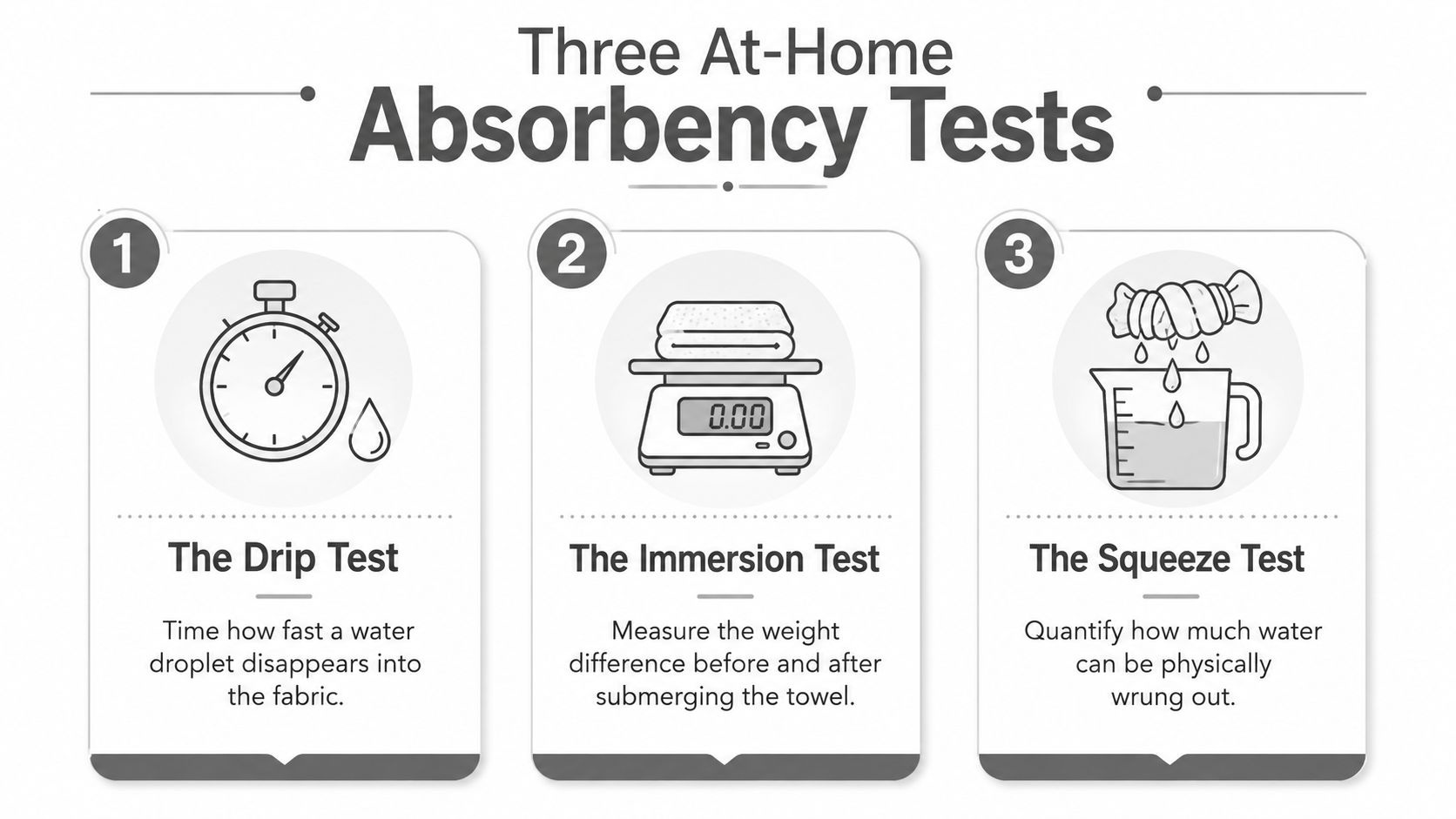
A heavier towel can hold more water and still feel slow during the first pass. Home testing separates two properties that shoppers often merge: initial pickup rate and total holding capacity. Compare towels after the same preparation, with equal water amounts and consistent handling. The aim is a practical observation, not a laboratory score.
Start with a drip test
Lay each towel flat and place a small, similar droplet on an undisturbed area.
- Watch whether the droplet beads on the surface or enters the pile.
- Note how quickly the visible shine disappears.
- Test another area, because compressed or uneven regions may respond differently.
A bead that lingers can indicate a surface finish, residue, or tightly packed construction. A droplet that vanishes quickly suggests a faster absorbency rate, but it does not reveal how much water the towel can retain. Treat this test like checking how quickly a sponge accepts a splash, not how much the sponge holds overall.
Use immersion to assess capacity
Weigh the dry towel, submerge it fully, and let excess water drain for the same duration and in the same position each time. Weigh it again, then compare the change. A greater increase indicates more water retained under those conditions. It can also point to longer drying, especially if the pile is dense.
Keep the handling consistent. Twisting one towel hard while barely pressing another measures your technique as much as the fabric. Immersion is most useful when towels feel similarly soft but differ in density or construction.
Finish with a dry-off test
Wet one forearm evenly and pat it with each towel using the same gentle motion. Notice how quickly the skin feels dry, how many pats are needed, and when the towel begins to feel saturated.
This test reflects bathroom use more closely than either a droplet or a scale. A medium-weight towel may dry the skin promptly without becoming cumbersome, while an ultra-plush towel may offer greater capacity but feel overloaded sooner in repeated use.
A good towel should feel effective before it feels overloaded.
Laundering and Care Habits That Preserve Absorbency
A towel's absorbency can decline even when its cotton remains intact. Residues coat the loops, while repeated high heat can compress the pile. Fabric softener is a common culprit. Its conditioning film makes fabric feel smooth but can slow wetting, much like a thin layer of wax on a sponge. Excess detergent, body oils, and incomplete rinsing can create a similar barrier.
New towels may also repel water briefly because manufacturing finishes remain on the surface. That first wash response does not define the towel's long-term capacity. Proper laundering removes surface residues and helps water move through the loops.
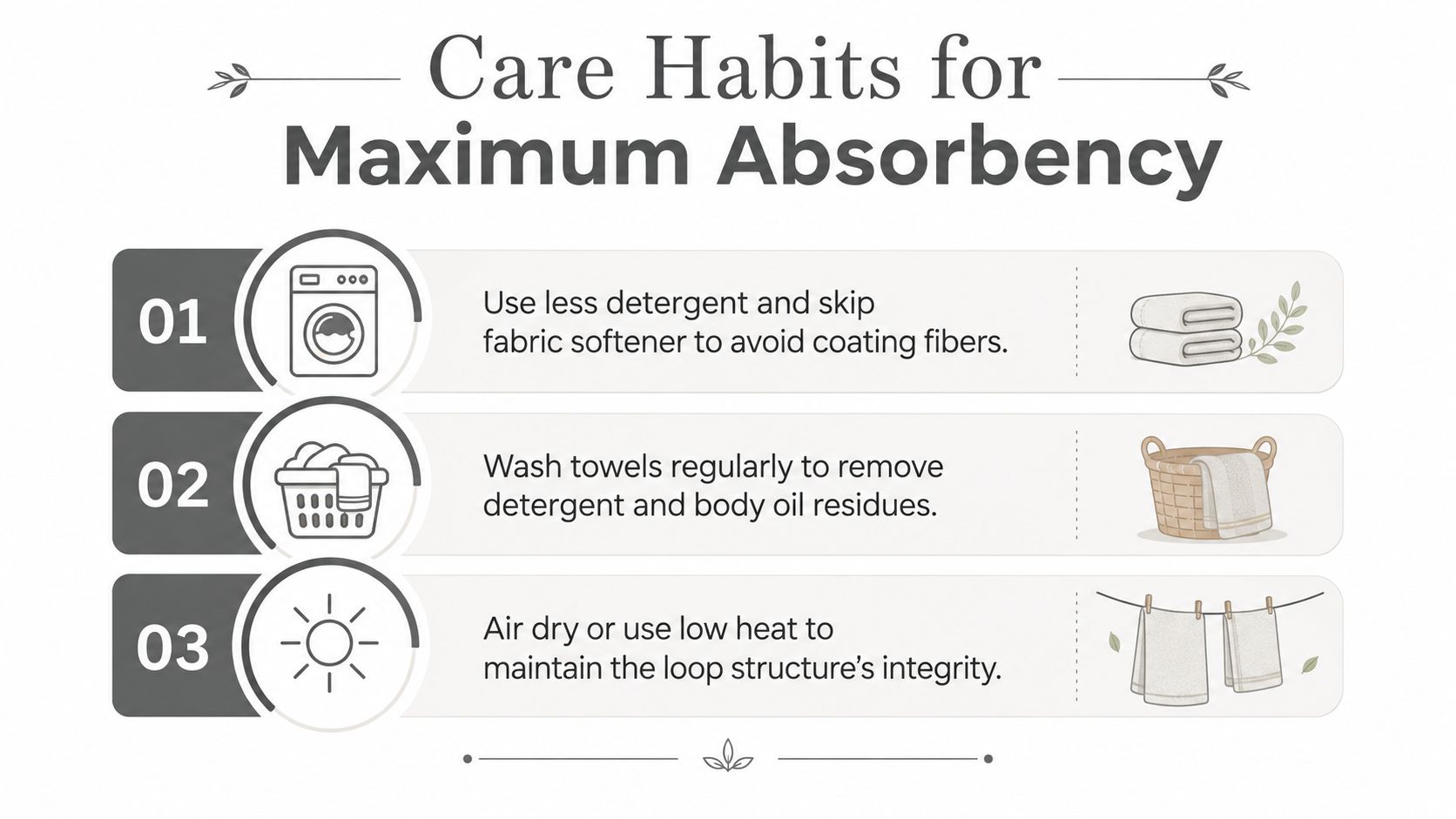
A simple routine protects the loops
- Use restrained detergent: Follow the washer's requirements. Extra soap can remain trapped in the pile instead of producing a deeper clean.
- Skip fabric softener: Leave the absorbent surface free of coatings that interfere with wetting.
- Choose warm water when suitable: Warm washing can loosen body oils and residue, provided the care label allows it.
- Use vinegar occasionally: A measured rinse with white vinegar may help with buildup. Never mix vinegar directly with chlorine bleach.
- Dry gently: Low heat or air drying places less stress on loop structure than repeated excessive heat.
- Fluff without coating: Dryer balls can separate compressed loops without adding a softening film.
Hard water may deposit minerals that leave towels stiff and less receptive to moisture. If a towel becomes rough or water-resistant despite careful detergent use, check whether the washer rinses thoroughly and whether mineral buildup is present. A residue problem can reduce the absorbency rate, so water takes longer to enter the surface, even though the towel's underlying capacity has not changed.
Drying also affects practical performance. A dense pile may hold more water but take longer to dry, while a medium-weight, well-constructed towel can regain usability sooner between showers. Textile research connects drying behavior with fiber composition and shows that surface absorbency also depends on pile length, yarn density, and twist. The textile study on absorbency and drying supports evaluating care and construction together rather than judging a towel by its fiber label alone.
Terry principles extend to other looped textiles. SEYANTE's terry cloth robe collection illustrates how the same structure is used in robes. Keep residues low, protect the pile, and let the textile dry fully between uses.
Choosing the Right Towel for Your Bathroom and Routine
A plush towel is not automatically the most practical towel. In a dry, well-ventilated bathroom, a dense terry can feel satisfying because its larger pile offers greater capacity. In a humid room with limited airflow, a medium-weight towel may perform better by reaching a usable state sooner. Choose according to how quickly the towel needs to be ready again, not touch alone.
For everyday use, assess absorbency rate and capacity together. A towel must pull water from skin promptly, then hold enough moisture for the job. GSM helps estimate mass, but it cannot describe loop arrangement, yarn construction, or drying behavior by itself. Treat the 500–700 GSM range as a starting point, alongside 100% cotton, terry construction, and even loops, rather than as a promise of performance.
Match the towel to the room
A humid bathroom benefits from an open or medium-weight structure that releases moisture between uses. The same advantage helps when several people share one towel, since a dense pile can remain damp after the first shower. In a dry, airy bathroom, heavier terry may suit shoppers who value a plush hand feel and greater capacity more than compact storage or quick drying.
Use this checklist:
- Clear fiber content: Prefer specific material information over broad terms such as “premium” or “luxury.”
- Stated GSM: Use it to estimate weight, then inspect construction and care requirements.
- Uniform loops: Even pile supports more consistent contact with water.
- A realistic care label: Dense towels demand more drying attention.
- A purpose that fits your routine: A lightweight wrap and a plush bath towel serve different roles.
SEYANTE offers Turkish cotton terry and waffle textile options, including lightweight waffle wraps and terry robes. These examples show how structure changes use. Open, lighter designs can suit people who value easier drying, while denser terry provides a more enveloping post-bath feel.
Coordinated self-care shopping can be handled while keeping towel selection grounded in fiber, construction, and care needs. You can compare bath and body sets for related products. For travel or outdoor use, the guide to towels for beach and travel addresses a different priority, where portability and drying speed may matter more than maximum bath-towel capacity.
Common Myths About Towel Absorbency Debunked
Myth: Higher thread count always means better absorption. Thread count doesn't describe the complete absorbency system. Fiber type, terry loops, yarn twist, pile density, and finishing can matter more than a single count.
Myth: Brand-new towels absorb best on day one. New fabric may carry manufacturing finishes that make the surface resist water temporarily. Washing helps remove those residues and allows the underlying structure to perform more naturally.
Myth: Fabric softener improves towels. Softener can make a towel feel silky, but its coating may reduce water access to the fibers. A towel that feels less slippery after proper washing may absorb more effectively.
Myth: A thicker towel is always more absorbent. Higher GSM can increase total water-holding potential, but it may also slow initial pickup or drying. Textile guidance reports that balanced constructions around 450–550 g/m² can outperform heavier options in short water-absorption tests, as explained in the comparative testing guidance.
The dependable framework is simple: judge rate and capacity together. A towel should pull water from your skin promptly, hold enough moisture for the job, and dry well enough for your bathroom and routine.
Choose towels by construction rather than plushness alone. Visit SEYANTE to explore Turkish cotton terry and lightweight waffle options, then match the fabric structure to the absorbency, comfort, and drying needs of your bathroom.