Maternity Robe with Pockets: The Complete Buying Guide
- The Moment a Good Maternity Robe Starts to Matter
- What Makes a Robe Maternity-Specific
- Fit That Adapts Through Pregnancy and Postpartum
- Pocket Design Beyond the Checkbox
- Fabric Choices That Change How the Robe Feels
- Your Hospital Bag and First Week at Home Checklist
- Gifting, Bridal Parties, and Bringing It Home
At 38 weeks, packing a robe can feel like a minor task until you're standing beside the suitcase, phone balanced on a water bottle, trying to decide whether the tie will still close over your belly. You're not just choosing something soft. You're wondering whether the pockets can hold your phone and the small essentials you'll reach for repeatedly, whether the front will open easily for skin-to-skin contact, and whether the fabric will feel comfortable after labor.
A good maternity robe with pockets earns its place because it solves several irritating problems at once. It keeps you covered during checks and visitors, gives you hands-free access to small items, and makes nursing easier without forcing you to change clothes. If you're still building your bag, this guide to essentials for first time mums is useful for the items that sit alongside your robe.
The Moment a Good Maternity Robe Starts to Matter
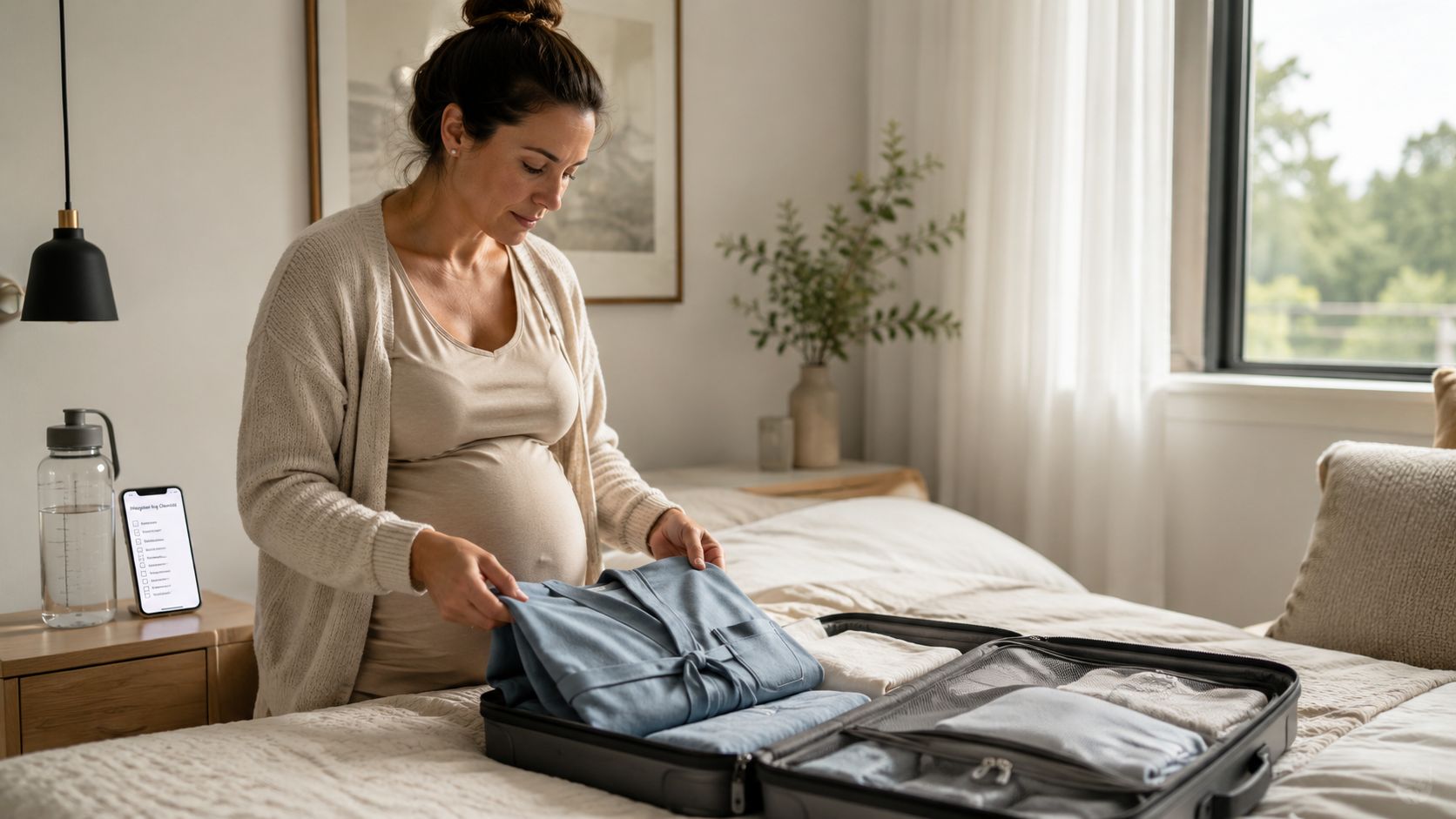
The robe usually matters before labor begins. You put it on while waiting for an appointment, pull it around yourself when a visitor arrives, or wear it over a hospital gown because the room feels cold and exposed. During pregnancy, comfort is important. During recovery, access and coverage become practical needs.
The first question is fit. A robe that closes neatly over a smaller bump may pull across the stomach later, while a fixed sash can become awkward as your body changes. The second is pocket behavior. A pocket isn't useful merely because a product page lists one. It needs to remain open enough for one-handed access, hold a phone securely, and avoid dragging the front of the robe downward when you sit or recline.
My practical rule: If you can't reach the pocket comfortably while seated, it isn't a good maternity pocket.
The front opening matters just as much. You may need quick access for breastfeeding, skin-to-skin contact, a lactation consultation, or a medical check. A wrap front with an interior tie is usually more useful than a robe that depends on a single loose belt, especially when one hand is occupied with a newborn.
The maternity wear category itself is substantial. The global maternity wear market was estimated at USD 23,422.6 million in 2024 and is projected to reach USD 30,867.5 million by 2030, with a 4.7% CAGR from 2025 to 2030, according to Grand View Research's maternity wear market analysis. That context matters because a pocketed robe isn't solving an imaginary niche problem. It's part of a broader move toward maternity clothing that works harder in daily life.
At home during the first week, you'll want the same things: coverage when someone knocks, nursing access, soft fabric, and somewhere to put your phone, tissues, or lip balm. The robe should reduce small decisions, not create more of them.
What Makes a Robe Maternity-Specific
A standard oversized robe gives you extra fabric. A maternity robe gives that fabric a purpose. The difference shows up in the cut, closure, sleeves, and pocket position.
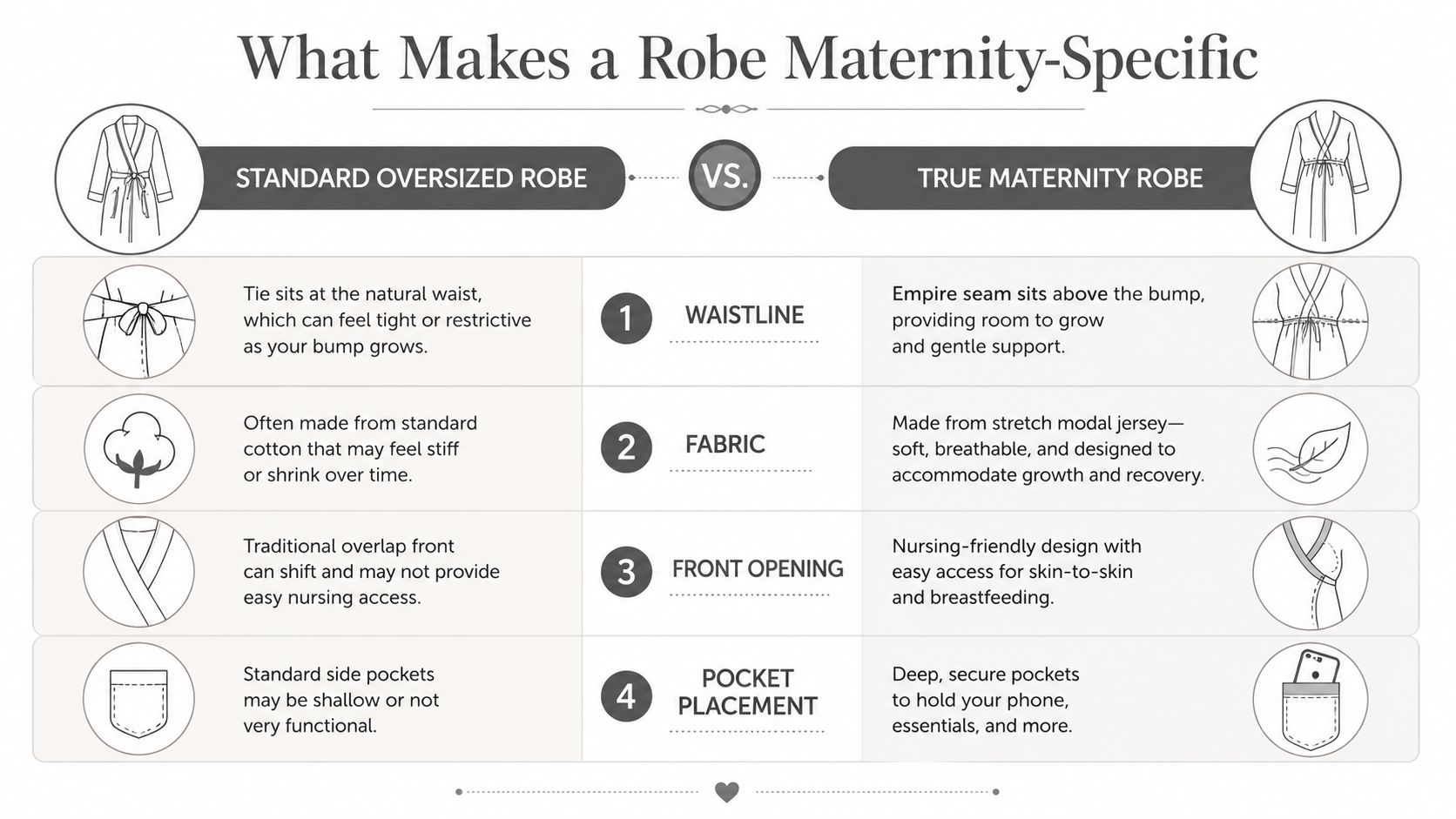
Look at the waistline first
A regular robe often gathers fabric directly at the waist with a sash. That can work for lounging, but the tie may sit across the fullest part of a late-pregnancy belly. A maternity design may use an empire seam, a raised waist, or a deliberately generous wrap so the fabric falls over the bump instead of compressing it.
The distinction is important after birth, too. Your abdomen doesn't immediately return to its earlier shape, and a robe that depends on a narrow waistline can feel restrictive. Adjustable interior ties give you a second fastening point, helping the robe stay closed without requiring a tight exterior knot.
Check how the front opens
A maternity robe should make nursing and skin-to-skin access simple. The wrap front should separate without a struggle, and the neckline shouldn't force you to pull the whole garment off one shoulder.
Sleeves also deserve attention. Wide or half-length sleeves are easier to roll while washing your hands, holding a baby, or handling feeding supplies. Tight cuffs and long sleeves that fall over your hands turn ordinary movements into irritating interruptions.
Treat pockets as part of the pattern
Pocket placement changes with the silhouette. Deep pockets placed too low can spill their contents when you sit. Pockets placed too high may force repeated reaching across the chest or bump. The most practical position is generally near the natural hand drop zone, with an opening that remains accessible when you're seated or reclining.
Historical context explains why pockets still stand out as a selling point in women's clothing. Women's pockets became associated with the 18th century, when separate tie-on pockets were common, while U.S. patent records documented a notable integrated women's pocket garment design in 1923, as described in Future Market Insights' maternity apparel overview. A pocketed maternity robe reflects that larger shift from decorative clothing toward garments designed for actual tasks.
Fit That Adapts Through Pregnancy and Postpartum
The robe you buy early in pregnancy has to behave differently from the robe you wear after delivery. Your shape changes, your tolerance for pressure changes, and your priorities shift from accommodating growth to offering easy access and forgiving coverage.
A fixed sash is the weakest option for a robe intended to last through pregnancy. It may look relaxed at first, then become difficult to position over a larger bump. A wrap front with an interior tie performs better because you can secure the inner layer before adjusting the outer belt. Drawcord waists can also work, provided the cord doesn't press into the abdomen.
Side-seam snap panels offer another useful approach. They allow the body to expand incrementally without adding a bulky layer across the front. For postpartum wear, that extra adjustability helps the robe remain comfortable as swelling and abdominal shape change.
Match the closure to the moment
A mid-calf length is my preferred compromise for hospital and home use. It offers coverage over the upper thighs while avoiding a trailing hem that can catch on equipment, tubing, or a baby's feet. Sleeve length matters for the same reason. Three-quarter or half-length sleeves stay out of the way better than long, loose cuffs.
For C-section recovery, inspect the belt position carefully. A stiff tie that presses against an incision can make an otherwise attractive robe unusable. An open-front silhouette, a high wrap tie, or a closure that sits comfortably above the tender area is a better choice during the early recovery period.
| Closure Style | Early Pregnancy (T1–T2) | Late Pregnancy (T3) | Hospital Stay | Postpartum Weeks 1–6 |
|---|---|---|---|---|
| Fixed exterior sash | Comfortable but may feel loose | Least adaptable | Acceptable only if the wrap stays closed | Can work if it doesn't press on tender areas |
| Wrap with interior tie | Easy to adjust | Strong choice for changing coverage | Excellent for checks and nursing access | Excellent for controlled, one-handed adjustment |
| Drawcord waist | Flexible for gradual changes | Useful if the cord sits comfortably | Convenient, but inspect cord placement | Good when pressure can be kept away from sensitive areas |
| Side-seam snap panels | Roomy and adjustable | Strong choice for expansion | Practical for layered hospital wear | Useful as the abdomen changes after delivery |
| Open-front cut | Easy for lounging | Works with a secure layer underneath | Excellent for nursing and skin-to-skin | Especially useful when a belt would cause pressure |
For a broader browse of robe silhouettes, see SEYANTE's women's robes. Focus on the closure and pocket construction rather than choosing by color alone.
Pocket Design Beyond the Checkbox
A pocket should carry a small load without changing how the robe hangs. That means depth, opening width, reinforcement, and position matter more than the simple phrase “with pockets.”
Side, patch, and hidden pockets
Side-seam pockets look clean and usually preserve the robe's shape. They work especially well when the opening is angled toward the hand and the pocket bag is anchored securely. On a wrap robe, though, a side pocket can gape when you sit if the opening follows the outer panel instead of the body.
Patch pockets are easy to inspect and often spacious. Their weakness is weight distribution. On a lightweight robe, a phone can pull the pocket downward, creating sag and making the front look uneven. A double-layer pocket bag, reinforced top edge, and attachment at more than one seam improve durability.
Hidden zip pockets provide the best security for identification, cards, or a phone during movement. They're less convenient during nursing because a zipper demands more precise handling, but they're useful when you're walking through a hospital or settling into bed without wanting contents to fall out.
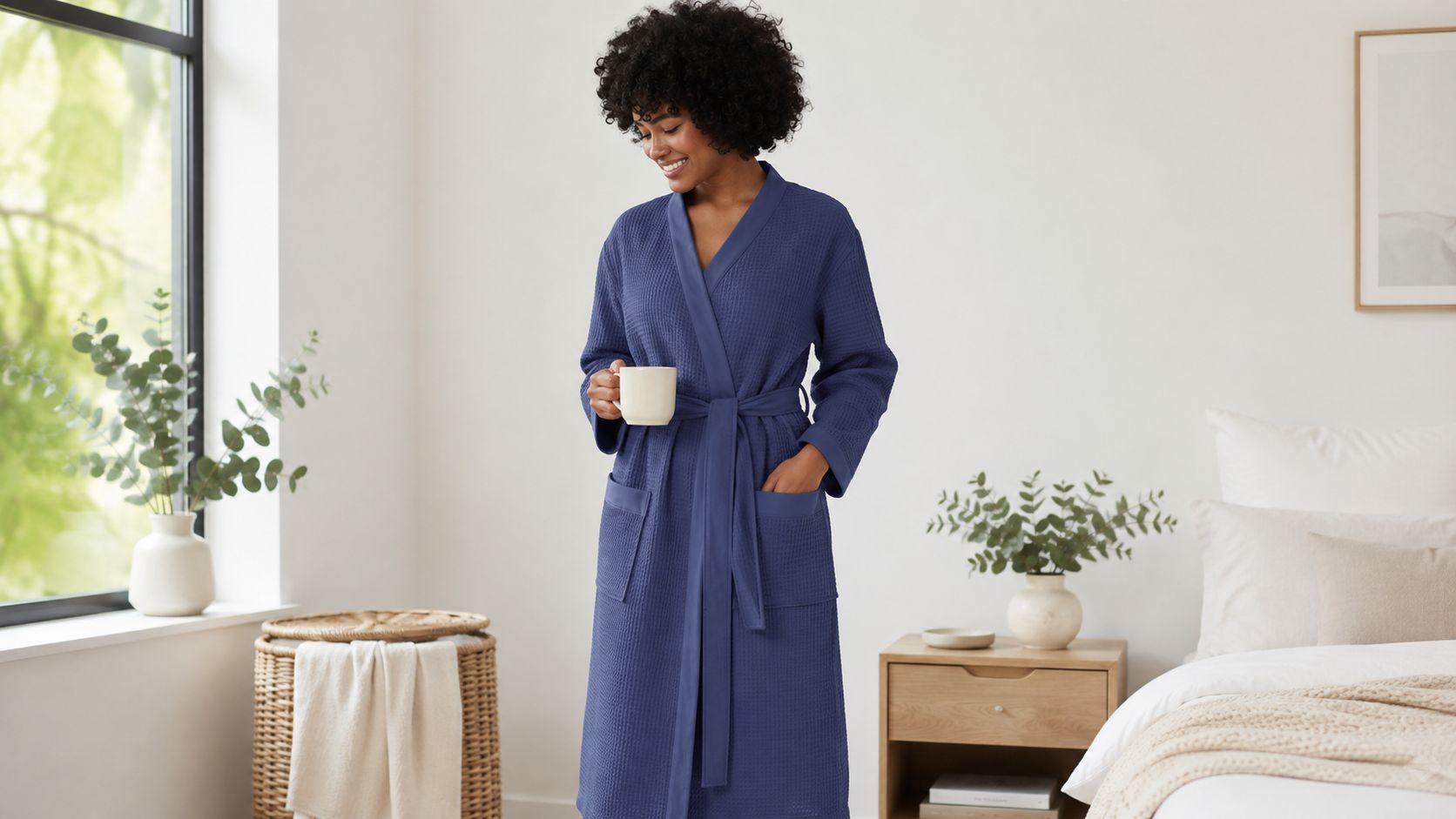
The Women's Lavender Blue Lightweight Kimono Waffle Spa Robe is described as a lightweight, breathable robe made from 100% GOTS-certified organic Turkish cotton, which illustrates why fabric weight and pocket construction should be assessed together.
What to inspect before buying
Use the product photos and measurements to answer these questions:
- Capacity: Can the pocket hold a smartphone, lip balm, tissues, or slim recovery supplies without stretching the robe?
- Opening: Is the mouth wide enough for one-handed access while seated?
- Security: Does it have a zip, flap, snap, or a naturally secure opening?
- Construction: Is the topstitched edge reinforced, and does the pocket have a lining?
- Placement: Will the pocket remain reachable during nursing or medical checks?
A useful design rule is a pocket deeper than 5 inches, reinforced topstitching, and either a hidden closure or a self-fabric flap. That rule is a practical benchmark for screening options, not a guarantee that every pocket will suit every body.
| Pocket Type | Typical Depth | Security | Best For | Watch Out For |
|---|---|---|---|---|
| Side-seam pocket | Moderate to deep | Moderate | Clean lines and quick hand access | Gaping on wrap fronts when seated |
| Patch pocket | Moderate to deep | Moderate | Visible storage and easy access | Sagging on lightweight fabric |
| Hidden zip pocket | Moderate | High | Phone, ID, cards, and walking around | Slower access during nursing |
| Flap pocket | Moderate to deep | High when secured | Small items that must stay contained | Added bulk at the front |
Fabric Choices That Change How the Robe Feels
Fabric labels describe materials, but they don't always tell you how the robe will behave against a changing body. Weight, stretch, weave, and drying behavior deserve as much attention as fiber content.
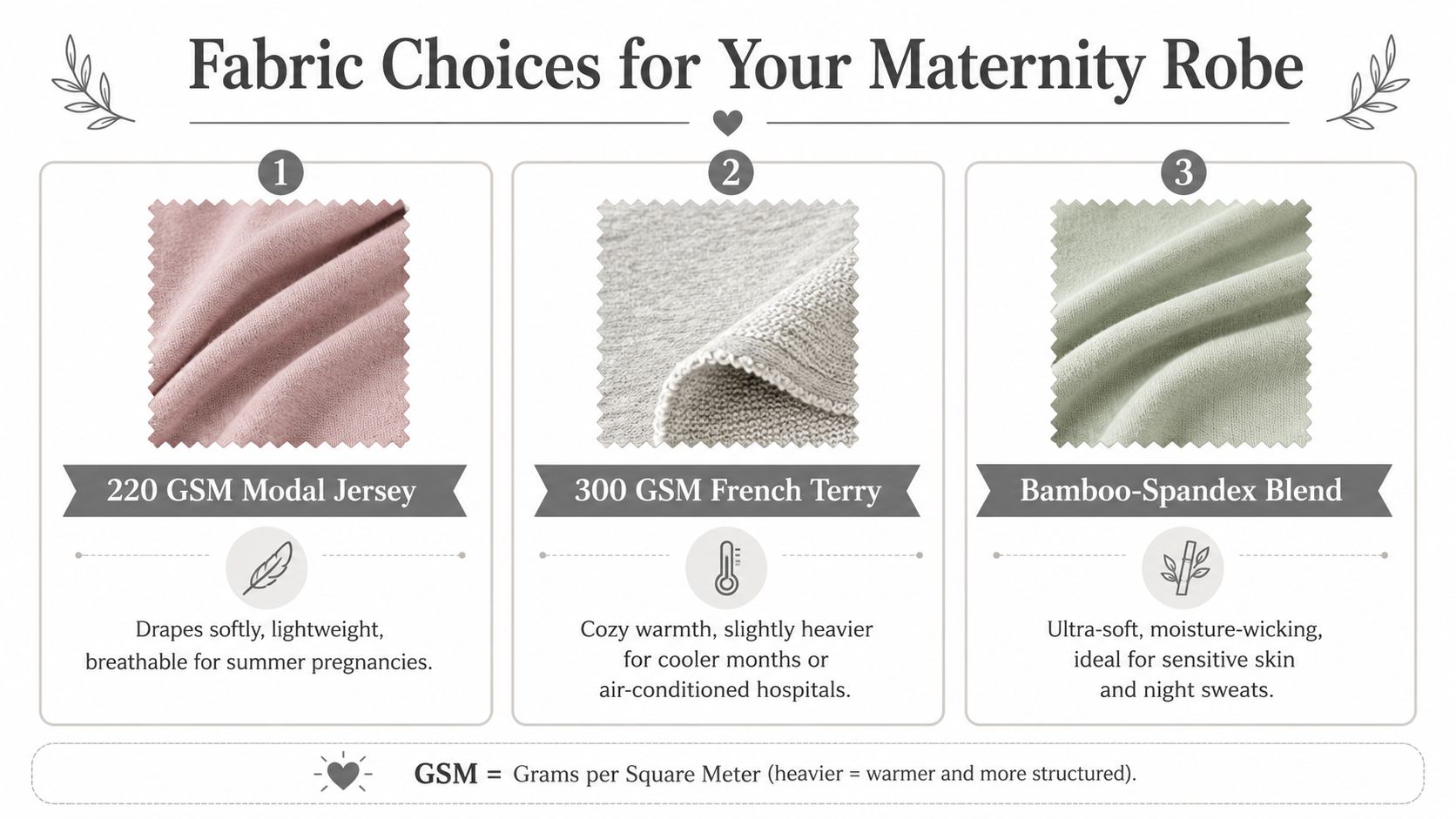
GSM means grams per square meter. A higher GSM generally indicates a fabric that feels warmer and more structured, while a lower GSM usually produces a lighter drape. The exact experience still depends on the fiber and weave, but the label gives you a useful starting point.
Translate the common options
Modal jersey feels soft, fluid, and close to a lightweight T-shirt. Its drape suits warm weather and people who dislike bulky layers. Stretch also helps reduce stress around pocket seams when the pockets carry small items.
French terry has a looped interior and a smoother outer face. It offers more warmth than a thin jersey without the full bulk of plush terry. It's a sensible middle ground for a cool home or an air-conditioned hospital.
Bamboo-spandex blends are usually selected for softness, stretch, and a smooth hand feel. They can be appealing for sensitive skin or night sweats, but always check the care instructions because blended fabrics vary.
Cotton remains a dependable choice when you want breathability and familiar washing. Waffle textures can feel airy and structured, while terry provides more absorbency and warmth. Heavier fabric can improve coverage, but it may create bulk around the hips and abdomen, which isn't ideal when you're already uncomfortable.
Read certifications and care instructions
GOTS certification addresses organic textile status and processing requirements within the certification standard. OEKO-TEX Standard 100 is associated with testing textiles for certain harmful substances. Neither label tells you whether the robe will fit well, dry quickly, or place its pockets correctly.
Care instructions reveal the robe's everyday practicality. Machine-washable fabric is valuable during the newborn stage, when spills and frequent changes are normal. A robe that requires delicate handling or long drying may become the one you avoid, even if it feels luxurious on the first wear.
For climate matching, choose lightweight breathable fabric for warm conditions, a medium knit for variable temperatures, and terry or flannel blends when warmth is the priority. Buyer guidance also distinguishes lightweight bamboo for hot weather from terry or flannel blends for colder environments, as outlined in this fabric and robe buying guide.
Your Hospital Bag and First Week at Home Checklist
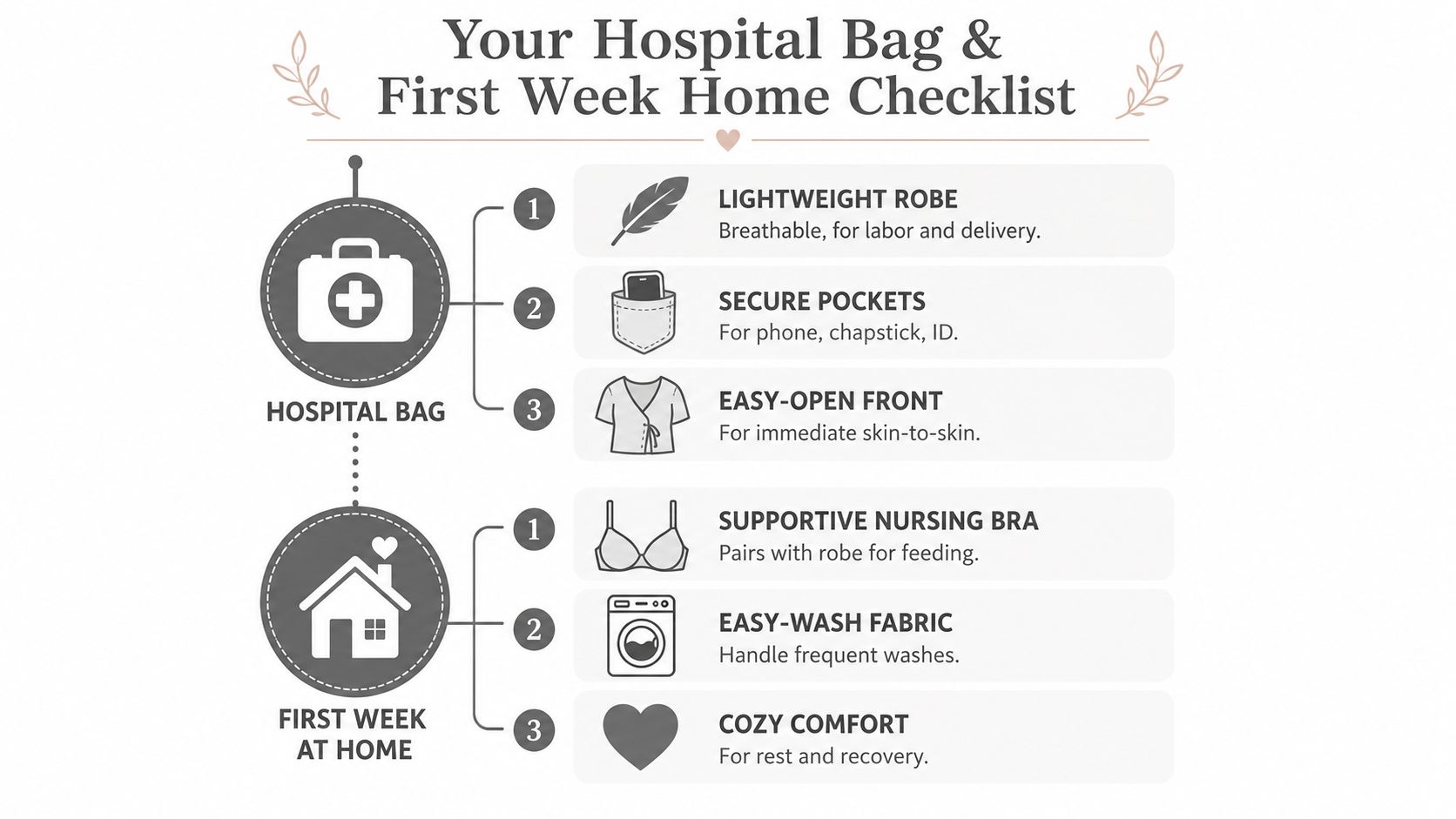
The robe should earn its space by serving a specific purpose at each stage. Pack for access first, then softness, then appearance. A dark or medium shade can be practical because it's less stressful if the garment encounters spills, while breathable fabric is easier to tolerate during labor and early breastfeeding.
At the hospital
Before leaving home, test the robe while seated. Put your phone in one pocket, place a small item in the other, and open the front with one hand. If the robe pulls across your stomach or the pocket contents fall out when you recline, it won't improve under hospital conditions.
During labor and delivery, you may need to open the front quickly for monitoring, checks, or skin-to-skin contact. Pockets should hold small essentials without interfering with leads, tubing, or medical access. Keep the robe loose enough for movement, but secure enough that it doesn't fall open every time you stand.
During postpartum recovery
Tender skin changes what feels comfortable. Look for a soft interior, flexible seams, and a closure that doesn't sit directly on a sensitive area. Pockets can carry breast pads, tissues, a phone, or other slim necessities, but don't overload them. A heavy pocket changes the robe's drape and can pull on the shoulder or side seam.
At home, machine washing matters more than decorative detail. You'll want to nurse without fully undressing, answer the door without searching for a cover-up, and keep your phone close while both hands are occupied.
A quick packing checklist
- Hospital bag: Pack one breathable robe with an adjustable closure.
- Pocket test: Confirm that the pockets hold your phone and small personal items securely.
- Front access: Check that the wrap opens easily for skin-to-skin contact and nursing.
- Coverage: Choose a length that keeps you covered without trailing around equipment.
- Recovery comfort: Avoid closures that press across tender abdominal areas.
- Laundry: Confirm that the fabric can handle the washing routine you expect at home.
- Feeding: Pair the robe with clothing that allows quick nursing access.
- Self-care: Keep a simple recovery routine in mind, such as the gentle ideas in postpartum rituals for soft touches.
Gifting, Bridal Parties, and Bringing It Home
A maternity robe is a strong gift because it supports a real transition rather than adding another decorative item to the nursery. For a baby shower, choose an adjustable robe with useful pockets and a washable fabric. For a postpartum gift, prioritize softness, easy nursing access, and a closure that won't irritate a sensitive abdomen.
Buying for someone else requires restraint. Don't guess based only on the recipient's usual clothing size, because maternity and postpartum fit depend on the cut, wrap overlap, and room through the body. Check the size chart, read the return policy, and favor adjustable construction over a fixed silhouette when you're buying before the baby arrives.
Choose the gift around its timing
For a maternity photoshoot, appearance may lead. A smooth fabric, coordinated sash, or personalized detail can create a polished look, but the robe should still open easily and fit comfortably over the bump.
For a shower gift, versatility wins. Pick a color the recipient will wear, a length that won't interfere with movement, and pockets that can hold a phone without sagging. A robe that works in the hospital and at home has a longer useful life than one designed only for photographs.
For a postpartum arrival gift, think about laundry and access. A new parent may wear the robe repeatedly, so a fabric that tolerates frequent washing and a front that opens without a struggle matter more than elaborate trim.
Robes can work for bridal parties too
Coordinated robes make sense for bridal preparation because they create a consistent look while keeping clothing easy to remove around hair and makeup. An expecting member of the wedding party may need a roomier cut, a flexible tie, or a maternity-specific silhouette rather than the same straight-sized robe as everyone else.
Personalization can come through monogramming, sash colors, or a shared fabric family. Keep the coordination subtle enough that each person receives something wearable after the event. The practical guidance in this article on choosing bridal party robes can help you balance group styling with individual comfort.
My condensed buying advice is simple:
- Prioritize adaptive fit if the robe needs to work before and after delivery.
- Inspect pocket design instead of accepting “pockets included” as enough information.
- Match fabric weight to climate and recovery setting.
- Choose easy care because the robe will face real household use.
- Check returns before gifting so the recipient can exchange a poor fit without stress.
A maternity robe should feel like equipment for daily comfort, not an outfit you admire from the packaging. SEYANTE offers maternity styles alongside Turkish cotton terry and lightweight waffle robes, with guidance on sizing and materials to help you compare fabric and fit. Visit SEYANTE to explore robe options designed for everyday self-care, hospital preparation, and life at home after birth.