Woman Bath Wrap: A Practical Buyer's Guide for 2026
You step out of the shower, reach for the towel, and start the familiar balancing act. The robe belt loosens as soon as you bend, the sleeves brush against damp skin, and one hand stays busy holding everything closed while you apply lotion or reach for clean clothes. A woman bath wrap is designed for that exact gap between drying off and getting dressed, giving you towel-like coverage without the constant readjustment.
The right choice isn't determined by softness alone. Fabric, length, overlap, and closure engineering decide whether a wrap stays secure when you sit, bend, walk, or lift a leg over the tub. This guide focuses on those practical details, especially the movement test that most product descriptions ignore.
The Post-Shower Gap Most Robes Leave Open
A robe is useful once you're dry and ready to lounge. It gives you sleeves, warmth, and room to move around the house, but its belt creates a weak point immediately after bathing. The belt depends on a knot or wrap tension that can shift whenever you lean forward, twist, or carry something.
A woman bath wrap takes a different approach. It's a pre-seamed rectangular garment, usually made from terry or waffle fabric, with a closure positioned around the bust or upper torso. Instead of draping a towel and then adding a robe, you fasten the wrap once and keep both hands free.
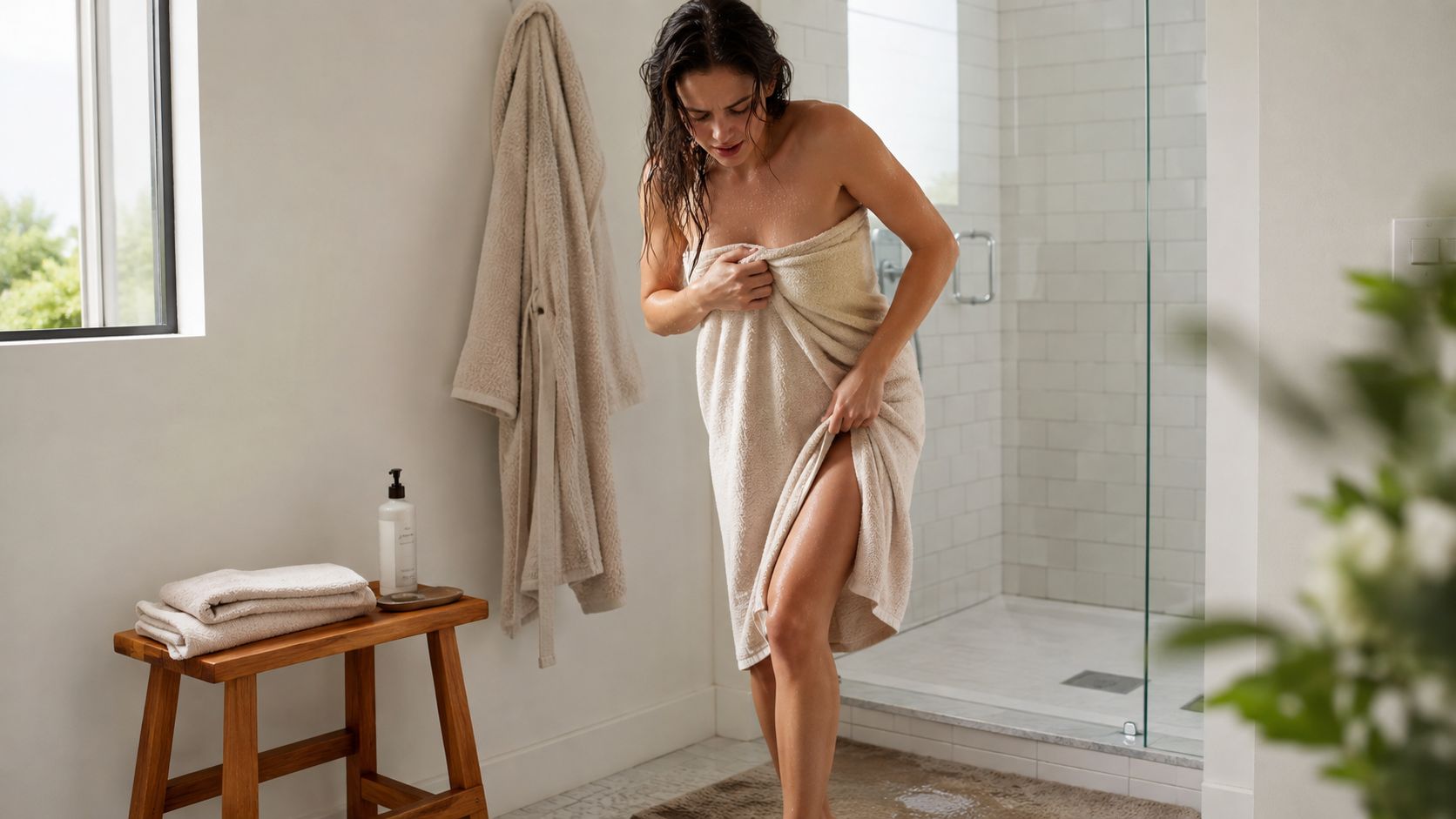
What a wrap is built to do
The garment has three jobs:
- Remove surface water: Terry loops create a larger contact area against the skin, while waffle textures offer a lighter drying layer.
- Hold coverage in place: A closure and overlapping front panel prevent the fabric from falling open during ordinary movement.
- Reduce post-shower fuss: You can fasten it quickly, walk to the bedroom, and use your hands for lotion, skincare, hair care, or dressing.
That distinction matters for anyone who dislikes bulky sleeves or damp robe cuffs. It can also make a gentle, low-effort routine more comfortable during periods when bending and reaching feel difficult. For broader ideas around comfort-focused personal care, see these gentle routines for postpartum relief.
Practical rule: Buy a wrap for secure drying and coverage, not as a substitute for a warm lounging robe.
A good wrap should feel stable before you move, then remain stable when you sit or lean. That makes closure design the first serious buying decision, not a finishing detail after color and softness.
Where the Woman Bath Wrap Actually Comes From
The woman bath wrap has roots in bath cultures that treated bathing as a social and restorative ritual rather than a quick private task. The Victoria and Albert Museum documents a 19th-century linen bath wrap from Turkey, made from three widths of fabric and worn around the body while the bather rested in a hammam after bathing. Its collection notes also describe how embroidered borders on towels and napkins had become highly stylized by the end of the 18th century, showing that the textile traditions behind modern bath garments were already well established before the 1800s. You can view the museum's record of this historic Turkish bath wrap.
The original logic was simple. A large textile could cover the body, remain breathable, and allow the wearer to move between bathing, resting, and dressing. Modern wraps preserve that basic function but add shaped panels, elastic, snaps, or adjustable fasteners to address a problem flat cloth alone doesn't solve, namely staying closed through movement.
From flat cloth to structured terry
Terrycloth added another layer of utility. Looped fabric techniques can be traced to garments from Ancient Egyptian times around 4000 BCE, while industrial expansion in the 1850s supported automated weaving and knitting, after which robes and towels became the main uses for terry fabric for decades. These historical details come from the textile background outlined by Frescobal Carioca's terry cotton overview.
The modern woman bath wrap is therefore a hybrid. It combines the direct absorbency of a towel with the controlled fit of a spa garment. That combination works well at hair-wash stations, treatment rooms, pool areas, and home bathrooms where a full robe feels excessive or gets in the way.
The category also sits inside a large and established bath-textile market. The global bath towel market was valued at USD 11.3 billion in 2024 and is projected to reach USD 18.6 billion by 2034, according to the cited textile source, with hygiene and wellness trends identified as drivers. Those figures describe the broader bath towel category, not bath wraps specifically, but they help explain why manufacturers continue refining cotton weights, weave structures, and closure systems.
History matters here because it explains the product's purpose. A wrap isn't merely a shortened robe. It evolved from the need to balance coverage, absorbency, breathability, and movement.
Terry vs Waffle and Which Fabric Wins for You
Terry wins when drying power and plushness matter most. Its uncut yarn loops create capillary spaces that pull water away from the skin, but the same construction can make the garment feel heavier when wet and slower to dry. Waffle weave uses a more open, textured structure, so it generally feels lighter, packs more easily, and suits warm or humid conditions.
A useful benchmark for premium terry is 400 to 600 GSM, according to technical guidance on towelling body wraps. GSM alone doesn't determine quality. Loop height, loop density, yarn quality, finishing, and overall weave construction also influence absorbency and durability.
| Factor | Terry Cloth | Waffle Weave |
|---|---|---|
| Absorbency | Higher, especially in balanced mid-to-heavy weights | Moderate, with a lighter drying feel |
| Weight when wet | Heavier and more substantial | Lighter and less cumbersome |
| Dry time | Usually slower because the loops hold more moisture | Usually quicker because the structure uses less bulk |
| Best setting | Home spa routines, cold weather, and post-bath comfort | Travel, pool use, humid bathrooms, and gym bags |
| Feel | Plush, cushioned, towel-like | Textured, breathable, and less bulky |
Choose based on the bathroom, not the marketing photo
A thick terry wrap is the better purchase if you want to step out of a bath and stay warm while your skin dries. It also makes sense in a cool home where a lightweight layer feels insufficient. The trade-off is obvious: you'll need more drying space, and you shouldn't expect it to feel light after a saturated shower.
Waffle is the smarter option for repeated use between washes, travel, and bathrooms that stay humid. It also works better when you need to pack the wrap into a small bag or carry it from a locker room to a pool. The texture sheds the heavy, damp feeling associated with dense towel fabric.
My recommendation: Choose mid-weight terry for a home self-care ritual. Choose waffle for portability, warm weather, and anyone who hates finding a damp garment hours later.
Don't select by GSM in isolation. A dense, well-finished lighter fabric can outlast a poorly made heavier one, while excessive bulk can make a wrap uncomfortable and difficult to dry. For a more detailed fabric discussion, use this waffle versus terry robe comparison.
How Sizing and Fit Actually Work
Many shoppers choose a size by label and discover too late that the wrap's length is acceptable while the front doesn't overlap enough. That happens because wraps depend on horizontal coverage more than conventional garments do. You need enough sweep around the body, enough overlap at the front, and a closure that can apply even tension without digging into the skin.
One published ladies' 100% cotton terry bath wrap chart holds length around 28 to 30 inches while the bottom sweep expands from 47 to 64 inches across its size range. That geometry shows why a wrap can support different body shapes by adding girth rather than making the garment longer. The sizing guidance is summarized in this bath-wrap fit reference.
Read the measurements in the right order
Start with your fullest waist and hip measurement, depending on where the wrap closes and where its lower edge sits. Then check length against your height and the coverage you want while seated. A wrap that ends too high may expose the upper thigh when you sit, while an overly long design can bunch around the legs and interfere with walking.
The chart below is a practical way to interpret the available body-specific guidance. The cited sizing information describes broad ranges rather than a universal industry standard, so always compare it with the individual product's measurements.
| Size | Waist | Hip | Wrap Length | Best For |
|---|---|---|---|---|
| XS to S | Check the product chart | Check the product chart | Around 28 to 30 inches | Snug coverage on a smaller frame |
| M to L | Check the product chart | Check the product chart | Around 28 to 30 inches | Balanced everyday fit |
| XL to X/XXL | Check the product chart | Check the product chart | Around 28 to 30 inches | More sweep and adjustable overlap |
Some guidance places one wrap range around women's sizes 6 to 16, while another extends from 18 to 3X, demonstrating why “one size fits most” isn't enough information. The robe size guide for small through XXL offers a useful reminder to compare measurements rather than relying on the letter on the tag.
Test security through movement
Before buying, ask whether the wrap will stay closed when you:
- Bend toward a low shelf to pick up a towel.
- Sit on the edge of a tub or vanity stool.
- Lift one leg over the tub edge.
- Lean forward to apply lotion to your lower legs.
Aim for 2 to 4 inches of front overlap when the wrap is positioned comfortably. Less overlap leaves little margin for movement, while excessive overlap can create bulky folds and uneven closure tension. A heavier terry wrap may also feel tighter than a waffle wrap with identical measurements because its fabric has more body and resistance.
Why Closures Matter More Than Softness
A soft wrap can still be a badly designed wrap. If the fastening system opens when you bend, the fabric's hand feel becomes irrelevant because you're forced to hold the garment closed with one hand.
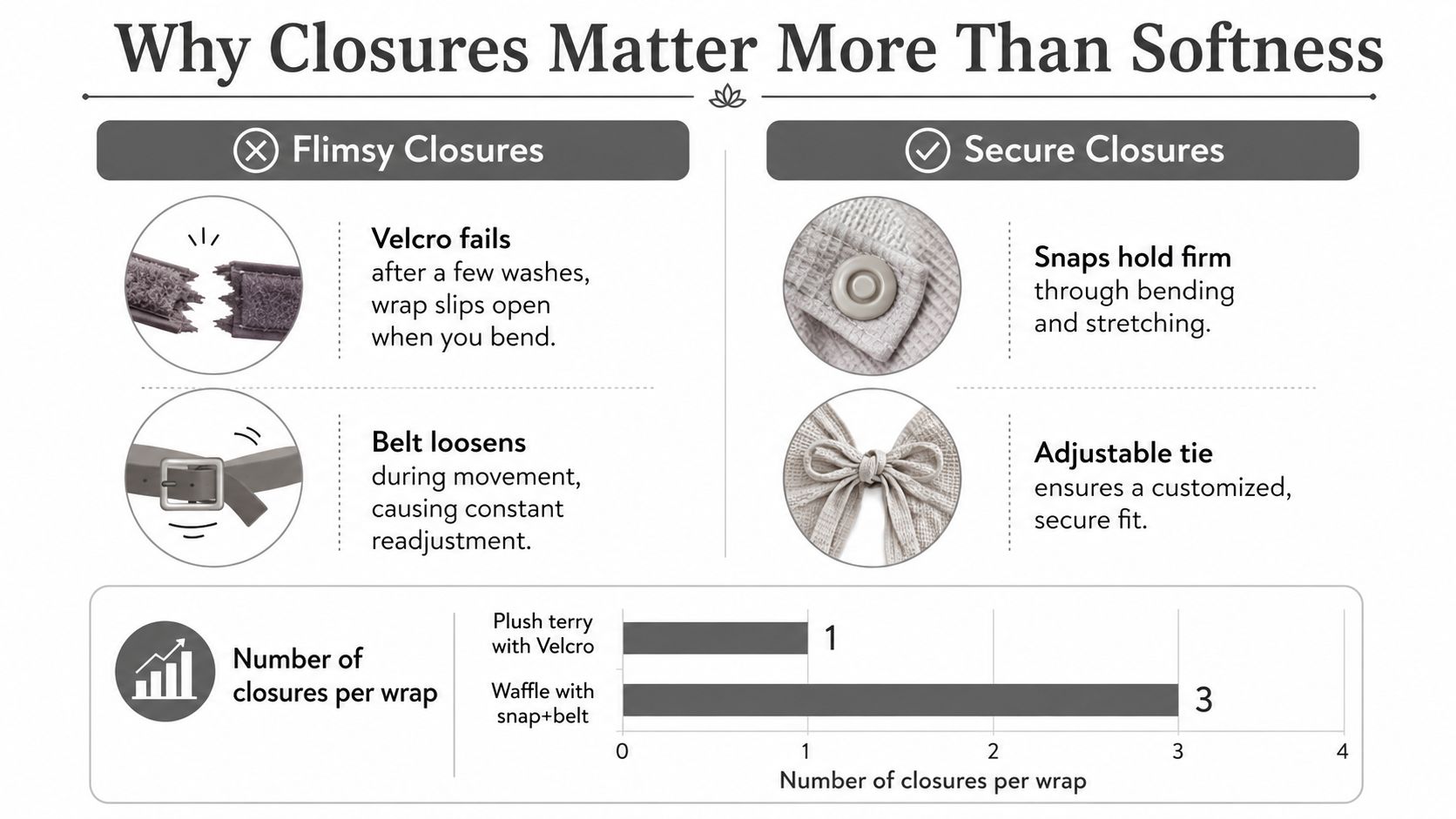
Compare the closure systems honestly
Hook-and-loop closures are fast and easy to operate with one hand. They can work well when the tab is wide, securely stitched, and positioned over sufficient overlap. A narrow tab on a plush wrap is a weak design because the fabric pulls against a small fastening area.
Snaps provide a cleaner hold and avoid scratchy contact when covered by an internal flap. They require more precise alignment, though, and several snaps are more dependable than a single central point because they distribute tension.
Ties offer the most adjustable fit and can accommodate changes in how tightly you want to wear the garment. Their weakness is user error. A short or slippery tie can loosen, especially when placed at the side rather than across a stable front panel.
Elastic bands improve comfort and maintain contact as you move. Elastic alone shouldn't carry the entire security load, since it can stretch over time. It works best when combined with a snap, tie, or overlapping closure.
Hidden hooks can create a neat appearance and keep hardware away from the skin. They're less convenient for quick one-handed fastening and need strong reinforcement at the attachment points.
Movement test: Fasten the wrap, bend forward, sit down, twist, and reach overhead. If the closure shifts during those motions, softness won't rescue the design.
Closure placement matters as much as closure type. Off-center snaps can pull one side higher than the other, while a side tie may loosen as the wearer turns. Look for a broad closure band, reinforced stitching, a generous overlap panel, and a closure positioned where the garment experiences even tension.
What survives real use
The most reliable arrangement is usually an adjustable primary closure supported by elastic or multiple fastening points. A broad snap system or well-constructed hook-and-loop tab can work, but it shouldn't be attached to a flimsy strip of fabric.
Marketing photos show a standing pose. Your bathroom routine includes bending, sitting, stretching, and carrying. Buy for the second list.
Care Habits That Protect Absorbency and Softness
Laundry mistakes can turn a useful wrap into a fabric-covered sponge that feels stiff, smells damp, or stops absorbing properly. Start by reading the care label, then treat the wrap as a technical textile rather than ordinary loungewear.
Wash for the weave
Fabric softener is the first product to remove from your routine. Its coating can reduce the fabric's ability to absorb water, especially when used repeatedly on looped terry. Bleach can weaken fibers and damage color, so use a gentle detergent and address stains directly instead of treating every wash aggressively.
A cautious baseline is cold washing when the care label allows it. The required care infographic recommends a 20°C pre-wash setting, while the accompanying guidance warns against high heat and fabric softeners. Terry can tolerate different instructions from waffle, so follow the garment label rather than applying one temperature to every textile.
- Body oils: Pretreat the area with a small amount of gentle detergent before washing.
- Makeup: Lift the residue before it sets, and avoid rubbing it deeper into the loops.
- Self-tanner: Rinse promptly and use a fabric-safe stain treatment rather than harsh bleach.
Dry without crushing the texture
Tumble dry low when the label permits it. High heat can damage waffle elasticity and crush the loops that give terry its drying performance. Shake the wrap out before drying so the fabric doesn't clump, and remove it once dry rather than leaving it tumbling for hours.
Air drying is useful in a well-ventilated space, but don't leave a damp wrap bunched on a hook in a humid bathroom. Hang it open or spread it over a broad rail, then fold it loosely once fully dry. Avoid ironing terry because direct heat compresses the loop structure and adds no useful finish.
For households with multiple users, rotating two wraps gives each garment time to dry completely. Even a single user benefits from alternating between a heavier terry wrap and a lighter waffle option when the bathroom stays damp.
For broader laundering and storage guidance, follow this practical guide to washing, storing, and caring for robes.
Storage rule: Never fold a wrap while it still feels cool or damp. Mildew prevention starts with complete drying, not a stronger detergent.
Proper care can keep a well-made wrap useful for two to four years, while common mistakes can reduce its usable life to under a year, according to the care guidance supplied for this article. Treat that range as a care-dependent expectation, not a guarantee.
Matching the Right Wrap to Real Moments
The best wrap for your bathroom may be the wrong wrap for a pool bag. A practical purchase starts with the moment you'll use it most, then selects fabric, closure, and length around that routine.
At home after a shower, choose a mid-weight terry wrap with a secure tie or reinforced adjustable closure. A generous lower sweep gives you coverage while sitting, and the lack of sleeves keeps cuffs away from wet hair and skincare products.
For spa visits, lightweight waffle is more versatile. It layers under a robe without creating excessive bulk, dries more readily between uses, and feels less cumbersome while walking between treatment areas. A neutral color also works well under other garments.
At the pool or beach, waffle is the clear practical choice. It carries less bulk, sheds sand more easily than plush looped fabric, and dries faster after contact with wet skin. Choose a broad upper closure or strap arrangement that won't slide as the fabric's surface becomes damp.
For bridal parties and getting-ready photos, prioritize clean lines over maximum absorbency. Satin trim, a lightweight waffle texture, or a smooth lightweight terry can photograph neatly, tie without bulky folds, and serve as a useful gift after the event.
Travel creates the strictest packing test. A quick-drying waffle wrap compresses more easily and avoids taking over the suitcase, making it the better hotel and gym option. Check the closure before leaving home, since an adjustable system is more useful than a beautiful wrap that requires constant holding.
| Occasion | Recommended Fabric | Best Closure | Ideal Length | Why It Works |
|---|---|---|---|---|
| Post-shower home routine | Mid-weight terry | Reinforced tie or adjustable closure | Mid-thigh coverage | Absorbs water and stays practical while moving |
| Spa visit | Lightweight waffle | Snaps with elastic support | Short to mid-thigh | Layers easily and dries between uses |
| Pool or beach | Waffle weave | Wide adjustable band | Secure seated coverage | Packs lightly and handles damp conditions |
| Bridal getting-ready | Lightweight waffle or terry | Clean tie or concealed snaps | Mid-thigh | Looks polished and allows easy movement |
| Travel or hotel stay | Quick-dry waffle | Adjustable closure | Compact mid-length | Packs efficiently and avoids excessive damp bulk |
Use this one-minute selector: terry for absorbency, waffle for portability, adjustable closures for movement, and enough length and overlap for seated coverage. If you can't identify the wrap's closure strength and measurements, don't buy it based on softness or appearance alone.
SEYANTE offers women's towel wraps in 100% Turkish cotton terry and lightweight waffle weaves, including an organic waffle towel wrap, alongside sizing and material guidance for shoppers who want to compare these features directly. Visit SEYANTE to choose a wrap around your preferred fabric, fit, and post-shower routine rather than settling for a vague one-size design.