Slippers Closed Toe: Materials, Soles and Fit Guide
If a slipper covers your toes but slips off your heel, is it really the right house shoe? Toe coverage, secure fit, and reliable traction are separate features, and a soft lining can make it easy to overlook the other two.
When shopping for slippers, closed toe is a useful starting filter, not a complete specification. The better choice matches your room temperature, floor surfaces, foot shape, and daily routine. Before keeping a pair, you should be able to explain where you'll wear it and confirm that it stays comfortable and secure while you walk.
Closed-Toe Slippers Explained and Their Materials Compared
A closed-toe slipper covers the front of the foot, while a fully enclosed style also surrounds the heel. That distinction matters: a backless scuff can have a closed toe without providing the retention of a heel counter or adjustable back strap.
Enclosed designs are a substantial part of the category. According to PW Consulting Health Care Research Center, closed-toe slippers represented 43.5% of the global slippers market in 2025, with reported revenue of $9.78 billion. That's a commercial market estimate, but it helps explain the broad choice of fabrics and constructions shoppers encounter.
Slipper materials compared by use
The descriptions below are practical starting points. Fabric thickness, backing, and the layers beneath the lining can change how the finished slipper feels.
Material | Warmth | Breathability | Best For | Trade-off |
|---|---|---|---|---|
Sherpa-lined fleece | High | Low to moderate | Cold floors and winter evenings | Traps heat and feels bulky |
Cotton terry | Moderate | High | Post-shower and warm rooms | Absorbs water and dries slowly |
Wool felt | High | High | Dry, cold-climate homes | Compresses over time and needs gentle care |
Suede or wool blend | Moderate | Moderate | Dry home floors and smart-casual looks | Stains easily and needs protection |
Knit or jersey | Low to moderate | High | Summer and light everyday use | Less structure and can stretch |
Memory foam lining | Moderate | Moderate | Cushioning during standing tasks | Adds bulk, and foam can break down |
Microfiber | Moderate | Moderate | Easy-care daily wear | Synthetic and may pill |
Warmth matters most on cold floors; breathability matters in warm rooms or when your feet perspire. Absorbency is a separate consideration. Terry can take up moisture, but that doesn't mean it'll dry quickly inside an enclosed slipper.
Memory foam also deserves clarification: it's a cushioning layer rather than an upper fabric. Check what covers it and what supports it underneath. A plush first impression doesn't establish lasting support.
For another natural-fiber option, you can browse pure cashmere slippers from Cashmere Boutique and compare the stated construction and care requirements with your routine.
Practical rule: Choose the upper and lining for the room you'll wear them in. Choose the sole for the surface underfoot.
Sole Types for Indoor, Outdoor and Mixed Use
Sole types matched to surfaces
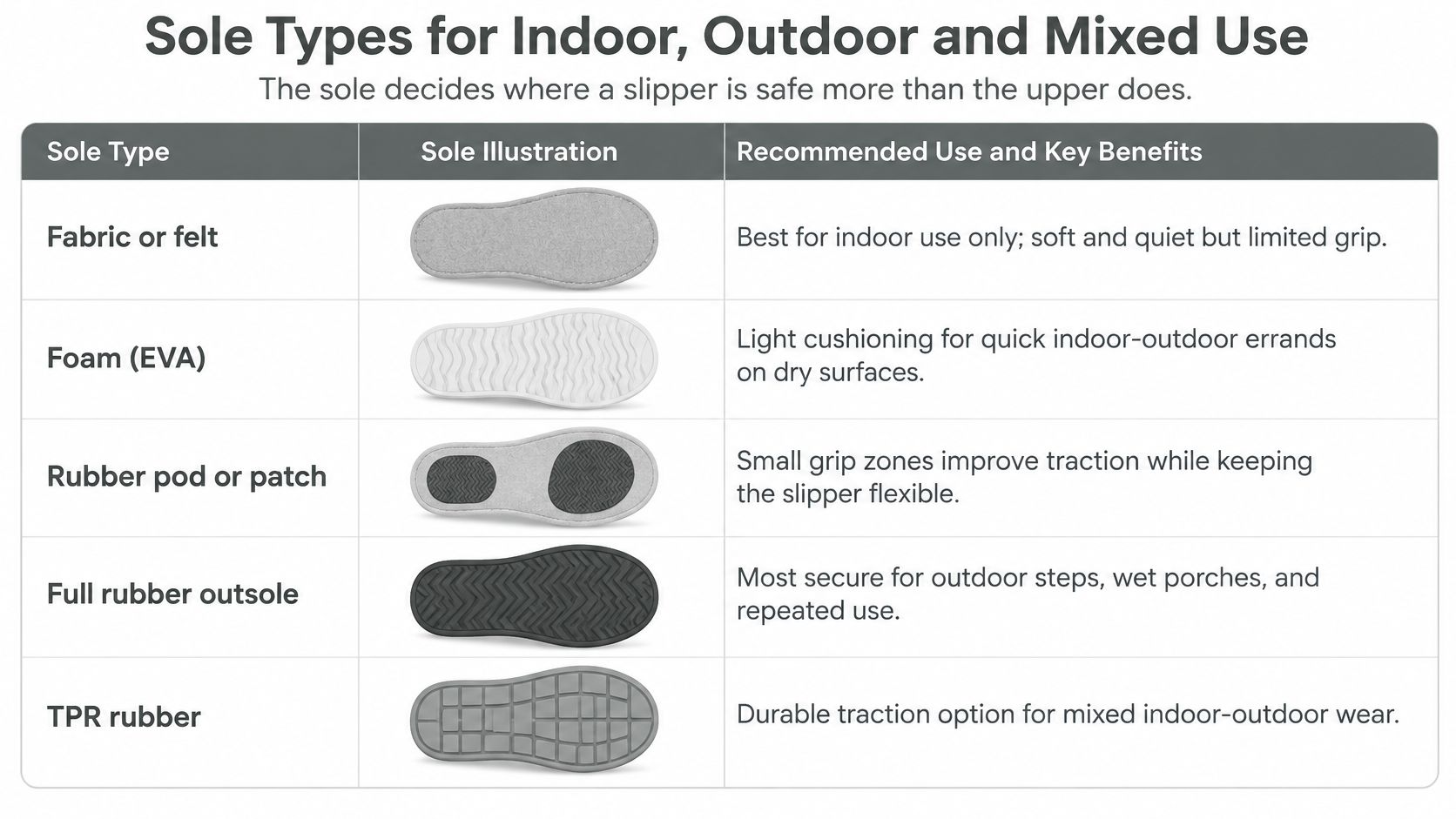
Use this table to shortlist constructions, not to treat a material name as proof of grip. The traction descriptions assume an appropriate tread and a clean, unworn sole.
Sole Type | Best Surfaces | Traction | Durability | Verdict |
|---|---|---|---|---|
Fabric or felt sole | Carpet and dry bare wood | Low on wet tile | Low to moderate | Indoor only |
Foam (EVA) sole | Carpet and bedrooms | Low to moderate | Low to moderate | Indoor only unless explicitly rated otherwise |
Rubber pod or patch sole | Tile, kitchens and bathrooms | Moderate | Moderate | Short indoor walks and light steps outside |
Full rubber outsole | Tile and short paved trips, including damp conditions when tested | Potentially high | High | Indoor and brief outdoor use |
TPR rubber sole | Mixed indoor and paved surfaces | Moderate to high | High | Mixed use |
The sole determines appropriate surfaces more than the upper does, but retention still matters. A grippy outsole can't keep your foot inside a loose slipper.
Match the construction to the route
If you stay in carpeted bedrooms, fabric, felt, or indoor foam may suit your routine. Keep those soles away from wet entrances.
If you cross kitchens or bathroom floors, consider rubber patches or a continuous outsole. Patches leave uncovered areas, so examine their placement rather than counting them.
If you step onto paved paths or a porch, choose a full outsole designed for that use. Wet paving requires credible traction evidence, not merely an outdoor label.
Foam deserves special attention because it appears in both indoor slippers and outdoor footwear. A molded outdoor EVA sole isn't equivalent to a thin foam layer covered with fabric.
What slip-resistance claims actually mean
Whole-footwear testing matters more than tread appearance. ASTM F2913 measures friction between complete footwear and flooring under controlled conditions, while ASTM F3445 establishes minimum slip-resistance performance requirements using whole-shoe testing; relevant conditions include contaminants such as water, oil, and grease.
Ask for documentation identifying the finished slipper, tested surfaces, and test conditions. A statement that the sole contains rubber doesn't answer those questions, and laboratory compliance doesn't guarantee performance on every floor.
At home, inspect the sole for smooth contact areas, unstable edges, and debris trapped in grooves. With the slipper off your foot, gently press it against a damp tile to identify obvious sliding, then dry the floor before a cautious indoor walking check. Don't deliberately walk onto wet tile to test traction, and don't mistake a home check for laboratory verification.
Fit, Sizing and Pre-Purchase Checks
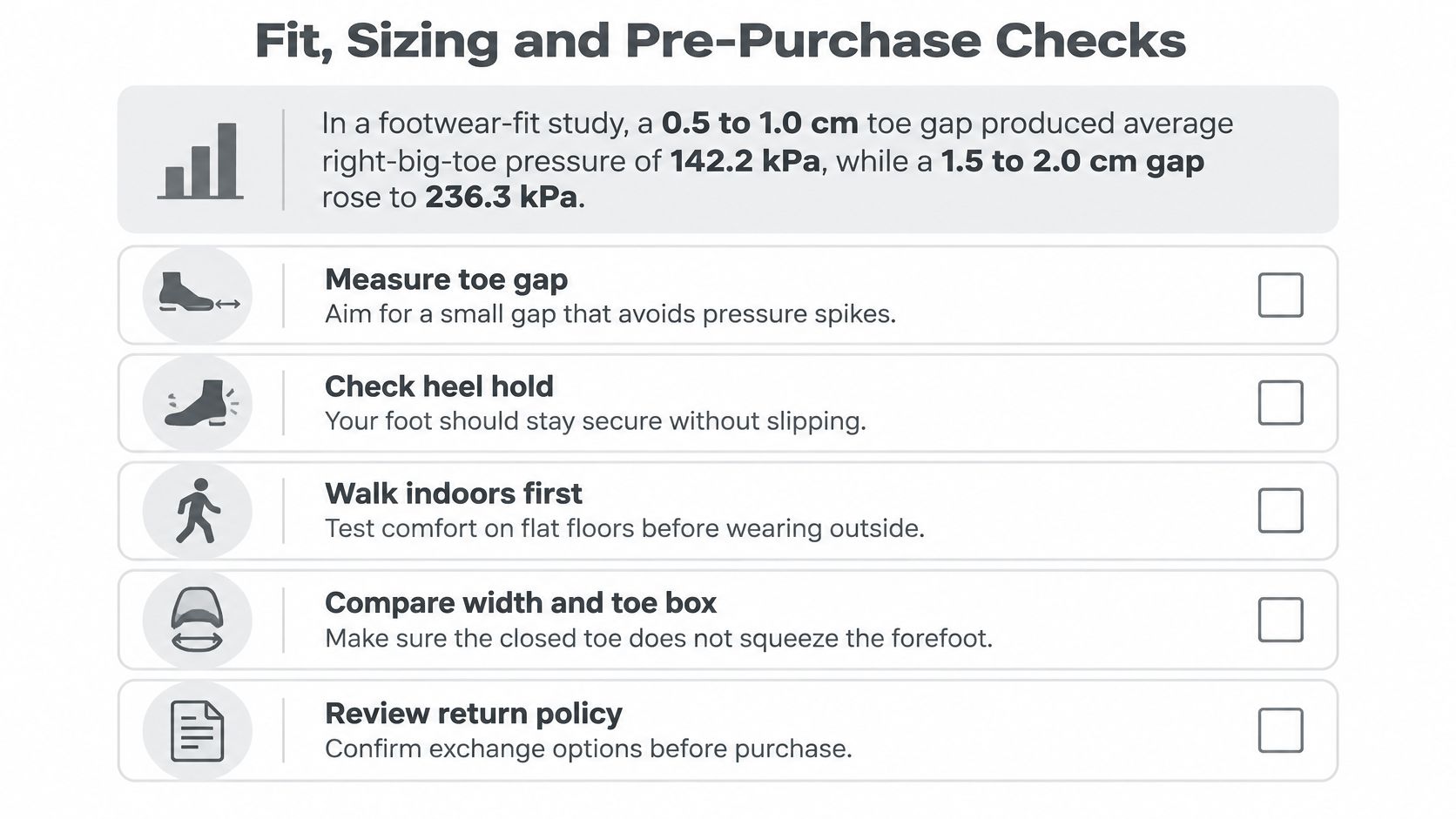
More toe space doesn't automatically produce a better fit. A footwear-fit study summarized by the Health Research Authority reported average right-big-toe pressure of 142.2 kPa with a 0.5–1.0 cm toe gap, compared with 236.3 kPa with a 1.5–2.0 cm gap, a statistically significant increase.
The practical lesson isn't to apply a study measurement as a universal prescription. It's to avoid buying extra length when the issue is insufficient width or depth. If your foot moves forward inside the slipper, the additional space may not prevent pressure at the toes.
Measure the foot, then assess the shape
Measure both feet while standing, using a sheet of paper, a pencil, and a ruler. Mark the heel and longest toe, measure the distance, and compare the larger foot with the brand's chart. Check whether the chart describes foot length or internal footwear length, because those aren't interchangeable.
Try slippers later in the day, especially if your feet become fuller after standing. Wear the socks you intend to use. Thick terry or thermal socks take up room across the toes and over the instep, so a barefoot fitting can be misleading.
Look for a broad, rounded forefoot that follows your toes rather than drawing them toward a point. Length, width, and depth must work together. If your toes feel compressed but your heel already moves, sizing up is unlikely to solve the whole problem.
Run a pass-or-return fitting check
Keep packaging intact and use a clean, dry indoor surface while assessing the pair.
Check heel retention. Walk normally and turn gently. The heel should remain seated rather than repeatedly lifting or making you grip with your toes to retain the slipper.
Let your toes relax. They should lie naturally without curling, pressing into the end, or rubbing against the upper. Check while standing, not only while seated.
Inspect pressure points. Pay attention to the big-toe joint, smaller toe joints, and instep. A soft fabric can still press firmly when stretched across a prominence.
Assess the side walls. The slipper should contain your foot rather than allowing it to spill over the sole edge. Look for enough structure to prevent sideways collapse during turns.
Walk on a hard floor and reassess later. Notice whether the foot migrates, the upper twists, or the cushioning feels uneven. Repeat the fitting when your feet are fuller rather than assuming the initial fit will remain unchanged.
Don't plan to break in a slipper that already pinches, slips, or changes the way you walk.
Check the buying conditions too
Confirm that the material suits your room and that the seller provides meaningful outsole information. Review return terms before wearing slippers outside or removing inserts and tags. A trial that leaves visible wear may affect return eligibility.
For a coordinated robe purchase, our robe size-chart guide addresses garment sizing separately. Our returned items must be in new, unused, or unwashed condition, with all original product inserts, accessories, and bags. Don't assume that another retailer uses the same requirements.
Keep the pair only when the relevant checks pass on both feet. Repeated heel lift, a pinched forefoot, or a sole curling upward at the toe are reasons to reconsider the size or construction rather than hoping the problem disappears.
How Long Closed-Toe Slippers Last and How to Care for Them
An unsuitable wash or hot dryer can damage a slipper before the outsole wears out. The vulnerable parts aren't limited to the visible fabric: foam, stiffeners, decorative trims, and bonded layers may require different treatment.
There's no dependable calendar lifespan for every pair. Daily wear, floor texture, moisture, construction, and cleaning all affect replacement timing, so inspect condition instead of relying on a promised number of years.
A material-led care routine
Read the complete care label. Machine-wash knit, fleece, or microfiber only when the finished slipper is labeled washable. Wool felt may require gentle hand cleaning, while suede generally needs brushing and a suede-specific cleaner rather than soaking.
Remove loose components and grit. Take out removable insoles if their instructions allow it, then brush debris from the outsole. Grit left in the tread can scratch floors and interfere with contact.
Use gentle cleaning for washable pairs. Choose cool water, a gentle cycle, and mild detergent when permitted. Skip fabric softener on terry so you don't coat its absorbent loops.
Reshape and air dry. Blot excess moisture without twisting, then support the shape with clean paper or a small towel. Keep slippers away from radiators and direct dryer heat, which can distort foam or weaken bonded components.
Clean the outsole separately. Wipe rubber soles with a damp cloth and clear packed grooves with a soft brush. Let the whole slipper dry before putting it away.
Store dry pairs without crushing them. Keep the heel upright and leave space for air circulation. If you rotate pairs, don't return a damp pair to use because the outside feels dry.
For the rest of your bath-time textiles, our robe washing and storage guide helps you organize a separate care routine. Don't assume a robe's wash settings are suitable for footwear with adhesives or foam.
Replace according to condition
Inspect the heel structure, contact areas beneath the ball and heel, and the interior cushioning. A collapsed heel counter, smooth outsole patches, flattened lining, or persistent odor after appropriate cleaning deserves attention.
Cleaning can remove dirt. It can't restore worn tread, rebuild a collapsed heel, or reverse permanently compressed cushioning.
If replaceable insoles are available, use only a compatible thickness. An overly thick replacement can reduce toe room or lift your heel above the retaining edge.
Pairing Closed-Toe Slippers with Your Robe
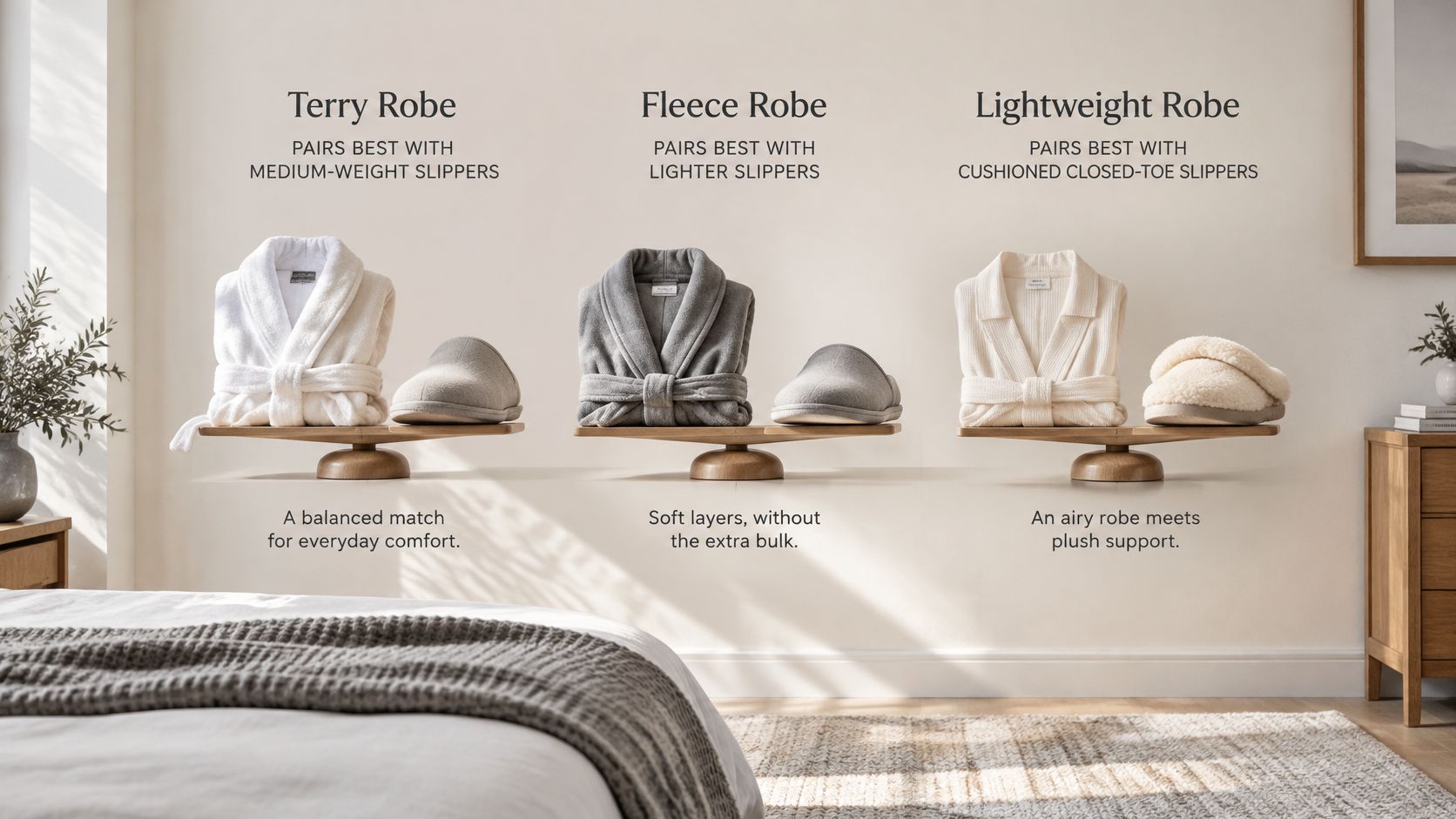
Match overall warmth and bulk, not just color. A heavy robe and densely lined slipper may feel excessive in a heated room, while a lightweight robe doesn't necessarily call for a thin slipper if your floors are cold.
The combination should also let you move freely. Robe length, sleeve management, and footwear profile become noticeable when you're carrying a drink, climbing stairs, or walking through a narrow doorway.
Match the fabrics and proportions
Terry robes: Cotton-lined slippers can continue the absorbent feel. Wool felt is an alternative for dry feet in a cooler room, but it shouldn't be treated as a quick-drying bath accessory.
Waffle robes: Knit or microfiber slippers preserve a lighter feel without adding a bulky cuff.
Plush or fleece robes: A cooler lining can balance the robe's insulation. Choose sole thickness for the floor and your walking needs, not appearance alone.
Long robes: Low-profile slippers can reduce interference at the hem, but the robe still needs enough clearance that you don't step on it.
Hooded robes: Prioritize a retained heel for household movement. The hood is a styling feature, not a reason to accept a loose slipper.
Our Women's Lavender Blue Turkish Cotton Waffle Hooded Robe is a lightweight, breathable option made from GOTS-certified organic Turkish cotton. A light knit slipper can complement that fabric weight, while a warmer lining may suit a colder bedroom.
Keep the bath-to-bed routine dry
After bathing, dry your feet thoroughly, including between the toes, before putting on slippers. Choose a dry cotton-lined pair if you prefer an absorbent interior, and hang the damp robe rather than letting it wet your footwear. If the slippers become damp, change into a dry pair before continuing your evening.
An absorbent lining isn't a substitute for dry feet, a dry floor, or a suitable outsole. Avoid stepping into slippers while standing in shower water, and keep loose bath mats out of your walking route.
For finishing details, our guide to accessorizing your bathrobe offers styling ideas. Before settling on the combination, walk along a clear hallway wearing both pieces and check for hem contact, dragging fabric, or heel movement.
When Closed-Toe Slippers Are the Wrong Choice
Closed doesn't mean suitable. Toe coverage can provide a barrier against minor bumps and cold surfaces, but it doesn't compensate for inadequate depth, loose fastening, or unstable construction.
A review of footwear and falls discusses the importance of fixation, heel structure, sole characteristics, and fit, rather than toe coverage alone. In a study of 176 older adults described in that review of footwear-related fall risks, 72% wore footwear that didn't fit correctly on both feet. That finding concerns the studied older adults, not every slipper wearer, but it supports checking the whole fit rather than trusting a category label.
Situations that call for a supportive indoor shoe
Situation | What to look for | What to avoid | Who to check with |
|---|---|---|---|
Swollen feet | Adjustable upper, broad forefoot, end-of-day fit check | Tight collars and short toe boxes | Podiatrist or clinician if swelling is new |
Bunions or hammertoes | Wide, adequately deep toe box and soft upper over the joint | Pointed toes and pressure over the joint | Podiatrist |
Diabetes or reduced sensation | Secure heel, smooth interior, appropriate depth, daily foot check | Loose heels, rough seams, and concealed rubbing points | Clinician or podiatrist before buying |
Parkinson's or stroke-related balance issues | Secure heel counter, grippy outsole, low-profile sole | Backless or loose designs and worn treads | Clinician or physiotherapist |
Older adults moving around at home | Firm heel, grippy outsole, supportive indoor shoe for night trips | Worn treads and heels that slide out | Clinician if near-falls repeat |
Softness isn't the same as suitability. A stretchy upper may accommodate a changing foot shape, but it still needs enough retention to prevent unwanted movement. Likewise, removable insoles are useful only when the remaining shoe has appropriate depth and the replacement doesn't compromise fit.
Survey findings concerning people with Parkinson's disease and stroke highlight why footwear advice needs to account for mobility and foot problems, not comfort alone. The survey of indoor and outdoor footwear habits also identified gaps in professional foot-care support among participants.
Know when to stop experimenting
People with diabetes, neuropathy, reduced sensation, or new swelling should discuss footwear with a podiatrist or clinician before buying. Lack of discomfort isn't a reliable fit test when sensation is reduced, and new swelling needs assessment rather than opting for a larger slipper.
This is general guidance, not medical advice. Repeated near-falls, a heel that slides out, or pain after wearing are reasons to stop using the pair and consider a supportive indoor shoe with professional guidance.
We offer luxury bathrobes for men and women in hooded, kimono, hotel, maternity, and lightweight styles. Visit SEYANTE to choose a robe for your daily routine, then pair it with slippers that pass your fit, floor-suitability, and condition checks.