How to Choose the Best Maternity Pajamas for Every Trimester
- The Real Problem With Most Maternity Pajamas
- Understanding Fabric Systems That Actually Work
- Fit Across Trimesters and Into Postpartum
- Nursing-Friendly Features Worth Choosing
- Seasonal Choices and Layering Strategies
- Sizing, Care, and What to Check Before You Buy
- How to Compare Brands Without Getting Sold To
- Bringing It All Together
At 3 a.m., the problem usually isn't the baby moving. It's the pajama waistband pressing into your stomach, the top riding above your bump, and a wave of heat that leaves you kicking off the covers. You tug everything back into place, try to settle on your side, and discover that your “comfortable” sleep set only worked when your body looked and felt completely different.
That's why choosing the best maternity pajamas isn't a matter of finding the loosest set you can wear tonight. Good sleepwear has to adapt through pregnancy, postpartum recovery, and nursing. Your temperature, ribcage, abdomen, skin sensitivity, and preferred sleeping position can all change during that arc. Buy for the whole transition, and one well-designed set can keep earning its place long after the bump is gone.
The Real Problem With Most Maternity Pajamas
Most maternity pajamas are sold as though pregnancy has one predictable shape. You buy them when your regular waistband becomes irritating, wear them until delivery, and then put them away. That approach misses the period when sleepwear often matters most, the weeks after birth when your body is healing and feeding may happen throughout the night.
A pajama top that feels perfect in the second trimester may become too short once your belly sits higher. A loose pair of pants may accommodate a late-pregnancy bump but slide down when your abdomen becomes softer postpartum. Fixed sizing doesn't solve either problem. It gives you more fabric in the wrong places.
The useful question isn't “Will this fit my bump?” It's “Can this garment change with me?”
Pregnancy sleepwear also has to deal with temperature swings. Pregnancy can raise core body temperature, and fabric that holds heat or slows evaporation can make night sweats more uncomfortable and contribute to broken sleep. After delivery, the same person may feel overheated one night and need another layer the next. The fabric system has to release heat, move moisture away from the skin, and stay gentle when skin feels unusually reactive.
Your upper body needs the same thoughtful support. A soft sleep bra with flexible cups, wide straps, and no harsh underwire can prevent a pajama top from carrying all the pressure around your changing bust. For practical guidance on choosing one, these best maternity sleep bra tips are worth reviewing alongside your pajama search.
The commercial category is also more substantial than a passing fashion idea. The global maternity wear market was estimated at USD 23,422.6 million in 2024 and is projected to reach USD 30,867.5 million by 2030, a 4.7% CAGR from 2025 to 2030, according to Grand View Research's maternity wear market analysis. Maternity sleepwear is a defined segment within that wider category, which helps explain why fit, recovery, and nursing function deserve specialized attention rather than a larger standard size.
Understanding Fabric Systems That Actually Work
Softness is only the first job. The best maternity pajama fabric has to perform as a system, balancing breathability, moisture management, stretch recovery, and certification credibility.
Start with airflow. Cotton, bamboo viscose, modal, and lyocell generally feel more comfortable than heat-trapping synthetic-heavy knits when your body is running warm. Moisture management matters just as much. A fabric that feels smooth against dry skin can still become clammy if it absorbs sweat without helping it evaporate.
Stretch recovery is the detail shoppers often miss. A knit may feel generous when you first pull it on, then become baggy around the knees, seat, or waistband after repeated wear. Look for a fabric with enough elastane or a well-constructed knit to expand around your abdomen and return to shape after washing. Pregnancy sleepwear guidance also favors breathable, moisture-wicking fibers such as bamboo viscose, TENCEL™ or modal, and cotton over hydrophobic synthetics that can retain heat and slow evaporation, as discussed in this maternity sleepwear fabric comparison.
How common fabric systems compare
| Fabric | Breathability | Moisture Management | Stretch Recovery | Best Certification Match |
|---|---|---|---|---|
| Organic cotton | High, especially in lighter weaves | Moderate, improves with open texture | Depends on knit and elastane content | GOTS and OEKO-TEX Standard 100 |
| Cotton-bamboo blend | High | Strong, with a smooth hand feel | Usually good in jersey blends | OEKO-TEX Standard 100, with fiber documentation |
| Modal or lyocell blend | Good | Strong, with fluid drape | Good when blended with stretch fibers | OEKO-TEX Standard 100 |
| Merino wool | Strong thermal regulation | Good, but requires careful care | Moderate | OEKO-TEX Standard 100 |
| Polyester-heavy knit | Often lower | Can dry quickly but may retain heat next to skin | Often strong initially | OEKO-TEX Standard 100, if independently documented |
Certifications help separate a carefully specified textile from vague “natural” language. GOTS addresses organic fiber and processing requirements across the supply chain. OEKO-TEX Standard 100 focuses on harmful substances in the tested textile. GOLS applies to certified organic latex, so it's relevant to products such as mattresses or pillows, not usually to pajama fabric itself. If a brand mentions a certification, look for the certification name, scope, and license information rather than relying on a decorative badge.
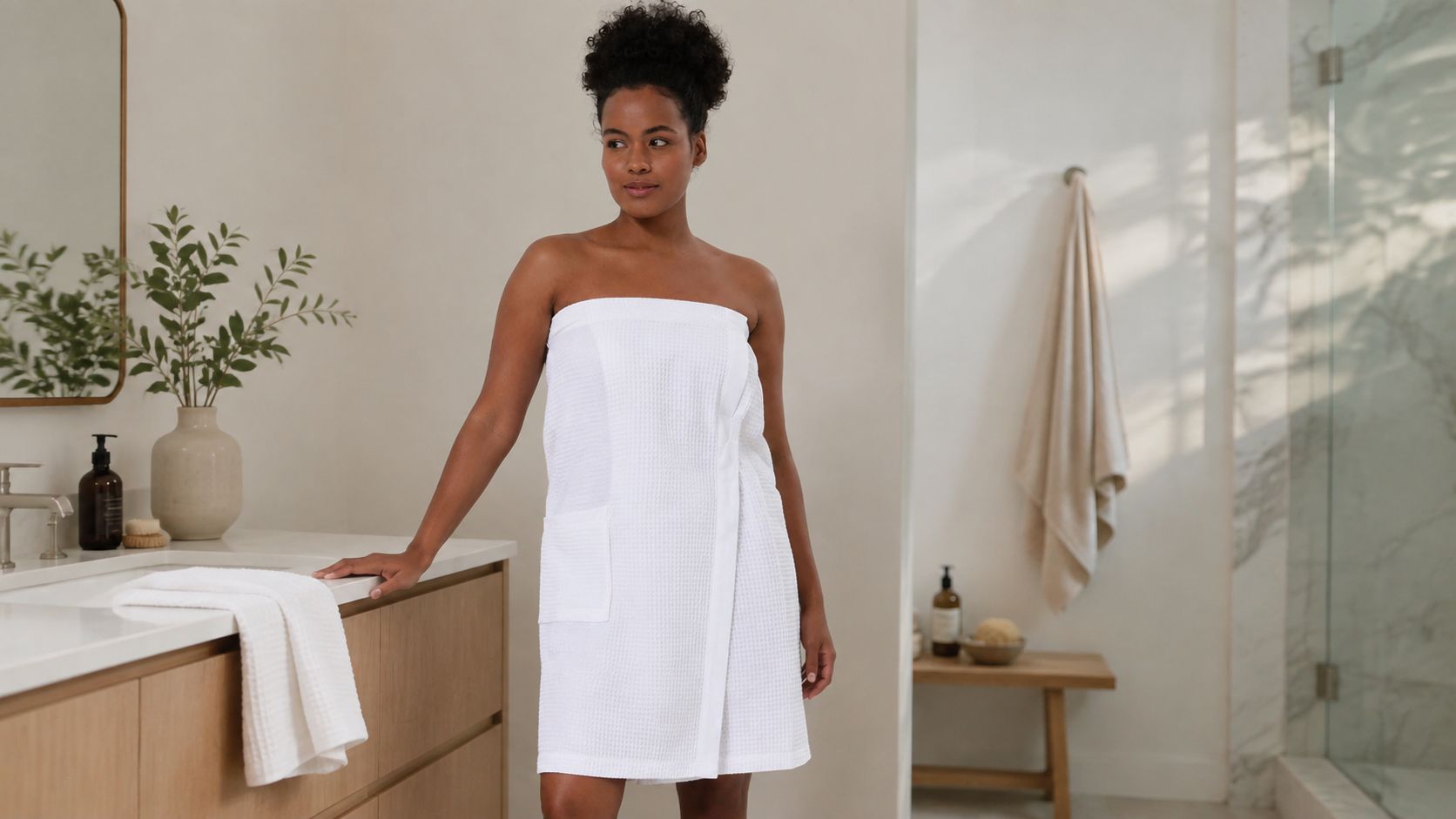
A waffle robe or wrap can complement a pajama system because its raised texture creates more space between fabric and skin. For a deeper explanation of robe textiles, use this guide to bathrobe materials and fabric types. A lightweight Women's White Organic Turkish Cotton Waffle Towel Wrap is described as a 100% GOTS-certified waffle towel wrap, designed for use after a bath.
Practical rule: Choose the lightest breathable fabric that feels comfortable in your climate, then check stretch recovery and certification before judging softness.
Fit Across Trimesters and Into Postpartum
A pajama set that feels perfect now may become irritating within weeks. Pregnancy shifts more than your abdomen. Your ribcage may broaden, your hips may change, and your belly can sit differently as each trimester progresses. Seams, waistbands, and hems that seemed harmless can start pressing in the wrong places.
Early pregnancy does not always require maternity sizing, but it still calls for smarter comfort choices. Skip firm compression bands, rough seams, scratchy labels, and rigid waist elastics. Choose a soft jersey with room to move. An oversized set is not automatically better if the top twists or the pants bunch while you sleep.
By the second trimester, adjustable construction earns its place. Drawcords, crossover panels, side ruching, and stretch waist sections give the abdomen room without forcing you to buy far too large. These details also help reduce chafing and abdominal pressure while preserving mobility.
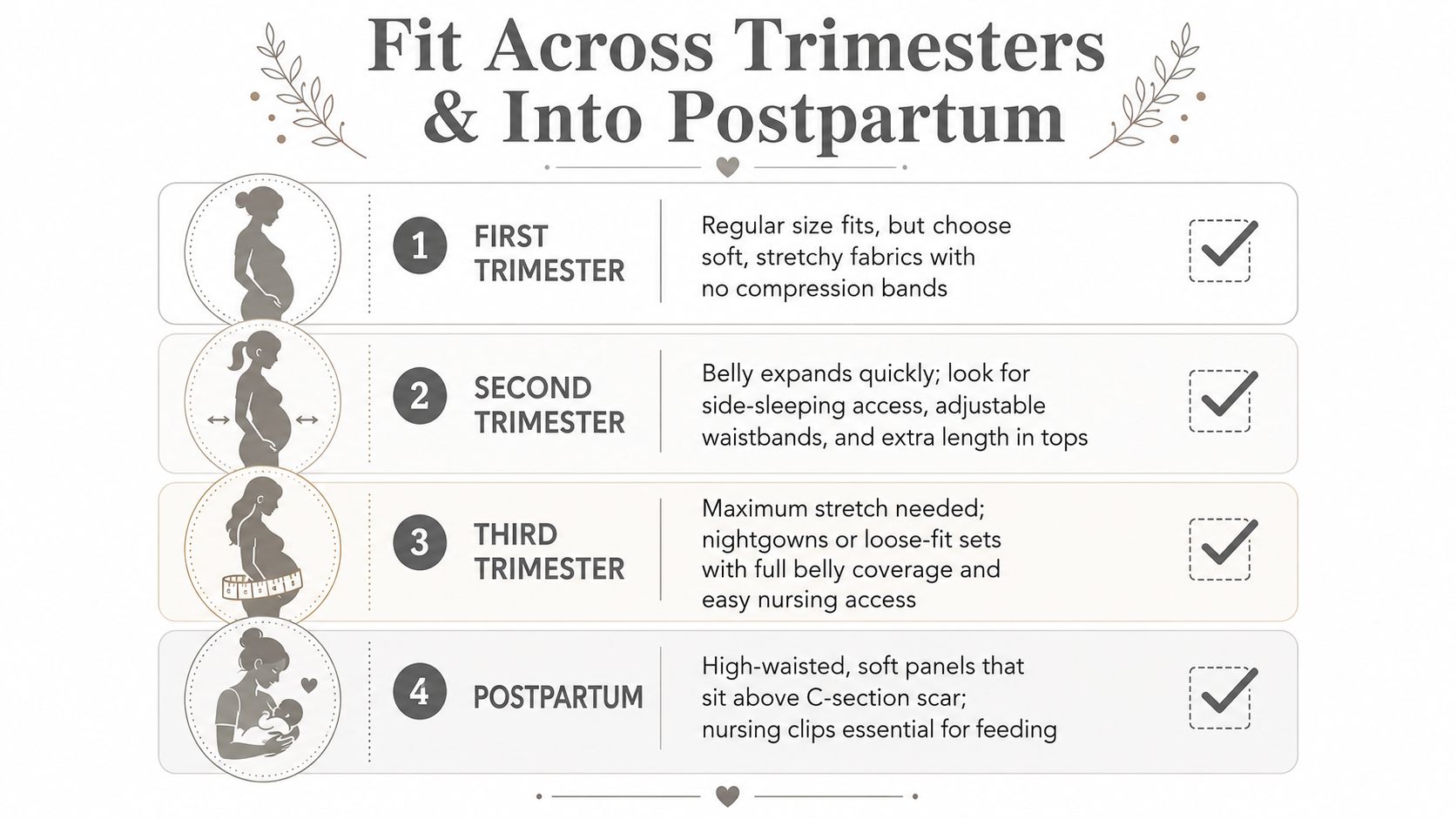
Fit features that earn their space
- First trimester: Choose soft seams, flexible knits, and waistbands that sit comfortably away from the lower abdomen.
- Second trimester: Look for a drawcord, crossover panel, or side stretch section. Extra top length prevents repeated tugging.
- Third trimester: Prioritize a high rise, full belly coverage, generous torso length, and fabric that stretches without turning transparent.
- Postpartum: Choose a soft panel or high waist that can sit comfortably over a healing area. A forgiving silhouette should still work as your shape changes.
Loose sizing often creates new problems. A very baggy top can climb around your body at night, while oversized pants may gather behind your knees. Adjustability beats excess fabric because it follows your body instead of hiding weak pattern design.
Plan the set as a layered investment. A pajama base should handle changing proportions, while a light robe adds warmth for feeding, recovery, or moving around the home. For ideas on making comfort part of recovery routines, explore these postpartum rituals for new moms.
If you are considering supplements for rest, speak with your clinician before using them. That includes guidance related to magnesium for pregnancy sleep. The pajama itself should do the basic work first: release pressure, stay in place, and remain useful through pregnancy and the nursing stage.
Nursing-Friendly Features Worth Choosing
Nursing access should be built into the pajama, not added as an afterthought. A top that fits beautifully over a late-pregnancy bump but requires you to remove the entire garment for every feed won't feel functional during long nights.
Three access styles consistently make sense.
Drop-down cups use a clip or opening that lets the cup fold below the breast. They can be convenient with one hand, especially when the opening is attached to a supportive shelf-bra frame. The downside is warmth. A built-in bra layer adds fabric around the bust, which may feel too hot if you already sleep warm.
Button plackets feel familiar and secure. Choose a placket that opens wide enough for practical access rather than a decorative row of tiny buttons. Buttons may take both hands, so they're less convenient when you're holding a baby, but they're easy to inspect and repair.
Wrap or kimono tops pull aside cleanly and accommodate a changing bust. They're also forgiving during pregnancy because the front overlap can expand. Their weakness is stability. A shallow wrap may gape when you sit up or turn on your side, so look for adequate overlap and a tie that stays flat against the body.
Details around the bust matter
Fabric near the chest needs controlled stretch and good recovery. A neckline that loses its shape becomes frustrating quickly, while a rigid seam can press into tender tissue during side-lying feeds. Avoid heavy piping, bulky tags, and seams positioned directly across the breast or underarm.
The most useful pajama is often a dual-purpose piece. A drop-front or wrap top can cover a 38-week bump, make hospital changes easier, and serve as a nightshirt for repeated feeding sessions afterward. That's a better investment than buying a pregnancy-only set and a separate nursing top before you know what access style you prefer.
A robe adds coverage without forcing you to change your entire outfit. Keep the tie high enough to avoid cutting across the abdomen, and choose sleeves that won't drag into water, bottles, or diaper changes.
Seasonal Choices and Layering Strategies
Seasonal maternity sleepwear is less about buying one summer set and one winter set than building a fabric-weight system. Pregnancy and postpartum temperature changes can make a heavy pajama miserable one night and a lightweight one inadequate the next.
| Season | Pajama Weight | Robe Layer | Best Use |
|---|---|---|---|
| Summer | Lightweight waffle or jersey | Lightweight open-front or waffle layer | Hot nights, humid rooms, hospital bags |
| Spring and fall | Midweight cotton or modal | Long-sleeve midweight robe | Variable indoor temperatures and everyday use |
| Winter | Brushed cotton or thermal knit | Warm robe over a lighter base | Cold bedrooms, morning feeding, recovery lounging |
| Any season | Breathable base layer | Removable robe | Homes with uneven heating or cooling |
For hot weather, I prefer a lightweight waffle knit over plain jersey when the garment is well made. The raised honeycomb texture can lift portions of the fabric away from the skin, allowing air to circulate and moisture to evaporate more readily. It won't solve an overheated room, but it can feel less clingy than a flat knit.
Midweight cotton or modal is the most versatile choice for spring, fall, and year-round indoor wear. Pair it with a long-sleeve robe rather than buying a thick pajama set, and you can remove the outer layer when night sweats arrive. This two-piece approach also works well in a hospital bag because the robe provides coverage for walking around without adding much complexity to the base outfit.
Winter sleepers should choose warmth strategically. Brushed cotton and thermal knits offer insulation, but a polyester-heavy set can feel static and stuffy when moisture builds up. I'd rather layer a breathable pajama with a warmer robe than trap heat inside one dense synthetic garment.
Layering wins because your temperature can change faster than the season does.
Keep the robe easy to open for nursing, loose across the abdomen, and long enough to provide coverage when you stand up. A practical set, a removable robe, and washable slippers create a more adaptable sleep routine than a single thick outfit.
Sizing, Care, and What to Check Before You Buy
Pre-pregnancy size is a starting reference, not a promise. Brands draft maternity sleepwear differently, and a “medium” can vary widely in rise, torso length, and hip room. Read the garment measurements, then compare the hip measurement with the widest part of your current body rather than choosing based only on your usual label.
Don't automatically size up. If the brand runs small, sizing up may be sensible, but a larger fixed size can create a loose waistband and a short top at the same time. Adjustable waistbands, stretch panels, and longer tops solve those problems more effectively than adding volume everywhere.
A practical pre-purchase check
- Measure the hips: Use your widest current point, and compare it with the brand's chart.
- Inspect the waist: Look for a drawcord, crossover panel, or flexible elastic that can be adjusted without digging in.
- Check the top length: Sit, turn, and raise your arms mentally. The hem should still cover the abdomen.
- Review the return policy: Confirm the window, exclusions, and whether an exchange remains possible after your body changes.
- Read the care label: A delicate fabric isn't useful if you won't realistically wash it often.
Natural fibers can shrink, and elastic can lose recovery under excessive heat. Wash according to the garment label, favoring cooler cycles when permitted, and avoid treating high heat as a shortcut to cleanliness. If a fabric isn't clearly pre-shrunk or garment-washed, leave room for the possibility that its fit may change after laundering.
For robe-specific washing and storage guidance, this robe care guide offers a useful reference. The same principle applies to pajamas: don't buy a garment whose care routine clashes with your real life.
If you can examine a set before buying, tug the waistband, stretch the knit, and study the inside seams. The elastic should return rather than stay distorted. Seams should lie flat, and nursing openings should operate without pulling the surrounding fabric out of shape.
How to Compare Brands Without Getting Sold To
A polished photo cannot tell you whether pajamas will work through a growing abdomen, postpartum recovery, and nursing. Compare the garment itself, the fiber documentation, and the care instructions. Brands that explain those details clearly usually give you more to evaluate than brands relying on lifestyle imagery.
I use five checkpoints before trusting a set.
Inspect the construction
Study stitch density, seam finishing, and reinforcement at high-stress points. Pajama shorts need a comfortable gusset or enough room through the seat to prevent pulling. Side seams should lie flat for side sleepers. Nursing plackets should open wide enough for practical access, then close without warping the front.
Test the waistband with a gentle stretch and release. Strong recovery should be immediate. If the elastic stays rippled or slack, the fit will become more irritating as the garment moves through pregnancy, washing, and postpartum wear.
Demand certification clarity
“Eco-friendly” gives you no usable buying information by itself. If a brand claims GOTS certification, look for the certification scope and license details instead of accepting an unsupported badge. GOTS-certified organic cotton can provide broader information than fiber identity alone, while OEKO-TEX Standard 100 addresses harmful substances in the tested textile.
Fiber origin and workmanship still need context. Turkish long-staple cotton can indicate a soft, durable fabric, but it does not replace certification or construction evidence. A well-made garment also needs transparent fiber content and care instructions you can follow.
| Evaluation Criteria | What to Look For | Red Flag |
|---|---|---|
| Seams | Flat finishing, secure stitching, reinforced stress points | Loose threads or scratchy internal edges |
| Waistband | Strong recovery and adjustable fit | Elastic that twists, rolls, or stays stretched |
| Certifications | Named standard with documentation | Unexplained “natural” or “clean” language |
| Manufacturing details | Clear country of manufacture and fiber origin | No manufacturing information |
| Laundering guidance | Specific instructions and testing information | “Easy care” with no temperature or drying detail |
| Returns | A clear, usable return window | Final-sale status hidden until checkout |
Compare the size chart with your current measurements, not your pre-pregnancy identity. A brand should also explain whether returns or exchanges remain available when your body changes between pregnancy and postpartum. That policy matters more than a small introductory discount because it protects the pajama's usefulness across multiple stages.
SEYANTE offers robes made from 100% Turkish cotton terry and lightweight waffle weaves, with many styles described as GOTS-certified organic. Use those robe details as a reference when building a layered maternity sleepwear system. The pajama still has to pass the fit, care, and nursing checks above, and the robe should add warmth without forcing you into a single-season purchase.
Bringing It All Together
At 3 a.m., the right pajamas should solve several problems at once. They need to fit a growing abdomen, support postpartum recovery, open easily for nursing, and work with a robe when the room feels cold. Treat the set as a layered investment across pregnancy, recovery, and feeding, not a one-season purchase.
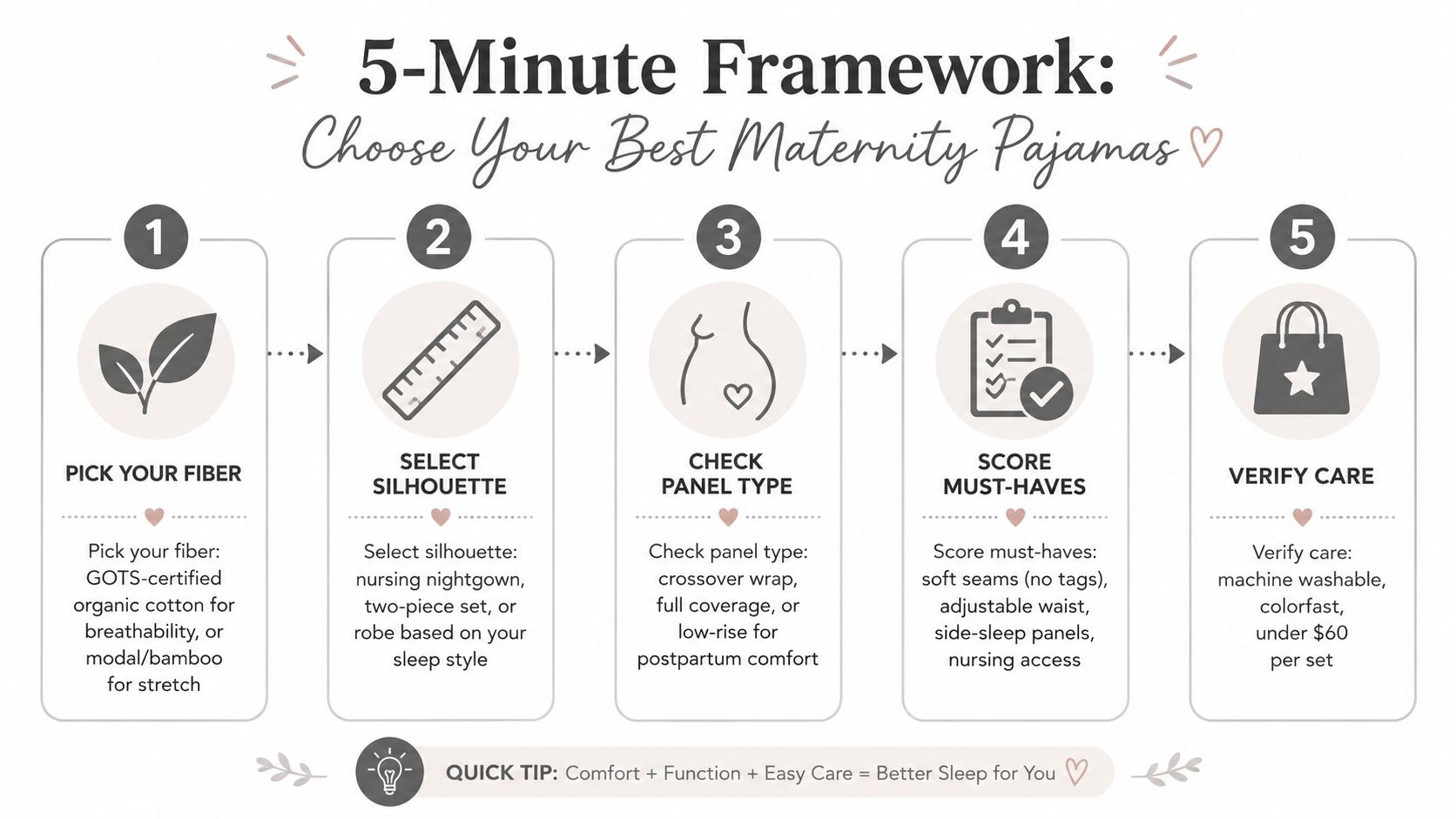
Use this five-point filter before buying:
-
Choose the fiber system. Breathable organic cotton makes a reliable year-round base. Cotton blended with bamboo helps manage moisture, while modal or lyocell provides softer drape. Choose lightweight waffle or jersey for warm weather, and brushed cotton or thermal fabric for cold rooms. Keep the warmer outer layer removable.
-
Require adjustability. A drawstring, crossover waist, stretch panel, or wrap construction should accommodate your abdomen without leaving the garment shapeless after birth. The best fit changes with you instead of becoming useful for only one stage.
-
Match the silhouette to your sleep habits. Two-piece sets let you adjust the top and bottom separately. Nightgowns reduce waistband pressure. Wrap tops provide flexible nursing access when the overlap stays secure. Choose the shape you will wear through late pregnancy and recovery.
-
Test the nursing design. Drop-down cups, wide button plackets, and pull-aside necklines can all work. Prioritize the opening you can operate with one hand while tired and holding a baby. Complicated fasteners quickly become a nuisance at night.
-
Pair the base with the right robe. A lightweight robe fits easily in a hospital bag and suits warmer rooms. A midweight robe adds coverage during recovery and pairs well with lighter pajamas. Before checkout, confirm the care instructions, return policy, certification documentation, and actual garment measurements.
Industry research describes maternity pyjamas as a specialized apparel market, with continued growth projected across regions, as reported by Business Research Insights. The practical takeaway is straightforward: construction, fabric behavior, and nursing access deserve more attention than color or short-lived trend appeal.
SEYANTE offers robes in 100% Turkish cotton terry and lightweight waffle weaves, with many styles described as GOTS-certified organic. Use those options as references when assembling a pregnancy-to-postpartum sleepwear system. Select the pajama base for fit, care, and nursing performance, then add a robe that provides flexible warmth across seasons and recovery stages.
Choose the set that still works when you are exhausted. It should breathe, stretch, stay in place, open quickly for feeding, and layer comfortably as your temperature changes. That is what makes maternity pajamas useful throughout the full journey, rather than only during the month you buy them.