Best Women's Turkish Bathrobe: How to Choose the Right One
- The Robe Moment That Reveals Everything
- What Makes Turkish Cotton a Standout Fabric
- Terry vs Waffle Weave Compared
- Understanding GSM and the Weight Sweet Spot
- Why Certifications Like GOTS Actually Matter
- Fit, Cut, and Construction Details Worth Verifying
- Matching the Robe to Your Real Routine
- Care Habits That Protect Absorbency and Softness
You've just stepped out of the shower. The bathroom is still fogged, your skin is damp, and you reach for the robe you bought because it looked luxurious online. Instead of absorbing the water, it smears it around. The sleeves fall over your hands, the belt slips loose, and the front gaps the moment you bend to pick something up.
That's the difference between a robe that looks appealing and the best women's Turkish bathrobe for your routine. Fabric origin matters, but so do weave, GSM, certification, fit, seams, pockets, and care requirements. Choose those criteria in the right order, and you can shop across brands without chasing a single product name.
| Decision criterion | Best choice for most shoppers | Why it matters |
|---|---|---|
| Cotton origin | Turkish cotton, preferably from the Aegean region | Long-staple fibers support softness, strength, and absorbency |
| Weave | Terry for post-shower drying, waffle for lighter wear | Construction controls water uptake, warmth, and drying behavior |
| GSM | About 400–550 GSM | Balances comfort, absorbency, and manageable drying |
| Certification | GOTS when organic sourcing and processing matter most | Covers organic fiber and processing standards across the supply chain |
| Fit | Shoulder-aligned seams, controlled sleeves, secure overlap | Prevents dragging, gaping, and restricted movement |
| Construction | Reinforced stress points and stable belt loops | Helps the robe handle repeated wearing and washing |
The Robe Moment That Reveals Everything
The first minute after a shower tells you more about a bathrobe than a product photo ever will. You wrap it around wet skin, reach for your moisturizer, and discover whether the fabric pulls away moisture or merely feels soft. A good robe starts working immediately. A weak one leaves you standing in dampness while its decorative texture does very little.
The first failure point is lingering dampness. Terry loops can flatten, loosen, or become coated with residue, reducing the surface that should catch water. A robe may still feel pleasant in the store, yet perform poorly after repeated washing if its loops and fibers aren't built to hold their structure.
The second is the cut. Skimpy armholes, narrow backs, and sleeves that hang past the knuckles turn a relaxed garment into an obstacle. You notice it while brushing your hair, making coffee, or reaching into a cupboard. The robe should give you coverage without making ordinary movement awkward.
The third is the closure. A belt that slides through weak loops or an overlap that barely reaches across the body will pop open at exactly the wrong moment. You shouldn't have to retie your robe every time you sit down.
Practical rule: Judge a robe by what it does with wet skin and moving arms, not by how plush it looks folded on a shelf.
The rest of the decision is technical but practical. Cotton origin helps explain the feel and durability. Weave determines whether the robe behaves like a towel or a light layer. GSM reveals how much fabric you're carrying. Certification clarifies what happened before the robe reached your bathroom, while fit and construction decide whether you'll reach for it every morning.
What Makes Turkish Cotton a Standout Fabric
Turkish cotton isn't a magic phrase that makes every robe premium. The meaningful questions are where the cotton was grown, whether the product identifies the fiber clearly, and how the manufacturer turned it into fabric.
Turkish cotton has a textile heritage reaching back more than 700 years, with sources placing its establishment in Turkey by the end of the thirteenth century during the Ottoman era. That history helped associate Turkish textiles with long-staple fibers, smoother yarns, and careful fabric construction. The heritage is useful context, but the fiber itself is what you feel.
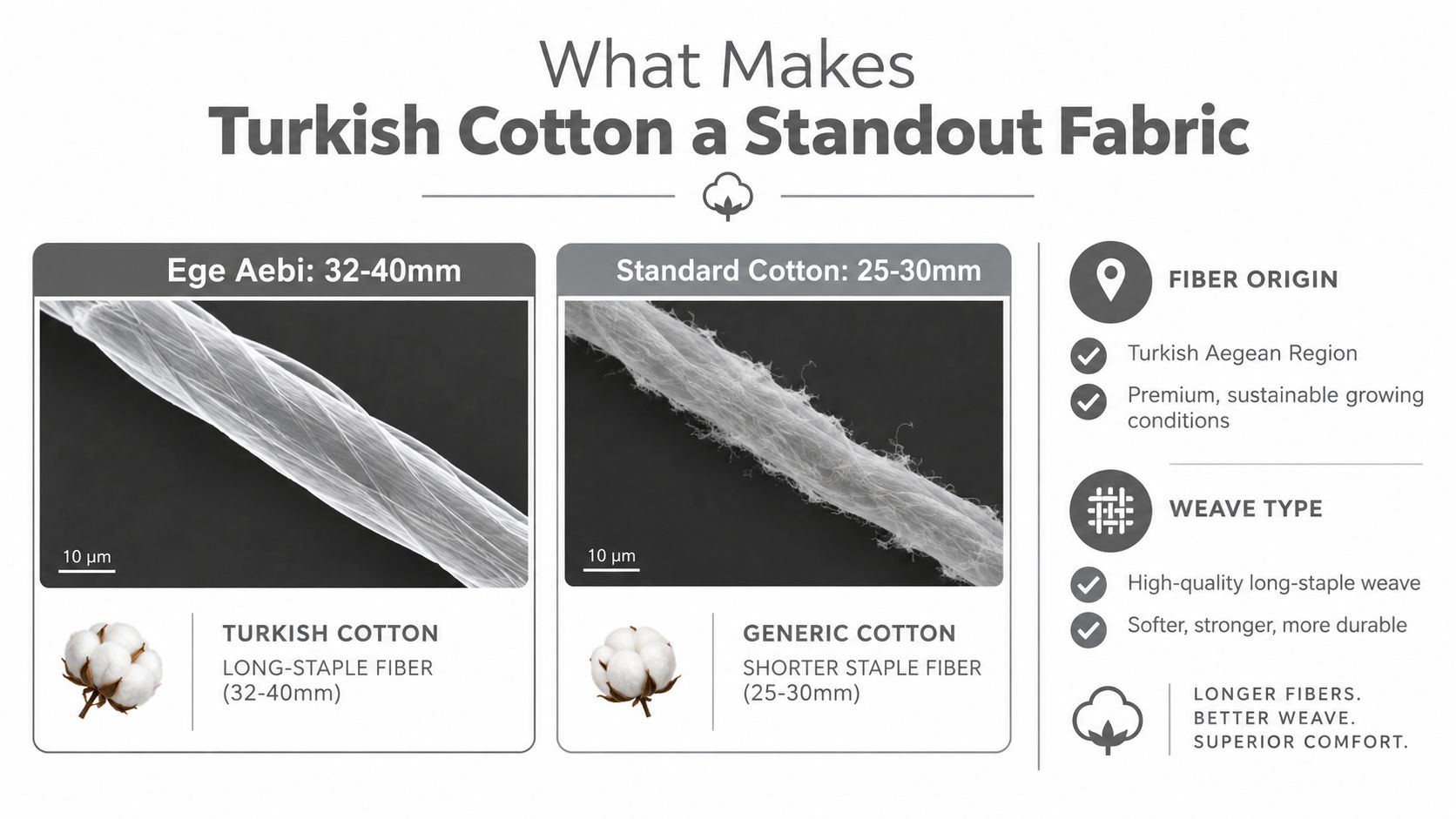
The Aegean region in western Turkey is widely recognized for producing some of the strongest Turkish cotton because its cotton has longer staple fibers than cotton from other growing areas. Those longer fibers are linked to softness, strength, and absorbency, the traits that make a robe feel more like a premium bath essential than ordinary loungewear. You can read a concise background on the fiber's origin and characteristics in this guide to what Turkish cotton is.
Read the label beyond the country name
Longer fibers can be spun into smoother, stronger yarns with fewer exposed fiber ends. In a terry robe, that supports loops that feel substantial without needing an unnecessarily bulky fabric. The result should be a surface that absorbs confidently, feels smooth against bare skin, and remains comfortable through regular laundering.
Don't assume Turkish cotton automatically beats every alternative. Egyptian and Pima cotton can also be long-staple options. Staple length, yarn quality, weave, and finishing matter more than a country label by itself. A product page that only says “cotton robe” gives you too little information, while one that identifies Turkish cotton, the weave, and the fabric weight gives you a useful basis for comparison.
Turkey also has a substantial cotton and apparel manufacturing base. In marketing year 2024/25, Turkey exported 311,967 metric tons of cotton, or about 1.43 million bales, and used 272,841 metric tons for textile purposes, according to U.S. Department of Agriculture reporting on Turkey's cotton sector. That industrial depth helps explain why Turkish cotton robes are widely available as spa-style and hotel-style products.
Terry vs Waffle Weave Compared
You leave a hot shower with wet skin, reach for the robe, and immediately notice the weave. Terry and waffle create two different robe experiences, so choose based on drying habits and post-bath use rather than marketing language.
Terry uses uncut loops that increase the surface area available to catch moisture. Choose it when you want to put on a robe before toweling completely dry. The loops absorb confidently and give the fabric a warmer, fuller feel. They also hold more water, which makes the robe heavier and slower to dry.
Waffle weave uses a raised grid with recessed cells. Those air spaces create a lighter hand and more ventilation. Waffle usually absorbs less than dense terry, but it feels easier to wear, dries faster, and suits loungewear after your skin has mostly dried.
| Attribute | Terry Weave | Waffle Weave |
|---|---|---|
| Absorbency | High, thanks to uncut loops and greater surface area | Moderate, with texture that supports lighter moisture handling |
| Dry time | Slower because the loops retain more water | Faster because the structure is lighter and more ventilated |
| Weight | Fuller and more substantial | Lighter and easier to layer |
| Warmth | Better for a cocooning post-shower feel | Better for warm rooms and warmer climates |
| Care demands | Needs thoughtful drying to avoid prolonged dampness | Usually easier to hang dry and rotate frequently |
| Best use | Directly after bathing, cooler bathrooms, spa-style comfort | Summer wear, travel, lounging, and quick turnaround |
Comparable fabric weights show the practical difference. A 350 GSM waffle robe can dry in about 18–22 minutes in a 140°F dryer, compared with 35–45 minutes for a terry robe at the same GSM, according to this waffle and terry robe materials comparison. Waffle cotton robes are also commonly specified around 220–320 GSM, keeping them light enough for faster hang-drying.
Use this rule when comparing robes across brands:
- Pick terry if you step out of a hot shower daily, want maximum water uptake, and prefer an enveloping feel.
- Pick waffle if you live in a warm climate, dislike heavy layers, need quicker drying, or want a robe that works as relaxed loungewear.
For a closer construction comparison, read this guide to waffle versus terry cloth robes. Skip terry if your bathroom stays humid and the robe must dry quickly between uses. Choose waffle when lighter weight and faster turnaround matter more than maximum absorbency.
Understanding GSM and the Weight Sweet Spot
GSM means grams per square meter, a measurement of fabric weight. On a robe product page, it gives you a far better starting point than words such as “luxury,” “hotel,” or “ultra-plush.” GSM doesn't tell you everything, but it helps predict how the robe will drape, how much moisture it can hold, and how demanding it will be to dry.
For most women, the practical sweet spot sits around 400–550 GSM, where comfort and absorbency remain high without making the robe excessively heavy. Around 450 GSM is often treated as a balanced premium point. At 550 GSM and above, the robe moves toward maximum plushness, but it also holds more moisture and can take longer to dry, according to this GSM guidance for Turkish cotton robes.
How the weight feels in real use
A lightweight robe feels easy to pull on, moves well around the house, and usually dries with less fuss. It may be exactly right for warm weather or for someone who wants a cover-up rather than a towel substitute. A mid-weight robe gives you more substance without making every movement feel padded.
A heavier robe delivers the classic spa sensation. The fabric drapes more generously, feels warmer around the shoulders, and absorbs more after bathing. It also demands more from your bathroom ventilation and drying routine. If the robe stays damp between uses, its plushness becomes a liability.
Use the product page this way:
- Choose lighter GSM if you overheat, live somewhere warm, hang dry, or mainly want a robe for lounging.
- Choose mid-range GSM if you want one robe to handle showers, makeup, breakfast, and general home wear.
- Choose heavier GSM if warmth and maximum plushness matter more than drying speed.
You can also learn how fabric weight works in this practical guide to GSM in towels and bath textiles. My direct recommendation is to start around 400–550 GSM for a first terry robe, then move lighter or heavier only when your routine gives you a clear reason.
Why Certifications Like GOTS Actually Matter
Certification is useful only when you understand what it verifies. A label isn't a substitute for checking the weave, GSM, fit, and construction, but it can answer questions that a product photo can't.
GOTS, the Global Organic Textile Standard, covers the supply chain from organic cotton cultivation through processing, dyeing, and finishing. It addresses environmental and social requirements across that chain, so the label communicates more than the presence of organic fiber. For a robe worn directly on bare skin after every shower, that broader scope can matter.
OEKO-TEX Standard 100 focuses on the finished textile and harmful substances. It doesn't require organic farming, so it serves as a product-safety check rather than proof of organic cultivation or full-chain sourcing. That makes it a reasonable alternative when the style, size, or weave you want isn't GOTS-certified.
Other labels can answer narrower questions. GRS relates to recycled content, while Fair Trade relates to labor and trading practices. Don't treat these certifications as interchangeable. Each one covers a different part of the product story.
What to check before checkout
Look for the certification name in the product description, specifications, or dedicated materials section. If a page says “organic” but doesn't identify a standard, ask what the claim covers. If it says “certified,” look for the actual certification rather than accepting an unexplained badge.
Prioritize GOTS when the robe sits on your skin frequently, you care about organic provenance, or you want processing standards included in the decision. Choose OEKO-TEX when finished-fabric testing is your priority and the rest of the garment fits your needs. A certification should narrow your choices, not distract you from a robe that fits badly or dries too slowly.
Fit, Cut, and Construction Details Worth Verifying
A superb fabric can't rescue a poor cut. The best women's Turkish bathrobe should let you walk, bend, reach, and sit without constant adjustments. Fit is also where women's robes often fail because a generous unisex cut can overwhelm a smaller frame, while a narrow fashion cut can sacrifice coverage.
Run this checklist before ordering
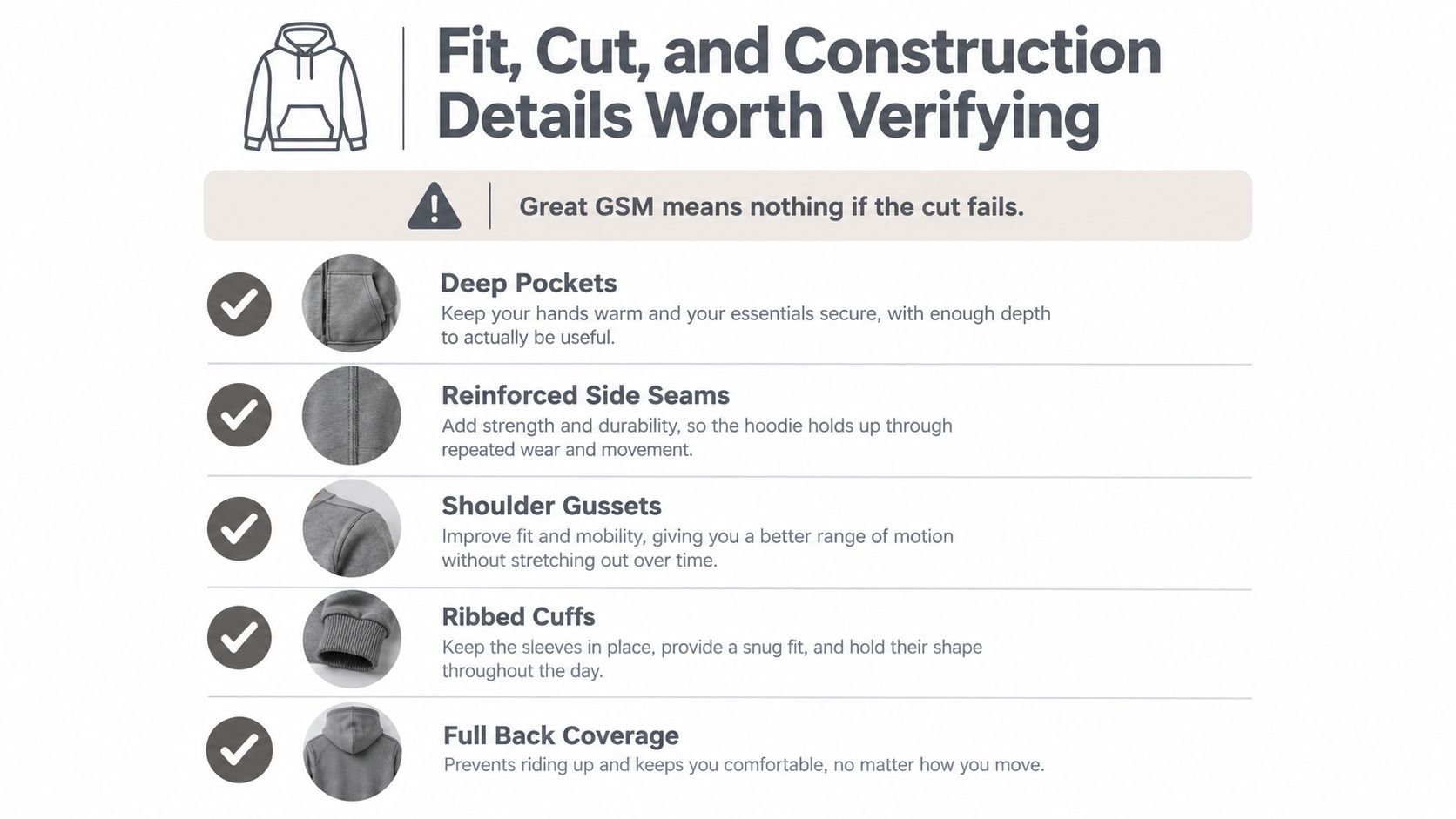
- Shoulder seams: They should land near the shoulder bone, not halfway down the upper arm.
- Sleeves: With your arms relaxed, the cuff should finish around the wrist. Extra length may look cozy online but becomes irritating at sinks and counters.
- Belt loops: They should keep the belt flat and positioned at your natural waist. Loose loops let the belt slide toward the hips.
- Stress seams: Look for double stitching or French seams around the armholes, side seams, and belt attachment points.
- Collar or hood: A shawl collar should frame the face rather than crowd the neck. A hood should sit securely without swallowing your head.
- Length: Mid-calf works well for everyday movement. Ankle length provides more coverage but can drag on petite frames.
- Pockets: Deep patch pockets are more useful than shallow openings that spill your phone when you sit.
Spot the construction red flags
Inspect product photos closely for loose terry loops, single-stitched side seams, a flimsy interior tie, and uneven hems. These details signal trouble because the robe experiences repeated pulling at the closure, shoulders, and side seams. A thick fabric with weak stitching can fail sooner than a lighter robe with disciplined construction.
Height changes the fit calculation. Tall shoppers should check sleeve length, back coverage, and whether the stated robe length reaches below the knee. Petite shoppers should be cautious with ankle-length cuts, dropped shoulders, and wide sleeves. If you're between sizes, prioritize a secure overlap and workable sleeves over a dramatically oversized silhouette.
Matching the Robe to Your Real Routine
The right robe depends less on the fantasy of a hotel bathroom and more on what happens after your shower. Start with the moment you use it most, then choose the construction that supports that habit.
The post-shower spa seeker
You want to step from the shower into softness and stay wrapped while your hair dries. Choose terry, with a weight toward the upper end of the practical range, or a heavier robe if your bathroom can dry it properly. GOTS-certified organic cotton is a strong priority if the robe will touch bare skin every day and organic provenance matters to you.
Choose a shawl collar for warmth around the neck, generous front overlap for coverage, deep pockets, and sleeves that finish cleanly at the wrist. A belt loop sewn securely into the side seam is more important than decorative trim. This profile should avoid skimpy lounge robes that look elegant but leave damp skin waiting for a towel.
The warm-climate user
Your priorities are different. You need breathability, quick turnaround, and freedom of movement more than maximum water absorption. Pick a waffle robe around 240–320 GSM, or another lightweight textured construction, and favor a kimono cut with shorter or controlled sleeves.
A lighter robe won't give you the same towel-like performance as dense terry, so pat your skin dry first if necessary. Look for a simple collar, stable belt, and pockets that don't add bulk. Certification still matters if you have skin sensitivities or prefer organic textiles, but don't let a certification persuade you to buy a robe that feels too warm for your climate.
The loungewear-leaning wearer
You want one robe for post-shower use, working at home, and slow weekend mornings. A mid-weight Turkish terry robe around 400 GSM is the safest single-robe choice. A terry-lined waffle design can also work if you want more drying ability inside and a lighter outer feel.
Prioritize a clean cut, moderate length, cuffs that stay out of your hands, and front pockets that hold small items securely. This profile benefits most from balance. A robe that's too heavy becomes a blanket, while one that's too light stops functioning as a bathrobe.
The best robe is the one that matches your drying routine, not the one with the most dramatic product description.
Care Habits That Protect Absorbency and Softness
Your washing routine determines whether the robe stays useful. Cotton terry needs enough care to preserve its loops, but it doesn't need complicated rituals.
Wash with cold or warm water rather than hot. Excess heat can stress cotton fibers and flatten the loops that hold moisture. Use a mild liquid detergent, preferably fragrance-free if you wear the robe against wet skin, and avoid overloading the machine so the fabric can rinse and move freely.
Skip fabric softener and dryer sheets. Their coating can sit on the loops and reduce absorbency over time, even while making the robe feel slick or artificially soft. A robe that feels soft but stops absorbing has been cosmetically treated rather than properly cared for.
Dry it completely without cooking the fabric
Tumble dry on low when the care label allows it. A short low-heat tumble can help re-fluff terry loops, while hang drying reduces heat exposure and keeps the robe moving toward full dryness. Heavy weaves benefit from being shaken out before drying so damp sections don't remain compressed.
For a bulky robe, add two clean tennis balls to the dryer to help separate clumps in the fabric. Don't use this method if the care label prohibits it, and remove the robe promptly when the cycle ends. Hanging a damp robe in a crowded bathroom can leave it stale, so use airflow and spread the garment open.
Prevent snags before they start
Separate the robe from zippers, hooks, and rough fasteners. Close nearby garments or wash the robe with smooth textiles. If you find a loose loop, don't pull it. Secure or trim it carefully according to the manufacturer's instructions so one snag doesn't become a long run.
A well-cared-for robe can remain a dependable part of daily use for years. A neglected one can become limp and less absorbent quickly, especially when softener buildup, hot washing, and incomplete drying combine. The buying criteria matter because good cotton and construction give your care routine something worthwhile to preserve.
SEYANTE offers women's Turkish cotton robes in terry and lightweight waffle constructions, including GOTS-certified organic options, hooded and kimono styles, and towel wraps for a lighter post-bath layer. Visit SEYANTE to compare the fabric, weight, fit, and certification details against your actual routine, then choose the robe you'll keep reaching for.