Cotton Fiber Length: What It Means for Your Robes
“Longer cotton is always better” sounds useful, but it's incomplete advice. A robe made with long fibers can still feel disappointing if the fibers vary widely in length, the yarn is poorly spun, or the weave and finishing don't suit the fabric's purpose.
Cotton fiber length matters because it affects how fibers hold together during spinning. Yet the finished experience, from softness against your skin to absorbency after a shower, comes from a chain of decisions. Fiber uniformity, strength, short-fiber content, yarn construction, weave type, and finishing all contribute. A plush terry robe and a lightweight waffle wrap may use excellent cotton while producing very different textures and drying behavior.
The useful question isn't “How long are the fibers?” It's, “How does the fiber length work with the rest of the textile?” Once you understand that distinction, product descriptions become easier to judge and claims about premium cotton become less confusing.
Why Longer Cotton Fibers Are Not the Whole Story
Longer fibers generally give spinners more material to overlap and bind into yarn. That can support smoother, stronger yarn with fewer exposed fiber ends. But fiber length describes potential, not a guarantee that the finished robe will be soft, dense, absorbent, or durable.
A robe's handfeel also depends on the yarn selected and the way the manufacturer builds the fabric. Terry cloth uses loops to create loft and surface area for moisture. Waffle fabric uses a textured grid and often feels lighter and more breathable. The same broad cotton category can therefore produce a thick spa robe, a structured hotel-style robe, or a lightweight wrap.
The quality chain matters
Think of cotton quality as a relay rather than a single contest. The plant supplies fibers with particular length and strength. Farmers and ginners must preserve those fibers. Spinners turn them into yarn, and manufacturers use that yarn in a chosen construction. Dyeing, washing, and finishing then influence the final surface.
If a batch contains a high share of short fibers, a favorable average length can hide weaknesses in the distribution. Short fibers create more loose ends in yarn, which can contribute to hairiness and irregularity. Uniformity and short-fiber content belong beside any long-staple claim.
Practical rule: Treat “long staple” as an encouraging starting point, not a complete performance specification.
Thread count can also distract shoppers from the raw material and construction. For a clearer explanation of why that number shouldn't dominate a robe decision, see this guide to why thread count matters when purchasing a robe.
What shoppers should really evaluate
A premium robe needs the right combination of traits for its intended use. A thick terry robe benefits from yarns that can support loops without excessive shedding. A waffle wrap needs enough structure to feel substantial while remaining easy to wear. Neither product becomes automatically superior because its cotton fibers are longer than those in every alternative.
Look for a product description that gives context about fiber type, fabric construction, certification, and care. If a brand names long-staple cotton but says nothing about the finished weave or manufacturing standards, you're seeing only one part of the story.
How Cotton Fiber Length Is Actually Measured
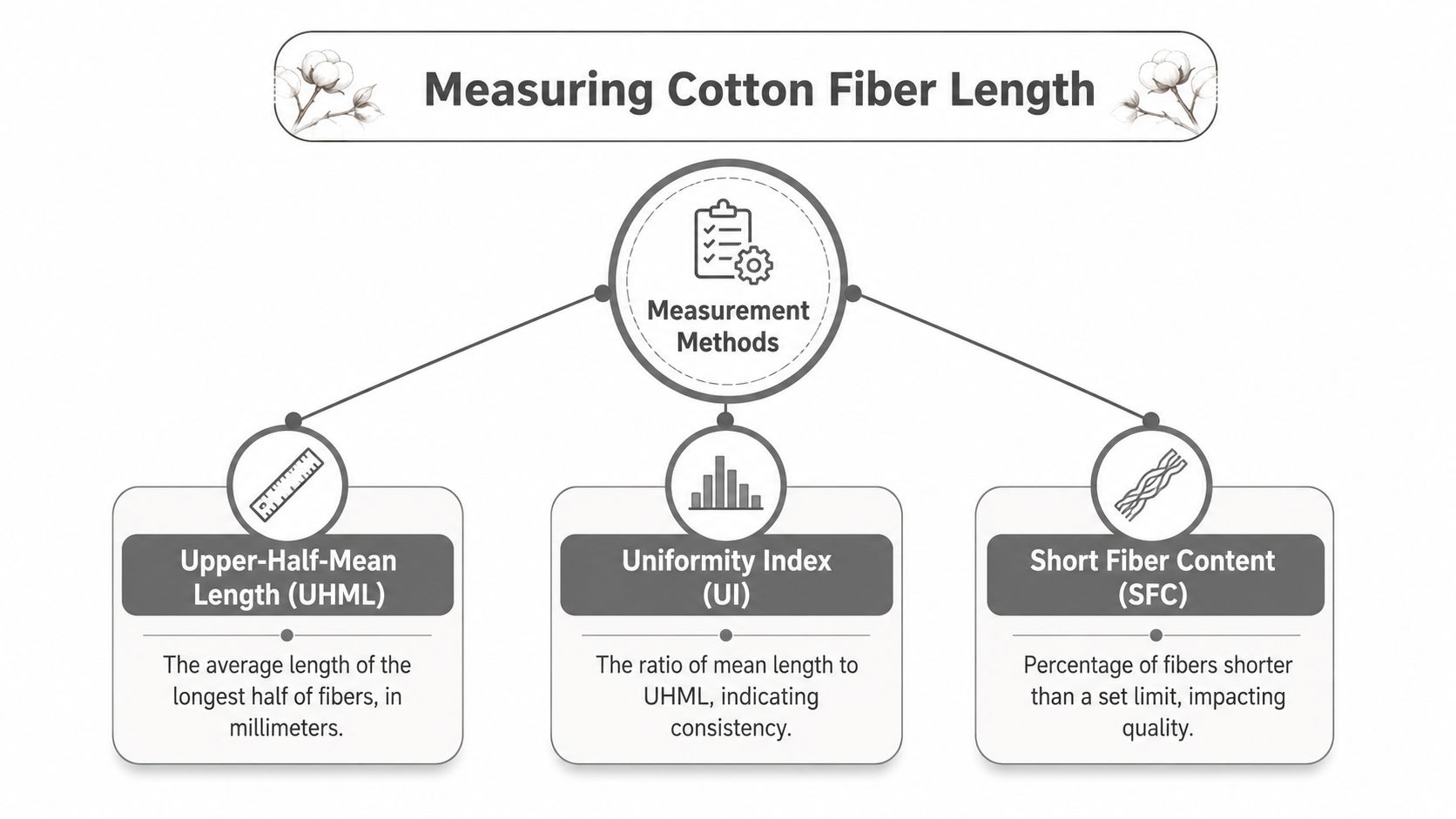
A cotton sample contains fibers of different lengths, so technicians need a consistent way to describe the group. The industry commonly uses upper-half-mean length, or UHML, which means the average length of the longer half of fibers in the sample. Major standards bodies and industry guides continue to use this approach because it's more stable and commercially useful than relying on individual fibers. Cotton Incorporated's cotton properties guide explains the measurement context and the ranges used in cotton classification.
A simple analogy helps. Suppose you're assessing a crowd's height. A basic average includes everyone, while UHML focuses on the taller half and averages that group. The result doesn't describe every person, but it gives mills a repeatable view of the fibers most useful for spinning a continuous yarn.
Three measurements answer different questions
UHML asks how long the stronger spinning population is. It's commonly reported in millimeters or hundredths of an inch. In classing language, staple length may also be converted into thirty-seconds of an inch, which can make product claims look unfamiliar to shoppers.
Uniformity asks how consistently the fibers cluster around the measured length. A lot with a respectable UHML can still behave unpredictably if the shorter fibers pull the distribution downward. Consistency helps a spinner anticipate yarn evenness and processing behavior.
Short-fiber content asks how many fibers fall below a defined length limit. Short fibers contribute more exposed ends and can increase the risk of uneven yarn. A long-staple label without supporting information about uniformity or short-fiber content leaves an important question unanswered.
Why one number can mislead
HVI systems report length using the upper-half mean approach, while more detailed systems can examine broader length distributions. This distinction matters because two cotton lots can have similar headline length values but different proportions of short fibers.
For buyers, the translation is straightforward. If a listing only says “long-staple cotton,” you know the material is being positioned around length, but you don't know the whole distribution. Ask whether the claim refers to UHML, a named cotton variety, or a marketing description. Also check whether the product supplies information about yarn quality or fabric construction.
Understanding Cotton Length Classifications
Cotton classifications provide a shared vocabulary for comparing fiber lots. The boundaries aren't merely decorative labels. They help mills estimate how the cotton may behave during spinning and how suitable it may be for finer, smoother yarns.
Long-staple cotton is commonly described around 28.2 to 32.0 millimeters, or 1.11 to 1.26 inches, while extra-long staple cotton sits above 32.0 millimeters, or above 1.26 inches. Cotton Incorporated's technical guide places U.S. upland raw cotton normally around 1.0 to 1.25 inches, while Pima cotton can reach 1.6 inches. It also identifies very short materials such as linters and comber noils as below 0.5 inches.
| Classification | Length Range (mm) | Length Range (inches) | Common Uses |
|---|---|---|---|
| Short staple | Below the long-staple range | Below about 1.11 inches | General cotton goods and materials where fine yarn isn't required |
| Medium staple | Commonly overlaps the central commercial range | Around the middle of common cotton lengths | Everyday apparel, home textiles, and blended constructions |
| Long staple | 28.2 to 32.0 mm | 1.11 to 1.26 inches | Smoother yarns, premium apparel, towels, and robes |
| Extra-long staple | Above 32.0 mm | Above 1.26 inches | Fine yarns and selected premium textiles |
The table is a guide, not a finished-product ranking. A long-staple classification tells you about fiber length, but the final robe still depends on spinning, loop or grid structure, fabric weight, and finishing.
Why classifications carry commercial weight
Longer fibers can improve spinning performance because they create better continuity within yarn. Mills can use this advantage when seeking even surfaces, reliable strength, or finer yarn constructions. That added processing potential is one reason higher-quality cotton can command a premium in trade.
U.S. federal staple standards were formalized in trade through 7 CFR § 28.303, effective July 12, 1985. The regulation uses graded categories in thirty-seconds of an inch, with official upper-quartile ranges for each class and lengths above one and one-quarter inches expressed in 0.041-inch increments. You can review the official federal staple-length standards for the classification framework.
How the ranges apply to robes
A robe buyer doesn't need to memorize every class. The practical distinction is that long and extra-long staple labels indicate a useful starting point for smooth, cohesive yarn. The claim becomes more meaningful when a seller also identifies the cotton type, explains the fabric construction, or provides credible testing information.
For a plush terry robe, the right length range must work with loop density and yarn strength. For a waffle robe, the yarn and weave must preserve a balanced texture rather than maximize softness. The best classification is the one that supports the intended textile design.
How Fiber Length Shapes Fabric Performance
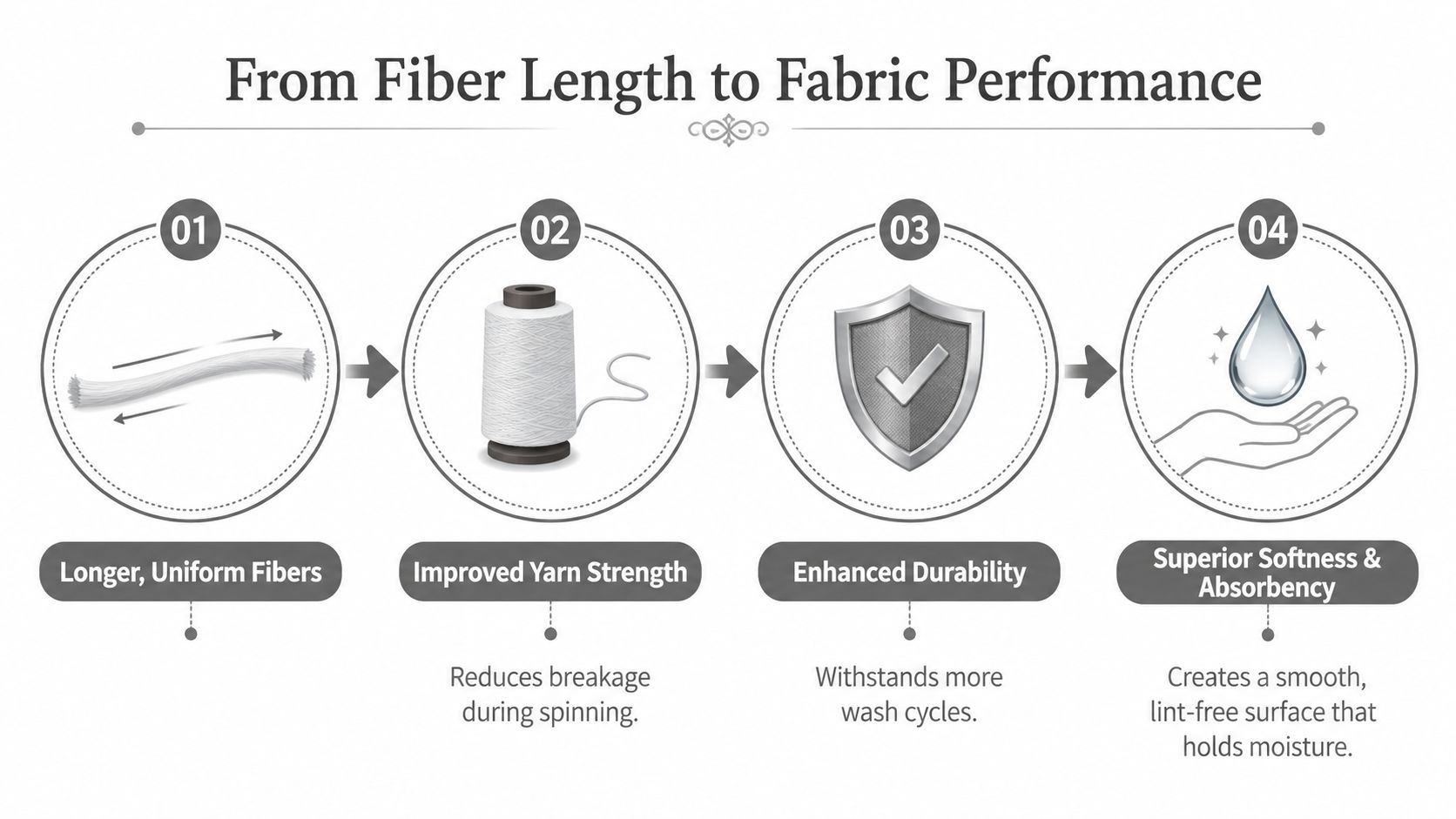
Fiber length affects fabric indirectly. The fiber first enters yarn, and the yarn then determines much of what you feel and see in the finished textile. Longer, more uniform fibers can reduce breakage during spinning and support a smoother yarn surface. That smoother surface can help a fabric feel cleaner against the skin.
Short fibers introduce more ends into the yarn structure. Those ends can protrude, create hairiness, and form weak points. A robe made with uneven yarn may feel fuzzy at first, then show more surface disturbance as repeated washing and friction loosen fibers.
Strength and durability begin in the yarn
Longer fibers offer more overlap inside a spun yarn. That overlap helps distribute tension across the yarn instead of concentrating stress at many short fiber ends. The result can be a more stable structure, which matters in areas that experience repeated pulling, rubbing, and laundering.
This doesn't mean every long-fiber robe will resist every form of wear. A dense terry construction may hold up differently from a light waffle structure. Stitching, finishing, laundering, and the amount of mechanical abrasion all influence the useful life of the robe.
Softness comes from more than fiber length
A clean yarn surface can feel smoother because fewer loose ends disturb the skin. That's one reason longer, more uniform fibers often support a soft handfeel. Yet manufacturers can also create softness through yarn selection, fabric finishing, washing treatments, and construction.
Absorbency depends heavily on the fabric's surface and internal spaces. Terry loops expose more cotton area and create room to hold water. Waffle structures use relief and channels that can feel breathable and dry more readily. Fiber length supports the yarn, while weave type shapes much of the user experience.
Still, a cotton name shouldn't replace questions about testing and construction.
Why short-fiber content deserves attention
A favorable UHML can coexist with a problematic share of short fibers. Those shorter fibers may increase hairiness and reduce consistency, even when the headline length sounds premium. That's why buyers should pair a long-staple statement with evidence of uniformity and low short-fiber content whenever the information is available.
The honest conclusion is narrower than “longer is better.” Longer, more uniform fibers can make it easier to produce strong, even yarn, but the weave and finishing decide how that yarn becomes a robe or towel.
Turkish Cotton and GOTS-Certified Choices
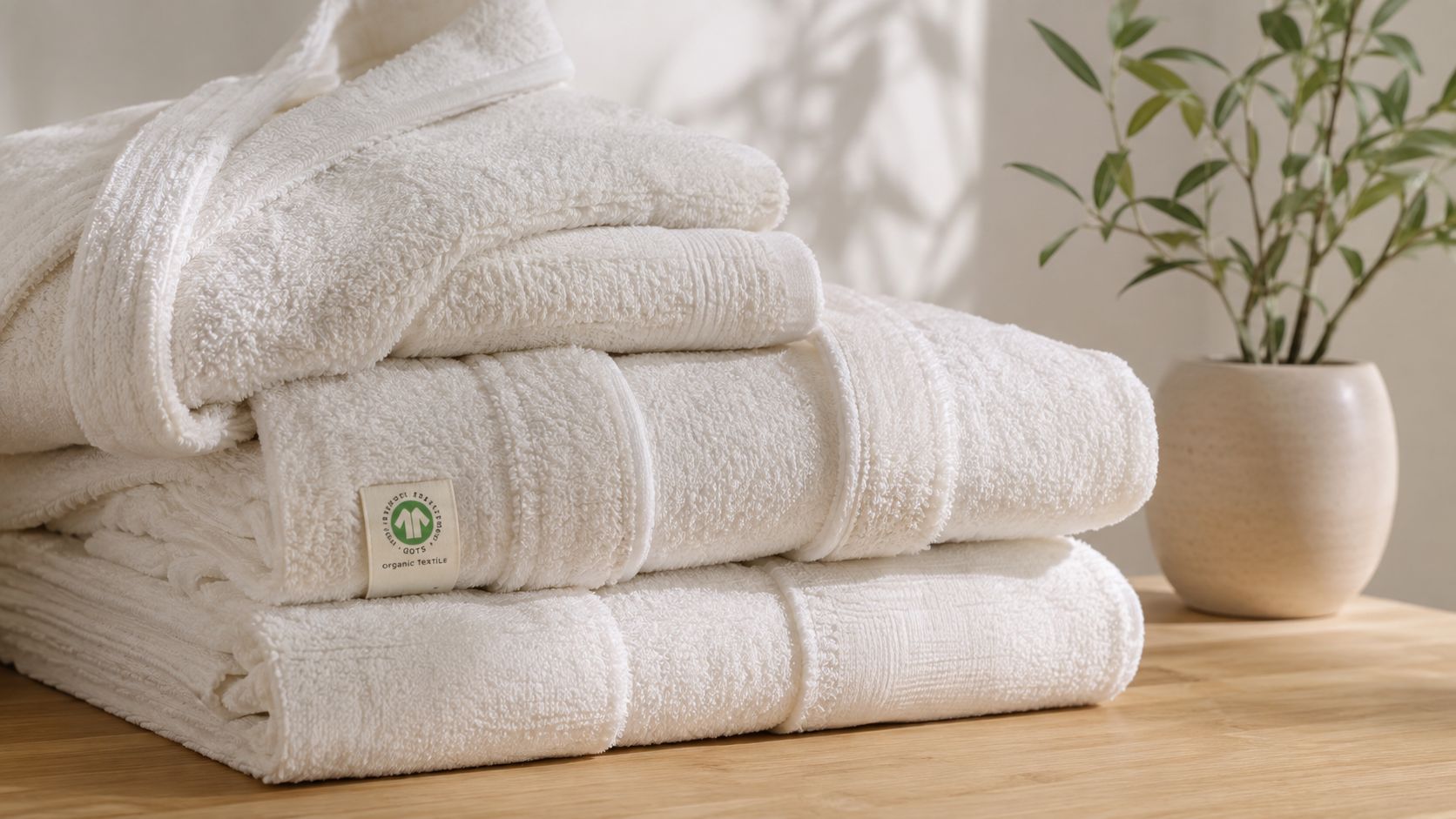
Turkish cotton appears frequently in premium bath textiles because buyers associate it with a comfortable balance of softness, strength, and absorbency. Those qualities don't come from a country label alone. They depend on the cotton variety, growing conditions, harvesting, ginning, spinning, and the final fabric construction.
Turkish cotton can be used in both plush terry and lighter woven structures. A terry robe may feel full and enveloping, while a waffle wrap may feel airy and textured. The distinction comes from design and manufacturing as much as from the raw fiber.
What certification can and can't tell you
GOTS certification adds supply-chain information beyond fiber length. For an organic textile, certification addresses controlled cultivation and processing requirements, helping buyers distinguish a documented production chain from an unsupported organic claim.
It doesn't automatically tell you that the cotton has the longest possible fibers or that a robe will have a particular weight. Certification and fiber length answer different questions. Certification speaks to how the textile is produced and controlled, while fiber testing speaks to the material's physical properties.
Ginning deserves special attention because post-harvest handling can damage fibers. Agronomic guidance identifies about 6 to 8% moisture as an ideal ginning benchmark, while lint moisture below 5% can reduce length by roughly 1/100 inch for each percentage point lower. These figures are documented in guidance on maximizing cotton fiber quality.
Comparing the buying signals
A conventional product may provide a cotton type and a fabric description without organic certification. An organic product may provide GOTS documentation but limited information about UHML or short-fiber content. A premium choice can offer both a credible certification and a clear explanation of the yarn or weave.
Shoppers interested in the regional background can also read about what makes Turkish cotton special. Use that context to understand the material, then evaluate the actual product details in front of you.
For a robe, ask whether the fabric is terry or waffle, whether the cotton is identified, and whether the certification applies to the finished product or the wider supply chain. Those answers will usually tell you more than a broad claim that the textile is “luxury.”
Practical Buying Signals and Care Tips
A product page rarely gives shoppers a full HVI or AFIS report. You can still make a more informed decision by separating specific material information from broad marketing language.
Start with the fiber claim, then look at the construction. “Long staple” is more useful when paired with a named cotton type, credible certification, or information about yarn and fabric. “100% cotton” confirms the fiber category but says nothing about length distribution, uniformity, or spinning quality.
Read the product description critically
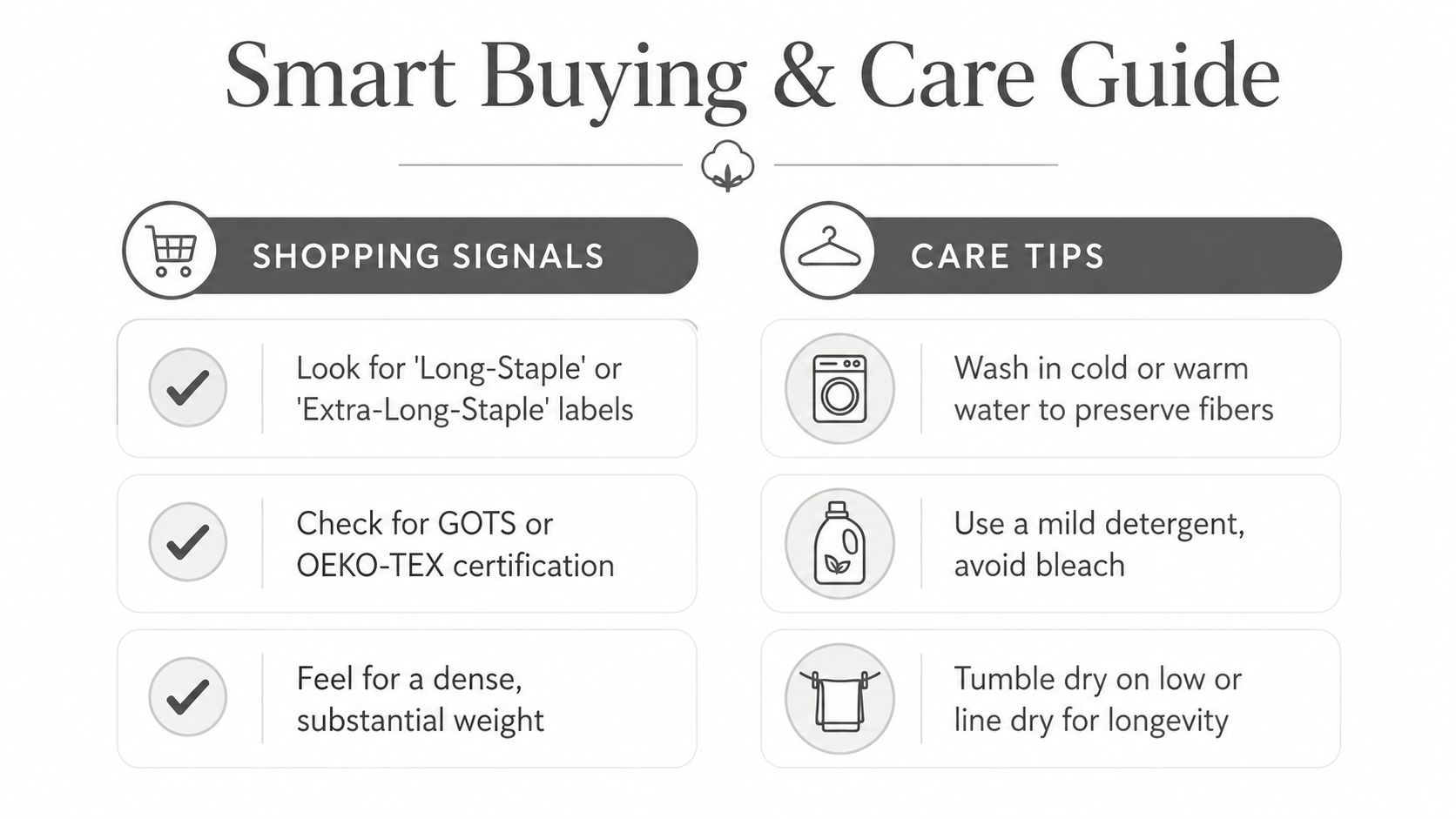
Use these signals while shopping:
- Look for paired claims: A long-staple statement accompanied by information about weave, yarn, certification, or testing is more informative than length alone.
- Identify the construction: Terry, waffle, and lightweight woven fabrics create different relationships between softness, loft, airflow, and absorbency.
- Check the certification language: GOTS can support an organic processing claim, but it doesn't replace details about the cotton's measured length.
- Assess the fabric description: Words such as dense, looped, textured, or lightweight describe construction. They don't prove fiber length, but they help you predict the robe's character.
- Ask a direct question: If the listing is unclear, ask whether “long staple” refers to a measured UHML result, a cotton variety, or a general merchandising term.
SEYANTE offers robes and related bath textiles in Turkish cotton terry and waffle constructions, including GOTS-certified organic options. That gives shoppers a concrete example of why fiber choice and weave should be considered together rather than treated as interchangeable quality signals.
Protect the yarn after purchase
Care won't change the original fiber length, but harsh laundering can damage yarn and loosen surface fibers. Follow the garment label first, then use gentle habits that reduce unnecessary stress.
Wash cotton robes in cold or warm water when the care instructions permit. Choose a mild detergent and avoid bleach unless the label specifically allows it. High heat and aggressive drying can make the fabric feel harsher over time, while low tumble drying or line drying is generally gentler.
Care principle: Preserve the yarn structure, not just the color. Gentle washing and controlled drying help the robe retain its intended surface and performance.
Avoid treating fabric softener as a substitute for good cotton. It may alter the surface feel while leaving residue that affects absorbency. For more detailed handling guidance, follow this robe washing, storage, and care guide.
Common Questions About Cotton Fiber Length
Does fiber length determine softness?
No. Longer fibers can support smoother yarn with fewer loose ends, but softness also depends on yarn construction, weave, finishing, and laundering. A long-staple waffle robe may feel lighter and more textured than a shorter-fiber terry robe with dense loops.
Will a longer fiber make a robe dry faster?
Not necessarily. Drying depends strongly on fabric thickness, loop height, weave openness, moisture content, airflow, and drying conditions. Fiber length influences the yarn's formation, but it doesn't determine how much water the finished robe holds.
How can I verify a length claim online?
Look for specific language. A useful description may identify UHML, a measured millimeter or inch range, a recognized cotton type, or information about uniformity and short-fiber content. If the page only says “premium long-staple cotton,” treat that as a broad claim and look for construction and certification details before drawing conclusions.
Does organic cotton mean longer cotton?
No. Organic certification concerns cultivation and processing requirements, not an automatic fiber-length category. Organic cotton can vary in length, just as conventional cotton can. Evaluate organic status separately from staple length and yarn quality.
Is thread count more important than fiber length?
Thread count doesn't replace fiber information. It describes a construction detail, while fiber length describes a raw-material property measured through technical systems. For a robe, fabric type, yarn quality, weight, loop or grid structure, and finishing may matter more to daily comfort than either headline number alone.
When do other cotton traits matter more?
They matter whenever the length claim is incomplete or the product has a specialized purpose. Strength, elongation, uniformity, short-fiber content, and the measurement method can change how useful a length number is. Recent research also shows that cotton samples with similar medium-range lengths can differ significantly in other quality traits, reinforcing the need to avoid a single-metric judgment. A 2025 study on cotton fiber quality reported cultivar lengths clustered between 27.03 and 31.65 millimeters, alongside meaningful variation in other properties.
Cotton fiber length is also an actively researched trait rather than a fixed fact. A 2025 systematic review of genetic and measurement advances describes gene-based work affecting length and newer approaches that examine distributions more closely than a single HVI value. For shoppers, the practical lesson is simple: use length as one strong clue, then judge the entire textile.
Choose a SEYANTE robe by looking at the cotton, construction, certification, and care requirements together, whether you prefer plush Turkish cotton terry or a lighter waffle weave. Visit SEYANTE to explore robes and bath textiles designed for everyday self-care, and use the product details to find the texture and performance that fit your routine.