Hotel Bath Robes: The Complete Buyer's and Hospitality Guide
A guest steps out of the shower, reaches for the robe on the bathroom hook, and makes a judgment before leaving the room. The fabric weight, collar shape, absorbency, and condition all communicate something about the property's standards. A robe that feels substantial and clean supports the sense of care guests expect. One with misshapen seams, thinning loops, or a stale smell undermines it quickly.
For procurement teams, hotel bath robes aren't decorative extras. They're high-wear textile assets exposed to frequent laundering, wet environments, guest handling, storage pressure, and brand expectations. The right purchase balances tactile comfort with drying time, construction quality, replacement timing, and the realities of your laundry operation.
Why Hotel Bath Robes Matter More Than You Think
The robe moment is brief, but it carries unusual visibility. Guests use it directly against damp skin, often in a quiet part of the room where small defects become obvious. A rough collar, loose belt loop, or robe that feels more like a thin cover-up than a bath textile can make the bathroom seem less considered.
Hotel bath robes also occupy a different operational category from ordinary bedding. Sheets are usually inspected, changed, and processed through a standardized room routine. Robes move between guestroom bathrooms, spas, pools, changing areas, and laundry carts. They may be left damp, dropped on the floor, stained with cosmetics or body products, or removed from circulation because the presentation no longer meets the property's standard.
A hospitality amenity with a long history
Luxury hotels in Europe and America began offering bathrobes to elite guests in the early 1900s, when robes signaled refinement rather than routine convenience. As hotels expanded spas, saunas, and pools during the 1950s and 1960s, terry cloth and waffle-weave cotton became more common because they combined comfort with absorbency.
That history still matters. A robe can communicate a property's positioning without adding another spoken sales message. A lightweight waffle robe suggests movement between treatments or warm-weather comfort. A dense terry robe feels more appropriate beside a deep soaking tub, heated pool, or spa suite.
The procurement decision behind the guest impression
The buying mistake I see most often is treating the robe as a low-priority line item. A low initial price can look sensible until housekeeping reports excessive shrinkage, laundry staff struggle with drying, and guests complain that the fabric feels worn after repeated use.
A better decision starts with the intended experience, then tests whether the construction can support it. Before approving a sample, ask:
- Where will it be used? Guestrooms, spas, pools, and treatment areas create different soil and turnover patterns.
- Who will process it? An on-premises laundry can control wash formulas and drying. An outsourced service may impose stricter limits.
- What does the room promise? A boutique suite and an efficient business room don't need the same robe weight or collar.
- Can the property support the par? A robe that dries slowly may require more inventory in circulation.
For teams building a more complete retreat at home or refining a property's bathroom presentation, guests who want to recreate that feeling can also learn from this guide to bringing home the luxurious hotel bathrobe experience.
What Makes a Robe Hotel-Grade
A hotel-grade robe is designed for repeated commercial laundering, not just an appealing first impression on a retail hanger. The strongest specifications address absorbency, dimensional stability, seam strength, color fastness, and drying behavior at the same time.
GSM is a starting point, not a quality guarantee
GSM, or grams per square meter, indicates fabric mass. For cotton terry hotel bath robes, the most useful hospitality range is generally 400 to 550 GSM, because it balances absorbency, thermal comfort, and durability. Hospitality guidance places 400 to 500 GSM near the practical sweet spot for high-end use, while 500 to 550 GSM offers a fuller hand feel without pushing drying demands as far as very heavy constructions would.
A higher GSM robe generally holds more water and feels more luxurious, but the added mass also slows drying and can increase laundry energy demand. A lower GSM construction may turn rooms faster, especially in warm climates or constrained laundries, but it can feel less substantial and may show wear sooner if the yarn and sewing are weak.
| Specification | Budget, 3-Star | Mid-Range, 4-Star | Luxury, 5-Star |
|---|---|---|---|
| Typical fabric direction | Ring-spun cotton or practical blend | Cotton-rich terry or waffle weave | Premium terry, terry-velour, or carefully selected specialty construction |
| Weight priority | Light to moderate for manageable processing | Balanced comfort and drying | Plush hand feel with capacity for longer drying |
| Construction focus | Secure seams and durable belt loops | Reinforced stress points and stable sizing | Dense, consistent pile, strong collar, and refined finishing |
| Guest impression | Clean, functional, comfortable | Soft, dependable, distinctly hotel-grade | Substantial, spa-oriented, highly tactile |
| Procurement test | Does it survive routine use without obvious distortion? | Does it retain structure and absorbency through repeated laundering? | Does the luxury feel justify the processing and replacement plan? |
Construction determines what survives the laundry
Terry and terry-velour robes are commonly selected for frequent commercial washing, with hospitality textile guidance describing mid- to upscale constructions as suitable for 150 to 200 or more wash cycles.
Look closely at the sample rather than relying on the fabric label:
- Ring-spun, combed cotton usually offers a smoother and more consistent yarn surface than poorly prepared fibers.
- Reinforced shoulder seams reduce splitting where the robe's weight hangs from the garment.
- Double-stitched belt loops matter because guests pull against them repeatedly when tying the robe.
- Bar-tacked stress points help secure pockets, loops, and other high-tension areas.
- Dimensional stability protects fit, sleeve length, and overall presentation after laundering.
- Consistent pile formation supports absorbency and prevents visibly thin zones.
Certification can support a sustainability or chemical-management program, but it shouldn't replace performance testing. Ask suppliers for laundering instructions, shrinkage expectations, color-fastness information, and sample results from the actual wash formula your operation uses. A robe that feels excellent before processing but loses shape after commercial drying isn't hotel-grade in practical terms.
Choosing the Right Material and Weave
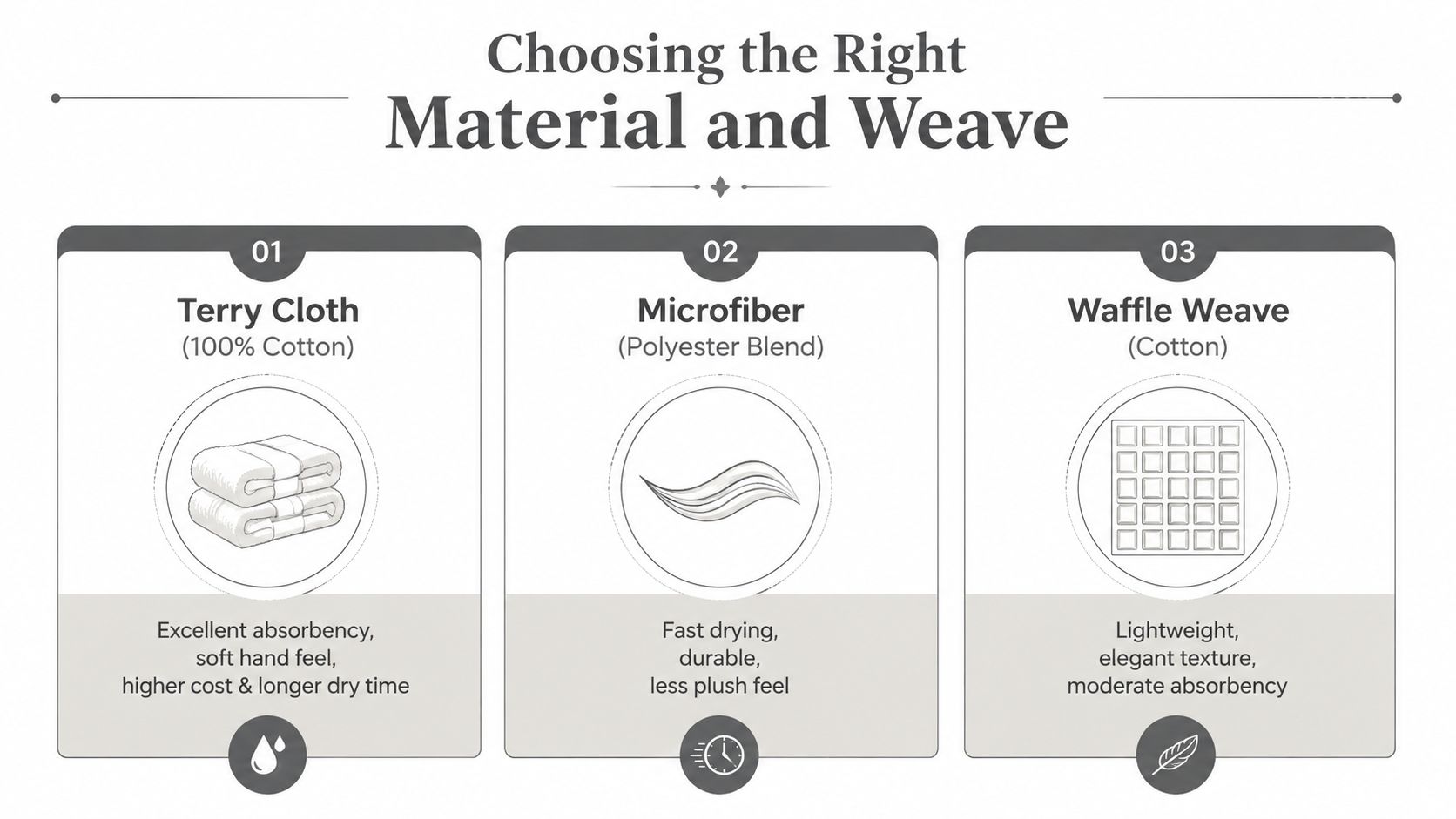
Material selection is a decision about workflow as much as comfort. Terry loop, terry-velour, waffle weave, and microfiber blends each create a different balance between water absorption, wet weight, drying time, appearance, and durability.
Terry remains the practical post-shower choice
Standard terry loop is the safest choice when guests are expected to put on the robe while still damp. The loops create a towel-like surface with strong absorbency and a familiar hotel feel. The trade-off is bulk. Terry retains more water, becomes heavier in the laundry stream, and generally takes more drying attention than a lighter weave.
Terry-velour adds a sheared, smoother face while retaining a looped or absorbent interior. It can feel more refined against the skin and present well in premium rooms, but the sheared face requires careful testing for pile consistency and appearance after repeated processing.
Waffle weave prioritizes lightness and turnaround
Waffle cotton robes suit spas, warm climates, treatment rooms, and properties where guests value breathable coverage more than towel-level absorbency. The textured grid gives the garment an elegant visual identity and usually reduces bulk, which supports easier storage and faster processing than dense terry.
That advantage comes with a clear limitation. Waffle weave is not the right answer when the robe must dry a guest after a shower or pool visit. It works best as a lightweight layer, not as a substitute for a towel.
Blends can win in a demanding laundry
Cotton-polyester blends may offer better shape retention, wrinkle resistance, and drying behavior than 100% cotton. They can feel less plush, however, and guests who associate luxury with natural-fiber softness may notice the difference immediately.
Microfiber blends are useful where quick drying and structural consistency matter more than a thick terry hand. They're worth sampling for extended-stay, business, and high-throughput operations, but the supplier should demonstrate that the surface still feels comfortable against damp skin.
Laundry rule: Don't approve a robe based on dry hand feel alone. Weigh the sample dry and after extraction, then record drying time under your actual equipment and load conditions.
The familiar softness of Turkish cotton can help buyers understand why fiber length, yarn preparation, and weave matter beyond the label. This resource on what makes Turkish cotton so special provides helpful background for that evaluation.
For on-premises laundries, test extraction, dryer capacity, folding speed, and storage volume before committing to heavy terry. For commercial linen services, confirm accepted weights, wash temperatures, finishing methods, and any surcharge or handling constraints. A robe that performs beautifully in a small test load can become an expensive bottleneck when processed with the property's full textile program.
How to Select Robes for Your Property Type
Start with the guest use case, then work backward through laundry capacity and replacement planning. The right robe for a boutique inn isn't automatically right for a resort spa, even when both properties describe their rooms as upscale.
Match the robe to the operating reality
A boutique property with limited drying capacity generally benefits from a moderate-weight terry robe that feels comfortable without holding excessive water. A spa may justify a more substantial construction because warmth, coverage, and absorbency are part of the treatment experience. An extended-stay property usually gains more from easy care and shape retention than from maximum plushness.
Use this decision sequence:
- Define the wet-use requirement. If guests wear the robe immediately after bathing, prioritize absorbency. If they wear it between rooms and treatments, prioritize lightness and mobility.
- Measure laundry constraints. Identify whether washing, extraction, drying, folding, or storage creates the bottleneck.
- Set the visual standard. Decide how much collar structure, pile fullness, whiteness, and color consistency housekeeping must maintain.
- Pilot before rollout. Process samples through the intended laundering routine and inspect seams, belt loops, collar edges, shrinkage, and hand feel.
- Separate programs when necessary. Guestroom robes, spa robes, and pool robes may need different materials and controls.
| Property Type | Recommended GSM | Best Materials | Key Features | Typical Lifespan |
|---|---|---|---|---|
| Boutique hotel | Moderate weight suited to the laundry capacity | Cotton terry or lighter waffle | Soft hand feel, manageable drying, refined collar | Set by inspection and wash-cycle performance |
| Luxury resort or spa | Higher weight where drying capacity supports it | Dense terry or terry-velour | Shawl collar, plush surface, strong absorbency, reinforced seams | Shorter replacement interval may be appropriate for intensive use |
| Extended-stay hotel | Light to moderate | Waffle weave or cotton-polyester blend | Wrinkle resistance, quick handling, stable shape | Extended through consistent rotation and inspection |
| Business hotel | Light to moderate | Practical terry or blend | Fast turnover, easy folding, dependable sizing | Driven by room-turn pressure and laundry throughput |
| Budget property | Light to moderate | Ring-spun cotton or durable blend | Reinforced stress points, clean presentation, simple styling | Managed through condition standards and controlled replacement |
Climate changes the calculation. A naturally dry environment may support heavier robes if the dryer room remains the limiting factor, while humid conditions can make rapid drying and ventilated storage more important. Guest turnover also affects circulation because robes must cover rooms, laundry, reserve stock, and items held for inspection.
The Economics of Robe Replacement and Laundering
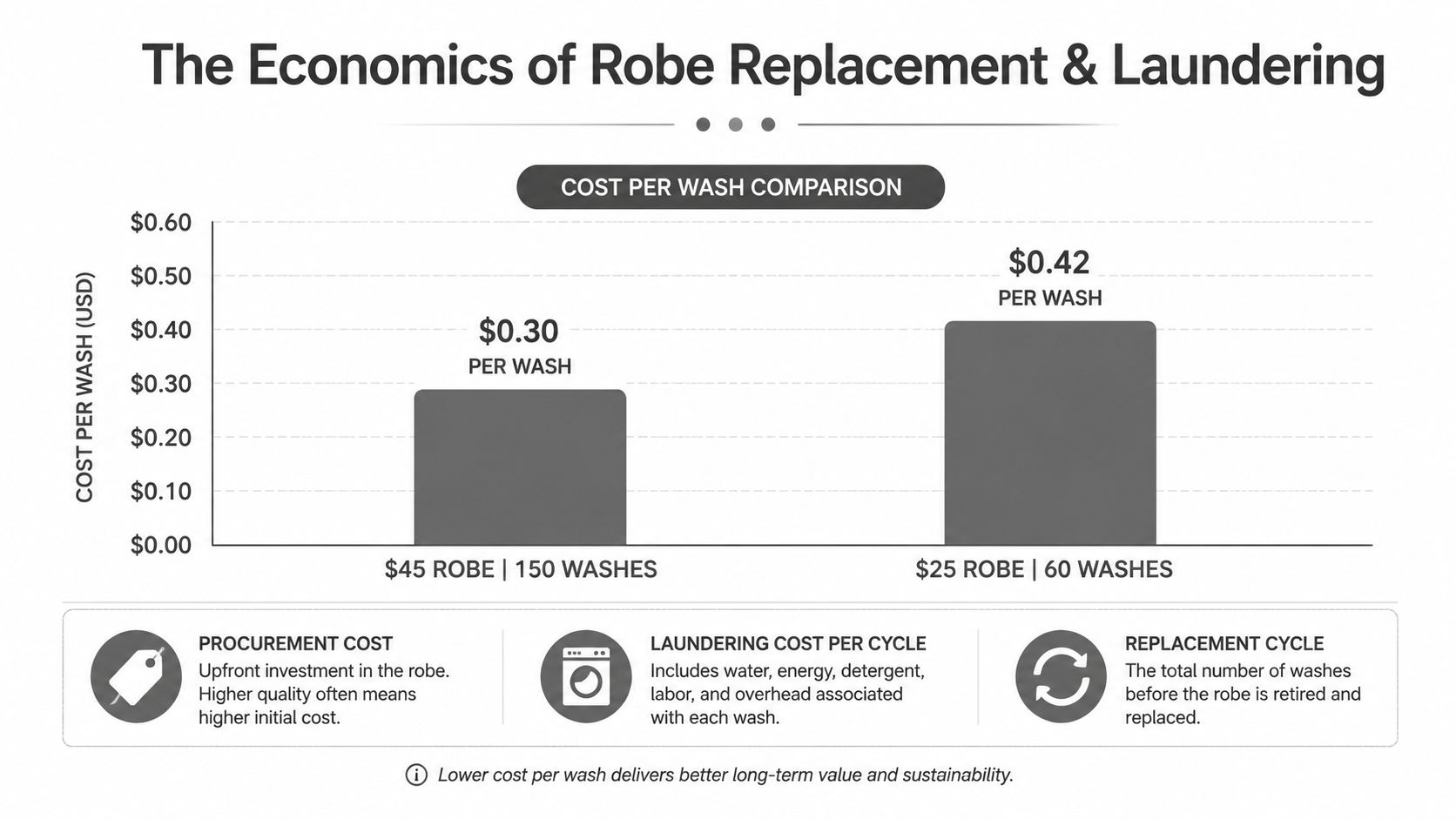
The purchase price tells only part of the story. A robe's real cost includes how many useful wash cycles it delivers, how much labor and energy it requires, how often staff remove it from service, and whether its appearance remains acceptable to guests.
Industry guidance for 2026 says most hotels replace bathrobes every 12 to 24 months, depending on occupancy, fabric quality, and service level. At a property operating at 80% annual occupancy with an average stay of 2 nights, each robe may be laundered approximately 140 to 150 times per year. Hotel bathrobe replacement guidance for 2026 also places luxury five-star replacement around 10 to 14 months, while boutique or low-occupancy properties may extend replacement to 24 to 30 months.
Calculate usable life before comparing unit price
A simple cost-per-use calculation makes procurement conversations more honest. The supplied comparison shows a $45 robe lasting 150 washes at $0.30 per wash, while a $25 robe lasting 60 washes costs $0.42 per wash. Those figures isolate purchase cost, not laundering, labor, loss, or storage, but they demonstrate why the cheapest unit isn't always the least expensive asset.
The next step is to add your operation's actual processing cost. Track:
- Water and energy: Heavier robes hold more moisture and demand more drying work.
- Detergent: Soil profile and wash chemistry affect consumption.
- Labor: Sorting, inspection, folding, repair, and room placement all count.
- Downtime: A robe held for stain treatment or repair isn't available inventory.
- Replacement: Retire based on condition, not a calendar alone.
Treat inventory as a circulation system
A property needs enough robes in rooms, in laundry, in storage, and in inspection. Instead of choosing a universal par level, map your actual turnaround time and peak demand. A tight operation may need more reserve stock than its average occupancy suggests, particularly if drying capacity is limited or spa and pool programs share the same inventory.
Sustainability sits inside this calculation. Longer-lasting robes reduce disposal and replacement pressure, but heavier constructions can require more laundering resources. Lighter robes may process efficiently while reaching a condition threshold sooner. The sound choice is the one that performs well across its complete service life, not the one with the lowest weight or the longest claimed lifespan in isolation.
Care and Maintenance Best Practices
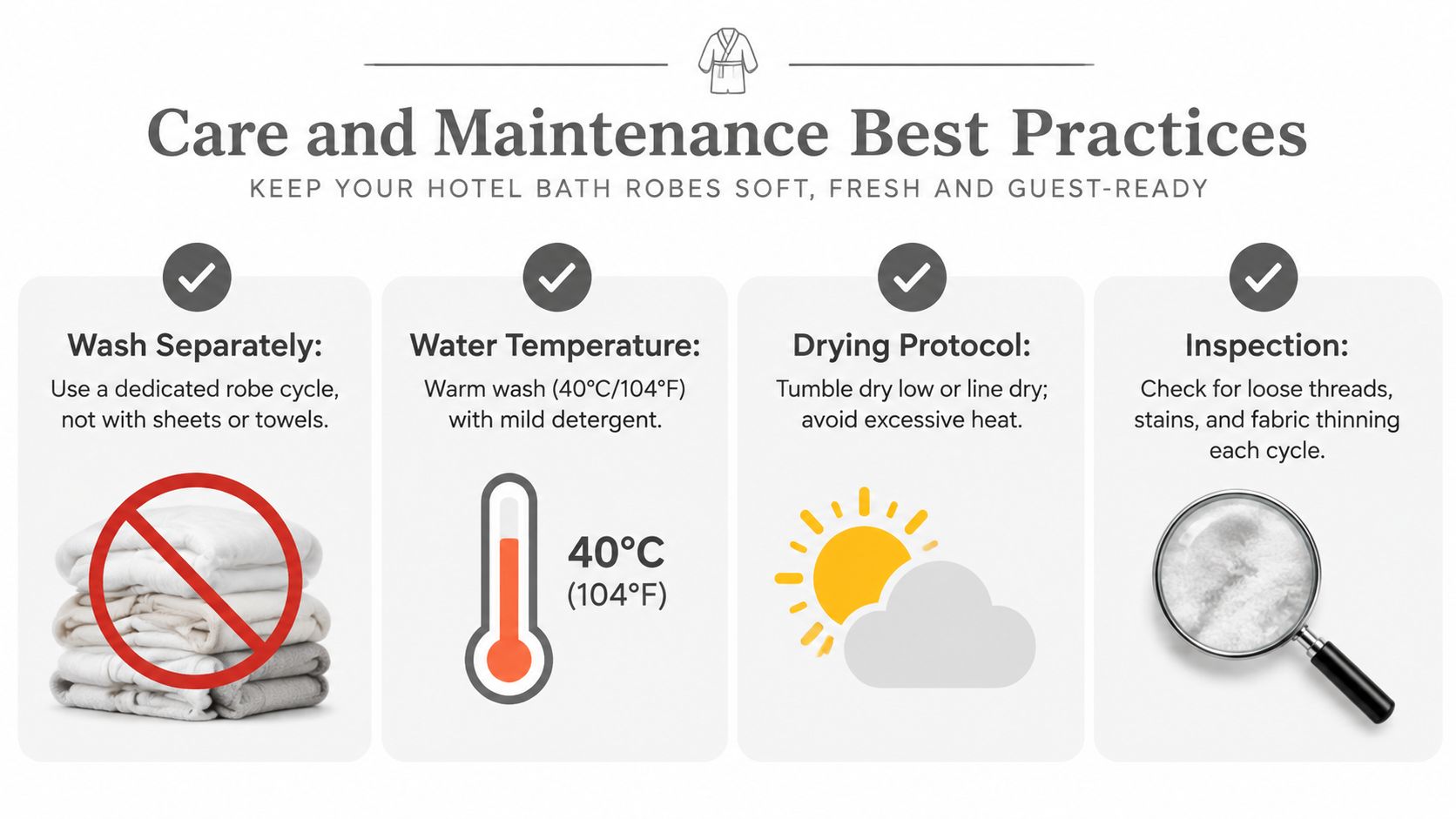
Care protocols should protect both hygiene and textile structure. The exact wash formula must match the fiber, dye, equipment, and supplier instructions, but housekeeping teams can still standardize the habits that prevent avoidable damage.
Control what enters the wash
Wash robes in a dedicated stream where possible. Processing them separately from sheets and towels helps reduce lint transfer and unnecessary abrasion, especially when the robes have a different pile, color, or finishing treatment.
Use the manufacturer's recommended temperature rather than assuming hotter is always cleaner. For colored robes, cooler processing helps protect shade consistency. For white cotton, the laundry manager should validate the balance between cleaning, sanitization requirements, and fiber preservation.
Avoid fabric softener on terry robes. It can coat the fibers and reduce absorbency over time. For white cotton, an oxygen-based whitening system is generally preferable to repeated chlorine exposure, which can weaken cotton and contribute to yellowing.
Dry with discipline
Over-drying is a common source of premature wear. Excessive heat can leave cotton fibers brittle, flatten the pile, and make seams more vulnerable. Use the lowest practical setting that produces a fully dry robe, remove garments promptly, and keep clean stock in a dry, ventilated area.
Housekeeping should also rotate inventory rather than repeatedly sending the same small group of robes through the laundry. Consistent folding protects presentation, while rotation distributes wear across the entire program.
Inspect before defects become guest complaints
Check belt loops, pocket seams, collar edges, loose threads, stains, thinning fabric, and distorted sizing. Record recurring failures by style and supplier so future orders address the actual weak point instead of repeating the same specification.
A practical robe-care reference for home or hospitality routines is this guide on how to wash, store, and care for your robe. Adapt the instructions to your commercial wash process and documented hygiene policy.
Making the Investment Case for Premium Robes
Ownership teams often compare robes by unit price because the purchase order shows a clear number. The operational case requires a wider view. A robe is used, washed, inspected, stored, repaired, and eventually retired. Every weakness in its construction creates work somewhere else in that chain.
Premium doesn't mean choosing the heaviest or most expensive robe automatically. It means selecting a construction that delivers the required guest feel while surviving the property's laundering conditions. The strongest business case combines cost per useful wash, replacement frequency, processing demand, condition-based retirement, and brand positioning.
| Cost Factor | Budget Robes, $25 per unit | Premium Hotel-Grade, $65 per unit |
|---|---|---|
| Initial purchase | Lower capital outlay | Higher capital outlay |
| Useful service life | Must be verified through a wash test | Must be verified through a wash test |
| Laundering impact | May be lighter, but construction can determine actual efficiency | May require more drying if heavier |
| Inspection and repair | Potentially higher if stress points fail early | Potentially lower when seams and loops are reinforced |
| Guest presentation | Functional if condition remains consistent | Can support a more elevated room experience |
| Replacement planning | More frequent if appearance declines quickly | More predictable when durability is documented |
| Decision metric | Lowest acceptable total cost | Lowest justified cost per useful service life |
Build the case with your own operating records
Run a controlled sample test. Process both shortlisted robes through the same laundry routine, then record shrinkage, drying behavior, absorbency, seam condition, collar shape, and the number of units rejected during inspection. Convert the result into a cost-per-use estimate using your actual purchase price and observed service life.
Then add the guest-facing evidence. Track bathroom-amenity comments in reviews, internal complaints about robe condition, replacement requests, and housekeeping time spent removing damaged units. Don't claim a robe alone caused a booking or rating change. Use those records to show management where textile condition affects the broader experience.
A property may still choose a lower-cost robe for a high-turnover room category and reserve a heavier construction for suites or spa areas. That's often more defensible than applying one robe across every outlet. The objective is a consistent standard, supported by evidence, with each textile assigned to the environment where it performs best.
For properties and shoppers evaluating Turkish cotton terry, lightweight waffle, and hospitality-oriented robe options, SEYANTE offers those categories alongside styles for different uses. Visit SEYANTE to review the collection and match robe construction to your guest experience, laundering capacity, and service standards.