Lightweight Terry Cloth Robes: A Complete Buying Guide
You've just stepped out of a summer shower. Your hair is damp, the air conditioner is humming, and you want something more useful than a towel that keeps slipping. Then you put on a thick robe and discover that it feels less like comfort and more like a warm, damp blanket.
That moment captures the appeal of lightweight terry cloth robes. They're designed to give you the moisture management of terry without making every post-shower routine feel bulky. The right one can help you move from the bathroom to the kitchen, patio, or bedroom without overheating, dragging at your shoulders, or waiting all day for the robe to dry.
The key is looking beyond words such as “spa-quality” or “lightweight.” GSM, loop height, loop density, fiber quality, cut, and care all influence how a robe feels in actual use. Once you know what those details mean, you can judge a robe by its construction rather than its marketing description.
Why a Lighter Robe Changes Your Whole Routine
A robe's weight affects more than how heavy it feels on a hanger. It changes how quickly the fabric takes on moisture, how much warmth it holds against your body, and whether you'll still want to wear it ten minutes after your shower.
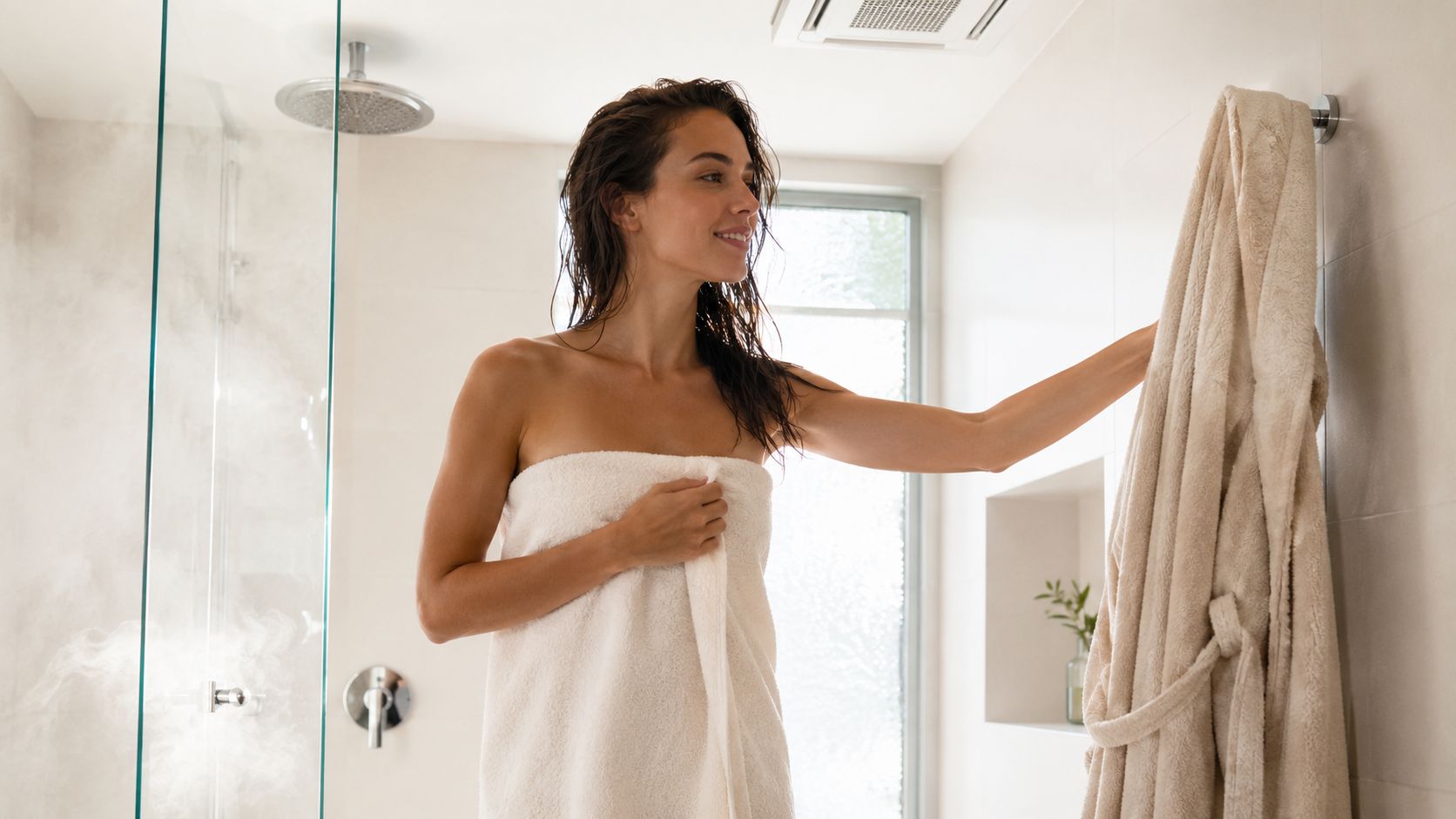
A heavy bath robe can feel wonderful for the first few seconds. Its substantial pile absorbs water and creates a wrapped-up feeling, especially in a cool bathroom. But if you're getting ready for work, making breakfast, or walking outside to collect the mail, that same bulk can become distracting. The fabric may hold moisture longer, and the added warmth can leave your neck, back, and arms feeling clammy.
A lighter terry robe changes the rhythm. It gives damp skin a soft layer to lean against without surrounding you in excessive insulation. You can wear it while your hair dries, apply skincare, or sit with coffee without feeling as though you're carrying a towel around your body.
Comfort after the shower
Terry cloth works because its raised loops expose more cotton surface to water. That structure supports absorbency, but the amount of fabric used still matters. Lower-GSM constructions reduce mass and bulk, while the shape and tightness of the loops determine how much moisture the robe can hold and how easily air can move through it.
Practical rule: If you tend to wear your robe for more than a few minutes after bathing, prioritize balance over maximum plushness.
The best lightweight terry cloth robes don't try to imitate a thick hotel robe. They serve a different routine. They're especially useful in warm rooms, humid climates, compact bathrooms, and homes where the robe needs to dry between regular uses.
That doesn't mean lighter always means better. A robe can be thin because it uses a sensible, airy construction, or because the fabric is sparse and poorly finished. The sections ahead separate those possibilities by connecting the feel in your hand to measurable construction details.
What Makes a Terry Robe Lightweight
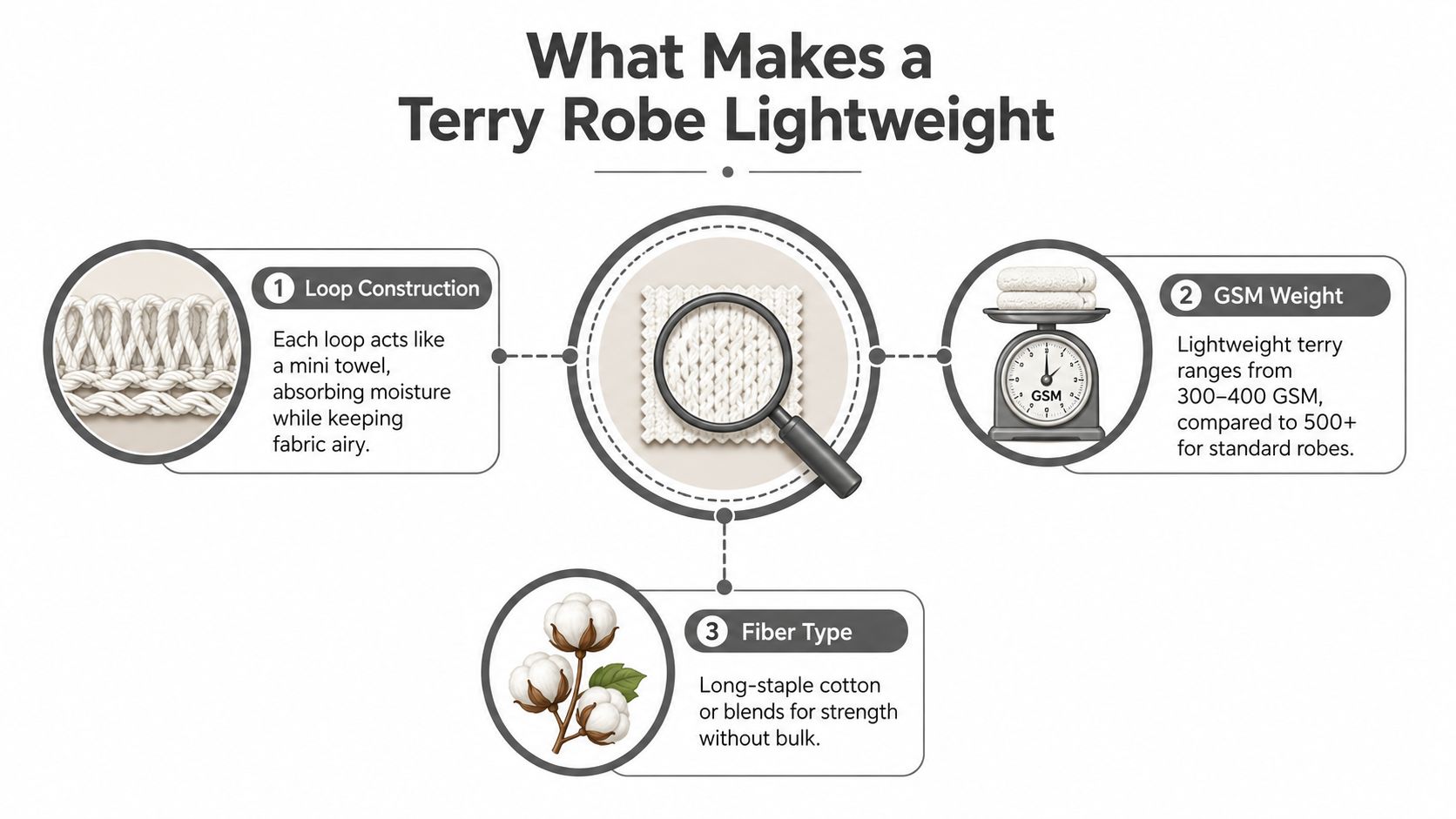
Fresh from the shower, a robe can feel either like a helpful drying layer or like a damp blanket. The difference comes from construction, not the label alone. Terry cloth combines cotton loops with a flatter woven base, so each loop works like a tiny sponge while the base keeps the garment stable.
Loop height measures how far the pile rises from that base. Taller loops expose more fiber, usually hold more water, and feel plusher. They also add bulk and may take longer to dry. Shorter loops feel smoother and lighter, which often suits a robe used briefly during everyday routines.
Loop density measures how closely the loops sit together. Short, tightly arranged loops can absorb more effectively than taller loops with wide gaps. Density can also make the surface less prone to snagging, although yarn quality and finishing still affect durability. Loop height and density work together, much like the difference between a thick, loosely packed sponge and a compact one.
Reading GSM correctly
GSM, or grams per square meter, measures fabric weight. Lightweight terry robes commonly use lower-GSM constructions in the 200 to 350 GSM range, compared with bath terry at roughly 400 to 600 GSM or more. These ranges appear in this terry cloth construction guide.
GSM tells you how much fabric occupies a square meter, not exactly how the robe will absorb or dry. A lower-GSM robe with compact, even loops may perform better than a heavier robe with an inefficient pile. In other words, weight is a useful starting point, not a complete verdict.
For fabric-buying decisions, this guide on how to choose blanket fabric reinforces the same principle: surface texture, base construction, and fiber choice shape performance alongside apparent thickness.
Why fiber still matters
Cotton remains a common fiber base for terry cloth. Global cotton production was estimated at about 120.6 million 480-pound bales for 2024/25, according to the U.S. Department of Agriculture's World Agricultural Supply and Demand Estimates. The connection between cotton and terry comfort is also discussed in this overview of terry cotton comfort and sourcing.
A lightweight robe should feel airy without feeling flimsy. Check that the base fabric lies flat, the loops look even, and the seams remain straight when you lift the garment. Those simple checks connect the robe's hand-feel to its actual construction, giving you more to judge than the word “lightweight” in marketing copy.
Lightweight Terry Compared to Other Robe Fabrics
Lightweight terry sits between two familiar experiences. It's more absorbent and towel-like than a smooth knit, but less bulky and heat-retentive than a traditional plush robe. Waffle weave usually feels airier still, while cotton and modal knits tend to behave more like clothing than bath linen.
The choice depends on what you want the robe to do. If you're stepping out of water and want the robe to take on residual moisture, terry has a structural advantage. If you mainly want a cover-up for lounging, a smoother or more drapey fabric may feel easier against the body.
| Fabric | Typical Weight | Drape | Absorbency | Drying Time | Care |
|---|---|---|---|---|---|
| Lightweight terry | Lower-GSM construction | Soft with moderate structure | Strong, depending on loop density | Faster than heavy terry, slower than very open weaves | Machine washable, protect loops from snags |
| Waffle weave | Often very light and airy | Relaxed and flexible | Moderate, with less towel-like surface | Generally quick | Usually straightforward, follow fiber instructions |
| Heavy terry | High-GSM, dense pile | Substantial and enveloping | Very strong | Slower because the pile retains more water | Needs thorough rinsing and drying |
| Cotton or cotton-blend knit | Light to medium, depending on yarn and construction | Clothing-like and fluid | Lower than looped terry | Often easy to dry, depending on blend | May require attention to stretch and shrinkage |
Waffle weave
Waffle robes use a textured grid rather than a raised towel pile. They're often the most packable option and can feel more breathable around the shoulders and arms. The trade-off is that they generally don't offer the same water-holding capacity as terry, so they're better for light post-shower coverage than for drying wet skin.
For a more detailed fabric-to-fabric discussion, read this comparison of waffle and terry cloth robes for daily use.
Heavy terry
Heavy terry feels plush, warm, and reassuringly substantial. It's a natural fit for cold bathrooms, long bath rituals, and anyone who enjoys a robe with noticeable weight. The downside is practical. More pile and fabric mass can mean longer drying and a warmer wearing experience, especially in humid rooms.
Cotton and cotton-blend knits
Knits drape closer to the body and can be softer in a T-shirt-like way. They're comfortable for lounging, but they don't have the same loop-driven surface area that makes terry effective after bathing. A blend may also change the way the robe handles heat, moisture, stretch, and laundering.
There's no universal winner. Choose lightweight terry for absorbency with manageable bulk, waffle for breathability and packing ease, heavy terry for plush warmth, and knit fabrics for drape-first lounging.
How to Choose the Right Lightweight Terry Robe
You are leaving the shower, the bathroom is warm, and the robe feels comfortable for the first minute. Then the fabric starts clinging, drying slowly, or pulling at your shoulders. That experience comes from more than a “lightweight” label. GSM, loop height, loop density, cut, and finishing must suit the way you plan to wear it.
Start with the fabric specification, then check whether the garment supports the same use. A lower GSM indicates less fabric mass, but it does not predict absorbency by itself. Short, dense loops can handle moisture differently from tall, widely spaced loops at a similar weight.
For most shoppers, a practical target sits within the lower-GSM terry range. Constructions around 250 to 350 GSM are commonly associated with lightweight terry, while heavier bath terry often begins around 400 GSM and extends beyond 600 GSM. Use those figures as a starting point, not a verdict. The robe's handfeel and construction can shift the wearing experience substantially.
Use this buying framework
| Criterion | What to Look For | Why It Matters |
|---|---|---|
| GSM | A lower-GSM terry specification suited to your climate and routine | Indicates fabric mass, but not absorbency by itself |
| Loop height | Short to medium, even pile | Balances softness, water uptake, and drying |
| Loop density | Closely arranged, secure loops | Supports absorbency and reduces sparse, flimsy areas |
| Fiber | Cotton content clearly stated | Helps you assess handfeel and moisture behavior |
| Fit | Room to wrap without excessive fabric | Affects airflow, mobility, and warmth |
| Finishing | Smooth seams and stable hems | Improves comfort and helps the robe hold its shape |
| Certification | Relevant textile or organic certification where important to you | Adds information about processing or material standards |
| Care label | Clear washing and drying instructions | Shows whether the robe fits your maintenance routine |
A robe below the lower end of the lightweight range may feel almost tissue-like, especially when its pile is sparse. A robe near the upper end can still feel light if it uses short loops and a simple cut, so inspect the construction rather than relying on the number alone.
Feel the pile, then inspect the fit
Run your hand across the surface. Short loops should feel smooth and compact, not bare. Tall loops should feel plush, but tug gently to see whether they seem loose. Dense, stable loops are usually more useful for regular wear and easier drying than dramatic fuzziness.
Length changes the experience too. A shorter robe frees the legs and feels practical for moving around. A mid-calf cut balances coverage with airflow. An ankle-grazing robe provides more warmth, but extra fabric around the feet and lower body can weaken the lightweight feel.
Finishing changes the handfeel. Combed cotton often feels smoother because shorter fibers are removed during preparation. Mercerized cotton can have a subtle sheen and polished surface. Pre-washed or stone-washed fabric may feel more relaxed from the first wear, though the care and shrinkage notes still deserve attention.
Certifications can help shoppers who care about chemical management or organic fiber standards. They add context, but construction remains visible in the loops, seams, and hems. A slightly higher upfront price may make sense when the robe has secure loops, clean finishing, and a care routine you can follow.
Best Uses for a Lightweight Terry Robe
The best robe weight depends on the moment you'll use it most. A traveler needs low bulk and easy drying. Someone building a spa routine at home may prefer a little more pile and coverage. A person living in a warm, humid climate usually benefits from less fabric surrounding the body.
Travel and hotel stays
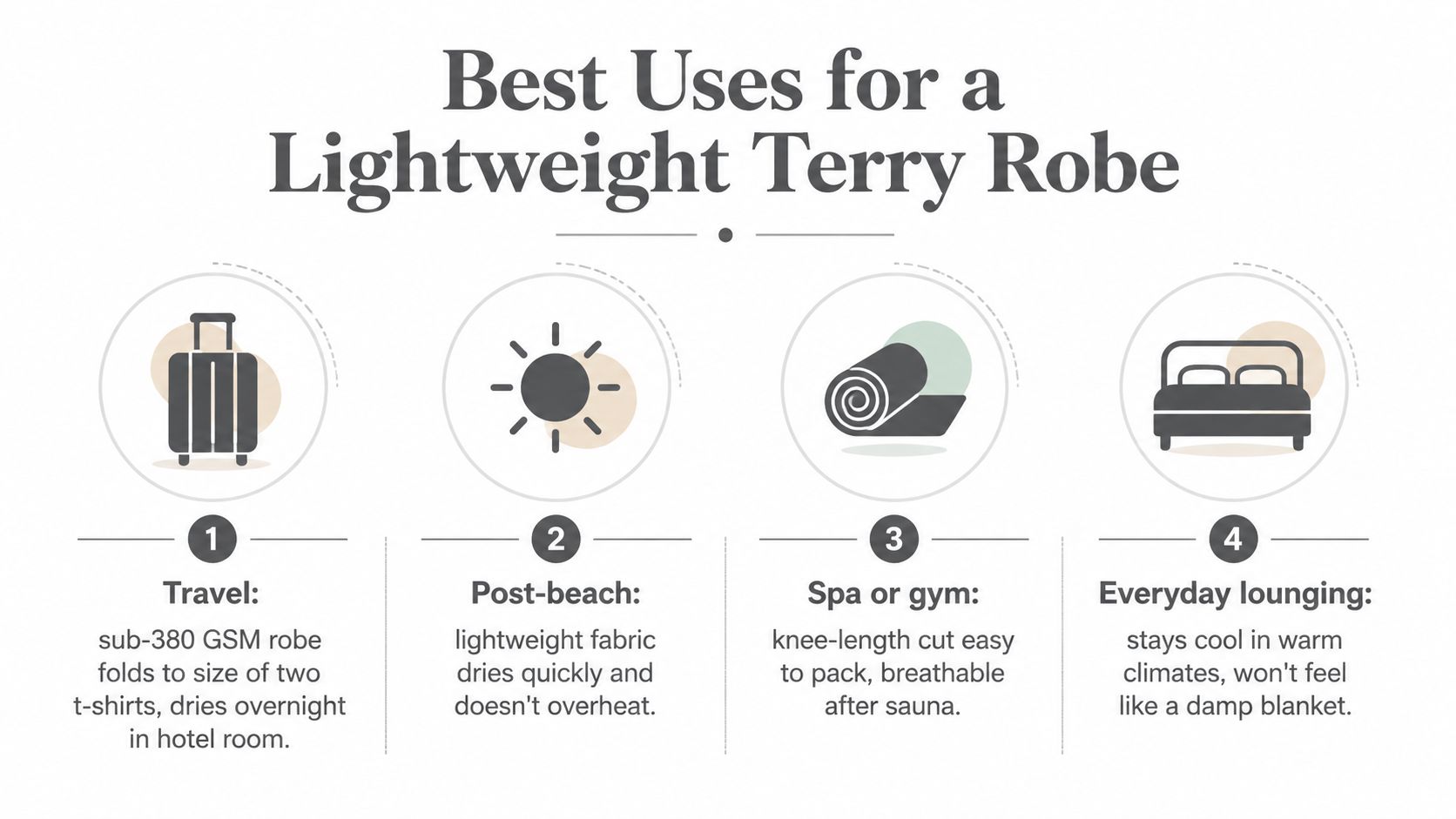
Choose a lower-GSM robe with a simple kimono shape and a shorter hem for travel. It takes up less space than a dense bath robe and works as a practical cover-up after a shower, at a pool, or between a changing area and your room.
A compact robe also places fewer demands on hotel drying space. Hang it fully open rather than leaving it folded over a crowded hook, and the reduced fabric mass can make care easier during a short trip.
Summer lounging
For warm-weather home use, look for short to medium loops and enough room through the shoulders. That combination helps the robe sit away from the body rather than cling after bathing. A knee-length or mid-thigh silhouette can feel easier to move in than a full-length style when you're wearing it over sleepwear.
For more warm-weather robe ideas, this summer bathrobe guide connects breathability, coverage, and everyday styling.
Post-workout use
After exercise, a lighter robe can be more comfortable than a dense one because it doesn't add as much weight while you're still warm. Shorter loops offer a smoother surface, and the lower mass makes the garment less cumbersome when you're walking from a gym, sauna, or pool area.
Don't expect a lightweight robe to replace a towel in every situation. It's better understood as a wearable layer that can take on residual moisture while giving you coverage and freedom of movement.
Spa-at-home rituals
A medium-light terry construction with a soft cotton hand works well after a bath or body-care routine. Choose a mid-calf cut if you want coverage without a fully enclosed feeling, or a longer style if warmth matters more than airflow.
Other useful settings include houseguest bathrooms, patio lounging after sun exposure, and the space between a swimsuit and a dry outfit. For guests, neutral colors and a relaxed fit usually make the robe easier to share. For poolside use, a lighter cut helps prevent overheating while still keeping you covered.
Match the robe to the transition, not just the temperature. The right construction should make the movement from water to the rest of your day feel simple.
Caring for a Lightweight Terry Robe So It Lasts
Lightweight terry is easier to wash and dry than a dense bath robe, but its loops still need protection. Friction, excess heat, and product buildup can change the surface over time.
Wash the robe in cool or warm water with a mild detergent. Hot water can stress cotton fibers and contribute to shrinkage, while too much detergent may remain trapped among the loops. Skip fabric softener if absorbency matters. It coats fibers and can flatten the pile, leaving the robe smoother but less effective at taking in moisture.
Wash the robe separately from garments with zippers, hooks, or rough fasteners. Those parts can catch individual loops and pull them from the base. Turning the robe inside out for its first few washes can also help protect an exterior finish and reduce surface friction.
Dry gently and completely
Use a low tumble setting, or hang the robe where air can circulate. If air drying leaves the pile feeling firm, a short low-heat tumble can loosen the loops. Avoid high heat, which can make cotton feel rough and may affect the shape of hems, cuffs, or belt loops.
Treat marks promptly with a gentle spot treatment. Chlorine bleach can weaken cotton fibers over time, so reserve stronger products only for situations specifically allowed by the care label.
Store it without stretching the shoulders
Fold the robe on a shelf when possible. A thin wire hanger can place concentrated pressure on the shoulders and gradually distort the shape. If you hang it after wearing, let it air out fully before putting it away.
For a more complete routine, this robe washing and storage guide covers the practical details that preserve softness and structure.
A robe should be dry before it's stored, not merely out of sight. This simple habit protects both freshness and the feel of the loops.
A Quick Checklist Before You Buy
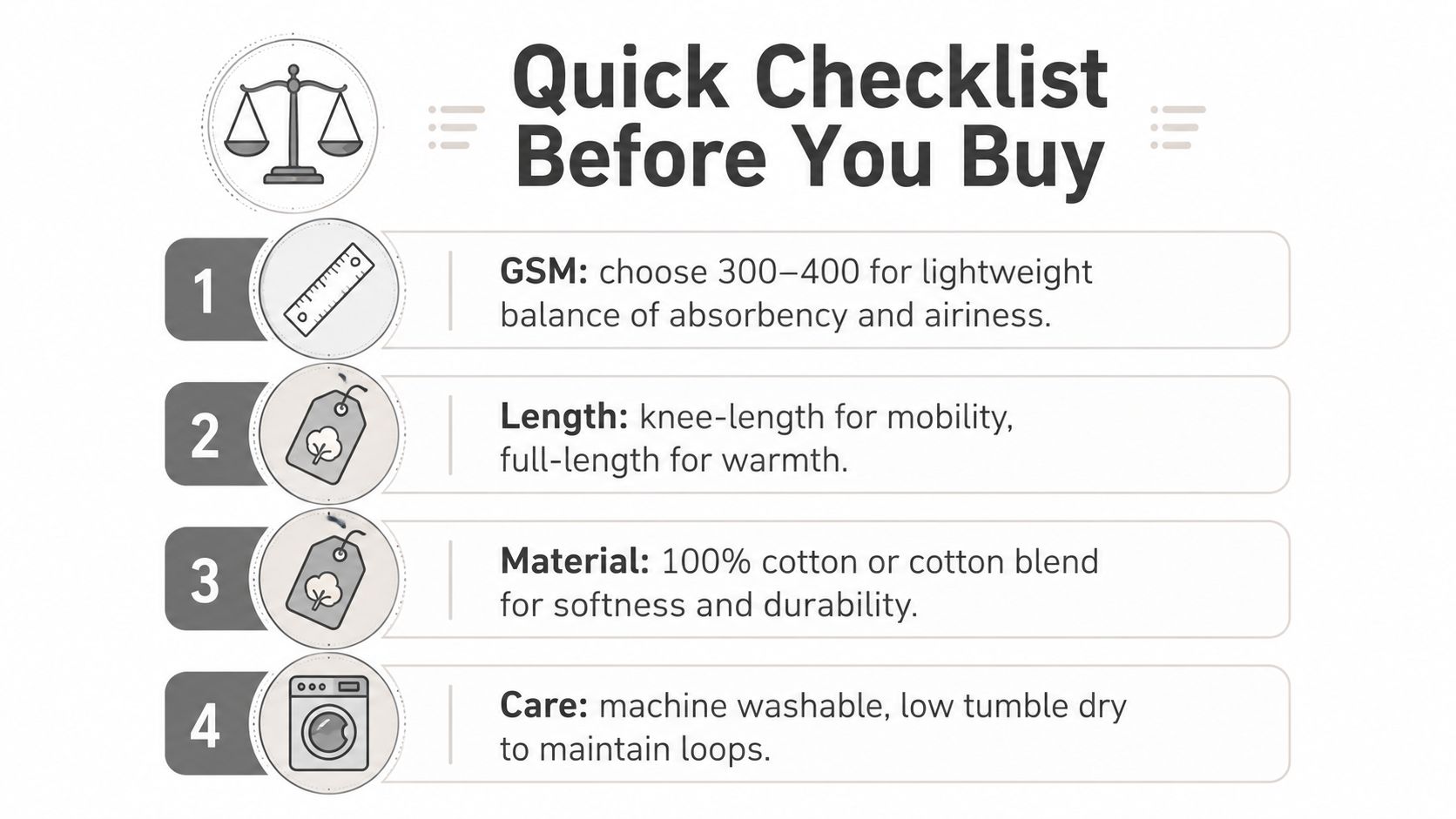
A useful lightweight robe balances lower fabric mass, stable loops, breathable fit, and manageable care. Use the checklist below while reading a product page or examining a robe in person.
-
Confirm the GSM. Look for a stated fabric weight rather than relying on “light,” “airy,” or “hotel weight.” Lower-GSM terry generally reduces bulk, but compare it with the loop description.
-
Inspect loop height. Shorter loops usually feel smoother and dry more readily. Taller loops offer a plusher hand but can retain more water.
-
Check loop density. The surface should look even and securely formed. Sparse areas may make a robe feel thin without making it efficiently breathable.
-
Verify the fiber content. Look for clearly stated cotton content and any blend information. Fiber affects softness, moisture handling, and care behavior.
-
Test the belt loops and pockets. Belt loops should be securely attached, and pockets should sit where your hands naturally fall. A pocket placed too low can pull on the robe when loaded.
-
Evaluate sleeve and hem length. Shorter sleeves and a knee-length cut encourage movement. Longer sleeves and hems provide more coverage, but they can add warmth and fabric around the body.
-
Look for relevant certifications. Certifications such as OEKO-TEX or GOTS may matter if you're prioritizing textile processing requirements or certified organic materials. Read the specific product documentation rather than assuming every certification means the same thing.
-
Read shrinkage and care notes. A robe that needs low heat, gentle washing, or careful drying may still be worthwhile, but its maintenance should fit your household.
| Final question | What a confident answer sounds like |
|---|---|
| Will this robe suit my main routine? | “It's light enough for summer mornings, but the loops still feel substantial.” |
| Can I care for it properly? | “I have a way to wash it gently and dry it fully between uses.” |
SEYANTE offers lightweight cotton and waffle robe options, including styles made from Turkish cotton, so shoppers can compare breathable construction with more absorbent terry silhouettes. Visit SEYANTE to explore robes for post-shower wear, warm-weather lounging, travel, and spa-inspired routines, then choose the fabric weight and cut that match how you'll use yours.