Mens Terry Cloth Robe with Hood
- The Moment a Hooded Terry Robe Makes Sense
- What Terry Cloth Is
- GSM, Weight, and What the Loops Are Doing
- Terry vs Waffle and Other Robe Weaves
- Fit, Length, Hood, Pockets, and Finish Details
- Organic Cotton, Turkish Cotton, and GOTS in Plain English
- Care Habits That Keep a Hooded Terry Robe Absorbent
- Choosing the Right Robe for Spa, Home, Gifting, and Wholesale
You step out of a warm shower with damp hair, warm skin, and a bathroom that suddenly feels colder than it did a few minutes ago. A towel handles your body, but your neck and head remain exposed, so you reach for a second towel, attempt a towel turban, and still end up carrying damp fabric around the room.
A mens terry cloth robe with hood simplifies that moment. Its looped surface helps lift moisture from the body, while the integrated hood covers the head and neck in the same layer. The right robe can feel like a practical extension of the shower, not just loungewear with a hood attached.
The challenge is choosing one that absorbs without becoming waterlogged, warms without overheating, and stays comfortable after repeated washing. GSM, loop density, fiber length, hood construction, and care habits all shape that experience. The guide below connects those details to real routines, so you can read a product page with more confidence.
The Moment a Hooded Terry Robe Makes Sense
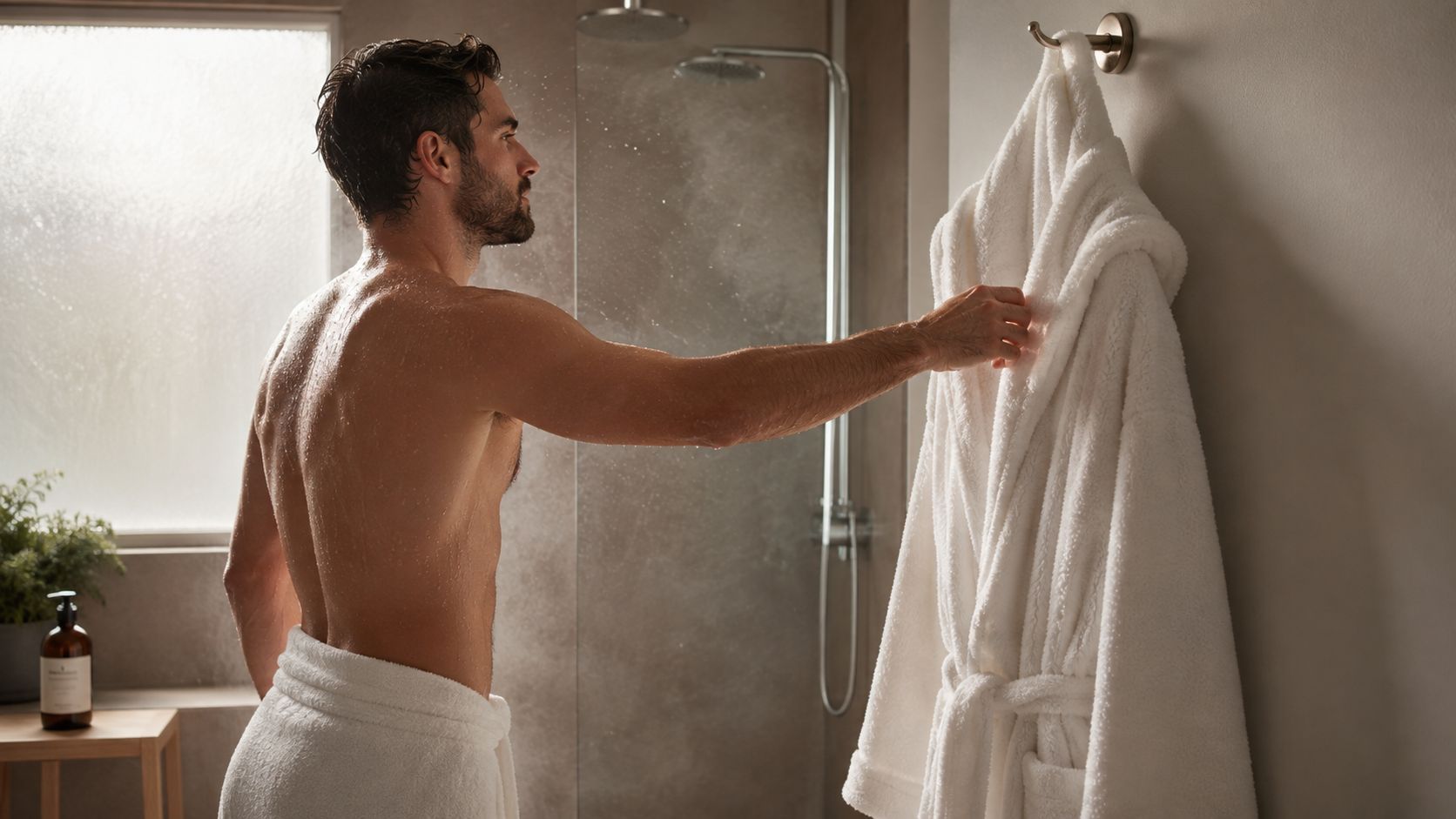
Steam still hangs on the mirror. Your hair is damp, your shoulders are cooling, and the towel you wrapped around your waist keeps loosening as you reach for moisturizer. A standard bath sheet solves one problem, but it leaves your head and neck outside the system. You either dry your hair separately or accept that the first few minutes after bathing will feel incomplete.
A hooded terry robe closes that gap. The body of the robe wraps around your torso and legs, while the hood gives damp hair a place to rest without requiring a separate towel turban. The looped fabric can also hold warmth close to the skin, which makes the robe useful beyond the bathroom.
The routines it serves best
A cold bathroom in winter is an obvious match. So is the post-workout shower, when your body is warm but the changing room or hallway feels cool. After a sauna or hot tub, the hood adds coverage while your temperature settles. On a slow weekend morning, it lets you move from shower to coffee without getting dressed immediately.
Compared with a bath sheet and separate head towel, the integrated hood offers convenience and more consistent coverage. It also avoids repeatedly twisting damp hair into a tight towel wrap, which some people find uncomfortable and others find unhelpful for managing frizz.
Practical rule: Choose a hooded robe when your main problem is the transition from wet to comfortable, not simply the need for something attractive to wear around the house.
The trade-off is that the hood adds fabric, warmth, and weight near the head and shoulders. That can feel excellent in a chilly room, but less pleasant in a humid climate or after intense exercise. The best choice depends on whether your robe's primary job is drying, warming, lounging, or combining all three.
What Terry Cloth Is
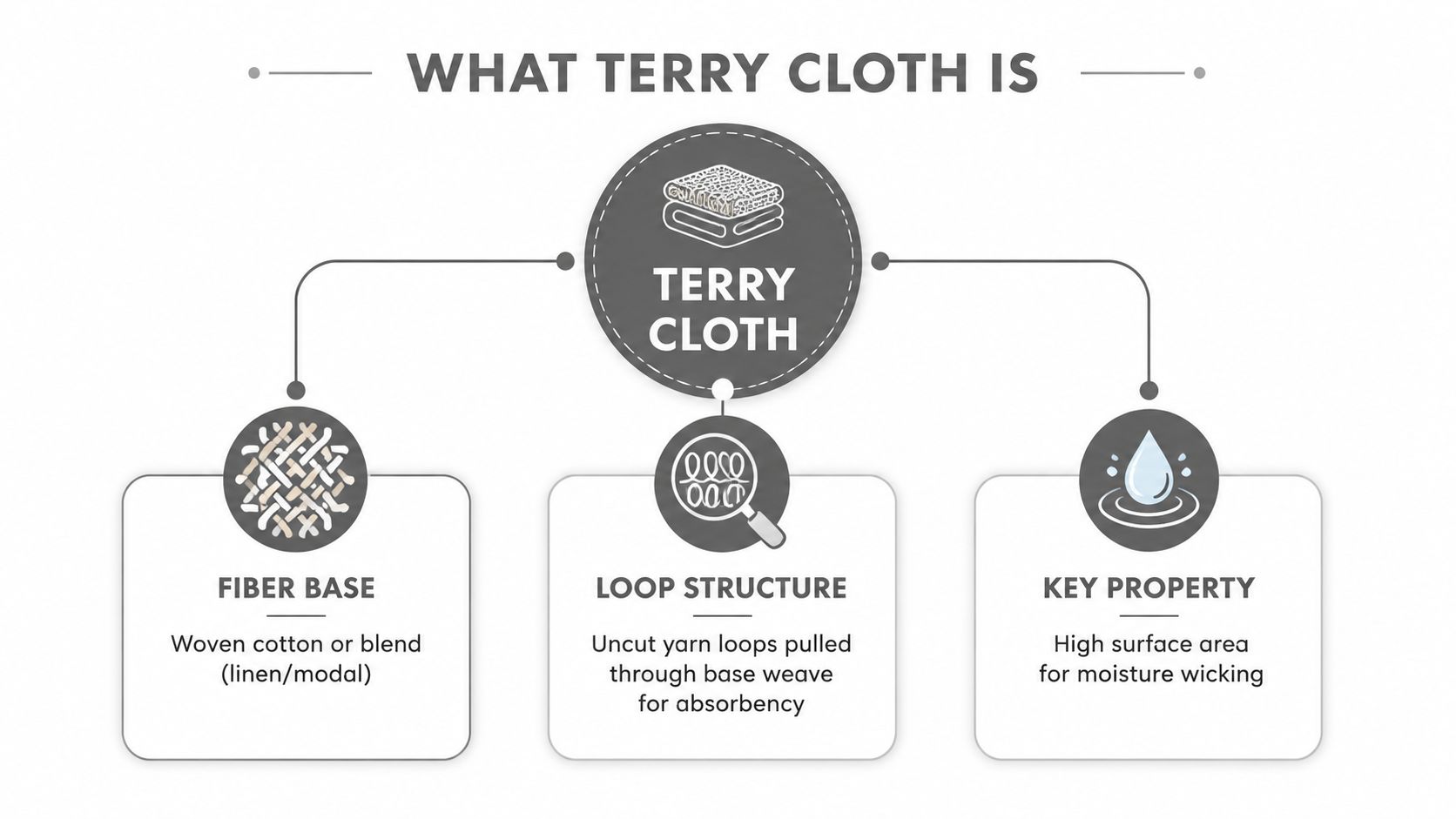
Terry cloth starts with a base weave and additional yarns that form uncut loops on one or both sides. Cotton is the usual foundation, although some fabrics combine it with fibers such as linen or modal. The loops produce the raised surface that makes terry feel thicker and more towel-like than a smooth woven fabric.
Terry cloth resembles a flat sheet studded with thousands of tiny cotton loops. Each loop exposes more fiber to air and water, giving moisture more places to collect. Together, the loops work like small reservoirs, helping the fabric draw in and hold water through capillary action.
Why loops matter more than thread count
Thread count can sound persuasive, but it does not directly predict how well a terry robe absorbs moisture. Loop formation, density, height, and stability matter more because they determine how much active surface meets wet skin.
Single-loop terry has loops on one side and a smoother back. Double-loop terry has loops on both sides, which can increase softness and moisture contact while adding bulk. Neither structure suits every buyer. A lighter single-loop robe may release moisture more easily, while a denser double-loop robe can feel warmer and more substantial.
For a broader material overview, see this guide to terry cloth robes by material. The useful product-page question is not whether the robe contains cotton. Check how that cotton has been formed into the pile.
Where Turkish cotton fits
Turkish cotton is commonly chosen for terry because its longer staple fibers can be spun into smoother, stronger yarns. Those yarns may create loops that feel less coarse and resist matting when the pile is well built and properly finished.
Fiber length supports comfort, but it cannot compensate for weak construction. Long-staple fiber in a loose or poorly secured pile may still disappoint. Read the material composition, fabric weight, loop description, and care instructions together. Those details show whether the robe is designed to feel absorbent after a shower or merely look plush on a product page.
GSM, Weight, and What the Loops Are Doing
GSM means grams per square meter. It functions as a practical indicator of how much fabric is packed into a robe, so a higher GSM generally means more material, greater body, and a denser handfeel. It does not describe the whole construction. Yarn type and loop architecture also affect comfort, absorbency, and drying, but GSM gives you a useful first reading on a product page.
Independent textile guidance places fashion terry around 250 to 400 GSM, while spa and bathrobe terry commonly sits around 400 to 600 GSM in this terry-cloth guidance. For a hooded robe used after showering, that spa and bathrobe range often balances absorbency, plushness, and manageable weight.
How weight changes the after-shower experience
A robe near the lighter end feels easier to move in and may release moisture faster. A robe in the 400 to 600 GSM range usually feels more like a traditional bathrobe, with enough pile to absorb water and enough structure to provide warmth without automatically becoming cumbersome.
Very heavy constructions above roughly 500 to 600 GSM can offer more warmth and collect more moisture, but the same loops may hold that water longer. Drying takes more time, and laundering becomes more demanding. Put a very heavy robe on while your skin is still dripping, and it may feel clammy because the fabric has taken in more water than it can release quickly.
| GSM Range | Feel | Best Use |
|---|---|---|
| Around 250 to 400 GSM | Lighter, less bulky, easier to handle | Warm rooms, gym use, and buyers who dislike heavy robes |
| Around 400 to 600 GSM | Plush, absorbent, and substantial | Everyday post-shower use and spa-style comfort |
| Above roughly 500 to 600 GSM | Very warm and dense, with greater water retention | Cool spaces and buyers who prioritize maximum coverage |
Read GSM alongside the loops
GSM measures total fabric mass, not the exact number or quality of loops. Two robes with similar GSM can feel quite different if one has taller, denser loops while the other uses a flatter pile. The loop surface is the robe's working area, much like a cluster of small hooks that catches water from your skin. Textile research links absorbency to loop shape and optimized loop density, rather than weight alone.
A study found maximum durability when loop density and loop length were tuned around 15 to 17 millimeters, with performance maintained after 10 wash cycles in this textile study. Treat that finding as construction context, not a promise that every robe with the same measurements will feel identical.
The hood adds to perceived weight. A well-balanced hood rests over your head without pulling the collar backward or pressing down on your shoulders. Match the listed GSM to your climate and post-shower routine, then inspect loop details, hood construction, and care instructions before treating the number as a final verdict.
Terry vs Waffle and Other Robe Weaves
Terry and waffle solve different problems. Terry uses raised loops to maximize contact with moisture, while waffle fabric uses a textured grid that reduces bulk and encourages airflow. Micro-terry sits between the two, offering a smaller looped surface with a lighter overall feel.
| Weave | Absorbency | Drying Time | Typical GSM | Best Use |
|---|---|---|---|---|
| Terry | High, especially with a dense loop pile | Usually slower because it holds more water | Often mid to heavy | Post-shower, spa, and post-workout warmth |
| Waffle | Moderate, with stronger airflow and lower bulk | Usually faster than dense terry | Often light to mid-weight | Warm climates, travel, and extended lounging |
| Micro-terry | Balanced, with a finer loop surface | Between standard terry and waffle | Often light to mid-weight | Transitional weather and mixed routines |
Choose by the problem in front of you
Suppose you've just finished a workout and want to cool down without carrying a saturated robe through the house. A lighter waffle construction may feel more breathable and manageable. If you've stepped out of a cold shower room and want the robe to pull moisture from your arms, chest, and back while adding warmth, terry has the stronger case.
A micro-terry robe can suit someone who wants some towel-like comfort but doesn't enjoy a thick spa garment. It can also work well when the robe moves between post-shower use and ordinary lounging.
A hood changes each comparison. On terry, it can create a warm, cocooning feel around damp hair. On waffle, it adds coverage without necessarily producing the same dense, towel-like weight. The best weave depends on whether absorbency, breathability, drying speed, or low bulk ranks first.
For a more detailed side-by-side discussion, see this guide to waffle and terry cloth robes for daily use. Don't choose a weave because one sounds more luxurious. Choose the structure that fits the way you wear a robe.
Fit, Length, Hood, Pockets, and Finish Details
Fabric quality can't rescue a robe with poor proportions. A hooded design places extra demands on the shoulder and neckline, so begin there rather than with color.
Start at the shoulders
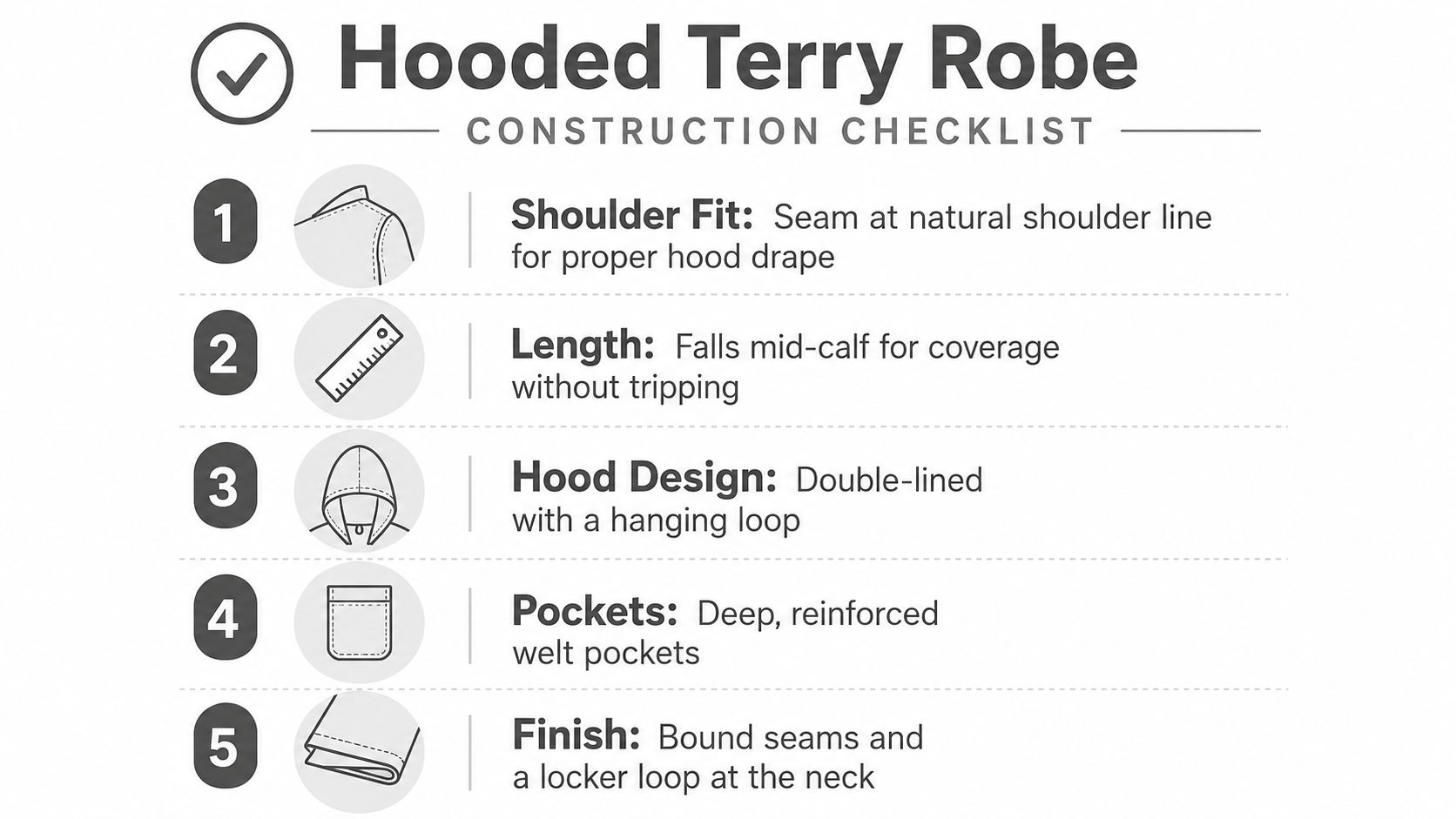
The shoulder seam should sit close to your natural shoulder line. If it falls too far outward, the robe can look oversized and the hood may pull the collar backward. If it sits too far inward, the upper body can feel restrictive and the hood may tug when you turn your head.
Length changes the robe's character:
- Mid-thigh lengths offer easy movement and suit active routines.
- Knee to mid-calf lengths balance coverage with mobility.
- Ankle-length designs provide the most warmth but can feel cumbersome on stairs or around furniture.
A two-piece hood typically has a shaped profile that lies flatter around the head. A single-panel hood can bunch more easily, especially when the robe is cut generously. Look for enough depth to cover damp hair without creating a heavy pocket of fabric behind the neck.
Inspect the working details
Pocket design affects both comfort and durability. Welted side-seam pockets create a cleaner profile, while patch pockets are easier to access and can hold more. Either should have reinforcement at the opening, especially if you carry a phone or keys.
Check that belt loops sit at a useful height and that the belt ties feel securely stitched. Cuffs deserve attention too. Dense, even loops at the sleeve opening are less likely to look worn quickly than a visibly loose pile.
Finish details worth noticing
Look for double-needle stitching at stress points, bartacked corners, bound hems, and a hanging loop at the neck. These details aren't decorative trivia. They help manage the repeated pulling, tying, hanging, and laundering a robe experiences.
Colorfast dyeing also matters if you want the robe to retain its appearance after regular washing. A product page may not show every seam clearly, so use close-up photographs, construction notes, and return information together. The robe should look stable when open, tied, and draped over the shoulders.
Organic Cotton, Turkish Cotton, and GOTS in Plain English
Product pages often place organic cotton, Turkish cotton, and GOTS beside one another, but these terms describe different things.
Organic cotton refers to how the cotton is grown. Organic standards restrict synthetic pesticides and fertilizers, and the crop must be managed under organic requirements before it can be sold as organic. The term says something about agricultural practice, but it doesn't automatically confirm how the cotton was spun, dyed, sewn, or finished.
Turkish cotton describes origin and fiber characteristics. Long-staple fibers can produce smoother yarns and more even loops, which may improve the handfeel of a terry robe. That doesn't mean every product labeled Turkish cotton has the same density or durability. The weave and finishing still decide how the robe performs.
What GOTS adds
GOTS, or the Global Organic Textile Standard, reaches beyond the field. It covers the textile supply chain from harvest through processing and manufacturing, with requirements for approved inputs and limits on residues from processing substances. That makes the certification more informative than a vague phrase such as “eco-friendly.”
OCS focuses on organic fiber content and chain-of-custody requirements, while GOTS includes broader processing and manufacturing criteria. The distinction matters when a robe sits against skin that may still be wet after bathing. Buyers who prioritize processing controls can use GOTS as a stronger filter than an unsupported sustainability adjective.
A fiber claim tells you what the material is. A certification claim should tell you how the material moved through production.
On a product page, look for the licensed GOTS logo and the relevant processing or trading scope. If the page only uses “organic” in descriptive copy without an identifiable certification reference, treat the statement as incomplete rather than assuming it covers the entire garment.
Care Habits That Keep a Hooded Terry Robe Absorbent
A terry robe works because its loops remain open enough to contact water. Care should protect that structure instead of coating it, crushing it, or stretching it while wet.
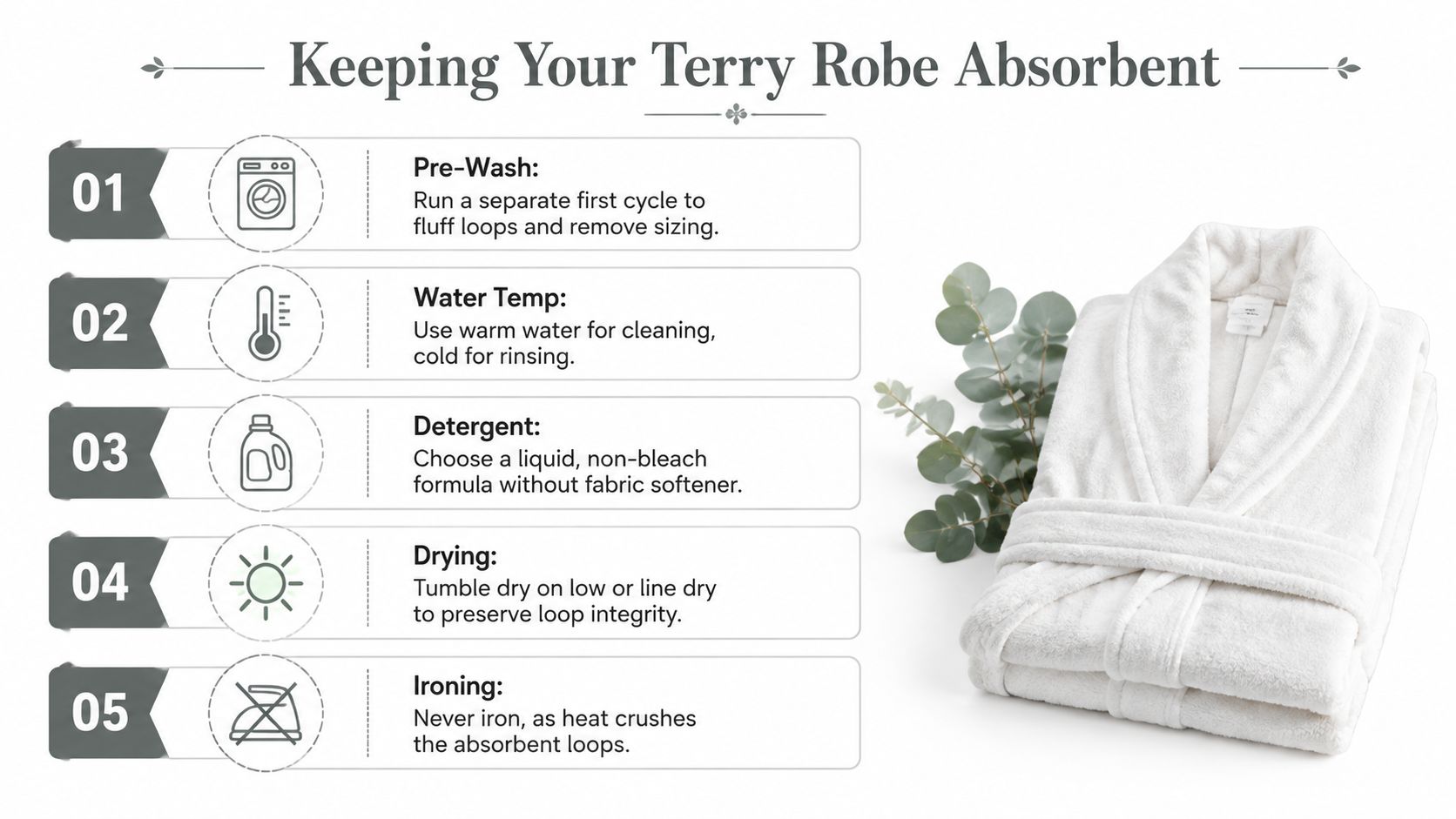
Start with the first wash. A separate initial cycle can help loosen the pile and remove finishing materials left from production. Follow the garment label, but in general, use a moderate temperature, a gentle liquid detergent, and enough room in the drum for the hood and body to move freely.
Avoid the coating that feels helpful
Fabric softeners and dryer sheets can coat cotton fibers, reducing the loops' ability to take up water. The robe may feel slick or temporarily softer, but that surface coating works against absorbency. Independent care guidance also recommends moderate heat, gentle detergent, and avoiding over-drying to help preserve terry performance as outlined in this robe care guide.
Use a non-bleach detergent unless the care label says otherwise. Avoid cramming the robe into a full load, and keep it away from garments with hooks, zippers, or rough trims that can snag loops. Pairing it with similarly textured laundry can reduce abrasive friction.
Dry the hood deliberately
Tumble drying on low or medium heat can restore loft, but excessive heat and over-drying can make cotton feel harsh. Wool dryer balls may help separate the fabric during tumbling without adding a coating. If you air-dry the robe, spread the hood open and support the garment across a broad hanger or drying surface. A heavy, wet hood can pull at the neckline if it hangs from a narrow point.
Use this practical sequence:
- Wash separately at first: Give the pile space to release sizing and settle.
- Measure detergent carefully: Excess product can remain inside dense loops.
- Skip softener and dryer sheets: Preserve the fibers' ability to absorb.
- Dry until fresh, not baked: Remove the robe promptly when it's dry.
- Air the robe after wearing: Let moisture escape before storage.
More detailed instructions for washing, storing, and caring for your robe can help you adapt the routine to your machine and local water conditions. Fold the robe rather than placing it on a thin wire hanger, use a breathable cotton storage bag for longer storage, and keep strong sunlight away from dyed fabric.
Choosing the Right Robe for Spa, Home, Gifting, and Wholesale
The same hooded terry robe won't serve every setting equally well. A home user may prioritize a comfortable hood and usable pockets, while a spa needs repeatable sizing, durable seams, and a laundering routine that staff can manage. Start with the setting, then choose the fabric and construction.
Match the robe to the use
Spa and hospitality: Favor a denser terry construction, reinforced hems, secure belt loops, and consistent sizing across the order. Staff need garments that can tolerate frequent handling and still present a clean, orderly appearance.
Home lounging: A mid-weight terry robe often gives a useful balance of warmth and absorbency. Generous hood coverage, deep pockets, and a shoulder fit that doesn't pull backward matter more than hotel-style heaviness if you'll wear the robe for long periods.
Gifting: Turkish cotton can provide the smoother handfeel many recipients associate with a premium robe. Neutral colors are easier to give when you don't know someone's exact taste, and presentation-ready packaging can make the gift feel complete without adding unnecessary accessories.
Wholesale purchasing: Ask for documentation before committing. Confirm material composition, any GOTS or Oeko-Tex documentation offered, size consistency, lead times, minimums, and return terms. A beautiful sample doesn't guarantee predictable delivery or uniform construction across a larger order.
For a wellness setting where the robe is part of a broader relaxation ritual, this resource on a Japanese head spa in London Ontario offers useful context about how head-focused treatments create a calmer guest experience. A hooded robe can complement that experience by keeping the client warm and covered before and after treatment.
Where SEYANTE may fit
SEYANTE offers hooded terry and waffle robe options, including Turkish cotton and GOTS-certified organic styles, alongside information for shoppers comparing materials and sizing. Its published policies include US shipping, a 90-day return period, and a wholesale program, so buyers can review those terms when evaluating a home purchase, gift order, or hospitality requirement.
Use this checklist before ordering:
- Primary moment: Shower, workout, spa service, lounging, or gifting?
- Fabric structure: Dense terry, lighter waffle, or micro-terry?
- Weight: Does the GSM suit your climate and drying routine?
- Hood behavior: Will it cover damp hair without pulling the neckline?
- Construction: Are seams, belt loops, pockets, and cuffs reinforced?
- Care reality: Can you wash and dry the robe without softener or over-drying?
- Documentation: Are organic or certification claims identifiable?
The right choice isn't the heaviest or most decorated robe. It's the one whose textile structure, cut, and maintenance demands match the moment you'll repeat most often.
SEYANTE offers men's hooded terry and waffle robes made for post-shower comfort, relaxed home wear, gifting, and hospitality use, including Turkish cotton and GOTS-certified organic options. Visit SEYANTE to compare robe materials, hooded styles, sizing guidance, and care-conscious construction before choosing your next everyday layer.