Kimono Robes Short: A Practical Buyer's Guide
You step out of a hot shower, reach for the robe, and discover that “short” can mean anything from neatly above the knee to barely more than a sleep shirt. The same problem appears at a spa, beside a pool, or while getting ready for an event. A robe can look beautiful online and still pull open at the hips, drag at the sleeves, or stay damp long after you've finished using it.
The smart way to shop for short kimono robes is to treat length, closure, fabric, and weight as practical specifications. The kimono shape has a useful construction history, but your decision today should come down to your height, climate, laundry routine, and the moment when you'll wear it.
What a Short Kimono Robe Actually Is
A short kimono robe is a wrap garment that generally finishes around the knee or mid-thigh. It has a straight sleeve line, a flat shawl or V-shaped collar, overlapping front panels, and a tie belt positioned around the natural waist. That combination separates it from a full-length robe that falls toward the ankle, and from a sleep-shirt-style cover-up that lacks the dropped kimono sleeve and overlapping wrap front.

The shorter hem solves real problems. You get less fabric around your legs when walking, sitting, or stepping into slippers. Shorter proportions often suit petite frames better, and the cleaner line works over pajamas, lounge trousers, or swimwear without creating a bulky column of cloth. If you're choosing between robes, decide first whether you want drying, warmth, coverage, or easy movement. Length should follow that answer, not the product photograph.
Read the fabric label, not the lifestyle copy
Most short kimono robes use cotton terry, waffle cotton, cotton blends, or smoother lightweight fabrics. For major robe markets, terry commonly sits around 400 to 600 GSM, while waffle commonly falls around 250 to 400 GSM, according to this practical comparison of terry and waffle robes. GSM means grams per square meter, so it gives you a useful indication of fabric density.
Higher-GSM terry usually brings more looped pile, greater absorbency, and more thermal weight. Lower-GSM waffle feels airier, dries faster, and packs more easily. A robe marketed as “spa-inspired” may still be too light for drying after a shower, while a plush robe may be excessive in a humid bathroom.
For a broader look at robe silhouettes and construction, this guide to luxury kimono robes is useful. The buying decision remains simple: choose terry for moisture and warmth, waffle for ventilation and mobility, then confirm that the hem and wrap provide the coverage you need.
Where the Short Kimono Silhouette Comes From
The kimono's shape survived because it solved dressing and movement problems efficiently. Historical records document the garment in Japan from the Hakuhō, or Early Nara, period, dated 645 to 710, to the present, while Britannica identifies the later Muromachi period, 1338 to 1573, as the period when the short-sleeved kimono known as the kosode was introduced. The modern wide obi dates from the 18th century, so today's short robe silhouette reflects a long progression rather than a recent fashion invention. See the Britannica history of the kimono for that historical outline.
Straight lines had a practical job
Traditional kimono construction uses straight-seamed rectangular panels cut from a long, narrow bolt of cloth. That approach creates the familiar T-shape, keeps pattern engineering relatively simple, and produces virtually no waste, as described in this overview of kimono construction. The garment doesn't depend on curved armholes or heavily shaped seams to create fit.
Modern short robes borrow the same logic. The underarm seam creates a flat shoulder line, the sleeve drops onto the upper arm, and the front panels overlap rather than meeting through a fitted center closure. A belt then controls the waist and keeps the robe in place. Width, overlap, and tie position matter more than sculpted tailoring.
Shorter lengths also make practical sense. They reduce fabric around the legs and make household movement easier. Western bathrobes and lounge robes retained that useful shape because it works well for indoor comfort, not only because it carries a recognizable Japanese visual reference.
Practical rule: Treat the kimono silhouette as a construction system, not a costume detail. The straight cut gives you adjustability, while the short hem removes excess bulk.
That distinction matters when you shop. A robe inspired by kimono design should still provide reliable coverage, a secure belt, and sleeves that stay out of the way. Historical influence can explain the pattern, but it can't compensate for poor sizing or the wrong fabric.
Terry vs Waffle and Why GSM Matters
Fabric weight helps separate real performance from marketing language. Terry cotton uses dense loops that hold water and create a warmer, heavier hand. Waffle cotton uses a raised grid that traps air, keeping the robe lighter and more breathable.
This terry versus waffle robe guide supports a simple buying rule. Choose terry when drying and warmth matter most. Choose waffle when you need ventilation, faster drying, and easier packing. Match that decision to your climate and routine, not the robe's appearance.
Terry cotton
Terry works best after a shower because its loops increase surface area for absorbing water. Around 400 to 600 GSM, it usually feels substantial and warm, with higher weights adding more thermal heft. A premium cotton terry above 500 GSM is commonly treated as a high-absorbency tier in the practical benchmark cited by the robe fabric comparison.
The trade-off is clear. Terry weighs more, becomes heavier when wet, and takes longer to dry. It suits a cool bathroom, a spa changing room, or poolside use, where absorbing moisture matters more than keeping the robe light.
For a short kimono robe, that weight can also affect movement. A heavier terry robe gives more coverage and warmth, but it may feel excessive in a warm home or humid climate. Use GSM as a practical guide to bulk, not as a quality score by itself.
Waffle cotton
Waffle fabric typically falls around 250 to 400 GSM, while lighter constructions offer less bulk and quicker drying. Its square texture creates air spaces, so the robe stays breathable without feeling completely flat or flimsy. A waffle robe around 280 to 380 GSM is the sensible middle ground for travel, warmer weather, and layering.
Check the weave before buying. Genuine waffle fabric has visible square cells on both faces. Printed or knitted textures can resemble waffle in photographs without providing the same dimensional structure or airflow.
| Attribute | Terry Cotton | Waffle Cotton |
|---|---|---|
| Typical weight | Around 400 to 600 GSM | Around 250 to 400 GSM |
| Main strength | Absorbency and warmth | Airflow and faster drying |
| Best setting | Post-shower, spa, pool, cooler rooms | Travel, summer, layering, humid spaces |
| Main drawback | Heavier and slower to dry | Less plush and less absorbent |
| Buying signal | Looped pile with a dense hand | Square cells visible on both faces |
Organic cotton does not settle the choice. GOTS-certified organic options exist in both constructions, while a looser organic weave can register at a slightly lower GSM and still feel comfortable. Compare the actual weight, weave, and intended use. For a short robe, the right GSM is the one that fits your climate and drying routine.
How to Get the Fit Right Without Trying It On
A short kimono robe should look deliberately cropped, not like a regular robe that ended too soon. Start with the shoulder-to-hem measurement, taken from the shoulder point to the bottom edge. Compare that figure with a robe you already wear successfully. A generic S, M, or L label cannot show how the length will sit on your body.
Height provides a useful starting point. On a petite frame, a mid-thigh hem may feel appropriately short. On a taller frame, the same measurement may sit closer to the hip and provide less coverage. Use the garment's actual measurement, then check the cut against your preferred coverage.
Measure the closure at the hips
The front needs enough width to overlap across your widest hip area. Waist measurement alone is a poor guide because the robe can close at the waist yet pull open when you sit or walk. Lay the robe flat, measure the front width, and compare it with your hip circumference. Garment-flat measurements are more dependable than a size chart that lists letters without dimensions.
Look for secure overlap rather than a barely closed front. If the panels meet only when you pull the belt hard, choose a wider cut. Tightening the belt cannot create extra fabric. It can strain the belt loops and leave the robe vulnerable to opening.
Use height as a reference, then verify the garment
Height narrows the options, but sleeve drop, shoulder width, and desired coverage determine the final fit.
| Height | Recommended Shoulder-to-Hem | Sleeve Length | Hip Overlap |
|---|---|---|---|
| Petite frame | Choose a clearly above-knee or mid-thigh length | Mid-forearm | Secure overlap across the widest hip |
| Average frame | Select a short length that stays above the knee | Mid-forearm | Several inches of comfortable overlap |
| Tall frame | Choose a longer short robe to preserve mid-thigh coverage | Mid-forearm | Front panels should remain closed while moving |
The shoulder seam should sit close to the natural outer shoulder, not halfway down the upper arm. Kimono sleeves drop from that point, so an oversized shoulder can make the sleeve cumbersome and encourage the robe to twist.
Before ordering, request the garment's flat measurements and compare them with a robe that fits well. For SEYANTE sizing, this direct comparison gives you more useful information than choosing S, M, or L in isolation. Record shoulder-to-hem length, front width, sleeve length, and your preferred overlap before buying. That small check prevents the common mistake of treating “short” as a universal measurement.
Matching the Robe to the Moment
The dominant activity should decide the robe. A short kimono robe for drying after a shower has different requirements from one worn over a swimsuit or packed in a carry-on.
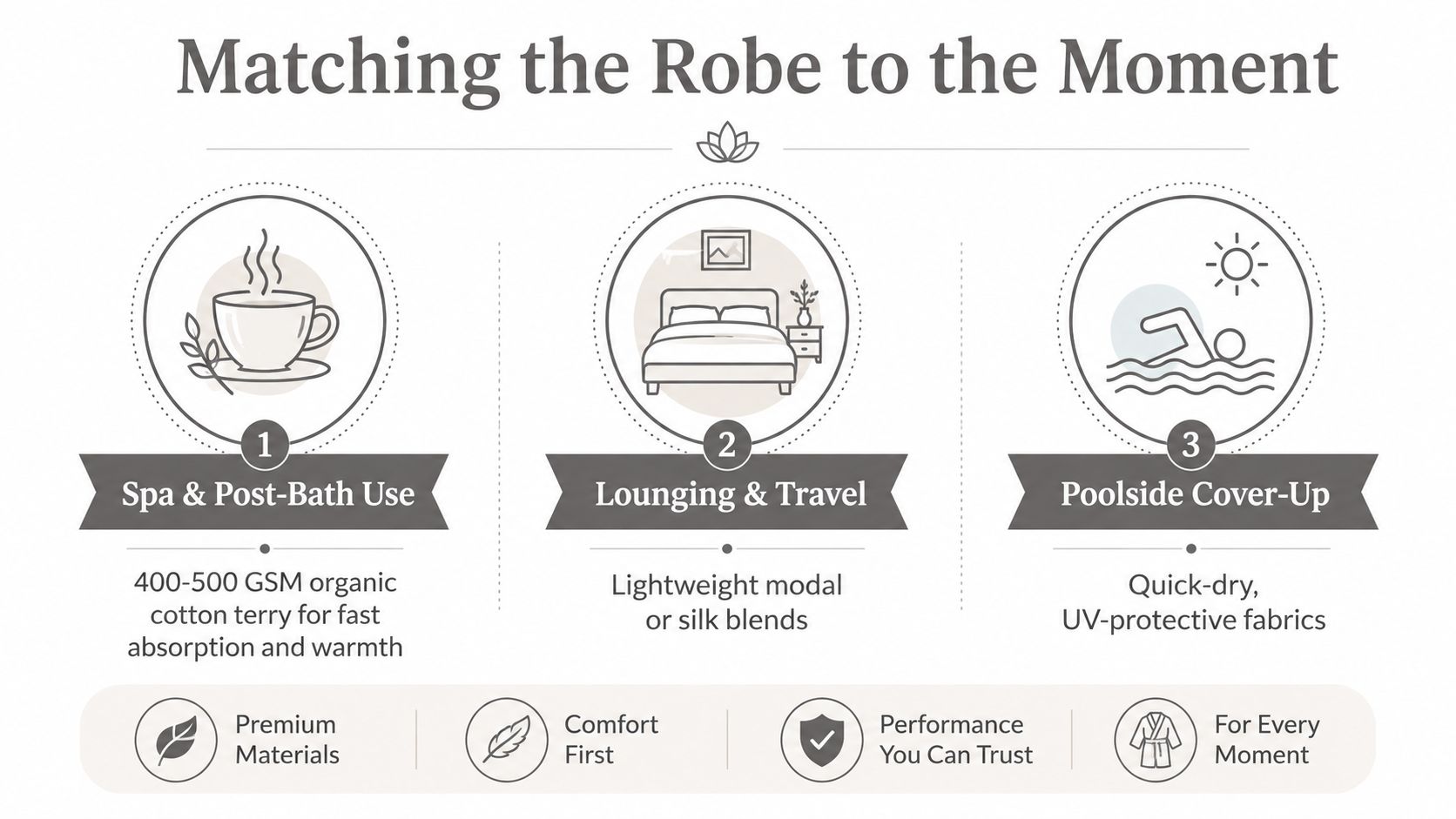
Spa and post-bath use
Choose terry when the robe needs to absorb water and hold warmth in a cool room. A dense looped surface is more useful here than a fashionable print or an extra-wide sleeve. If your bathroom stays humid and the robe can't dry thoroughly between uses, choose a lighter construction or improve airflow rather than buying the plushest option available.
Travel and everyday lounging
Waffle is the practical travel choice because it folds with less bulk and dries faster than dense terry. It also layers neatly over sleepwear or swimwear without making the outfit feel padded. For daily lounging, pick the fabric that matches your temperature preference. Warm sleepers generally prefer waffle, while people who feel cold after bathing often prefer terry.
Bridal preparation
For getting-ready photographs, prioritize a clean hem, stable wrap, and a fabric that doesn't catch every cosmetic particle. Lightweight waffle or a smooth blend usually photographs with a neater outline than plush pile. Ivory or champagne tones create a coordinated look, but the closure still matters because a robe that falls open will distract from the finished image.
Hospitality, pool, and beach use
Waffle works well for guest rooms and rentals because faster drying supports easier turnover. At the pool or beach, quick-drying waffle or a breathable cotton blend is more practical than dense terry, especially when the robe will move between water, sun, and a changing area.
Choose for the wettest, busiest moment. A robe that suits your wardrobe color but fails after a shower is the wrong robe.
Care and Washing That Actually Works
Cotton terry and waffle need different treatment. Washing them identically is an easy way to flatten terry loops or distort the waffle grid.
Terry care
Wash terry in cool water, around 30°C or 86°F, using a gentle cycle and mild detergent. Skip fabric softener. It coats the loops and gradually reduces the absorbency you bought the robe to provide.
Tumble dry on low heat, and shake the robe partway through drying to lift the pile. High heat can flatten the loops permanently. A clean rinse also helps because detergent residue stiffens cotton fibers and makes the robe feel less supple.
Waffle care
Waffle can tolerate a warmer wash, around 40°C or 104°F, but it can shrink more aggressively. Hang it to dry instead of placing it in the dryer. Air drying protects the dimensional grid and reduces the chance of a distorted hem or baggy elbow.
Wash the robe before its first wear. Untreated cotton can experience 3 to 5% vertical shrinkage, so account for that change before deciding that the original fit is perfect.
Storage and replacement
Hang terry without compressing the pile for long periods. Folding it tightly can flatten the creases and reduce bounce. Waffle can be folded flat without the same concern.
Inspect the robe rather than replacing it because of a calendar. Terry needs attention when the loops stop springing back or the surface stays flattened after washing. Waffle needs attention when the grid loses definition or bags out at the elbows. Your laundry habits, water, heat, and frequency of wear will determine lifespan more reliably than a universal replacement schedule.
Gifting and Wholesale Considerations
Short kimono robes make strong gifts because they combine presentation with a clear daily use. A full-length robe can feel dramatic, but a shorter cut is easier to move in, easier to pack, and less likely to overwhelm the recipient's frame. The gift feels considered without becoming impractical.

Why bridal parties choose the short cut
Bridal groups often need robes that look coordinated while people move, pose, sit, and change shoes. A shorter hem keeps the lower silhouette clean and avoids bunching around the knees. Waffle cotton also packs more easily for destination events, while a matching belt and consistent sleeve line create cohesion in photographs.
For a personal gift, prioritize the recipient's routine. A terry robe suits someone who wants warmth after bathing. A waffle robe suits someone who travels, lives in a warm climate, or prefers a lighter layer. Color should come after those functional decisions.
What boutique buyers should verify
Wholesale buyers need more than a product image. Ask for:
- Garment-flat measurements: Confirm that the same size has a consistent shoulder, sleeve, hem, and front width.
- Fabric specifications: Verify GSM and weave consistency across color batches.
- Hand-feel swatches: Check softness, drape, loop density, and surface texture before committing.
- Customization options: Embroidery, name placement, collar details, and coordinated packaging can turn a basic robe into a keepsake.
- Production timing: Confirm lead times before the busiest wedding and hospitality periods.
Packaging matters, but construction matters more. Acid-free tissue, ribbon ties, and recycled mailers can improve presentation. They won't rescue a robe with weak belt attachments or inconsistent sizing.
For organizations sourcing coordinated gifts, this wholesale luxury robe gifting guide provides relevant planning context. Boutique buyers should still request samples and inspect the actual stitching before placing a larger order.
Five Checks Before You Buy
A short kimono robe earns its price when the specification matches the way you'll use it. Run these checks before ordering.
-
Confirm the weave and weight. Match terry or waffle to your climate and routine. Product photography can make a lightweight robe look plush, so verify the fabric description and GSM.
-
Measure the length. Compare shoulder to hem with your height and preferred coverage. Shorter wearers generally need a shorter measurement, while taller wearers need enough length to preserve a comfortable mid-thigh line.
-
Test the closure on paper. Check the front width across your hips, the amount of overlap, the belt position, and the belt-loop attachment. A tie can't correct insufficient panel width.
-
Inspect finishing details. Look for secure hems, reinforced belt points, clean seams, and sleeves that finish around the mid-forearm. Pattern matching matters for printed robes, but structural finishing matters more.
-
Read the care instructions. If you won't hang dry waffle or use low heat for terry, choose the fabric that fits your laundry habits. The best robe is the one you'll maintain correctly.
The final test is behavioral: If the robe fits your body but conflicts with your climate or laundry routine, you'll stop reaching for it.
SEYANTE offers short kimono options in 100% Turkish cotton terry and lightweight waffle weaves, including GOTS-certified organic choices, with sizing and material guidance to help you compare the robe to your actual needs. Visit SEYANTE to choose a short robe based on fit, GSM, and use case, then make it part of a more comfortable daily routine.