Luxury Turkish Bathrobe Guide: What Makes One Worth Choosing
You step out of the shower, reach for the robe hanging on the hook, and know within about five seconds whether it was a smart buy. Some robes dry you, warm you, and make the whole routine feel calmer. Others just sit on your shoulders like a damp towel with sleeves.
That gap is why a luxury Turkish bathrobe deserves more thought than it usually gets. Plenty of robes look plush on a product page. Fewer are built for the way you live, which means your climate, your bathroom humidity, how often you wash laundry, whether you run warm, and whether your robe is for post-shower drying, lounging, travel, guest use, or all of the above.
A good Turkish robe isn't automatically the heaviest one. Sometimes the right robe is a thick terry style that feels almost hotel-like. Sometimes it's a lighter waffle weave that dries faster and works better in a warm home. Real luxury is fit for purpose.
Why a Turkish Robe Deserves a Closer Look
A lot of people buy robes the same way they buy throw blankets. They touch the softest one, see a pretty collar, and assume thicker means better. Then real life starts. The robe stays damp in a humid bathroom, feels too hot while making coffee, or never quite absorbs enough water after a shower.
That's where Turkish robes stand out. The category isn't just about softness. It's about fiber quality, weave structure, and fabric weight working together. When those pieces line up with your routine, the robe feels easy to own. When they don't, even an expensive robe can feel wrong by week two.
Luxury depends on the moment
A robe for winter mornings isn't the same robe for summer travel. A new parent doing quick showers may want something lighter and easier to wash. A boutique guest room may need a robe that looks polished, holds up well, and fits a wide range of bodies. A person who takes long baths may want more absorbency and more wrap.
Practical rule: If a robe only sounds luxurious on the shelf, but not in your bathroom, it isn't luxury for you.
The question worth asking isn't “What is the plushest robe?” It's “What robe supports the ritual I have?”
Turkey matters for more than branding
Turkey matters here because the country has real textile depth, not just name recognition. One industry report says Türkiye's textile and apparel sector generated $26.18 billion in exports in 2025, while another source notes about $9.4 billion in textile exports and $16.77 billion in apparel and ready-to-wear. The same report says Turkey is the world's 4th largest home textile exporter and 3rd largest exporter of towels and bathrobes. It also notes a substantial cotton pipeline, with USDA reporting 300,000 metric tons of projected Turkish cotton exports in MY 2025/26 and 325,000 metric tons estimated in MY 2024/25, all of which helps explain why premium robe production is so established there (Türkiye textile and apparel industry report).
That scale doesn't tell you which robe to buy. It does tell you Turkish bathrobes come from a developed textile ecosystem rather than a vague “luxury” label.
From Hammam to Modern Robe
You step out of a hot shower in July, reach for a thick robe, and five minutes later you feel overheated. On a cold winter morning, that same robe can feel perfect. That difference helps explain the Turkish robe story better than any luxury label does.
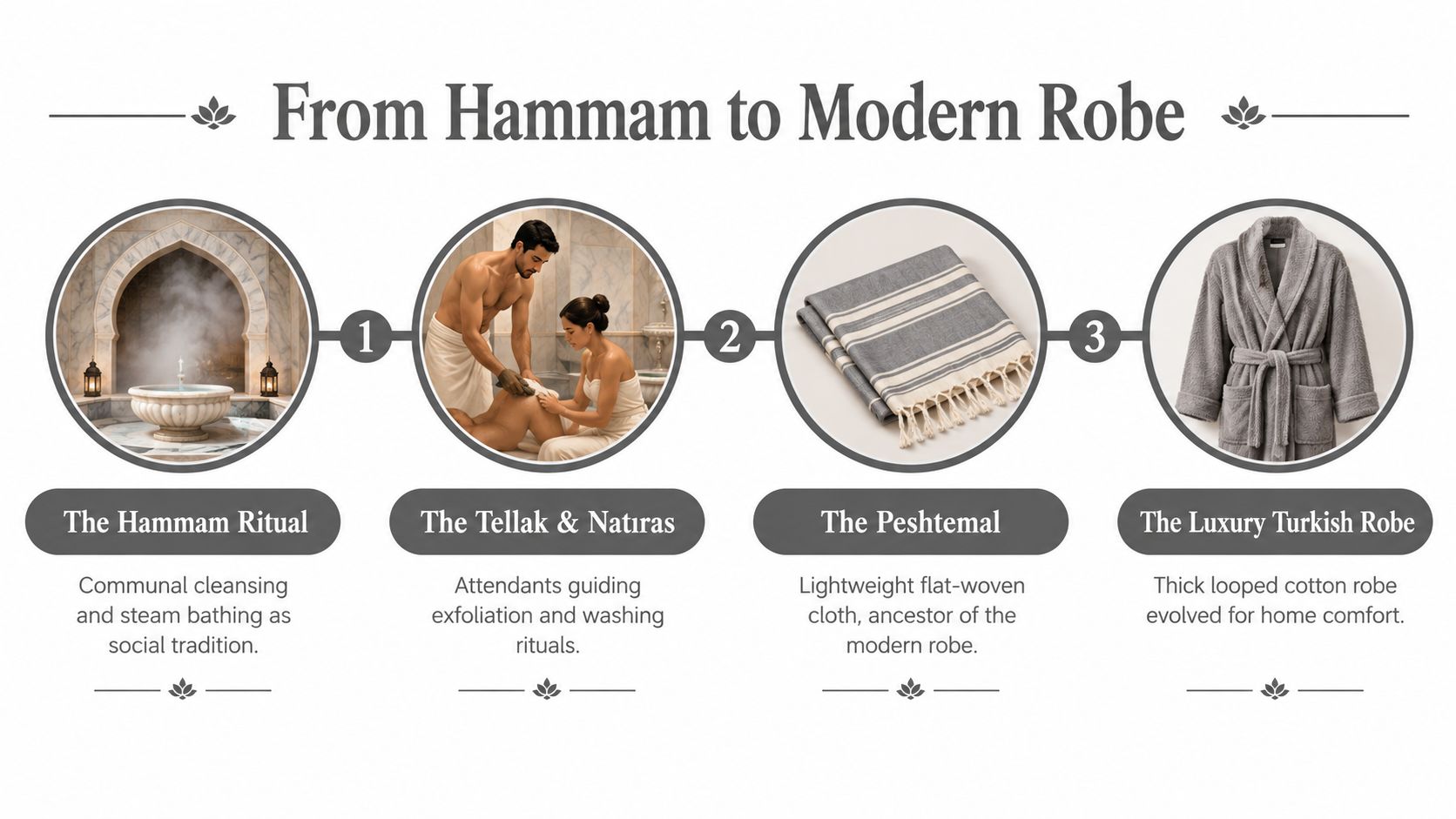
Long before bathrobes were sold as spa indulgences, the hammam shaped what bath textiles needed to do. A hammam is a humid, warm bathing environment built around washing, steam, and rest. In that setting, fabric had to wrap the body, handle moisture, and stay comfortable in heat. A heavy pile robe was not always the smartest answer.
The early ancestor of the modern Turkish robe was the peshtemal, a flat-woven cotton wrap used in the bath. It was light, flexible, and easier to manage in a steamy room than a thick, plush fabric.
The original idea was comfort in context
That part matters because many shoppers assume luxury means maximum thickness. Hammam textiles followed a different logic. They were chosen for the room, the temperature, and the bathing ritual.
A peshtemal works like a well-ventilated summer layer. It covers you, dries reasonably well, and does not trap too much heat. That is why a lighter Turkish robe can feel more luxurious than a dense robe that leaves you damp and overheated after ten minutes.
Later, terry cloth changed the bathing experience. Its looped surface holds more water, so it feels more absorbent right after a bath or shower. That shift helped create the robe many people now picture in hotels and spas. Softer, thicker, more cocooning.
Both robe families still make sense today.
- Peshtemal lineage: light, flat-woven, breathable, easier to pack and faster to dry
- Terry lineage: looped, thicker, more absorbent, better for cooler rooms or longer lounging
- Modern robe design: often combines older fabric traditions with updated cuts such as kimono shapes, shawl collars, and hoods
The useful lesson is simple. Turkish robe heritage is not a straight line toward heavier fabric. It is a history of matching textile structure to the moment.
If you want more context on how these silhouettes developed over time, this guide to classic Turkish robes gives a helpful visual and practical overview.
What Makes Turkish Cotton Different
People often hear “Turkish cotton” and treat it like a style term. It's more useful to think of it as a fiber behavior term. The cotton changes how the robe feels on skin, how it handles moisture, and how well it ages with washing.
Start with the yarn, not the fluff
Longer cotton fibers generally spin into smoother yarns. Smoother yarns usually mean fewer loose fiber ends sticking out of the fabric. That's why a well-made Turkish cotton robe often feels cleaner in the hand and stays more refined over time.
Shorter-fiber cotton can still work fine in some products, but in robes it often feels rougher sooner and looks tired faster. The difference shows up after repeated laundering, not just on day one.
What your body notices first
Readers usually get confused here because “soft” and “absorbent” sound like the same thing. They're not.
A robe can feel plush but still not dry you well. A robe can also absorb water well but feel bulky and slow to dry. Turkish cotton is popular because it often lands in a useful middle ground: soft enough to feel luxurious, absorbent enough for post-bath use, and breathable enough that it doesn't always feel swampy on the body.
A worthwhile robe should help the skin move from wet to comfortable, not just cover dampness.
Turkish Cotton vs Generic Cotton
| Property | Long-Staple Turkish Cotton | Generic Upland Cotton |
|---|---|---|
| Yarn feel | Smoother and cleaner in hand | Often fuzzier or rougher |
| Pilling tendency | Typically lower because fewer fiber ends are exposed | Often higher over time |
| Post-shower comfort | Balances absorbency with breathability | Can feel either thin or heavy depending on build |
| Durability in robes | Better suited to repeated laundering when well woven | More variable from product to product |
| Luxury signal | Comes from fiber quality plus construction | Often relies more on surface finish |
Turkey's cotton reputation also connects to place. The Aegean growing region is commonly associated with consistent premium cotton production, which is one reason Turkish cotton is so often discussed in bath textiles.
If you'd like a skin-focused explanation of why fiber quality changes comfort, this piece on what makes Turkish cotton different for skin benefits breaks it down clearly.
Terry vs Waffle in Plain Language
This is the choice that trips people up most. They know they want a luxury Turkish bathrobe, but they don't know whether that means thick terry or light waffle. The answer depends less on status and more on habit.
Terry is the wearable towel
Terry has raised loops. Those loops increase surface area and help the fabric grab and hold water. If your robe's main job is drying you after a shower, bath, or swim, terry is usually the stronger technical choice.
Independent guidance consistently describes terry as the top option when rapid water pickup is the priority, while waffle weaves are lighter and release moisture faster because of their more open structure. The broader textile mechanism is straightforward: weave geometry affects porosity, airflow, and thermal resistance, which changes warmth, drying speed, and breathability (absorbency and weave behavior in bath textiles).
Waffle is the breathable specialist
Waffle robes don't wrap you in the same dense way. That's the point. Their open, grid-like structure tends to feel airier and less clingy, especially in warm weather or after a quick rinse when you don't need a robe doing the work of a bath towel.
They're often a better fit for humid bathrooms, travel, and laundry routines where fast drying matters as much as comfort.
Terry vs Waffle Robe at a Glance
| Attribute | Terry Weave | Waffle / Peshtemal |
|---|---|---|
| Main strength | Strong absorbency | Breathability and faster drying |
| Feel on body | Plush, cushioned, enclosing | Light, airy, less bulky |
| Best after | Baths, showers, swims | Sauna transitions, warm-weather showers, travel |
| Drying time | Slower | Faster |
| Bathroom fit | Better in cooler, drier spaces | Better in humid or compact spaces |
| Packing | Bulky | Easy to fold and carry |
| Overall mood | Hotel-like, cocooning | Spa-light, relaxed |
How to pick without overthinking
Choose terry if most of these sound like you:
- You want drying power: You put a robe on while still a bit wet.
- You like warmth: Cold floors and chilly mornings matter.
- You want that hotel feel: Plushness is part of the ritual.
Choose waffle if these sound more familiar:
- You run warm: Heavy fabrics get uncomfortable fast.
- Your robe gets frequent use: Quick drying helps between wears.
- You travel or have limited storage: Bulk becomes annoying.
If you want a side-by-side explanation focused on daily wear, this comparison of waffle vs terry cloth robes is helpful.
Reading GSM Without Getting Lost
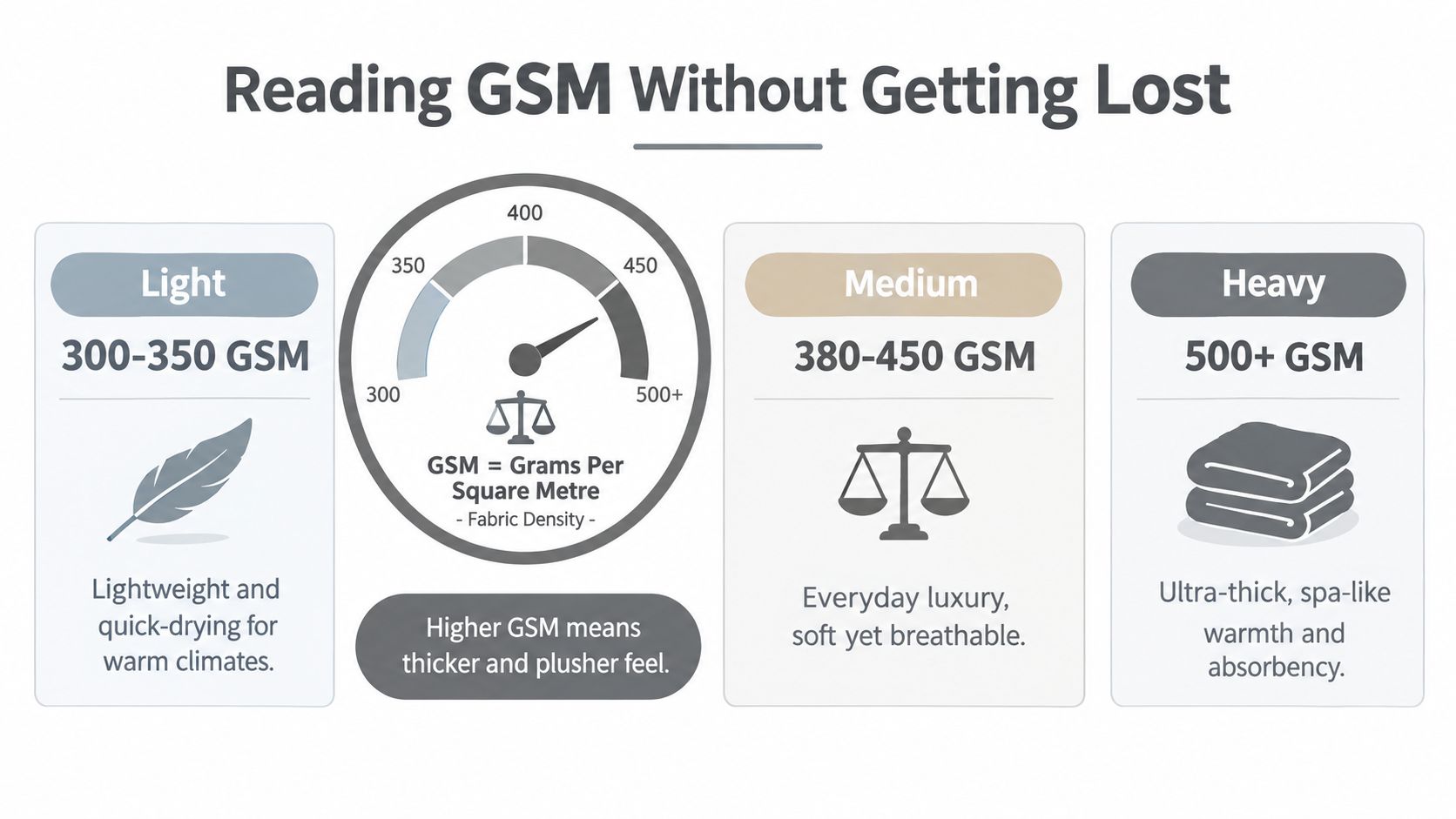
GSM means grams per square metre. In plain English, it's a fabric density number. Higher GSM usually means more material packed into the same area, which often translates to a thicker, weightier feel.
The key word is usually. GSM is most useful when you're comparing robes in the same weave family. A heavy waffle robe and a heavy terry robe won't behave the same way.
The practical ranges that matter
For Turkish-cotton bathrobes, industry guidance places premium spa or hotel-style robes around 500 to 700 GSM, while 100% cotton terry in the 400 to 600 GSM range is widely cited as the best balance of absorbency, durability, and comfort. The same guidance notes that robes below about 400 GSM can feel too thin for effective drying, and 500 to 550 GSM is often treated as the sweet spot for balancing absorbency with manageable dry time (bathrobe materials and GSM guidance).
That doesn't mean bigger is always better.
- Lighter builds: easier to dry, easier to layer, usually better in warm spaces
- Midweight builds: often the easiest for everyday use
- Heavier builds: stronger sense of wrap and warmth, but more drying time and more wet weight
Use your bathroom, not just the label
A heavy robe in a bright, airy house can feel excellent. The same robe in a small humid bathroom may stay damp longer than you'd like. If you wash robes frequently, a slightly lighter weight can be more realistic. If your robe is mostly for cold-weather lounging, extra density may be worth it.
The smartest use of GSM is as a lifestyle filter, not a bragging number.
What GOTS Certification Really Means
You are standing in front of two robes that look equally soft. One says "organic cotton." The other says "GOTS certified organic." Those labels are not interchangeable.
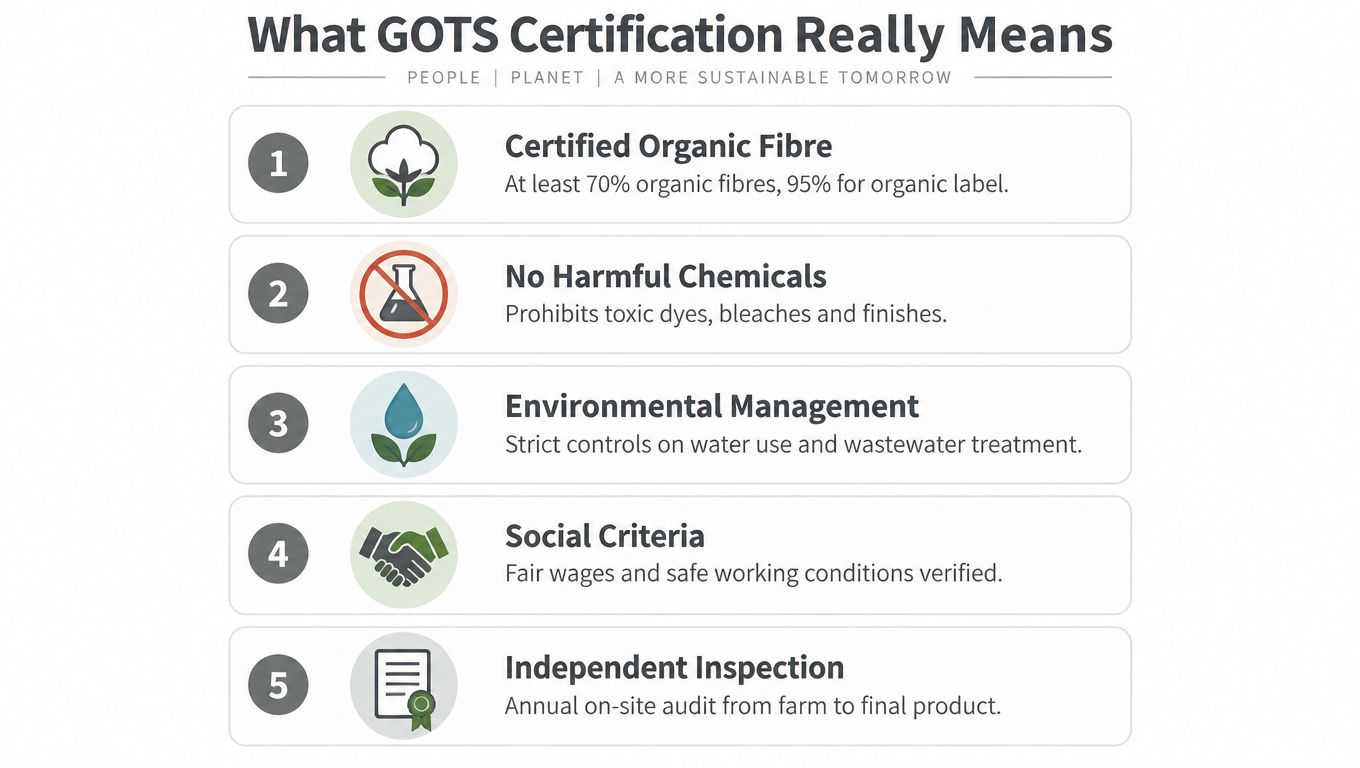
GOTS stands for Global Organic Textile Standard. It is a certification system for processed textiles, not just a nice-sounding fiber claim on a hangtag. That distinction matters with robes because what touches your skin is not raw cotton straight from the field. It is cotton that has been spun, dyed, washed, finished, and sewn.
It is about the full textile chain, not only the farm
A plain "organic cotton" claim can refer only to the fiber itself. GOTS covers the steps that turn that fiber into fabric and then into a robe. It also sets clear labeling thresholds. Under the standard, products labeled "made with organic" must contain at least 70% organic fibers, while products labeled "organic" must contain at least 95% certified organic fibers (GOTS labeling requirements).
That is the useful part for shoppers. You are not guessing what "organic" means from brand copy alone.
Why that matters in a bathrobe
A robe lives close to the skin, gets wet often, and goes through repeated washing. So the value of certification is less about instant hand-feel and more about process clarity. A GOTS-certified robe may feel plush or light, waffle or terry, depending on how it was made. Certification does not automatically make it softer, thicker, or more absorbent.
It gives you a better-documented answer to a different question. How was this textile produced, and how much of the fiber content meets a certified organic standard?
That makes GOTS easier to understand if you treat it like a verified recipe label rather than a comfort score.
What you may be paying for
Part of the price difference comes from traceability and stricter production requirements. Organic cotton also makes up a small share of the global market, which helps explain why certified products often cost more. Industry market reporting also notes pricing premiums for organic cotton and tighter supply than conventional cotton (organic cotton market constraints and premiums).
For some buyers, that premium makes sense. For others, it does not.
- Choose GOTS if process transparency matters to you
- Choose it if vague eco claims bother you
- Treat it as one buying filter, not proof of superior softness
Luxury, in this category, is about fit for the moment. If you want a robe for daily post-shower use in a warm climate, the right weave and weight may matter more to your comfort than certification alone. If you want a robe whose material story is easier to verify, GOTS can be part of what makes the robe feel worth owning.
Choosing the Right Style for the Moment
The biggest buying mistake isn't choosing a “bad” robe. It's choosing a robe for an imaginary life. The robe that feels perfect in a luxury hotel photo may be wrong for a warm apartment, a shared laundry setup, or a person who only wants something for ten minutes after showering.
Match the robe to the ritual
Recent market coverage shows two impulses shaping the category at once. One is the hotel-at-home pull toward plush, enveloping robes. The other is growing interest in lighter, more sustainable home textiles. That leaves many shoppers stuck between “softest possible” and “most practical to live with,” even though the better question is use-case fit.
Matching Robe Style to Use Case
| Use Case | Recommended Weight (GSM) | Weave | Details |
|---|---|---|---|
| Cold morning after shower | 500 to 600 GSM | Terry | Shawl collar or hood for warmth |
| Long bath and lounge | 500 to 600 GSM | Terry | Longer length, soft belt, roomy sleeves |
| Warm climate daily routine | Lighter weight | Waffle | Kimono cut, breathable drape |
| Humid bathroom | Lighter to midweight | Waffle | Fast-drying structure, less bulk |
| Guest room or hospitality | Midweight to heavier depending on setting | Terry or waffle | Easy-care finish, classic color, durable seams |
| Travel or spa bag | Lightweight | Waffle / peshtemal-inspired | Packable, low bulk, quick drying |
| Bridal or gifting | Depends on recipient and season | Either | Monogramming, elegant trim, polished silhouette |
Small details change the experience
Collar shape matters more than people expect. A hood helps after wet hair or in a cooler bathroom. A shawl collar looks a bit more formal and gives more neck warmth. A kimono cut usually feels lighter and cleaner.
Length matters too. Knee-length robes are easier for moving around the house. Longer robes feel more ceremonial and cocooning.
If you want a concrete example of the long, enveloping style many shoppers picture when they say “plush robe,” the plush long robe Eberjey Renew shows the silhouette well, even if your own ideal fabric choice still comes down to weave and weight rather than length alone.
For readers shopping across terry, waffle, hooded, kimono, hotel-grade, or maternity options, SEYANTE offers Turkish cotton robe styles in those categories, including GOTS-certified organic options, which can be useful when you're trying to match a robe to a very specific routine rather than a generic luxury label.
Care Habits and Buying Checklist
A good robe can age beautifully. A badly cared-for robe can lose absorbency, flatten out, and feel tired much faster than it should. Most of the damage comes from everyday habits, not dramatic mistakes.
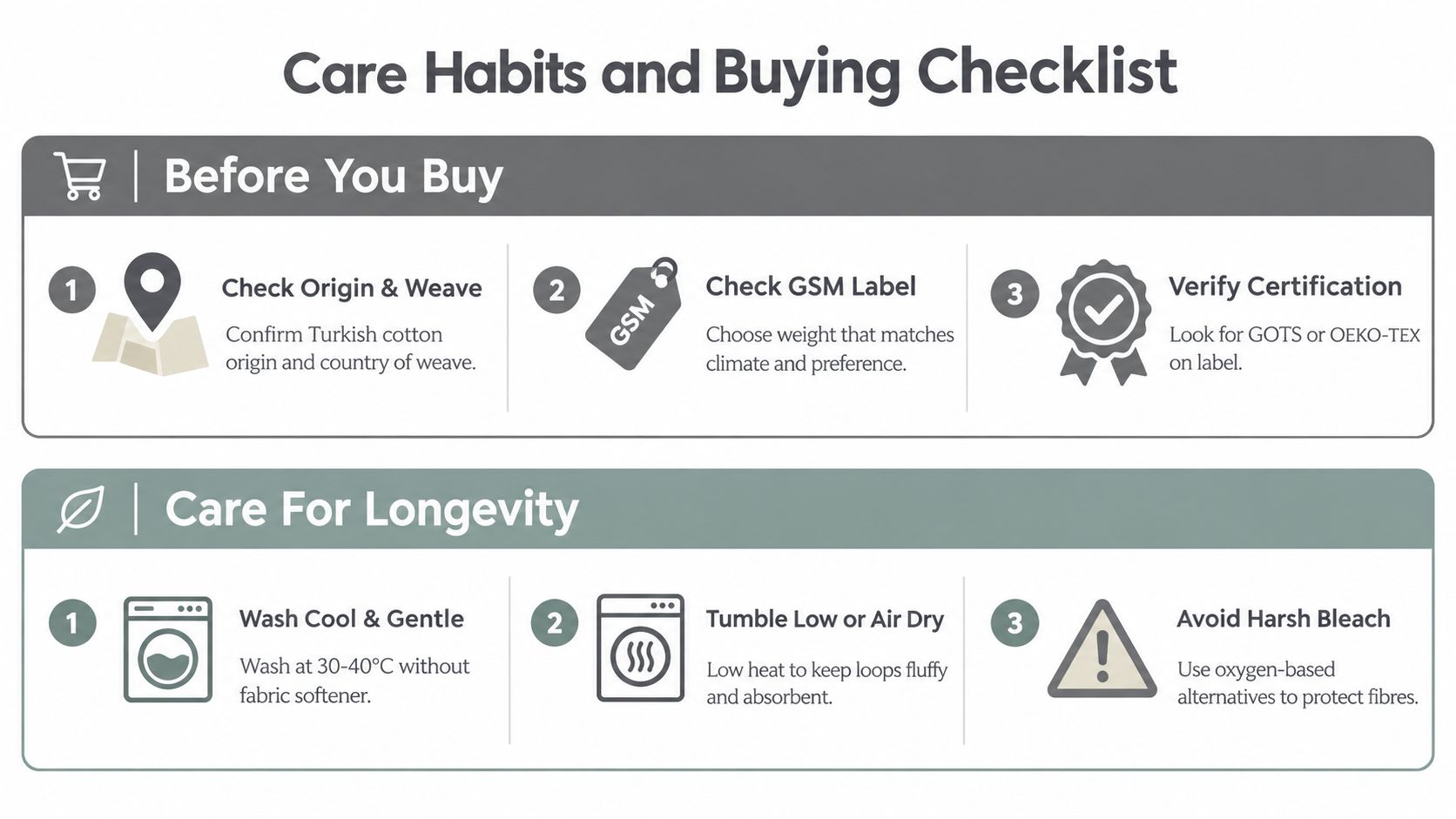
What to check before buying
People often focus on color first. Check construction first.
- Origin and fiber claim: Confirm that the robe clearly identifies Turkish cotton if that matters to you.
- Weave logic: Terry should show healthy loop structure. Waffle should look even and stable, not loose and flimsy.
- Weight for your routine: Match the robe to your bathroom conditions and wear frequency, not just to touch-in-store softness.
- Certification paperwork: If organic or lower-chemical processing matters, look for documentation rather than soft wording.
- Finishing details: Reinforced seams, secure belt loops, and clean hems are practical signs of care in manufacturing.
Habits that keep absorbency intact
Wash the robe before first use. That helps remove finishing residues and lets the cotton start behaving more naturally. Skip fabric softener if absorbency matters to you, because coatings can make cotton less effective at taking up water.
Low heat is safer than aggressive heat, especially for looped fabrics. Line drying also works well when space and weather allow. If you want a broader wardrobe perspective on caring for luxury textiles without overcomplicating it, Vivien Lauren's care guide has sensible principles that apply well to robes too.
A short checklist worth remembering
Buy for the climate, wash for the fiber, and judge the robe after real use, not after the first touch.
Use this quick filter before checkout:
- Will this robe dry me, warm me, or both
- Will it dry fast enough in my home
- Does the weave fit my routine
- Is the weight realistic for how often I'll wear and wash it
- If sustainability matters to me, is the claim documented
A luxury Turkish bathrobe earns its place when it keeps making your routine easier. Not just prettier.
If you're narrowing down what kind of Turkish robe fits your routine, SEYANTE offers 100% Turkish cotton terry and lightweight waffle robes, including GOTS-certified organic options, across hooded, kimono, hotel-style, and maternity designs. Visit SEYANTE to compare weaves, weights, and robe styles in a way that makes it easier to choose for your climate, your ritual, and your everyday comfort.