Organic Hooded Bathrobe: Terry vs Waffle Weave
- Why the Right Organic Hooded Bathrobe Matters
- Decoding GOTS Certification for Organic Textiles
- Turkish Terry vs Waffle Weave Performance
- Quality Indicators and Construction Details
- Matching the Robe to Your Specific Use Case
- Care and Maintenance for Lasting Softness
- Investing in Sustainable Everyday Comfort
You've just stepped out of a hot shower, your hair is dripping, and the bathroom feels cooler than expected. A standard robe may cover your body, but your shoulders, neck, and wet hair still need attention. A well-made organic hooded bathrobe solves that gap by combining head-to-toe coverage with fabric chosen for moisture, warmth, and comfortable skin contact.
The right choice isn't defined by softness alone. Fiber origin, weave structure, fabric density, hood design, and certification all shape how the robe feels after a shower and how well it performs after repeated washing. A thick terry robe can feel wonderfully cocooning, while a waffle robe may be easier to dry and more comfortable in a warm bathroom.
Why the Right Organic Hooded Bathrobe Matters
A hooded robe earns its place in a daily routine when it handles the moments immediately after bathing. Step out of a hot shower in a cool home and a collar-only robe leaves wet hair against your neck. A hood helps retain warmth around the head and shoulders, while an absorbent body fabric starts managing moisture without requiring a separate towel.
That combination matters for more than appearance. Someone with long hair may want to wrap the hood around damp strands while moving from the bathroom to the bedroom. Someone recovering after childbirth may prefer a robe that closes securely and offers warmth without needing to balance a towel. Even a quick morning shower feels calmer when the robe doesn't slide open or leave the upper body exposed.
Practical rule: Choose the hood for your actual routine, not for the product photograph. It should sit comfortably, cover wet hair, and stay in place without pulling at the neck.
The three decisions behind comfort
The first decision is the fiber. Organic cotton can provide a natural hand feel and strong moisture management, but “organic” on a label doesn't automatically tell you how the fiber was spun, dyed, finished, or sewn. Those stages influence softness, color stability, skin contact, and long-term wear.
The second is the weave. Terry uses raised loops that increase surface area and hold water effectively. Waffle fabric uses a recessed grid that feels lighter, breathes well, and can release moisture more readily during drying. Neither weave is universally superior. The better choice depends on whether you value plush absorbency or lightness and ventilation.
The third is verifiable certification. A robe can contain organic cotton without being certified across the full manufacturing chain. For shoppers who care about processing chemistry, traceability, and labor criteria, a recognized standard gives the material claim more meaning.
A premium robe also has to function as clothing. The belt should stay tied, the pockets shouldn't pull away from the side seams, and the hood should be shaped rather than loosely attached. These construction details determine whether the robe remains dependable after repeated use.
The broader bathrobe category has substantial commercial scale. Market estimates place it at USD 2.66 billion in 2025, with one projection reaching USD 4.66 billion by 2033, while another forecast estimates growth from USD 4.12 billion in 2025 to USD 6.13 billion by 2032. Cotton bathrobes are also a significant part of that market, with one estimate assigning them 35.2% share and USD 2.92 billion in 2025. These figures place organic hooded styles within an established apparel and home-textile category, not outside it as a novelty. Market estimates for the bathrobe category and cotton segment
Decoding GOTS Certification for Organic Textiles
You are comparing two hooded bathrobes that both say organic cotton. One feels substantial and carefully finished, while the other offers little information beyond the fiber label. The difference may lie not in the cotton plant alone, but in what happened to that fiber during spinning, dyeing, finishing, sewing, and distribution.
The word organic describes the fiber. It does not automatically describe the entire finished robe. A product page may mention organic cotton while leaving the rest of the manufacturing chain unclear. That distinction matters for a bathrobe worn close to the skin, often when the body is still damp.
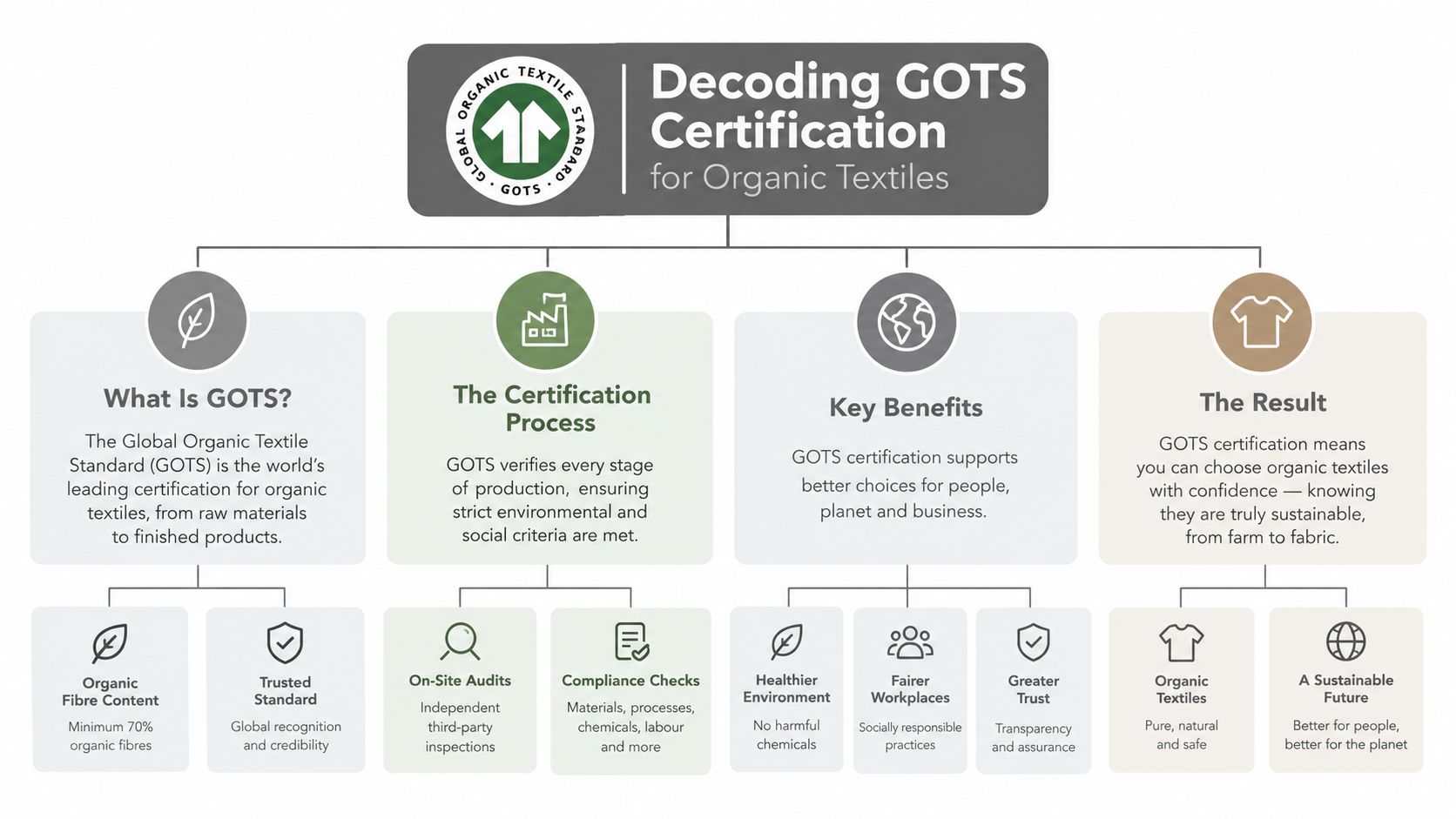
The Global Organic Textile Standard, or GOTS, evaluates more of that chain. Its requirements cover certified organic fibers and independent certification from fiber processing and spinning through wet processing, manufacturing, and trading. The “made with organic” grade requires at least 70% certified organic fibers, while the “organic” grade requires at least 95%. GOTS requirements for organic fiber content and supply-chain certification
Fiber content isn't the whole story
A cotton plant's growing method is one stage in a robe's journey. The fiber is cleaned, spun into yarn, woven or knitted, dyed or finished, cut, sewn, labeled, and distributed. Every stage can influence the fabric's hand, appearance, and suitability for next-to-skin wear.
GOTS connects those stages under one framework. The standard covers the supply chain from raw-fiber collection through manufacturing, labeling, and distribution. It also restricts specified hazardous inputs and requires independent third-party certification. Those chemical controls apply to processing, so they address more than the conditions of the original crop. The GOTS standard and its supply-chain, chemical, and certification requirements
Certification does not determine whether a robe has the right GSM, a durable weave, or a comfortable hood. A high-density terry robe may feel plush but take longer to dry, while a lighter waffle structure may suit warmer conditions. GOTS answers a different question: whether the organic claim and relevant processing stages meet a defined, independently checked standard.
How to verify a product page
Look past a small organic symbol. Check these details:
- The exact certification language: Does the page identify the robe as GOTS-certified, or only state that it contains organic cotton?
- The certified product or supplier: Confirm whether certification applies to the finished robe, the fabric mill, or another stage.
- The fiber percentage: “Organic cotton” and “100% organic cotton” are different claims, especially when trims, labels, or blended yarns are present.
- Processing information: Clear details about dyeing, finishing, and manufacturing indicate better supply-chain transparency.
- Supporting documentation: A credible seller should answer reasonable certification questions instead of relying on broad sustainability wording.
Verified organic textiles can also have higher input costs. Organic cotton lint reached 342,000 metric tons in 2024-25, representing 1.4% of global cotton production, and organic fiber commanded premiums of 20% to 30% over conventional fiber. These figures do not prove that every expensive robe is responsibly made. They help explain why traceable organic material may cost more than conventional cotton. Organic cotton production and premium information
Turkish Terry vs Waffle Weave Performance
The most useful fabric comparison starts with the weave rather than the country name. Terry has loops that stand proud of the base fabric, creating more surface area for water absorption. Waffle has a textured grid, usually with recessed cells that reduce weight and encourage airflow.
Turkish cotton can be used in both structures. The label tells you about fiber origin and tradition, but it doesn't by itself determine whether the robe will feel heavy, dry quickly, or absorb like a towel. For that, inspect the weave and the GSM, or grams per square meter.
| Feature | Turkish Terry | Waffle Weave |
|---|---|---|
| Surface structure | Raised loops | Textured grid |
| Moisture handling | Strong absorption, especially with longer loops | Moderate absorption with a lighter hand |
| Warmth | Plush and insulating | Breathable and less bulky |
| Drying behavior | Takes longer as density and pile increase | Usually releases moisture more readily |
| Drape | Fuller, weightier fall | Lighter, easier movement |
| Best fit | Chilly mornings, spa use, towel-like comfort | Warm climates, travel, post-workout routines |
Reading GSM without overcomplicating it
GSM describes fabric density, not quality by itself. Independent textile guidance generally places 300–400 GSM in the lightweight-to-standard range, 400–600 GSM in the everyday and spa range, and fabrics above 600 GSM in the heavy hotel-grade range. Guidance on GSM, terry construction, absorbency, warmth, and drying
A 400–600 GSM terry hooded robe often offers a practical middle ground. It can absorb water and provide satisfying drape without becoming so heavy that wearing it feels like carrying a wet towel. Higher-density terry suits someone who wants maximum plushness and warmth, but it can take longer to dry, especially in a poorly ventilated bathroom.
A lighter waffle robe makes more sense when you shower after exercise, live in a humid climate, or need a robe that fits easily into a suitcase. Its texture can feel pleasantly structured rather than fluffy, and its lighter mass makes daily handling simpler.
The fabric that feels most luxurious in a hotel suite may not be the fabric you want to wash and dry at home.
Don't confuse plushness with performance
Plush is a sensation created by pile height, density, finishing, and fiber feel. It isn't a technical guarantee of absorbency or durability. If you're comparing fuzzy textile terminology more broadly, this explanation of the diferencia entre plush fleece y fleece offers useful context on why surface feel and fabric construction aren't interchangeable.
For a robe, ask how you'll use it. Terry is the stronger choice when you want the robe to participate in drying after a bath. Waffle is the better fit when the robe's main job is light coverage, ventilation, and comfortable movement after you've already towel-dried.
Quality Indicators and Construction Details
A robe can have attractive fabric and still disappoint if the pattern and stitching are careless. Inspect the garment as you would a well-cut jacket. The important clues appear at points where the wearer pulls, ties, sits, and reaches.
Start with the hood. It should be deep enough to cover wet hair without forcing your head forward. The seam joining the hood to the neckline deserves close attention because it carries movement from the head and shoulders. A shaped hood with a stable opening usually performs better than a flat piece of fabric attached for appearance alone.
Inspect the stress points
Pockets receive repeated strain when you place both hands inside or carry small items. Their openings should be cleanly finished, and the corners should have reinforcement rather than relying on a single line of stitching. Belt loops need similar attention. A loop sewn securely into the side seam will tolerate daily tying better than a narrow strip attached with minimal stitching.
Check the front closure too. An exterior belt provides adjustment, but an interior tie helps keep the robe closed when you bend, walk, or sit. This small feature improves security without requiring a tight belt.
Look for:
- Double-stitched hems: They help stabilize the lower edge and sleeve openings.
- Neat seam finishing: Loose threads can become wash-day problems.
- Even loop pile: Terry should look consistent rather than thin in random areas.
- Balanced sleeve width: Sleeves should allow movement without dragging through water.
- Useful pocket placement: Pockets should be reachable without distorting the side seams.

Read the product photographs critically
Online photos can show texture, but they rarely reveal weight or seam strength. Look for close-ups of the hood, cuffs, pockets, belt loops, and inside closure. A product description should state the fiber composition and, ideally, the weave or fabric weight.
Sizing is equally practical. A hooded robe needs enough room across the shoulders and upper arms to layer over damp sleepwear, but excessive volume can make the hood shift and the belt drag. Use the garment measurements rather than choosing only by your usual clothing size.
Finally, consider how the robe will be washed. A dense terry style may need more drying space than a lightweight waffle style. Construction quality includes not only how the garment looks on day one, but also whether its seams, loops, and closures are prepared for the routine you'll give it.
Matching the Robe to Your Specific Use Case
The best organic hooded bathrobe is the one that matches the job. Start by deciding whether you need drying, warmth, breathability, or portable coverage. Most robes can provide several of these, but the weave and GSM determine which function leads.
For chilly mornings, slow starts, and postpartum recovery, a medium or heavier terry robe offers reassuring coverage. The hood can protect wet hair and the back of the neck, while the looped surface creates a towel-like feel against the body. Choose a structured hood, secure interior tie, and generous sleeves so you can move comfortably without the robe opening.
Postpartum shoppers may also value a robe that doesn't feel restrictive around the waist. A flexible belt position and a forgiving cut matter more than an aggressively fitted silhouette. Check the care instructions before buying because frequent washing is likely to be part of the routine.
Choose lighter fabric for movement
A waffle robe suits a different rhythm. It works well after a workout when you've already dried off and want a breathable layer, or in a warm climate where heavy terry feels excessive. The lighter structure also makes it practical for travel, especially when luggage space and drying convenience matter.
For spa days, the decision depends on the treatment and environment. Terry creates a plush, enveloping experience for lounging, while waffle feels lighter during movement between a shower, sauna, treatment room, and resting area. A hospitality buyer may choose both styles to serve different guest preferences rather than forcing one fabric to do everything.
Boutique hotels and spas should evaluate more than appearance. A useful procurement checklist includes:
- Consistent sizing: Guests should receive a predictable fit across the range.
- Durable closure points: Belt loops and interior ties must withstand frequent handling.
- Wash practicality: The robe should suit the property's laundering and drying process.
- Clear material information: Staff need accurate answers when guests ask about organic content or certification.
- Coordinated accessories: Hair turbans, towel wraps, or matching robes can create a more cohesive experience.
Gifting introduces another consideration, presentation. A hooded terry robe feels generous and cocooning, while waffle can look refined and contemporary. For bridal parties or coordinated gifts, prioritize clear sizing guidance and an exchange process that allows recipients to find a comfortable fit.
The key is to match fabric weight to the recipient's routine. A robe for a cold bathroom should not be selected using the same criteria as one intended for summer travel.
Care and Maintenance for Lasting Softness
Organic cotton becomes more useful when you care for it according to its construction. The goal isn't to make a robe feel artificially slick. It's to preserve the natural absorbency, flexible hand, and structural stability that made you choose cotton in the first place.
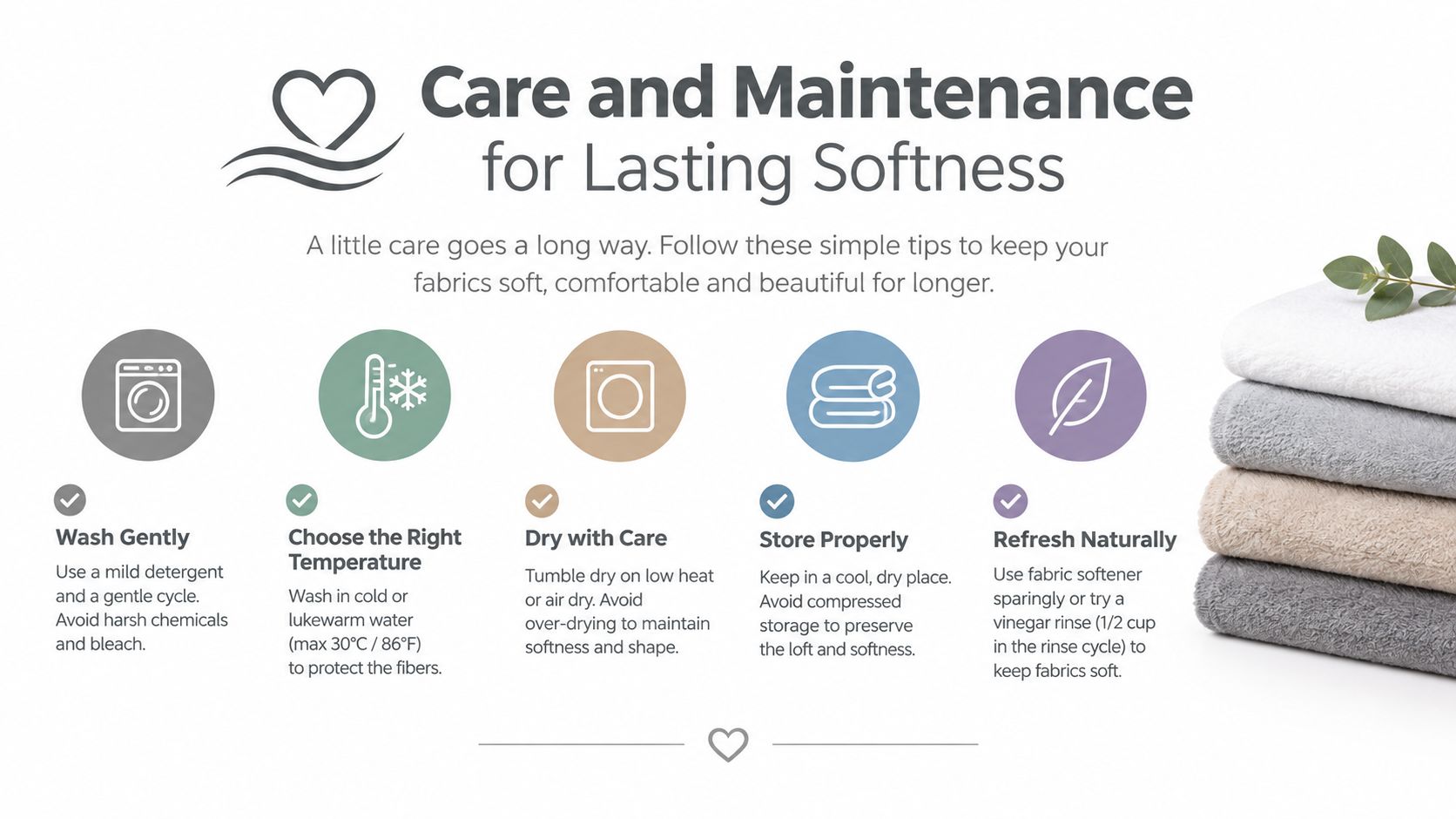
Read the sewn-in care label first. Manufacturers may recommend different temperatures, cycles, or drying methods depending on the dye, trim, and finish. Then follow a simple routine:
- Wash with similar textiles: Keep the robe away from garments with zippers, hooks, or rough hardware.
- Use a mild detergent: Harsh chemistry can stress cotton fibers and affect the hand feel.
- Skip routine fabric softener: Softener can coat absorbent loops and reduce their ability to take up water.
- Avoid overloading: The robe needs room for water and detergent to move through the fabric.
- Dry promptly: Leaving damp cotton in the machine encourages stale odors and unnecessary creasing.
Adjust drying to the weave
Dense terry needs patience. Tumble drying on a suitable setting can help restore loft, but excessive heat may stress fibers and shrinkage-prone areas. If you line-dry a heavy robe, spread it fully over a strong drying surface rather than leaving it bunched over a narrow rail.
Waffle fabric usually benefits from airflow because its lighter structure releases moisture more easily. Don't assume that lighter means indestructible. Repeated high heat can still affect cotton, seams, and dimensional stability.
New terry robes may shed loose lint during early washes. That doesn't necessarily indicate a defect. Wash the robe separately or with similar towels until loose fibers diminish, and avoid mistaking temporary lint for pilling. Pilling can result from friction, especially where the robe rubs against furniture or rough clothing. Gentle washing and reduced abrasion help limit it.
If the robe feels stiff, review the detergent amount, rinse performance, and drying method before adding more product. Residue, hard water, and incomplete drying can all change the hand feel. Store the robe completely dry with enough space for air circulation, particularly in a humid bathroom.
Investing in Sustainable Everyday Comfort
A robe becomes a worthwhile everyday purchase when its materials, construction, and care demands fit your routine. Ask four practical questions: Is the organic claim verifiable? Is the weave suited to your habits? Does the GSM suit your climate and preferred warmth? Can the construction handle regular washing? A high GSM cannot compensate for an unsuitable weave, and a certified fiber cannot make weak seams durable.
GOTS certification gives “organic” a wider meaning. It connects fiber content with processing, manufacturing, labeling, and distribution, rather than assessing the cotton alone. The standard is used in more than 70 countries, and the number of GOTS-certified facilities grew 15.4% in 2025 to 17,800 globally. That growth reflects broader certified processing, but the label still deserves a close check. Confirm that certification applies to the robe or its specific supply chain, not merely to an unrelated material claim. GOTS adoption and certified-facility information
Sustainable sourcing is also becoming part of how shoppers judge value. Organic textiles grew 7.4% over 2023 to USD 2.5 billion in 2024, with decade-long growth of 92%. Independent bathrobe market data reports that nearly 48% of buyers prefer organic cotton or sustainable fabrics, while 31% choose environmentally friendly dyes. These figures connect environmental choices with the purchasing experience, including how a robe feels, performs, and fits personal values. Organic textile market and buyer-preference information.pdf)
Before ordering, compare the sizing guide with garment measurements. Check the return window and care instructions too. Shoulder width, sleeve length, body coverage, and layering room rarely show clearly in a styled photograph.
For daily use, choose terry when absorbency and warmth matter most. Choose waffle when a lighter feel and faster drying suit your routine. Then verify the organic claim with documentation, not a green-colored label or vague wording.
SEYANTE offers organic hooded bathrobes in Turkish cotton terry and lightweight waffle weaves, with GOTS-certified options, sizing guidance, and styles for everyday self-care, gifting, maternity, and hospitality use. Visit SEYANTE to compare robe constructions and select a fabric weight and hooded fit for your routine.