Towel Wrap Monogrammed Guide to Style and Care
- Introduction to Monogrammed Towel Wraps and Why They Feel Special
- What Makes a Towel Wrap Ready for Monogramming
- Embroidery vs Printing for Your Towel Wrap Monogram
- Where to Place Your Monogram for Comfort and Style
- Choosing Fonts Colors and Monogram Styles You Will Love
- Personalization Ideas for Gifts Bridal Parties and Everyday Luxury
- How to Care for Your Monogrammed Towel Wrap So It Lasts
You've found the right gift, but you're hesitating over the details. Will the embroidery make the wrap stiff? Should the initials sit at the chest or near the hem? Can a personalized piece be returned if the size or style isn't right? A towel wrap monogrammed with care can feel like a private spa ritual, a thoughtful bridal gift, or a polished hospitality amenity. Done without considering fabric construction, placement, and policy, it can look attractive while being less comfortable to wear.
Introduction to Monogrammed Towel Wraps and Why They Feel Special
A plain towel wrap already solves a practical problem. It gives you coverage after a bath, keeps damp skin comfortable while you get ready, and turns a routine transition into a calmer moment. Add a carefully chosen monogram, and the same wrap becomes more personal. A single initial can make it feel like a daily signature, while coordinated initials can turn a group of wraps into a meaningful bridal-party gift.
Consider a newly graduated student leaving home for the first time. A monogrammed wrap isn't only decorative in that setting. It marks an everyday object as hers, something useful enough to wear regularly but personal enough to remember who gave it to her. The same idea works for a housewarming present, a birthday bundle, or a self-care set assembled for someone who enjoys spa-like comfort at home.
Monogrammed towels also have a deeper textile history. Museum records describe embroidered towels as culturally significant textiles used for centuries, and note that Turkish towels became popular souvenirs among American and European tourists from the 18th century onward. Russian embroidered towels from the late 19th and early 20th centuries further show how towel embellishment developed into an established craft tradition. You can explore that history through the RISD Museum's account of Turkish towels.
The useful distinction: personalization should add identity without taking away softness, absorbency, or easy care.
That balance guides every good buying decision. First, look at the wrap itself, including its fiber, weave, weight, and finished edge. Then choose between stitched and printed personalization, decide where the design should sit, and confirm how the item will be washed and whether custom orders are returnable. For a practical overview of how a wrap functions in warm-weather routines, see how towel wraps support comfort in summer.
What Makes a Towel Wrap Ready for Monogramming
The best base for personalization is stable enough to support thread but comfortable enough to wear directly against the skin. Start by identifying the weave. Terry cloth has raised loops, much like a plush carpet. Those loops provide absorbency and give embroidery a substantial surface, but dense stitching can flatten or stiffen the area underneath.
A waffle weave behaves differently. Its recessed squares create a lighter, more breathable texture, similar to a small honeycomb. It can look refined and feel less bulky, but the monogrammer must keep the design appropriately sized and avoid excessive stitch density. A design that is too heavy can pull at the texture or interrupt the wrap's natural drape.
Fiber matters, too. Cotton generally gives a comfortable, absorbent foundation, while the specific yarn quality and finishing determine how smoothly the wrap handles washing and embroidery. If you're comparing Turkish cotton options, this guide to what makes Turkish cotton distinctive can help you assess the base before adding personalization.
Inspect the wrap before ordering
Use a simple pre-personalization checklist:
- Surface stability: Look for an even weave without loose, weak areas around the intended design.
- Finished border: A clear hem or border gives the embroiderer a reliable visual anchor and a practical placement zone.
- Closure construction: Check whether the wrap uses elastic, a button, or a tie. The monogram shouldn't interfere with the fastening.
- Comfort against skin: A beautiful design won't compensate for scratchy thread, bulky backing, or a wrap that fits poorly.
- Care instructions: Confirm that the fabric and thread can tolerate the laundering routine you expect.
The global bath linen market has been estimated at about US$12.6 billion in 2024 and is projected to reach US$17.1 billion by 2030, a 5.2% CAGR, according to Research and Markets' bath linen market overview. That growth reflects the way buyers increasingly treat bath linens as both everyday necessities and premium home products.
Before approving a design, ask for a clear description of the thread type, backing, design dimensions, and placement. The more textured the fabric, the more important it is to see how the proposed lettering will sit on the surface rather than judging the digital artwork alone.
Embroidery vs Printing for Your Towel Wrap Monogram
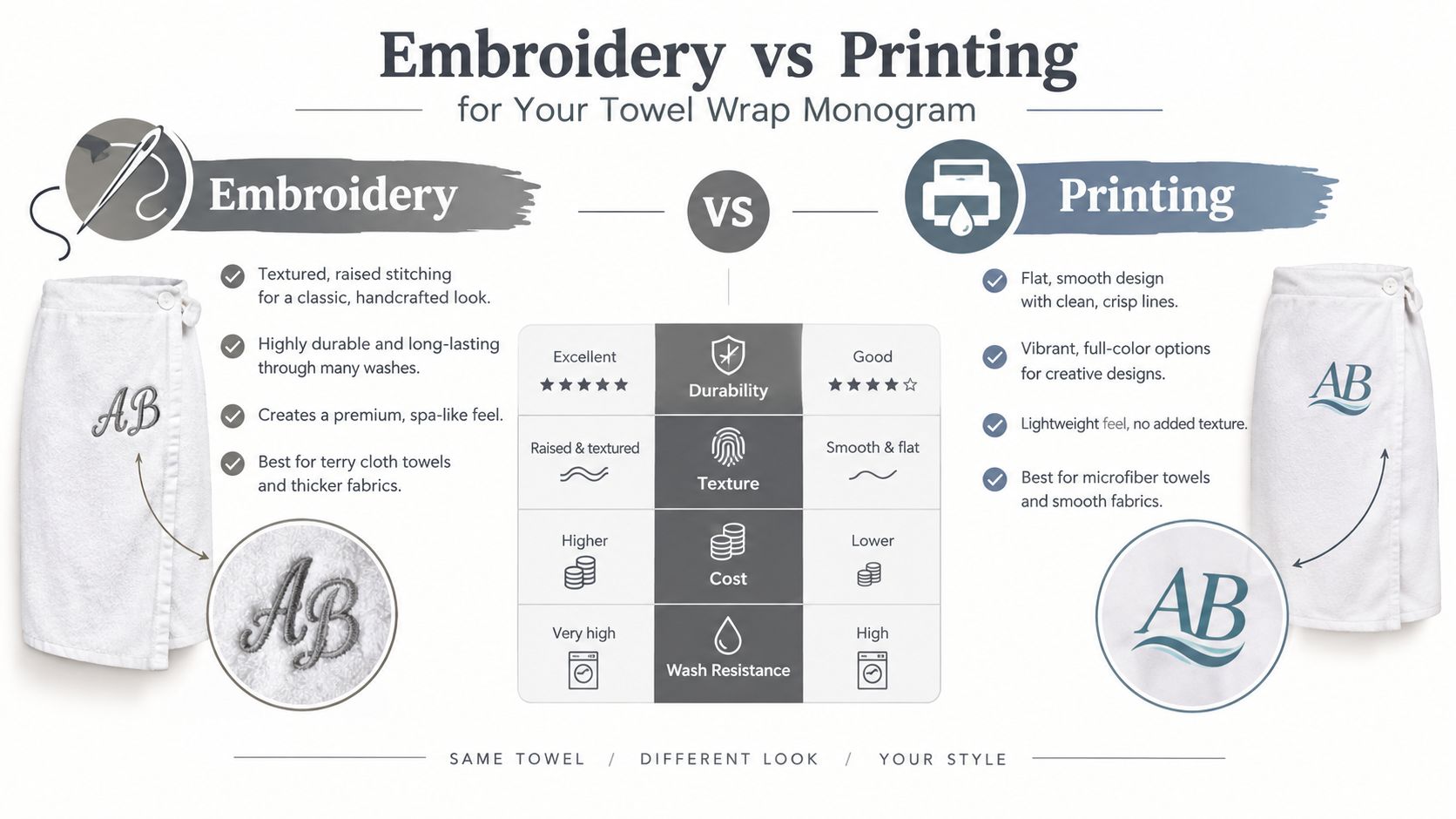
Embroidery and printing create distinctly different experiences. Embroidery adds physical texture, while printing keeps the design flat. That difference affects the way the wrap looks, feels, and ages.
| Feature | Embroidery | Printing |
|---|---|---|
| Surface feel | Raised or dimensional | Flat and smooth |
| Visual character | Traditional, tailored, spa-inspired | Graphic, colorful, contemporary |
| Strongest use | Terry and structured cotton wraps | Smooth, lightweight, or synthetic surfaces |
| Main consideration | Dense stitching can create a firm patch | Surface treatment may wear differently with laundering |
| Perceived finish | Often reads as a keepsake detail | Works well for expressive artwork |
Embroidery usually suits a monogram because initials are small, symbolic, and easy to appreciate as a tactile detail. A satin stitch can create a polished letter, while an outline or lighter fill can preserve more flexibility. Stitch density matters more than many buyers realize. More thread doesn't automatically mean better quality. On a towel, excessive density can make the decorated zone feel rigid and reduce its ability to bend naturally.
Printing makes sense when you want a full-color motif, a very flat finish, or a design that would be difficult to reproduce with thread. It can also suit a smoother fabric where raised stitching would feel out of place. The right choice depends on the use case rather than on a universal hierarchy.
Match the method to the occasion
For a daily self-care wrap, choose the method that preserves comfort first. For a bridal gift, embroidery often supports the keepsake quality of initials or a wedding date, provided the lettering remains restrained. For hospitality, think about whether guests should see a subtle emblem or a more visible brand treatment. A small mark can feel considered, while a large design may shift the item from personal amenity to advertising.
Monogram order also matters. Confirm the exact initials, capitalization, font, thread color, and final dimensions before production.
If the seller offers a mockup, inspect it at the wrap's actual scale. A letter that looks elegant on a screen can become too dominant once stitched onto a narrow front panel. Conversely, an ultra-small monogram may disappear into a waffle texture or a thick terry pile.
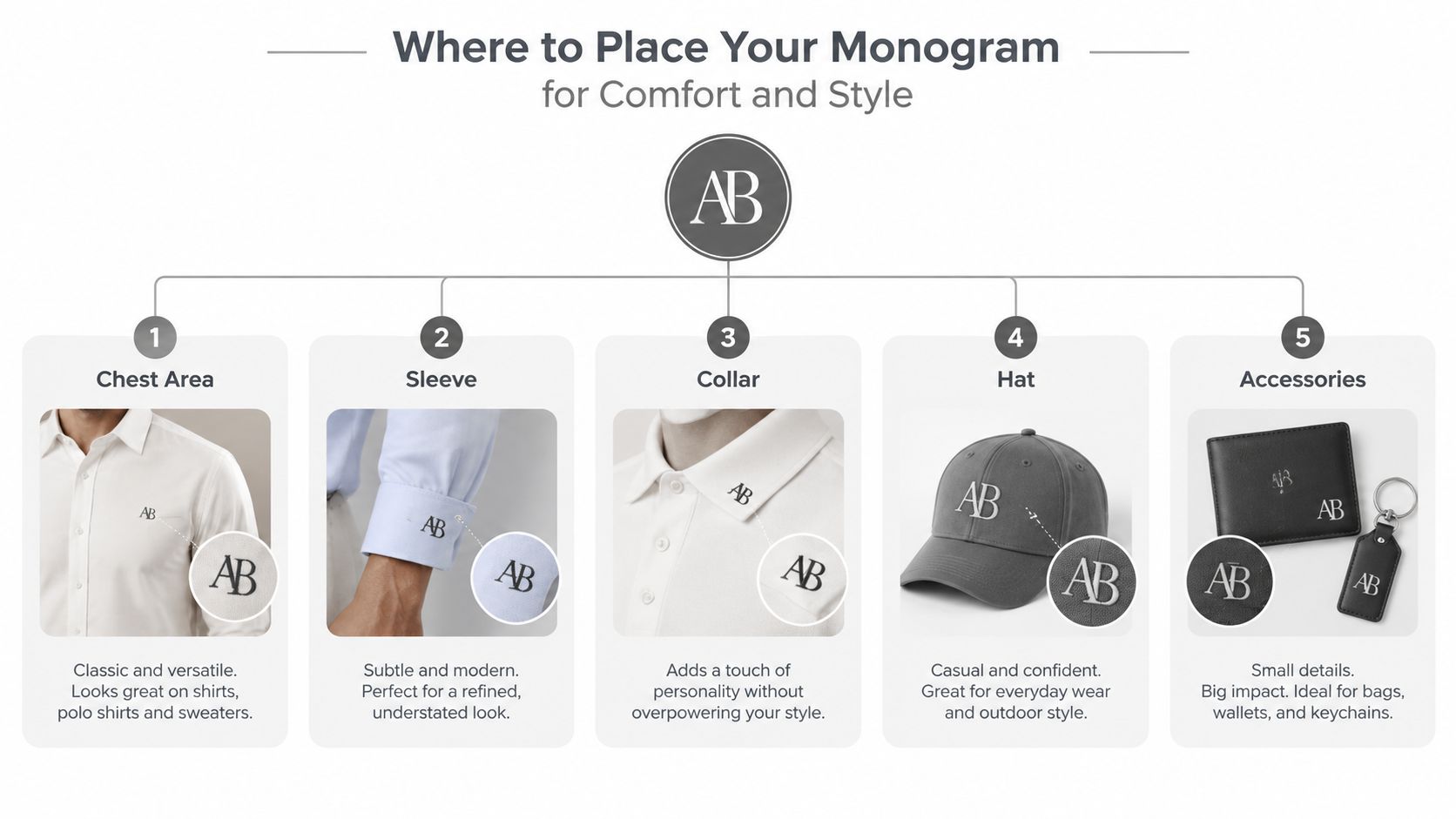
Where to Place Your Monogram for Comfort and Style
Placement is a performance decision, not only a styling decision. Embroidery creates a locally firmer area, so the design should sit outside the wrap's main absorbent field and align with a hem or border whenever possible. That keeps the central surface flexible and allows the wrap to dry and drape more naturally.
For towel sets, embroidery guidance places the bottom edge of a bath-towel monogram about 2 inches above the border, or 4 inches above the hem when there's no border. The corresponding guidance places a hand-towel design about 1.5 inches above the border and a washcloth design about 1 inch above the border. These measurements come from technical monogram placement guidance for towel sets. A wrap isn't identical to a bath towel, but the principle carries over: keep dense stitching away from the area doing the most absorbing.
Think about the wrap's front panel
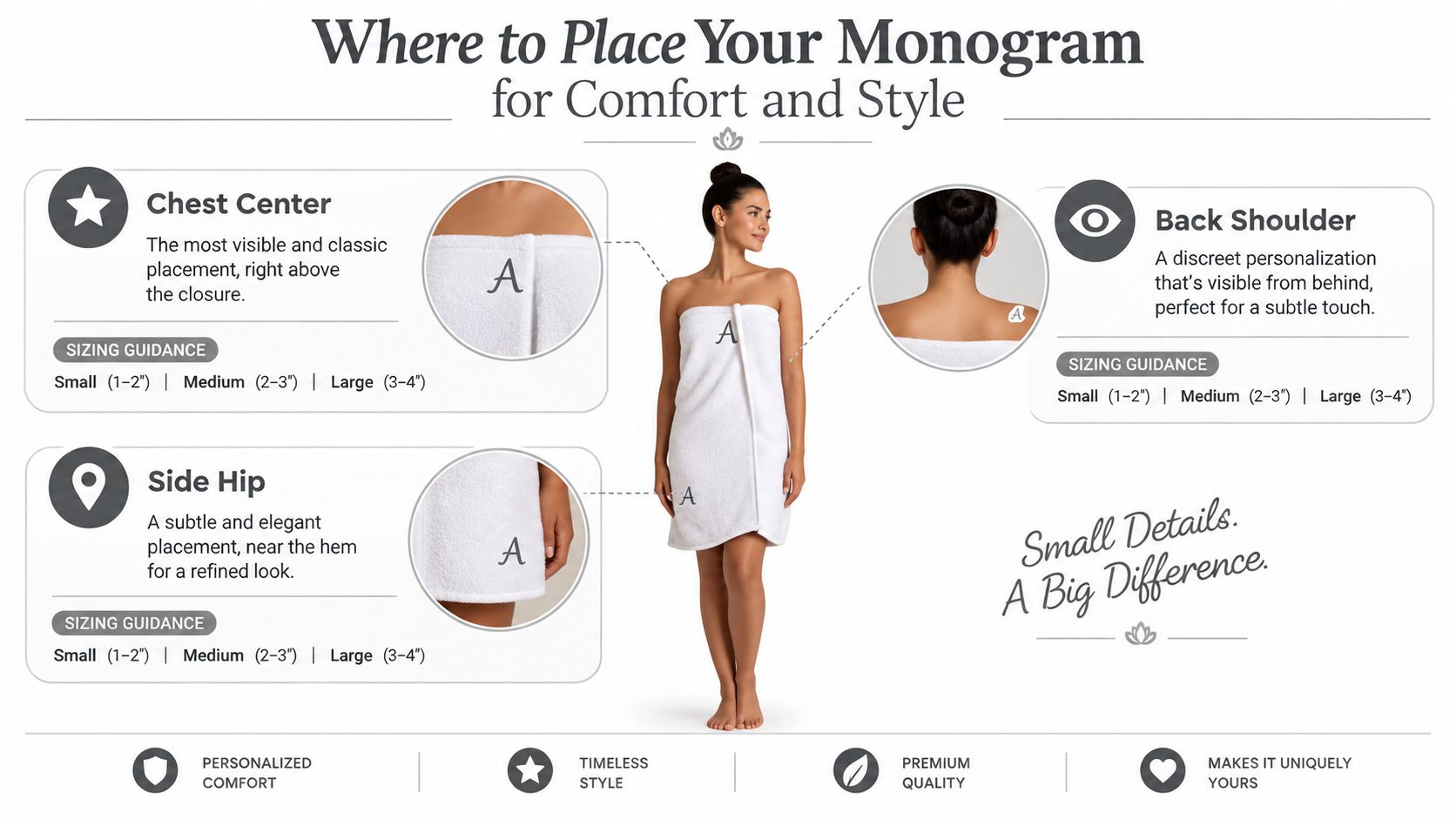
A chest-center monogram offers the strongest visibility, especially when the wrap is worn open over a robe or used in a spa setting. It should sit above the closure and away from elastic, buttons, and tie channels. If the front panel is narrow, reduce the lettering rather than forcing a wide design into the available space.
A side-hip monogram feels quieter and can be easier to place near a lower border. It suits buyers who want personalization without making the initials the first thing anyone notices. A back-shoulder position offers discreet visibility from behind, but check whether the shoulder area stretches or folds during wear.
Keep body shape and fit in the calculation
The same design won't sit identically on every wrap. A longer wrap may offer enough lower-panel space for a larger monogram, while a shorter style may place the design close to the waist or closure. Consider where the fabric will overlap, especially if the wrap uses a tie or adjustable fastening.
Placement rule: put the decoration where the fabric is stable, visible, and least responsible for absorbing water.
Ask the seller how the design will be stabilized. A light backing can support the stitches, but an overly firm backing may create an uncomfortable patch against the body. If you're choosing a dense script, request a smaller test or a lower-density interpretation where possible.
Choosing Fonts Colors and Monogram Styles You Will Love
Once construction and placement are settled, the visual language becomes easier to choose. Start with the message you want the wrap to send. A single initial feels modern and restrained. A full name is clearer for shared bathrooms, travel, or hospitality. A traditional three-letter monogram carries more formality, but confirm the ordering convention before production because families and regions don't always use the same arrangement.
Font style changes the perceived weight of the design:
- Script lettering feels romantic and works well for bridal or feminine gift sets, but it needs enough open space to remain legible.
- Block lettering gives a clean, confident finish and suits everyday use.
- Serif lettering adds a heritage-inspired character without requiring elaborate flourishes.
- Interlocking initials create a more decorative emblem, though dense overlaps can become hard to read at small sizes.
- Minimal line lettering keeps a waffle wrap airy and contemporary.
Color controls contrast. White thread on a white wrap can create a quiet, tone-on-tone effect, while a deeper thread gives the initials more presence. On a terra cotta wrap, cream, warm white, or a muted neutral can preserve a soft spa palette. On a white wrap, charcoal or a restrained earthy shade offers definition without making the design look corporate.
Thread sheen also changes the result. A slightly lustrous thread catches light and makes formal lettering stand out. A matte thread looks more understated and can suit a minimalist monogram. Before committing, compare the thread against the actual fabric in daylight. Digital color previews can't fully show how texture, pile, and sheen interact.
Use scale as a design tool
The monogram should be easy to recognize without overpowering the wrap. A large design can work on a broad chest panel, while a smaller mark is usually more successful near a hem or side hip. Consider the recipient, too. A simple initial may feel more personal than a large family emblem for someone who prefers quiet details.
Coordinate, don't duplicate
For a gift set, repeat one element rather than every element. Matching thread color across different wrap shades creates cohesion, while allowing each recipient to choose a different initial style preserves individuality. If the wrap is already textured, a cleaner font often gives the eye enough rest.
Personalization Ideas for Gifts Bridal Parties and Everyday Luxury
A monogrammed wrap works because it combines a practical object with a personal signal. That makes it suitable for occasions where a purely decorative gift might be forgotten. The recipient can wear it after bathing, while getting ready for the day, or during a relaxed morning at home.
For a bridal party, select one base color and thread family, then personalize each wrap with a single initial or first name. Coordinated styling looks polished without forcing every person into the same font. If the group has different preferences, keep the placement consistent and let the lettering vary slightly.
A birthday or housewarming gift can be more individual. Pair the wrap with a hair turban, a robe, or a small bath accessory in a related color. A white wrap with tonal stitching feels calm and versatile, while a terra cotta wrap with cream lettering creates a warmer, more expressive combination. Lightweight GOTS-certified waffle towel wraps can suit recipients who prefer breathable texture and a less bulky post-bath layer.
Keep hospitality personalization restrained
In a boutique guest setting, the decision is less about giving each item a personal identity and more about creating a memorable amenity. A small emblem near the lower border can communicate care without making the wrap feel like promotional merchandise. Use the same placement across the set, and check that the decoration won't sit against the most sensitive areas of the body.
The broader personalization market is moving beyond one-off novelty gifts. Coverage of customized textiles identifies weddings, corporate gifting, hospitality, and special occasions as important uses because these products combine practical use with lasting visibility. The global personalized gifts market was projected to grow at about 9% CAGR through 2026, according to personalization trend coverage in the towel industry.
A luxury cue is restraint. One well-placed initial can feel more considered than a large design competing with the fabric.
For everyday self-care, personalize for the person who'll wear the wrap, not for the photograph of the gift. A durable base, comfortable fit, and sensible placement matter more than elaborate lettering.
How to Care for Your Monogrammed Towel Wrap So It Lasts
Care should protect two different materials at once: the cotton pile and the embroidered thread. A gentle routine gives both a better chance of retaining their original feel. Before the first use, pre-washing can help remove finishing substances and settle the thread into the fabric.
Use these basic practices:
- Choose cold to warm water. This reduces stress on both the fabric and the decoration.
- Use mild detergent. Strong chemicals can affect fibers and thread color over time.
- Skip fabric softener. It coats towel loops and can reduce absorbency, even when the wrap still feels soft.
- Tumble dry on low heat. High heat can put unnecessary strain on cotton and stitched details.
- Avoid aggressive handling. Don't pull at loose threads or twist the embroidered area sharply.
Commercial laundering at around 60°C can be feasible when the base towel is sufficiently heavy, such as 600 GSM, and the embroidery has been designed to withstand that process. For home use, follow the care label first because weave, finishing, and thread can vary.
Check ownership details before personalization
Custom items are often treated differently from standard products. Some retailers make monogrammed bath items non-returnable, so confirm the return policy, production timing, size chart, and spelling approval process before you submit the order. This matters especially when the wrap is a gift or when you're uncertain about fit.
For broader robe and textile maintenance, this guide to washing, storing, and caring for a robe offers related storage principles. Let the wrap dry fully before folding it, and store it somewhere ventilated rather than compressing it while damp.
A well-chosen towel wrap monogrammed outside the main absorbent field can remain soft, useful, and distinctive. Treat the embroidery as part of the textile, not as an indestructible label, and it should age with the wrap rather than compete with it.
SEYANTE offers lightweight waffle towel wraps made from Turkish cotton, including white and terra cotta options, alongside robes and hair turbans for coordinated self-care and gifting. Choose the fabric, placement, and personalization approach that fit the recipient, then visit SEYANTE to explore the collection.