Bathrobe with a Hooded: Materials, Fit and Care Guide
- Hooded Bathrobe Materials at a Glance
- How Terry, Waffle and Velour Absorb and Dry
- Matching a Hooded Robe to Your Climate and Routine
- Checking Size and Hood Fit Before You Buy
- Caring for a Hooded Robe So It Keeps Drying Well
- What Organic and Certified Claims Cover
- Choose Your Hooded Bathrobe Before You Buy
What good is a plush hood if it's still damp when you want to wear your robe again? A hood can make the moment after a shower more comfortable, but it also adds fabric that needs washing, drying, and space to hang.
If you're searching for a bathrobe with a hooded design, start with the fabric rather than the silhouette. The right choice should suit your bathroom's temperature, your tolerance for weight, and how quickly you need the robe ready for its next use.
Hooded Bathrobe Materials at a Glance
| Fabric | Feel and warmth | Absorbency | Drying speed | Best for |
|---|---|---|---|---|
| Turkish cotton terry | Heavy, plush, warm right after bathing | Highest in this general comparison | Usually slowest | Cold rooms and maximum post-bath absorbency |
| Cotton waffle | Light, textured, cooler | High in a suitable absorbent construction | Usually fastest | Warm or humid homes, travel, and daily use |
| Cotton velour | Dense soft pile, moderately warm | Moderate on the cut-pile face | Often between terry and waffle | Plush lounge feel when drying time matters less |
Terry gives you the most towel-like experience, with substantial fabric that feels reassuring after bathing but asks for more drying space.
Waffle trades some of that enveloping feel for a lighter garment that's easier to pack, wear for longer periods, and hang without bulky folds.
Velour prioritizes a smooth, soft surface, making it appealing when you're already mostly dry and want something comfortable for lounging.
Read the fabric name carefully
These are buying guidelines, not guaranteed performance rankings. A lightweight terry robe can dry sooner than an unusually heavy waffle robe, while velour may have a cut-pile outer face and absorbent loops inside. Check both surfaces rather than judging the garment by its exterior photograph.
“Turkish cotton” describes the cotton's origin, while “terry,” “waffle,” and “velour” describe textile construction or surface treatment. They aren't interchangeable quality labels. Our guide to bathrobe materials and fabric types can help you separate fiber descriptions from weave and finish.
The hood follows the behavior of its fabric. A substantial terry hood feels different from a light waffle hood, even when both have the same shape. Also check whether the hood is lined, since another layer changes its bulk.
Practical rule: Pick terry for cold rooms and post-bath absorbency, waffle for quicker turnaround and comfort in heat, and velour for a plush lounge feel when drying time matters less.
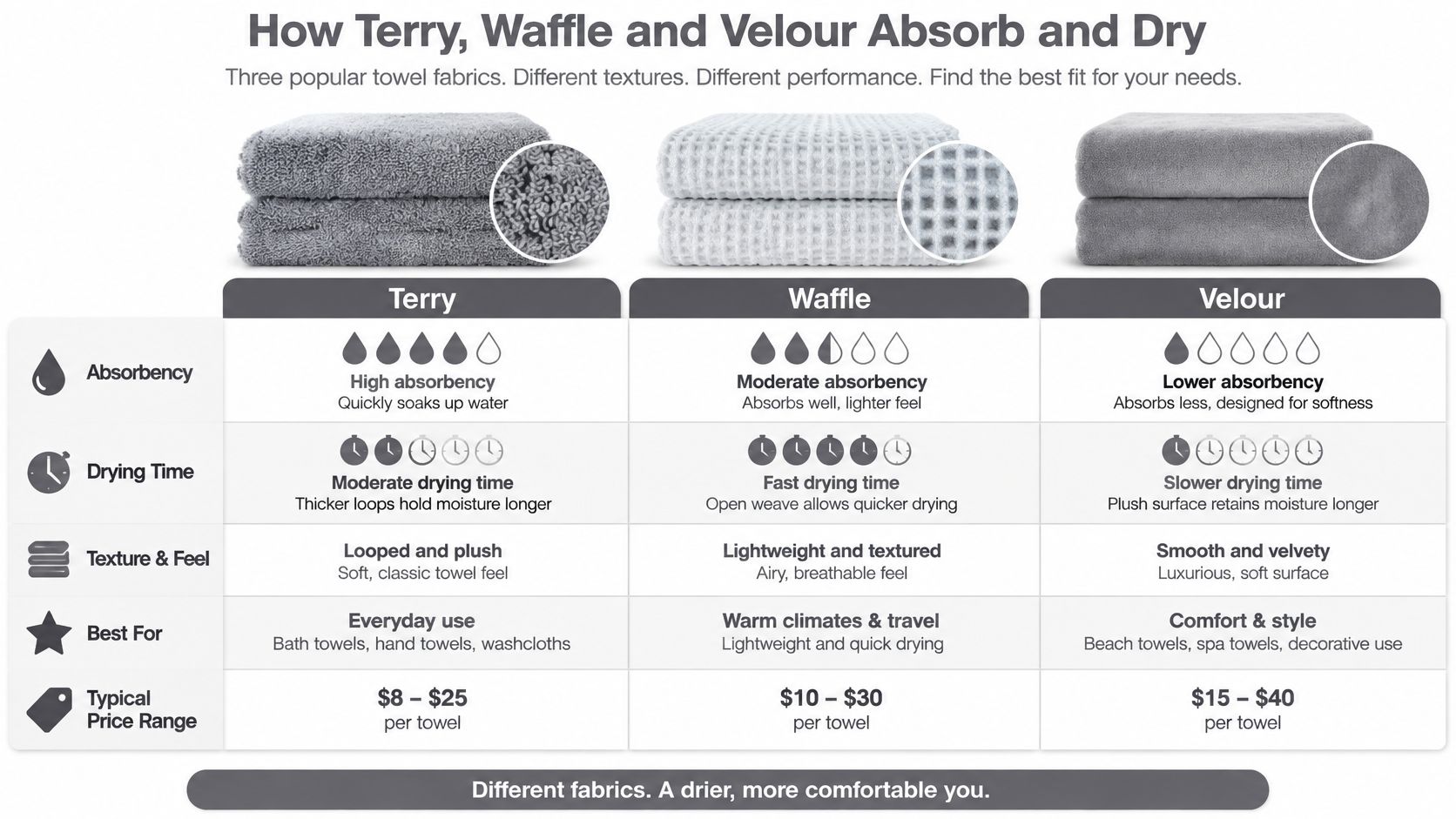
How Terry, Waffle and Velour Absorb and Dry
Terry's protruding loops give water more surface to contact. The Institute of Making at University College London explains this looped construction and its use in absorbent towels, the same basic textile technology used in many bathrobes.
But more fabric doesn't automatically mean faster absorption. A compact weave can resist water entry even when it feels thick. A review of terry textile performance identifies loop geometry and fabric density as important variables, with greater weft density reducing pore size and slowing water penetration.
Separate pickup speed from capacity
Absorbency rate means how quickly the fabric takes in water. Total water uptake means how much it can hold. You might want fast pickup against wet skin, but holding more water also leaves more moisture to remove afterward.
Waffle fabric uses a recessed grid rather than a deep towel-like pile. In a lighter construction, there's less wet material to dry. Velour has cut pile that feels smoother than intact loops; check the inner face to understand which surface will touch your skin.
Compare these details together:
- Fabric weight: GSM means grams per square meter. It describes mass per area, not a complete quality score.
- Pile and construction: Look for accessible loops and a fabric that bends comfortably rather than feeling tightly packed.
- Post-wash dimensions: Check shrinkage guidance so the robe remains wearable after laundering.
With a sample you own, press a corner against a damp cloth or place a small drop of water on it. Watch whether the moisture spreads into the fabric or stays beaded on the surface. This isn't a laboratory test, but it's more informative than squeezing a cuff for softness alone.
Matching a Hooded Robe to Your Climate and Routine
A robe that feels best on day one may be the one you hang up damp for two days. The useful question is where you will wear it and where it will dry. The hood works like a small towel sewn into the robe: it helps with hair, and it holds water until air reaches it.
| Situation | Better fabric | Why it fits |
|---|---|---|
| Night shower, robe needed again at breakfast | Cotton waffle | Less wet fabric to remove overnight |
| Two robes hanging behind one closed bathroom door | Cotton waffle | Thinner material takes less space and dries faster between turns |
| Post-workout or after swimming | Cotton waffle or lightweight terry | Less drying burden, with a hood to cover wet hair |
| Spa-style lounging at home | Terry or velour | Plush feel and substantial drape |
| Maternity or extended wear | Cotton waffle | Light, breathable, and easy to layer |
| Travel with one hotel towel bar | Cotton waffle | Packs smaller and air-dries with less room |
| Washing several robes on the same day | Cotton waffle | Less bulk in the machine and quicker line drying |
The bathrobe buying guide from Real Buyer Experiences sets out the trade-off between heavier terry's immediate warmth and absorbency and lighter waffle's cooler feel and faster drying. That distinction becomes practical when the same robe has to serve more than one shower.
Will it stay damp overnight?
It can. A wet hood folded against the back of a robe may still feel damp the following morning, especially in a humid bathroom with little ventilation. Waffle is a sensible starting point when overnight turnaround matters, but no fabric name guarantees that deadline. A substantial robe can still be damp at breakfast; weight describes how much fabric you feel, while drying describes how quickly moisture leaves it.
Say you shower at night and your partner showers in the morning. If both robes hang close together behind a closed door, lighter fabric helps, but you also need enough space for air to reach them. Hooks spaced apart do more for drying than two robes pressed into the same corner.
Is the hood useful beyond the shower?
After swimming, a hood can cover damp hair while you move away from the pool or changing area. Lightweight terry suits someone who still needs water pickup; waffle suits someone who has already towel-dried and wants easy coverage. For maternity or extended wear, prioritize comfortable overlap and easy movement instead of assuming a specialized style must be thick. For quiet lounging, velour may be satisfying even if it would not be your first choice for drying off.
Hang a wet robe where air can move around it. A hood folded flat against the back holds moisture longer than an open hood.
Checking Size and Hood Fit Before You Buy
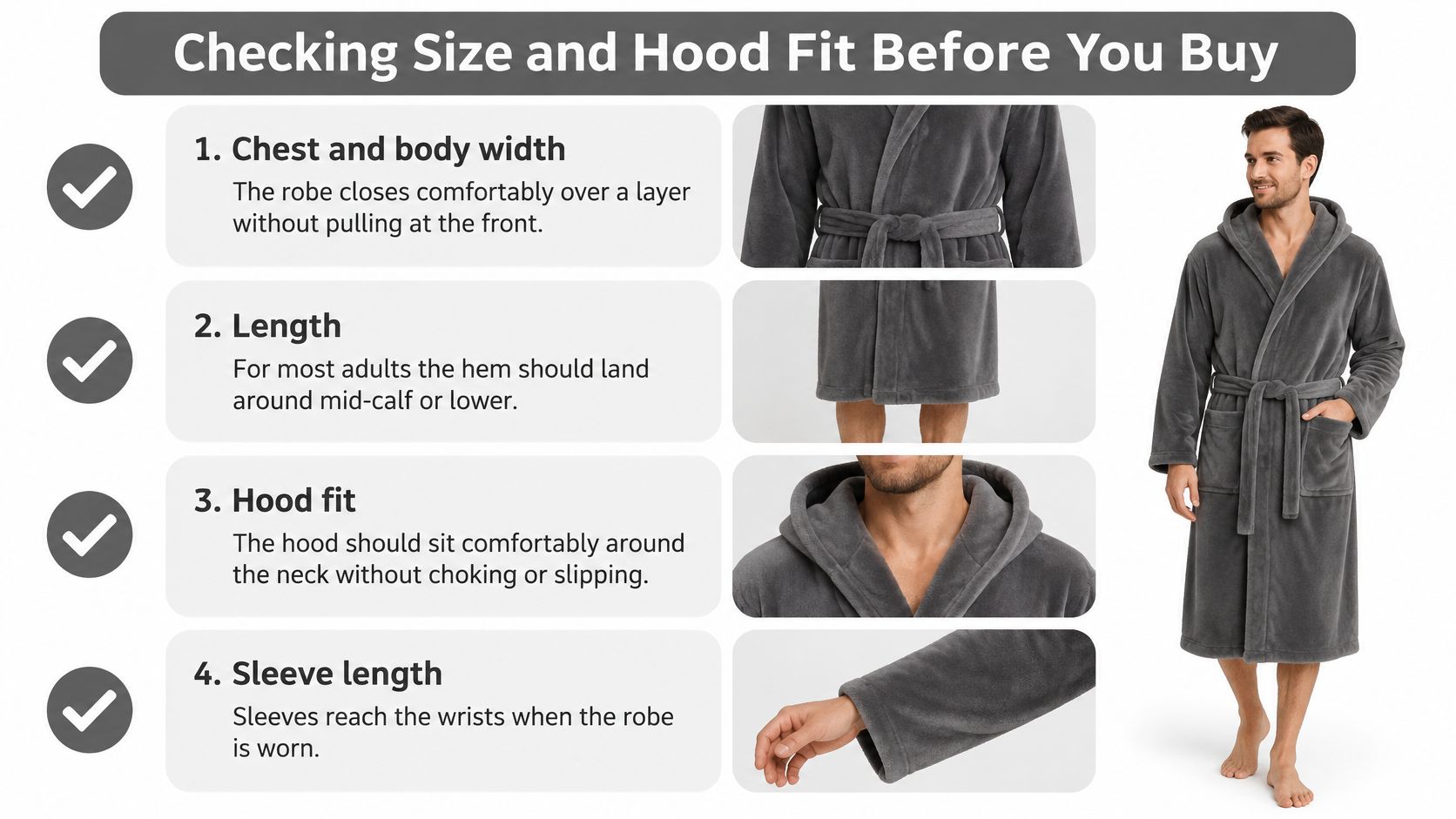
Measure a robe you already like before choosing a size. Lay it flat and record the chest width, total length from the shoulder seam, and sleeve length from shoulder to cuff, then check whether the seller measures garments the same way.
Don't confuse a flat garment width with a body circumference. Our robe size chart guide helps you compare measurements rather than relying on familiar letter sizes.
Your fitting checklist
- Chest and body width: The front panels should overlap comfortably over your usual layer. Reach forward and sit down to check that the opening doesn't pull apart.
- Length: Mid-calf is a useful starting point for everyday adult coverage, not a mandatory fit. Choose a hem that won't drag on the floor or interfere with stairs.
- Sleeves: Your wrists should stay covered with your arms relaxed. Check that the cuffs won't trail through water when you wash your hands.
- Hood opening: Pull the hood up over towel-dried hair. It should leave your ears comfortable and your view clear without tugging at the neckline.
- Belt position: Tie the belt where you'd normally wear it, then move naturally. You shouldn't need to cinch it tightly to prevent chest gaping.
- Hanging arrangement: Inspect the hanger loop and neckline. You need a way to support the garment without trapping the hood in a tight fold.
- Weight around the shoulders: Try the hood both up and down. A heavy hood shouldn't pull the robe backward or leave you adjusting the collar repeatedly.
If you're buying online, use product photographs to check proportions, but use measurements to choose the size. A relaxed robe still needs a deliberate fit, particularly around the shoulders and front overlap.
Caring for a Hooded Robe So It Keeps Drying Well
Drying is about more than cotton content. Experimental terry-fabric testing published in Vlakna a textil found that pile construction and finishing affected drying behavior, so a fabric description alone can't tell you when a whole robe will be ready to store.
A routine that protects absorbency
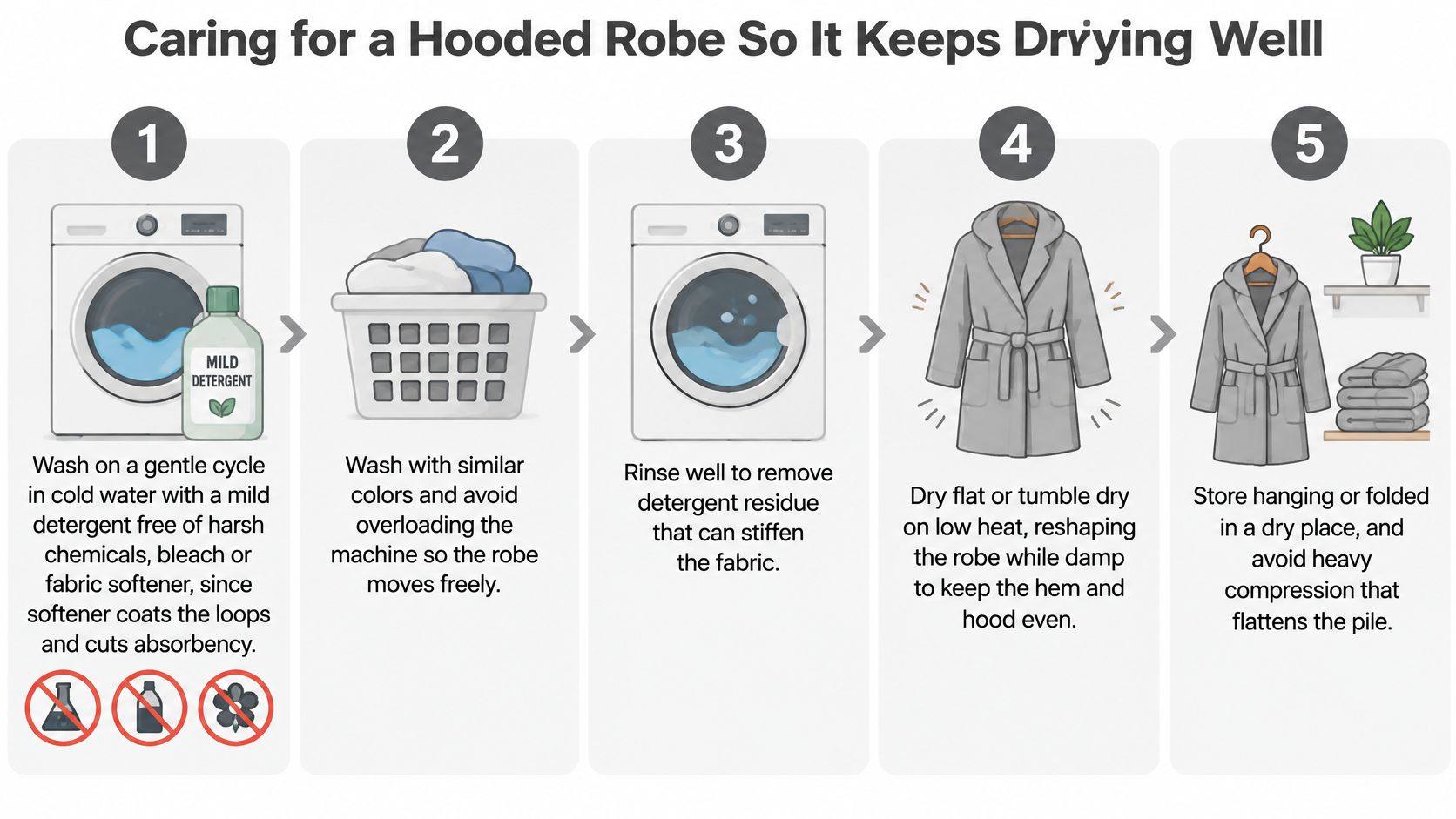
Wash gently without coating the fabric. For our robes, use a gentle cycle, cold water, and mild detergent without harsh chemicals, bleach, or fabric softener. Softener can coat absorbent surfaces, while excess detergent can leave residue, so don't add extra just because the robe is bulky.
Reduce rubbing and tangling. Turn the robe inside out and close any zips; secure loose ties without cinching the garment tightly. Wash with similar colors and leave room in the drum for the robe to move and rinse freely.
Use gentle drying. Our robes can be air-dried or tumble-dried on the lowest heat setting. Shake out the garment and reshape the hood and hem while damp rather than using high heat to force a faster finish.
Open the hood while hanging. Use a sturdy hanger and arrange the hood so its inner surface is exposed to air. The common mistake is letting it collapse into a wet pocket against the upper back.
Check before folding. Feel inside the hood, along the neckline seam, and around the belt loops before storing the robe. Don't fold it overnight just because the sleeves feel dry; trapped dampness can lead to stale odors and mildew.
Hang it after every use. Don't leave the robe bunched on a floor or chair after bathing. Spread it out with space around it, especially if the bathroom remains steamy.
Before storage: Check the thickest seam, not the easiest-to-reach cuff.
A fully dry terry robe should feel comparatively light, with springy loops and no cool, damp patch inside the hood. If that patch remains, give it more airflow rather than putting it away.
What Organic and Certified Claims Cover
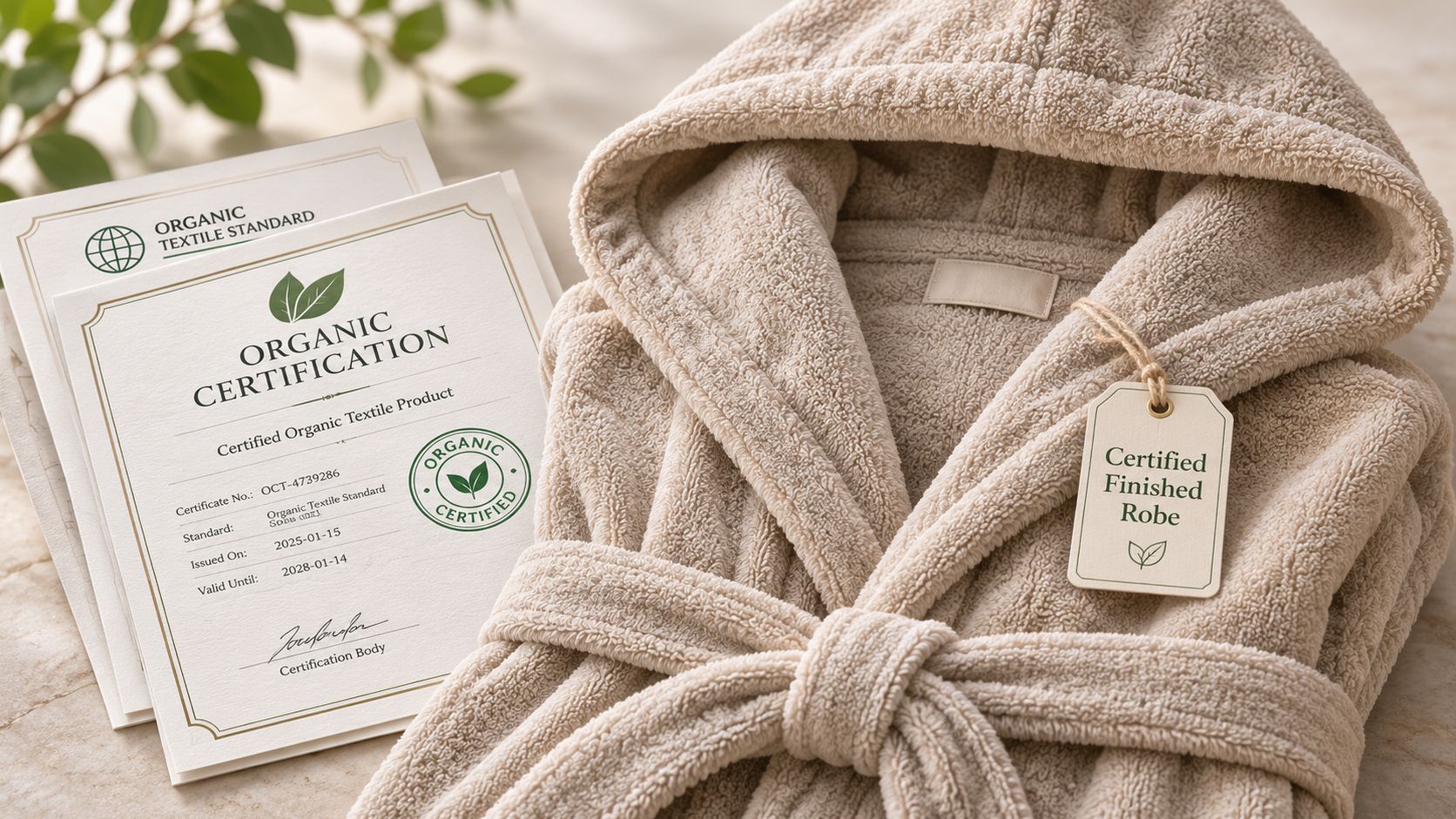
An organic fiber claim describes how cotton was grown; finished-product certification can also cover how that cotton is processed into a textile. That distinction matters when you are comparing a hooded robe, because a soft hood and a certified fiber can point to two different parts of the supply chain.
The Soil Association's textile labelling guide cites research in which 77% of surveyed consumers considered key GOTS elements important, including organic fibers, fair working conditions, and the absence of harmful chemical residues. Certification labels can still be hard to decode, which is why reassuring wording alone is not enough. A label becomes useful when you can see what it covers.
Check the claim's scope
- Organic cotton: Look for clear fiber content. An organic-cotton description may describe the fiber without certifying the finished robe.
- Named standard: GOTS, the Global Organic Textile Standard, addresses organic textile production alongside processing, environmental, chemical, and social requirements.
- Verifiable certification: Look for the certifying body, identifying details, and a scope that supports the claim being made about the garment.
- Separate promises: Don't infer lifetime durability, unrestricted dye safety, or a particular packaging claim from an organic label alone.
Our bathrobes are made with GOTS certification. Our guide to understanding GOTS offers more context for interpreting the standard.
A construction check still matters alongside certification. Yarn quality, seams, loop structure, and care requirements tell you whether a robe will tolerate your routine, especially around the hood where fabric layers overlap. A conventional robe you will use for a long time may be a more useful purchase than a certified one that fits poorly and stays unworn. If certification is a priority, seek both: a verifiable claim and a garment you can comfortably maintain. Treat certification as evidence about production; judge fit, seams, and drying behavior separately.
Choose Your Hooded Bathrobe Before You Buy
Answer these questions before comparing colors: Where will I wear it? How fast must it dry? How much weight can I tolerate around my head and shoulders? Your answers will narrow the choice more effectively than a “luxury” label.
Pick the fabric for the job. Use your actual bathing and lounging habits, including whether you towel-dry first. If you rarely pull a hood up, consider whether you need the extra fabric at all.
Confirm the measurements. Compare a robe you own with the seller's size guide, then check the hood opening and front overlap. Don't size up automatically to solve a shoulder or sleeve problem.
Check maintenance and certification. Make sure your washing setup suits the care label. If organic certification matters to you, verify its scope before paying for the claim.
Compare the complete purchase. Look at fabric, garment weight, construction, and price together. Our Men's Beige Hooded Turkish Cotton Waffle Robe is priced at $74.99; check the live listing before ordering rather than assuming every waffle or hooded style has the same price.
A hood is worthwhile when you'll use it for damp-hair coverage and comfort after bathing or swimming. It's less compelling if it spends every wear folded behind your neck.
Shortlist two fabrics that fit your routine today. Measure against the size guide, then check the live price, care instructions, and certificate details on the seller's page before ordering.
SEYANTE offers Turkish cotton terry and lightweight waffle robes for men and women, including hooded styles for different comfort preferences. Visit SEYANTE to compare fabric options and sizing guidance, then choose a robe that suits both your after-bath routine and your drying space.