8 Spa Day at Home Ideas for a Real DIY Retreat
- 1. Turkish Hammam-Inspired Warm Towel Ritual
- 2. Warm Epsom Salt Bath Ritual
- 3. At-Home Facial Steam Treatment
- 4. Sheet Mask Night
- 5. Dry Brushing
- 6. Gua Sha Facial Massage
- 7. Hot Oil Scalp and Hair Treatment with Turban Wrap
- 8. Foot Soak and Reflexology Ritual
- 8 At-Home Spa Rituals at a Glance
- Build Your Sequence, Then Sink Into the Robe
The door is closed. Your phone is face-down in another room, the mirror has fogged at the edges, and a robe hangs within arm's reach. That is the entire setup for a real spa day at home: no booking, no reception desk, no drive home afterward with wet hair.
What usually goes wrong isn't the products. It's the order and the clock. You steam, then soak, then realize the mask has been on for forty minutes, then dry off in a cold bathroom while answering three messages. The ritual collapses because nothing had a start or a finish.
The spa day at home ideas below all share three traits. Each step has a defined duration. Each costs less than a takeaway. And each ends with you warm and dry rather than overstimulated and late. Some of these rituals have solid evidence behind the comfort they deliver. A few only have tradition and good marketing, and I'll say which is which as we go. If scent is going to do the heavy lifting in your bathroom, this Canadian guide to self-care candles covers wicks, wax and burn times before you light anything in a small, steamy room.
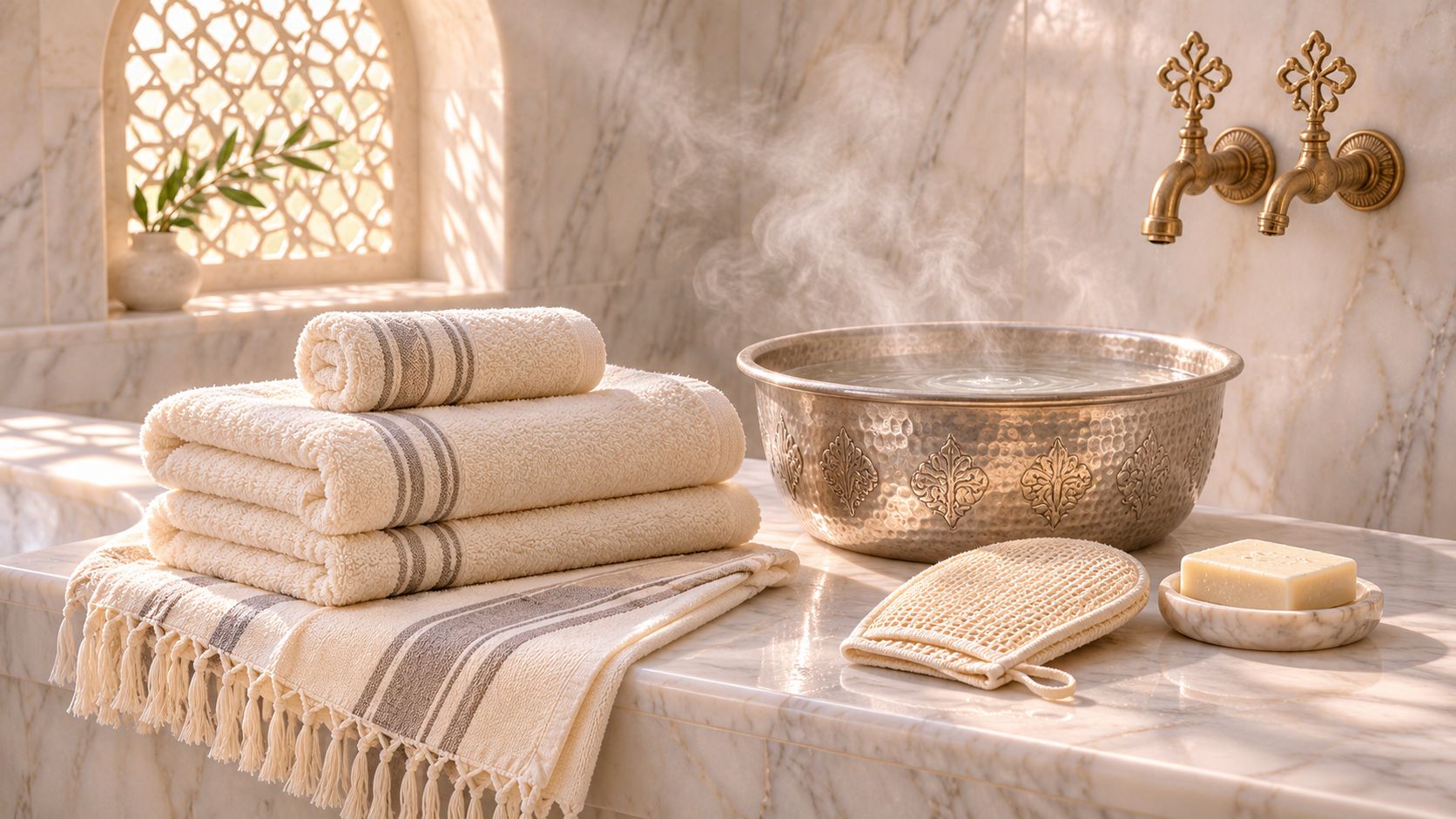
1. Turkish Hammam-Inspired Warm Towel Ritual
The hammam is Turkey's steam bath tradition, and the part you can reproduce at home is the warm cloth: thin cotton peshtemals or a stack of bath towels, heated and wrapped around the shoulders and legs while you sit in a steamy room. Historic public bath houses in Istanbul such as Çemberlitaş Hamamı still run that sequence, and hotel spas sell the same warm wrap plus a kese exfoliating mitt as a signature treatment. The category is growing, too. The Global Wellness Institute reports the global spa sector reached $105.8 billion in 2023, up from $71.9 billion in 2019.
How to run the 40-minute version
- Prep (10 minutes): roll four towels and warm them in the dryer for 5 to 10 minutes, or dampen and wring them in hot water. Put a stool in the bathroom and a glass of water within reach.
- Steam (5 minutes): run the shower hot with the door closed to build a steamy room. Keep the water comfortably warm, never scalding.
- Wrap (15 to 20 minutes): sit on the stool wrapped in the warm towels. Use the final five minutes to exfoliate with a kese mitt or soft cloth in gentle circular strokes.
- Wind-down (10 minutes): dry off, put on a robe, and sit somewhere cool with your water. Cooling gradually is important.
The warmth relaxes you and the exfoliation removes surface skin cells. The sweating does not draw out toxins; that's thermoregulation doing its ordinary job, and the claim doesn't hold up.
Say you finish work at six and want to be on the sofa by half seven. Towels go in the dryer at 6:05, the shower runs at 6:10, and you're wrapped by 6:20. That leaves twenty minutes of wrap, ten minutes of cooling, and no scrambling.
If you'd rather wear something than balance towels, these towelling body wraps explain the fit and fabric differences before you buy.
2. Warm Epsom Salt Bath Ritual
Epsom salt is magnesium sulfate, and the honest case for it is sensory rather than pharmacological. Dissolved in warm water it makes the bath feel silkier and marks the start of a ritual, which is why spas sell it inside muscle-relief packages and brands pre-blend it with essential oils. The magnesium-absorption story doesn't survive much scrutiny. Twenty minutes of stillness in warm water is what settles you.
Prep, soak, wind-down
- Prep: two cups for a standard tub, scattered under running water so it dissolves fully. Test the temperature with your hand before you step in.
- Soak: about 20 minutes, at comfortably warm rather than hot, especially if you have heart or blood pressure concerns. Get out the moment you feel lightheaded.
- Wind-down: robe on immediately to hold the warmth, then a glass of water or herbal tea.
Scent is where many people go wrong. The National Association for Holistic Aromatherapy notes that many blends use 1 to 5% dilution and that sensitivity varies by oil, body area and individual skin condition. Undiluted drops in bathwater land on skin unpredictably, so diffuse for ambient scent or pre-dilute in a carrier oil first.
The rule I'd tape to the mirror: if you wouldn't apply it neat to your face, don't tip it neat into your bath.
A worked example: after a long run, bath running at 8:40, soak from 8:45 to 9:05, robe and water by 9:10, in bed by 9:45. That's a recovery routine, not a project.
For the full sequence around the soak, this detox bath guide covers temperature and timing. If you want the Japanese version of the same idea, from yuzu baths to bagged bath salts, the Buy Me Japan bath care guide explains what each product is for.
3. At-Home Facial Steam Treatment
Set up the bowl before you start: choose a stable table, a heatproof bowl, a clean hand towel, and a place to sit comfortably. Facial steam can soften surface oils and skin, making cleansing easier. It is a brief comfort ritual, not a pore treatment. Pores do not open and close, steam does not purge them, and it cannot permanently shrink them.
In 2024, 40% of global consumers said they take an integrated approach to beauty that incorporates self-care practices supporting overall health, according to Euromonitor International. Ten minutes is a practical limit for a simple at-home steam, not a conclusion drawn from that survey.
The ten-minute version
- Prep: Boil water and pour it into the bowl on a stable surface. Tie your hair back and keep the towel within reach.
- Steam: Sit with your face 12 to 18 inches above the water, tenting the towel over your head. Keep the exposure to 5 to 8 minutes. Lift the towel or stop if your face feels flushed.
- After: Cleanse gently, then apply a mask or moisturizer. Skip exfoliation if your skin feels sensitive after the heat.
The useful effects are modest: warmth can soften surface oil and skin, which may make cleansing easier. It does not clear pores or provide lasting changes. Avoid steaming over irritated or sunburned skin, and skip it if heat triggers flushing. A compromised skin barrier can become redder with warmth.
A workable Sunday schedule: begin steaming at 7:00 and stop after six minutes. Cleanse and apply a mask by 7:15, then moisturize before bed. Keep the bowl comfortably below face level and stop immediately if the heat feels uncomfortable.
4. Sheet Mask Night
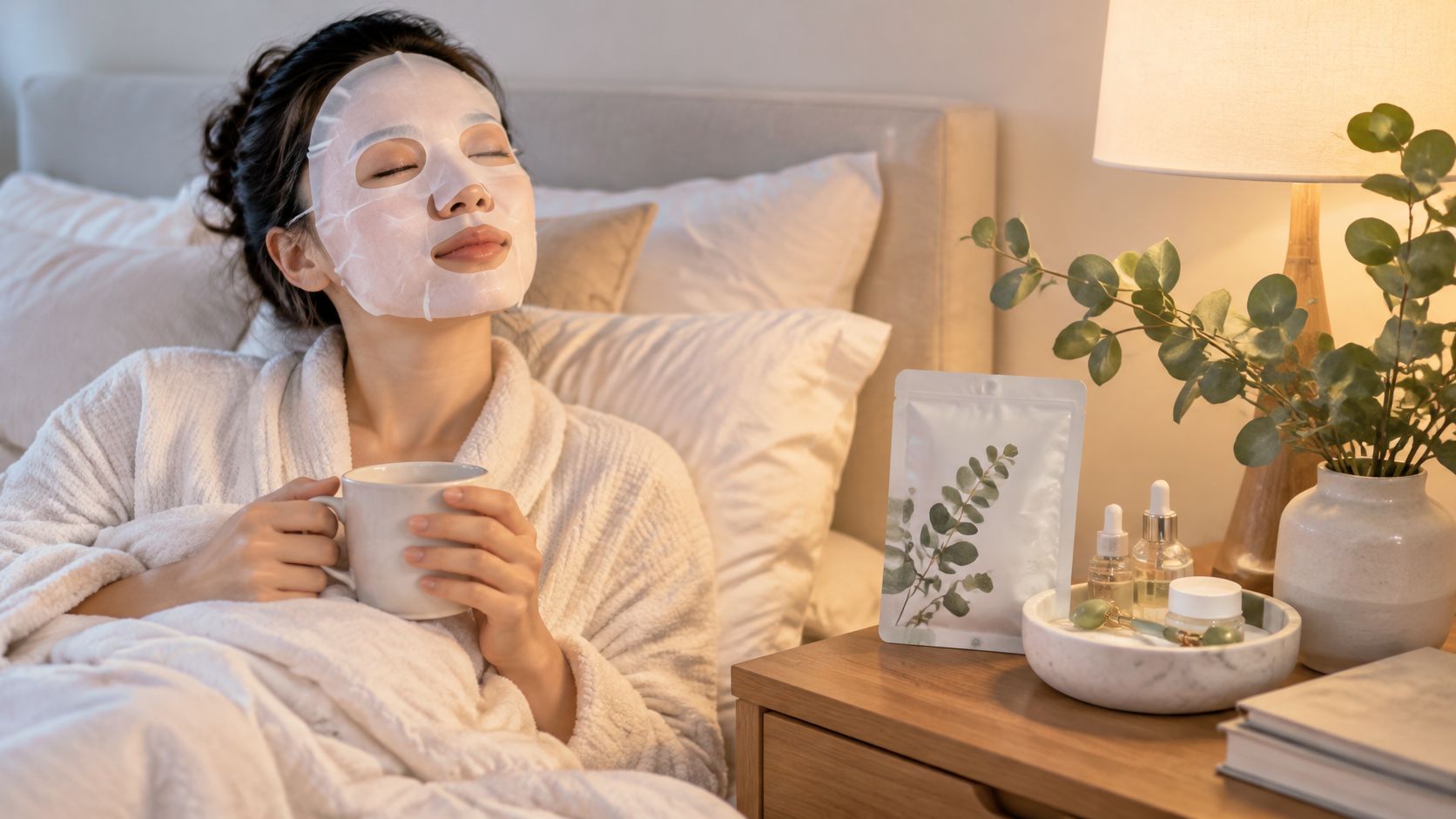
Sheet masks come from the South Korean skincare market: a fabric sheet soaked in essence, pressed onto cleansed skin for 15 to 25 minutes. It's the lowest-effort treatment on this list, which is exactly why it survives a busy week. Spending patterns back the enthusiasm. In a Harris Williams survey of 1,250 consumers, 95% of U.S. beauty enthusiasts planned to spend the same amount or more on beauty and personal care than they had the year before.
- Cleanse and pat dry. Essence absorbs better on bare skin than over serum and sunscreen.
- Smooth the sheet from the center outward so no air pockets form. Air pockets mean dry patches.
- Set a timer for the package time. Past that, the sheet starts drying and pulls moisture back out of your skin.
- Massage leftover essence in rather than rinsing, then seal with moisturizer.
Hydration and temporary plumping are real, and they last hours rather than days. A sheet mask doesn't replace a retinoid or treat acne, and sleeping in one wastes the mask.
Patch test new formulas on your jawline for a day first, especially fragranced essences. A worked example: mask on at 9:00 during a twenty-minute episode, off at 9:20, moisturizer, lights out by 9:45.
5. Dry Brushing
Dry brushing is two to three minutes of firm, dry strokes with a natural-bristle brush before you shower, and it's the most useful ritual on this list for anyone without a tub. Renovation data makes the case plainly. In the 2025 U.S. Houzz Bathroom Trends Study, only 36% of renovated bathrooms included any wellness-oriented feature, and just 18% included a soaking tub or spa bath. If your bathroom is a standard shower stall, the brush fits anyway.
Technique that doesn't irritate
- Start dry, before the shower, on clean, unmoisturized skin.
- Long strokes toward the heart: feet up the legs, hands up the arms, then gentle circles over the torso.
- Light pressure, two to three minutes total. Redness that fades within a minute is normal; soreness is not.
- Shower, then moisturize within a few minutes while skin is still damp.
Mechanical exfoliation removes dead surface cells and the brushing feels stimulating, and that's the whole benefit. It doesn't drain lymph in any therapeutic sense, doesn't remove cellulite, and doesn't detoxify the body. Your lymphatic system handles that without help.
Two minutes of brushing is a ritual. Ten minutes of scrubbing is a dermatology appointment waiting to happen.
Skip it on sunburn, eczema flares, broken skin or varicose veins. Wash the brush weekly with mild soap, dry it bristles-down, and replace it once the bristles splay.
A worked example: brush from 7:20 to 7:23, shower, moisturize by 7:35, dressed by 7:40.
6. Gua Sha Facial Massage
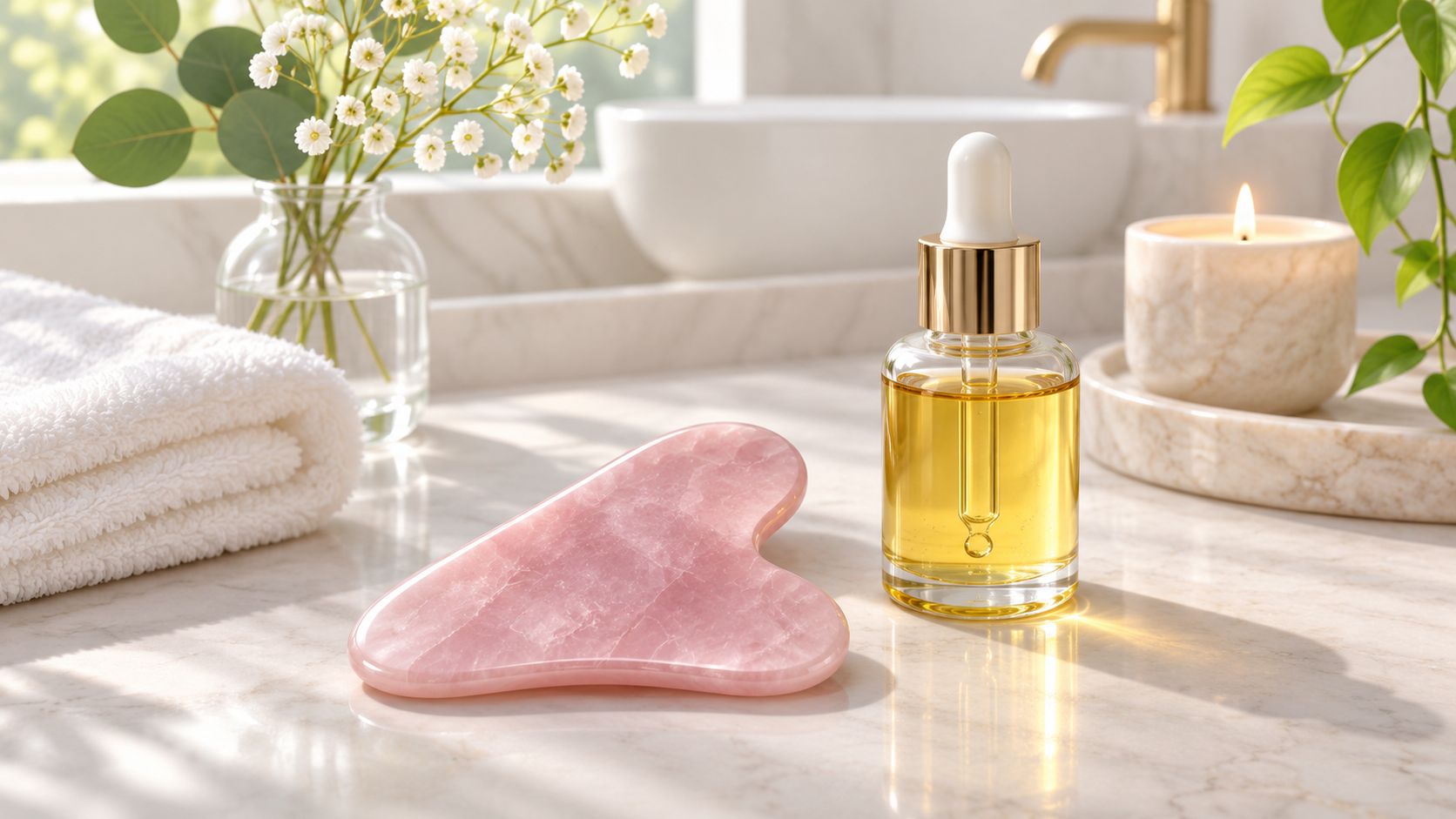
Gua sha is a facial massage technique with roots in traditional Chinese medicine, now a standard add-on in esthetic treatment rooms and a social-media staple. Tool choice matters far less than technique: jade, rose quartz and stainless steel all glide the same if you use enough slip. McKinsey's 2025 wellness trends report identifies home-based health and wellness as a continuing growth area, and notes that 25% of homeowners use the primary bath for rest and relaxation while 24% use it for beauty or pampering.
The five-minute routine
- Oil first. Facial oil or a slippy serum, enough that the tool never tugs. Dry skin plus stone equals irritation.
- Neck up, jaw out, cheek up, brow out. Light to medium pressure, three to five passes per zone.
- Five minutes total, once a day at most. More pressure does not deliver more benefit.
The visible effect is temporary fluid movement, which is why one side of your face can look slightly less puffy for a few hours. Claims about sculpting bone, boosting collagen or releasing toxins don't hold up. It's a pleasant massage, not a treatment.
Keep the tool away from active acne, broken skin, cold sores or a rosacea flare. Wash it with mild soap and warm water after each use, and chill it in the fridge if you want a morning version that helps with puffiness.
A worked example: tool out at 7:00 while the kettle boils, five minutes with oil, cleanse and moisturize by 7:15.
7. Hot Oil Scalp and Hair Treatment with Turban Wrap
Warm oil on the scalp and mid-lengths, wrapped in a turban for 20 to 60 minutes, then shampooed out twice. It's the one treatment here that earns its waiting time, because the processing window forces a pause you can't shortcut. That pause matters more than the oil. In the American Psychological Association's 2023 Stress in America survey of 3,185 U.S. adults, 36% said they did not know where to start with managing stress and 47% wished they had someone to help them. A routine with clear start and stop points answers that better than an instruction to relax.
Order of operations
- Warm the oil in a bowl of warm water for a few minutes, then test a drop on your wrist.
- Section and apply to the scalp first, then mid-lengths and dry ends. Keep it off the roots if your scalp is already oily.
- Wrap in a turban or towel and leave for 20 to 60 minutes.
- Shampoo twice, then condition the ends. One wash rarely lifts a full oil treatment.
Oil conditions the hair shaft and reduces breakage from friction, which is a real and measurable benefit. It doesn't feed the follicle, and scalp massage doesn't accelerate hair growth. If your hair is fine, keep oil away from the roots or you'll be washing for two days.
For a wrap that stays put while you move around, this hair turban tutorial shows the twist-and-tuck. The ArtNaturals hot oil treatment guide covers timing for different hair types.
A worked example: oil on at 8:00, turban on, laundry and a podcast until 8:45, shampoo twice, hair dry by 9:30.
8. Foot Soak and Reflexology Ritual
Basin out at 9:30, water checked on the wrist, feet in by 9:32. Block about 25 minutes for the whole close: soak, massage, then dry. It is the cheapest ritual on the list, and the one you are most likely to repeat on a weeknight.
Prep is a basin you can sit over without hunching, water that feels warm on the wrist, and a towel already in reach. Hot water wrinkles the skin faster and can leave the feet sore, so stop at warm. Soak for 10 to 20 minutes. Work your thumbs from the heel toward the ball of the foot, then along each toe. Pressure should be firm and still comfortable. Five minutes of that is enough. Wind down by drying between the toes, moisturizing, and pulling on socks or a robe so you are not padding across a damp floor.
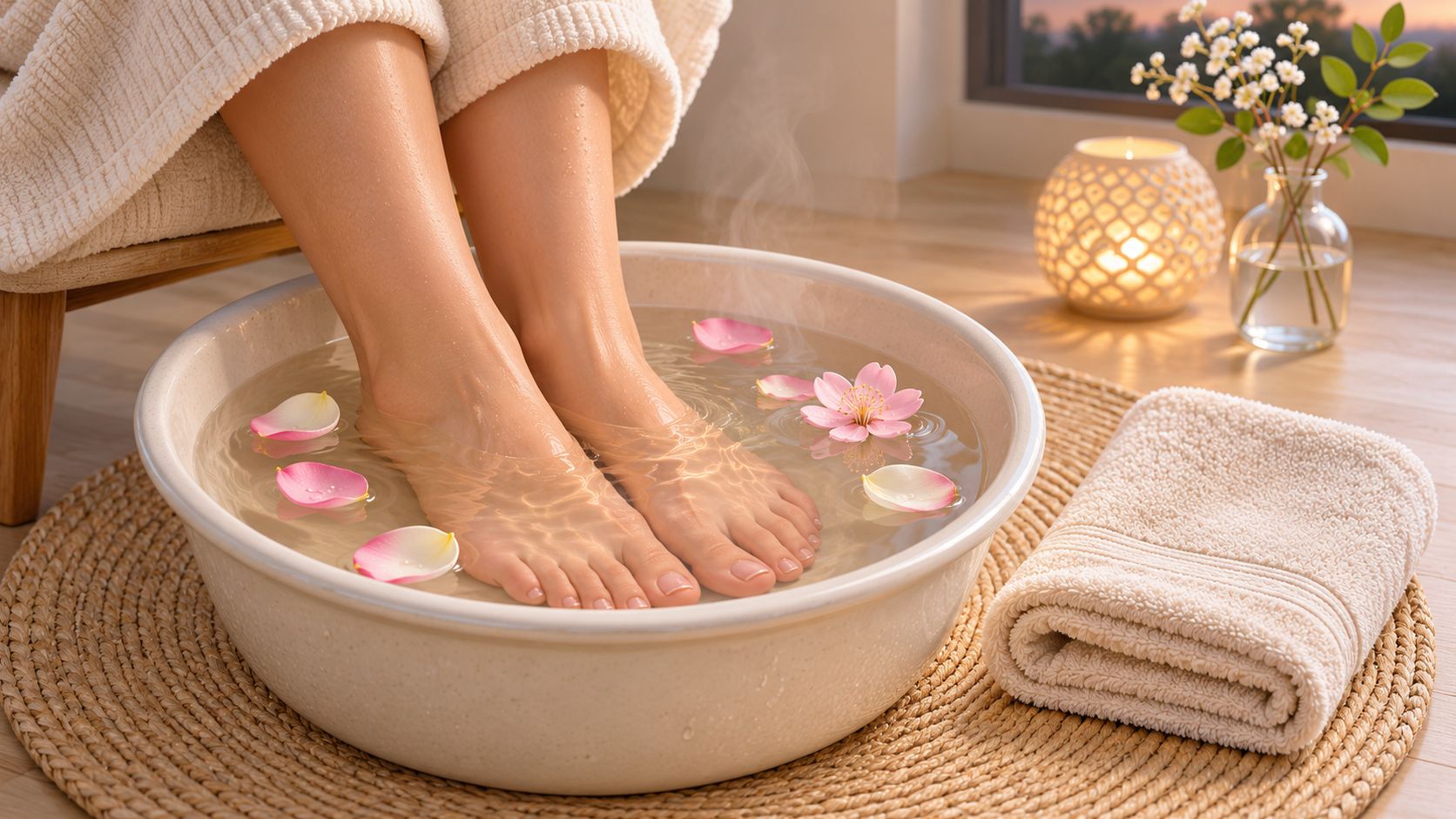
The soak softens rough skin. The massage eases muscular tension in the feet and calves. Reflexology charts that map points on the sole to organs and body systems are not supported by evidence. Do it because tired feet feel better, not because a chart promises an organ reset.
A worked example after a mask: feet in at 9:30, out at 9:50, massage until 9:55, socks on, lights out by 10:15.
The spend around home spa products is large, which is why a basin still looks like the bargain. Analysts at Dataintelo estimated the global home spa market at $18.2 billion in 2025, projected $32.8 billion by 2034 at a 6.8% compound annual growth rate, with aromatherapy products at 14.1% of market value, in Dataintelo's home spa market analysis. Warm water and ten minutes still cost almost nothing.
Once your feet are dry, the Women's Lavender Blue Lightweight Kimono Waffle Spa Robe is a lightweight kimono waffle spa robe you can pull on for the rest of the evening.
8 At-Home Spa Rituals at a Glance
Forty minutes for a hammam-style towel ritual is a different evening from two or three minutes of dry brushing. Read the totals below with prep and wind-down included, so a "short" soak does not run past the time you have.
| Ritual | Time Needed | Main Focus | Difficulty | Best For |
|---|---|---|---|---|
| Turkish Hammam-Inspired Warm Towel Ritual | 40 minutes | Warmth, relaxation, gentle exfoliation | Moderate | A slow, sensory self-care ritual |
| Warm Epsom Salt Bath Ritual | 20-minute soak, plus prep and wind-down | Relaxation and unwinding | Easy | Tired muscles and a calming soak |
| At-Home Facial Steam Treatment | About 5-10 minutes | Softening skin before facial care | Easy | Preparing for cleansing or a mask |
| Sheet Mask Night | About 15-25 minutes | Quick facial hydration | Easy | A convenient, low-mess spa night |
| Dry Brushing | 2-3 minutes | Surface exfoliation | Easy | A quick pre-shower routine |
| Gua Sha Facial Massage | About 5-10 minutes | Facial massage and reducing the appearance of puffiness | Easy | A calming addition to an evening skincare routine |
| Hot Oil Scalp and Hair Treatment with Turban Wrap | About 20-60 minutes | Hair conditioning and scalp massage | Moderate | Dry or damaged hair |
| Foot Soak and Reflexology Ritual | About 10-20 minutes, plus massage | Relaxing tired feet | Easy | Feet tired from standing or walking |
The two moderate rituals, the 40-minute towel wrap and the oil treatment that can run to an hour, are the ones that set the length of the night. Steam, gua sha, and dry brushing stay under ten minutes and fit beside something else. I would not stack both long rituals on a weeknight unless the clock is the point.
Build Your Sequence, Then Sink Into the Robe
A real spa evening at home is a short stack with a hard stop, not one long bath. Start with dry brushing or a warm towel wrap, move into a soak or steam, add one facial or hair treatment, and close with a foot soak while the earlier steps settle. Two or three rituals fit a weeknight. Four is a project, and the extra step usually eats the wind-down.
In YouGov's 2024 survey of 1,199 U.S. adults, 32% reported practicing self-care daily and 43% at least weekly. That gap is where a written sequence helps: a start, an order, and a stop time turn a weekly intention into something you can repeat.
U.S. household spending on personal-care products and services averaged $978 in 2024, up 2.9% from $950 in 2023, according to the U.S. Bureau of Labor Statistics. Spend that budget on fewer timed steps. A longer shopping list does not add minutes of rest.
The robe is the last layer, not another treatment. Put it on after the soak so you stay warm through the foot work, then stop when the block ends. I would rather end on time, still warm, than push a fourth ritual past the point where the evening still feels like rest.
SEYANTE makes robes for this kind of slow evening: GOTS-certified organic Turkish cotton terry and lightweight waffle weaves, plus towel wraps and hair turbans for the oil treatment and post-soak steps. Terry holds heat after a bath. Waffle breathes better if the bathroom already runs warm. Orders include a 90-day free return policy. Choose a weight that matches how you use the room, then browse the full collection at SEYANTE and build the ritual around it.