Hooded Velour Dressing Gown: Fabric, Warmth and Care Guide
The most repeated advice about hooded velour dressing gowns is to buy the thickest, softest one you can afford. That advice gets it backwards. Plushness is the easy part of a robe. Any mill can brush up a surface that feels wonderful on the shop rail. The harder questions are whether that surface still springs back after twenty washes, whether the robe dries before it turns musty, and whether the hood you loved in a cold bedroom becomes a heat trap in June.
A hooded velour dressing gown is a real category with real trade-offs. It trades breathability and drying speed for warmth and a dense, quiet hand. Sometimes that trade is exactly right, and sometimes a thin waffle weave will serve you better for years.
What follows is the practical version. How velour differs from terry and waffle, how to read the numbers on a spec sheet before you spend anything, what to check on the hood and pile, how to wash the thing without flattening it, what the failures look like when they start, and the situations where I would tell you to walk away from velour entirely.
How Velour, Terry and Waffle Robes Differ
A hooded velour dressing gown is a long robe with a hood, cut from velour, which is a knitted fabric whose loops are cut or sheared into a raised, plush pile. That definition matters because velour is a construction, not a fibre. The silky density you feel on a good one comes from how the knit was made, not from a label word.
The silhouette itself is old. The Philadelphia Museum of Art's object record notes that luxurious men's dressing gowns were worn by fashion-conscious men from the late seventeenth century onward, and museum collections trace the garment through a British cotton example from about 1825 to French and British gowns dated between 1915 and 1935. Softness, warmth and post-bath practicality are the modern additions to a garment that has always been about private ease. The hood extends that privacy from the shoulders to the head.
| Feature | Hooded velour | Terry cloth | Waffle weave |
|---|---|---|---|
| Surface | Sheared knit loops, smooth and plush | Looped pile, towel-like texture | Raised grid pattern, textured |
| Warmth | Dense, warm feel | Moderate warmth | Light, breathable |
| Absorbency | Varies by fibre; cotton-rich versions absorb more | High | Moderate |
| Drying time | Slower in cotton-rich blends | Slow | Fast |
| Stretch | About 40-80% in weft-knit velour | Slight mechanical give only | Barely any; woven with a generous cut |
| Best use | Cool rooms, lounging, cosy evenings | Drying off after a shower | Warm weather, travel |
Read the table as three different jobs. Velour is the warm lounging fabric. Terry is the drying-off fabric, which is why hotel bathrooms are full of it. Waffle is the light, quick-drying fabric for warm rooms, shared bathrooms and anything that has to be packed in a bag. If you want the fuller breakdown of the last two, our comparison of waffle versus terry cloth robes for daily use goes deeper, because those two get confused constantly.
The common mistake is treating velour as one uniform product. It isn't. A polyester velour and a cotton-rich velour at the same weight feel similar on the hanger and behave nothing alike in a steamy bathroom. Finishing changes things again, since a densely sheared pile reads as luxury while a longer, fuzzier pile sheds sooner. Two gowns described identically online can be very different garments.
I've left the stretch cells for terry and waffle as practical descriptions rather than numbers, because no reliable figure covers them the way it does for weft-knit velour. Guessing would be worse than saying so.
So before you read further, name your habit. Do you put a robe on wet, straight from the shower? Do you wear one over pyjamas for two hours before bed? Do you run hot at night? The answer decides which column of that table you belong in.
Reading Warmth and Weight in Velour Specs
Fabric weight is the first number worth finding, and most product pages bury it or skip it. Apparel velour typically runs about 200-350 grams per square metre, while heavier upholstery and automotive grades commonly range from 280-500 grams per square metre, according to this textile analysis of velvet and velour construction. That overlap explains the thing shoppers notice in the fitting room: a good velour gown feels substantial without the bulk of a coat.
| Weight band | Typical feel | Best use |
|---|---|---|
| 200-350 g/m² (apparel velour) | Substantial without outerwear bulk | Hooded dressing gowns |
| 280-500 g/m² (upholstery and automotive) | Heavier and stiffer | Not typical for a gown |
| Above 350 g/m² | Stiff and bulky | Rarely suitable for a gown |
What gram weight actually predicts
Weight tells you about warmth and drape, not quality. A 220 g/m² velour that drapes softly and springs back under your thumb is a better robe than a 340 g/m² one that stands up on its own like a coat. Heavier fabric holds more warmth against the body and takes longer to give up moisture. Lighter fabric moves more freely and dries faster but won't hold heat in a cold bedroom.
Stretch, and why it changes the fit
Weft-knit velour stretches roughly 40-80%, against approximately 12-25% for velvet, per the same textile source. That's the difference between a robe that follows your shoulders when you reach for a kettle and one that rides up and binds. High stretch is forgiving. It also means a velour gown can be cut closer than a woven robe and still feel easy, so don't assume a slim silhouette will restrict you.
Fibre decides how it handles moisture
Most buyers stop reading too soon at this point. Cotton's moisture regain is about 7-8.5%, against roughly 0.4% for polyester, so a cotton-rich velour takes up moisture from skin and air while polyester mostly passes it along. In practice, cotton-rich velour feels better against damp skin after a bath and worse if you leave it crumpled in a humid bathroom. Polyester velour feels drier and dries faster but can turn clammy against a sweaty back.
The ten-second shop test: press the pile flat with your thumb and let go. It should recover most of its height immediately. Then hold the gown up by the shoulders and watch the hem. If it hangs like a curtain, it will feel heavy and warm; if it swings, it will breathe.
My working rule is simple: heavier means warmer and slower to dry, so match the weight to the room you'll wear it in and the laundry rhythm you keep. A cold house and a weekly wash can carry 300 g/m². A warm flat and a wash every three days suits something leaner.
Buying Checks for the Hood, Pile and Fit
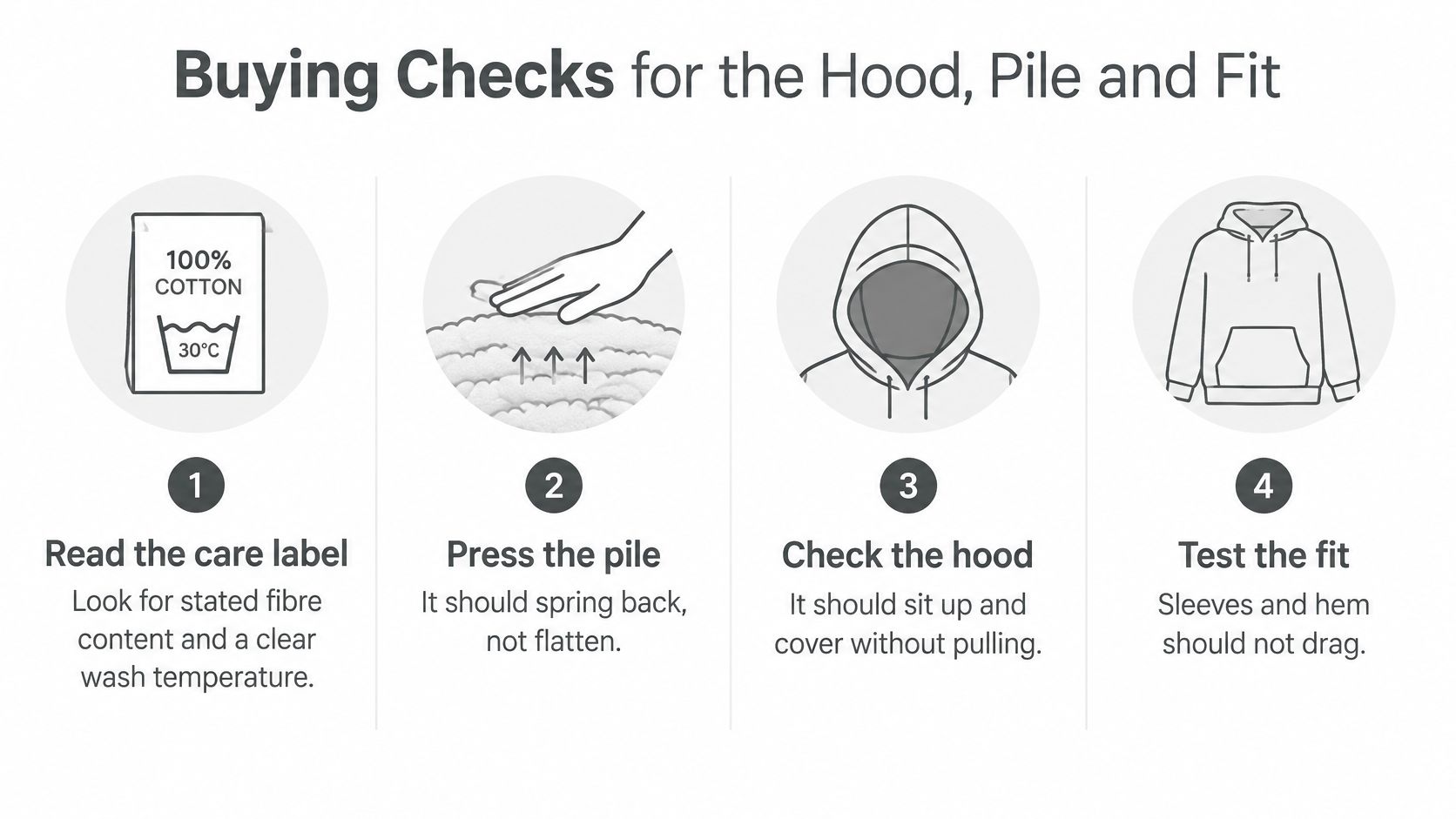
The parts that fail first on a hooded velour dressing gown are not the parts you admire on the hanger. They're the hood attachment, the belt loops, the shoulder seam and the hem. Run these seven checks before you pay, whether you're in a shop or reading a product page.
- Read the care label and fibre content. You're looking for a stated composition and a clear wash temperature. "Machine washable" on its own tells you nothing about whether the pile survives hot water, and a gown with no fibre percentage is a gamble.
- Press the pile across the chest and one sleeve. It should feel dense and even, with no bald patches, no visible backing through the surface, and no loose loops waiting to snag. Uneven pile means uneven wear within months.
- Inspect the backing. Hold the fabric up to light and look through the base. A breathable backing reduces the overheating problem that makes people abandon plush robes in spring. A rubbery, airtight back turns the gown into a sauna.
- Test the hood properly. Put it up. It should sit without pulling the shoulders forward, and the seam where it meets the body should be reinforced, ideally with a second row of stitching or a covered tape. That join takes the whole weight of a wet hood.
- Confirm shoulder ease. Cross your arms and reach forward. The thick surface shouldn't restrict you. If the body is cut narrow, the stretch will help, but only up to a point.
- Check the belt. Fabric loops stitched into the side seams, not tiny thread loops, and a belt long enough to tie in front with the ends hanging past the hips. Thread loops tear first.
- Match length to height. A gown that stops mid-calf pulls at the shoulders when you sit down. Measure from your shoulder to just below the knee, or accept that you'll be hitching it up constantly.
The hood deserves its own pass-or-fail rule. Put it up, look down, and shake your head gently. If it flops forward over your eyes or slides off the back of your skull, it will annoy you every single time you wear it. A hood that sits up and covers without pulling is the whole point of the category.
The shortlist of must-haves: stated fibre content, a stated wash temperature, dense and even pile, reinforced hood seam, generous shoulder width, stitched belt loops, and a hem that clears your calves when seated. Anything that fails two or more of those is a dressing gown you'll stop wearing by February.
How to Wash and Dry Velour Without Flattening It
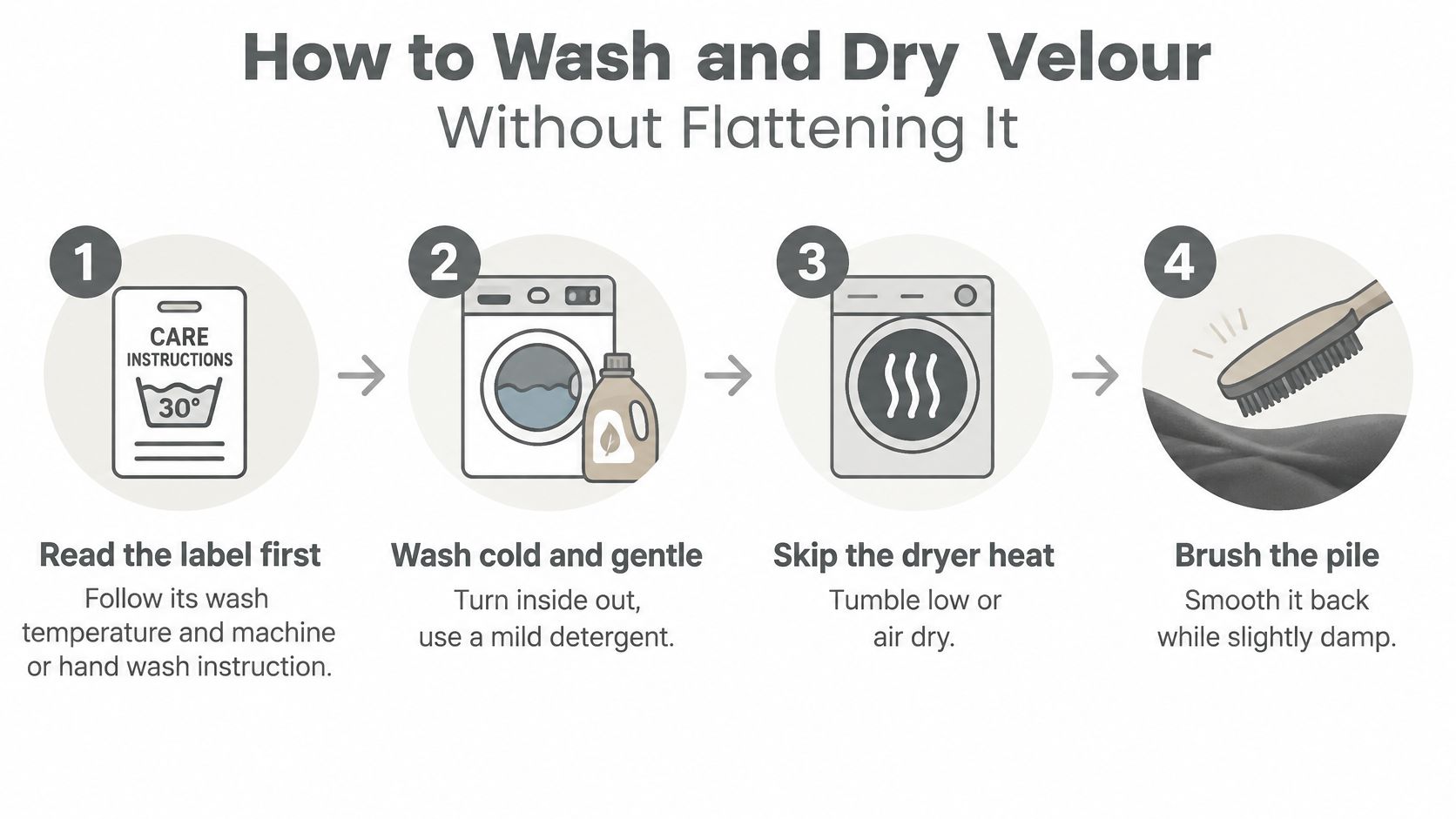
Pile fabrics need controlled washing because heat and agitation change the surface, the shape and the lifespan of the garment. In the United States, the FTC care labelling rule requires apparel labels to state whether an item is machine or hand wash and to give a suitable water temperature, and drying instructions must identify machine or alternative drying plus the allowable heat level. That label is your starting point, not the generic advice on a blog.
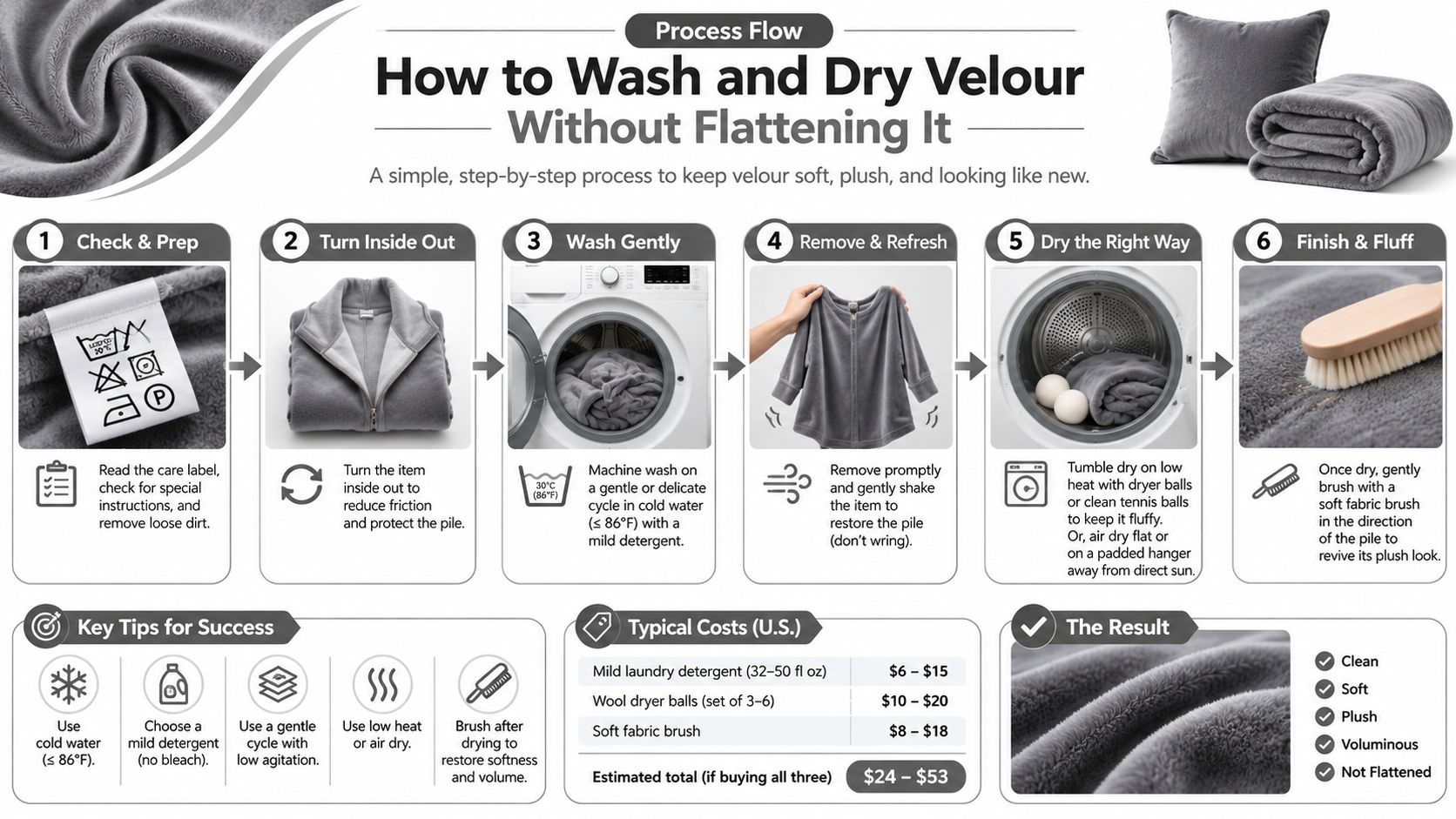
Here is the routine I'd follow, in order.
- Read the label and set the temperature from it. If it says cool, cool it is. Warm water relaxes the knit and can shrink a cotton-rich hood.
- Turn the gown inside out. Most surface damage comes from friction against zips, hooks and the drum itself, so put the pile on the inside where it's protected.
- Wash on a gentle cycle with cold water and a mild detergent. Skip bleach and skip fabric softener, which coats the fibres and dulls the pile instead of softening it.
- Leave out laundry balls and abrasive accessories. They work against pile, not for it.
- Drain and press the water out by hand. Wringing twists the knit and sets creases you'll never fully remove.
- Reshape the hood and smooth the pile while damp. Run your palm with the nap, from shoulder to hem. This is the step people skip and then blame the fabric for.
- Air dry flat or on a sturdy hanger, or tumble on the lowest heat only if the label allows. High heat is the single biggest cause of shrinkage and flattened fibres.
- Hang it fully dry before it goes in a wardrobe. Damp pile in a closed space smells of the cupboard within a day.
Practical rule: treat the tumble dryer as a last resort, not a convenience. Twenty minutes on low to take the dampness off, then finish on a hanger.
If your machine is small or the gown is ankle length, a wash and fold with islandwide pickup service takes the load out of a domestic drum and avoids the long, high-spin cycle that flattens pile. For the fuller routine across fabrics, our guide to how to wash, store and care for your robe covers the storage side in more detail.
We set the same standard for our own robes: a gentle cycle, cold water, a mild detergent without harsh chemicals, bleach or softeners, then air drying or the lowest heat setting. It's a short set of rules and it's the difference between a robe that lasts three winters and one that looks tired by March.
A healthy result looks like this. The pile is even and lies in one direction. The hood still holds its shape when you put it up. The hem hasn't crept up your calf and the shoulders haven't tightened. If any of those have changed after a wash, the temperature or the tumbling did it.
Pile Problems and Shedding Fixes
Most complaints about a hooded velour dressing gown arrive six to twelve months in, and almost all of them trace back to washing and storage rather than manufacturing.
| Symptom | Likely cause | Fix |
|---|---|---|
| Flattened pile | Hot dryer or heavy spin | Air dry or use low heat, reshape while damp |
| Pilling or bald patches | Friction and abrasive wash | Wash inside out on a gentle cycle |
| Fuzz shedding in the wash | Long cycle or laundry ball | Shorter gentle cycle, no laundry ball |
| Shrunken hood or shoulders | Hot water or high-heat drying | Cool wash, low heat, hang to dry |
| Sagging hood | Hanging the gown by the hood | Use a sturdy hanger, fold the hood inside |
Shedding is the hidden cost, and it's bigger than expected. A 2025 study reported in Fibers and Polymers found that wash duration and detergent combination strongly affect microfibre release, that adding a laundry ball increased shedding by 10-60% across tested fabrics, and that release peaked during a 75-minute wash with a laundry ball in the drum. A separate household study measured an average of 5,849,943 microfibres per litre across three washing trials in 30 homes. That's why care advice isn't cosmetic.
The eco assumption deserves correcting. Under that study's conditions, cotton released more microfibre mass than nylon, so a natural fibre is not automatically a low-shed fibre.
What that means practically is shorter, gentler, cooler cycles and no gimmick accessories. The wash steps above cover the cycle, temperature and drying routine, so the habit to keep is simpler than the routine: check the label before the first wash, turn the gown inside out every time, and dry it flat or on a hanger rather than by the hood.
Choose Between Hooded Velour and a Lighter Robe
Here's the decision rule. Choose hooded velour for cool rooms and slow, cosy mornings. Choose waffle or terry for heat, humidity and frequent washing. If you'd overheat within ten minutes of wearing it indoors, the fabric is wrong for you, no matter how good it feels on the rail.
| Situation | Better choice | Reason |
|---|---|---|
| Cold bedroom or winter morning | Hooded velour | Retains heat and covers the head |
| Warm bathroom after a shower | Waffle or terry | Dries faster and avoids overheating |
| Humid climate | Lightweight waffle | Breathable and quick to dry |
| Hot sleeper | Lighter velour or waffle | Less trapped heat around the body and head |
| Frequent laundering | Waffle | Lower care load and faster drying |
| Hotel-style lounging | Hooded velour | Plush feel suits slow, cosy evenings |
The plushness trade-off is real and worth stating plainly. Research published in Environmental Science & Technology found that compact woven structures and highly twisted yarns produced lower microfibre releases than looser structures, and that fabric hairiness strongly influences shedding. The softest, fuzziest finish is therefore not automatically the most durable one. Softness and longevity pull in opposite directions.
The hood question
Warmth around the head and neck is the reason to buy this category and the reason some people can't wear it. In a cool room, a hood is useful: it covers the gap between a robe collar and a damp hairline. For a hot sleeper, or anyone with long wet hair after a shower, a hood holds heat and moisture exactly where you don't want it. If you air-dry your hair in a robe every night, a hooded velour gown is the wrong tool.

Three buyers, three answers
The warmth seeker. Cold house, winter mornings, robe on over pyjamas while the kettle boils. Velour at 280-350 g/m², cotton-rich, with a hood that sits up. Wear it over light sleepwear rather than alone, and you get the insulation without the cling.
The hot or humid-climate sleeper. You want the opposite of everything above. A lightweight waffle in an open weave dries between wears, doesn't trap heat at the neck, and tolerates a wash every other day. Velour worn alone in a warm flat in July is a ten-minute garment.
The coordinated buyer. Bridal parties, guest rooms and gifts are about consistency, not personal warmth preference. Pick one fabric for everyone, confirm the hood, and check that each wearer knows the wash rules before the robe leaves the box.
For lighter alternatives, we carry hooded terry and waffle robes, including a Women's Lavender Blue Turkish Cotton Waffle Hooded Robe in 100% GOTS-certified organic Turkish cotton, which suits warm rooms and travel where velour would be too much. Our guide to choosing a lightweight robe covers the open weaves that dry fastest. On the warmer side of our own range, the Women's Charcoal Turkish Cotton Terry Hooded Robe is $161.24 and the Men's Beige Hooded Turkish Cotton Waffle Robe is $74.99. Our catalogue does not list a hooded velour gown, so if velour is what you want, take the criteria above to another maker and check fibre, weight and hood construction before you buy.
The next step is short. Decide the fabric from the situation table. Confirm the hood sits up without pulling and that the weight matches your room. Then read the care label and decide whether you'll actually follow it, because a robe you're afraid to wash is a robe you'll stop wearing.
SEYANTE makes robes for people who care how a fabric behaves after the twentieth wash, not just how it feels on the first. We offer hooded terry and waffle robes in GOTS-certified organic Turkish cotton, along with lightweight kimono and hotel styles, all with clear fibre content and care guidance so you know what you're buying. If you're weighing a warm plush robe against something breathable, browse the collection at SEYANTE and match the fabric to the room where you'll wear it.