Custom Robes for Him: A Practical Buying Guide
- Why Men Buy Custom Robes in the First Place
- Turkish Terry vs Waffle Weave Compared
- Sizing and Fit Blocks for a Real Male Body
- Monogramming and Branding Without Compromising Comfort
- Ordering, Lead Times, and Wholesale Considerations
- What a Real Sustainability Claim Looks Like
- Pricing Tiers and What Each One Buys You
- Care, Longevity, and a Final Ordering Checklist
You step out of a hot shower, reach for a robe, and find it's either too thin to dry off in or so heavy you don't want to wear it while making coffee. The sleeves ride up when you reach for a mug, or the chest pulls when you tie the belt. A robe should fit the routine, not just look good on a product page.
Choosing custom robes for him comes down to three practical decisions: fabric weight and weave, fit block, and personalization. Get those right and the robe can work for post-shower drying, everyday lounging, or a thoughtful gift. Get them wrong and even a luxurious fabric may feel cumbersome, poorly proportioned, or uncomfortable against bare skin.
Why Men Buy Custom Robes in the First Place
An off-the-rack robe often treats every wearer and every morning alike. In practice, one man wants absorbent coverage after a shower; another wants a light layer for reading, travel, or breakfast. A standard size can also miss the details that matter most: room across the chest, sleeves that reach the wrist, and a hem that suits the wearer's height.
A custom order gives you control over those details. Start with the routine, then choose the construction and fit to match it:
- For drying off: Prioritize absorbency and a fabric that feels comfortable when damp.
- For lounging: Put weight, airflow, and ease of movement first.
- For gifting: Choose a forgiving fit and personalization that feels considered without dominating the robe.
Make the fabric do the right job
Terry and waffle weaves serve different needs. Terry's loops hold more water and add warmth, while waffle fabric feels lighter and allows more airflow. A man who steps from a shower into a cool bathroom may prefer the extra coverage of terry. Someone in a warm apartment who wears a robe for an hour after getting dressed may be happier in waffle.
The weight matters as much as the fabric label. Cotton alone doesn't tell you whether a robe will feel dense, breathable, or quick to dry. Ask about fabric weight and construction, and consider how often the robe will be washed.
Fit should support movement
A robe needs room for sitting, bending, and wrapping across the body. A close fit may look neat on a hanger but pull at the shoulders or chest when the wearer reaches forward. A more generous cut gives room for sleepwear underneath, though excessive volume can make sleeves and hems awkward.
Practical rule: Choose a robe for the way it's worn most often. Don't buy heavyweight terry for a daily lounging robe just because it feels luxurious in a showroom.
Personalization comes last. A monogram can make a robe feel personal, but it shouldn't interfere with softness or function. Think about placement and thread density before choosing a bold design.
Turkish Terry vs Waffle Weave Compared
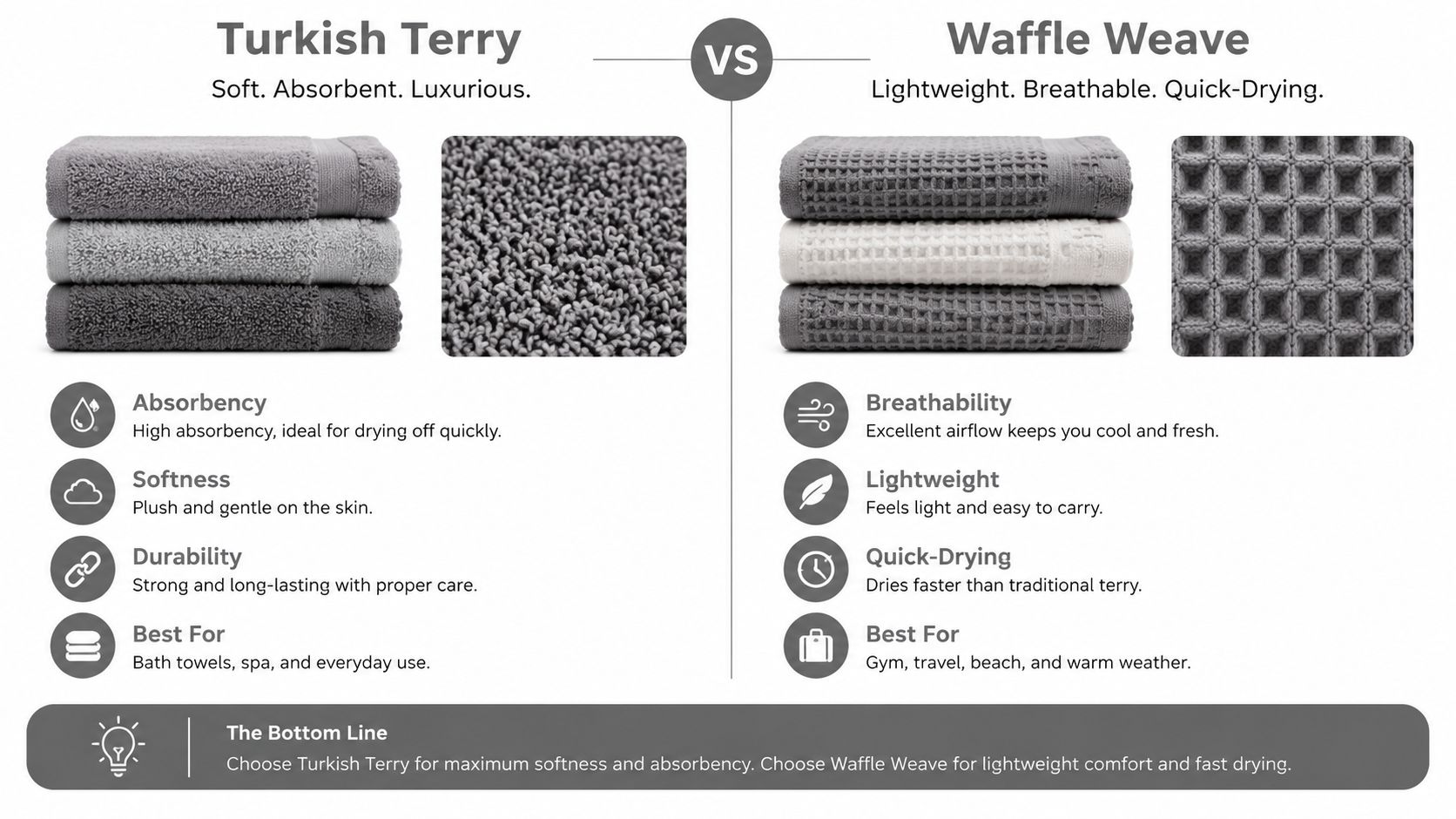
A robe bought for post-shower drying needs a different construction from one worn through a warm evening at home. Terry's loops hold water and add warmth; waffle's grid keeps the fabric lighter and more breathable. Match the weave to the wearer's routine, room temperature, and preferred feel.
What the fabric construction changes
In terry, raised loops form the pile. Greater pile height adds thickness, fabric mass, tensile strength, and moisture absorption, while reducing air permeability, according to research on cotton terry construction (cotton terry pile-height research). That makes higher-pile terry a strong choice after bathing or in a cool bathroom, though it can feel heavy in a heated room.
Waffle fabric has a textured grid rather than a deep loop pile. Its lighter feel suits warm climates, travel, and longer periods of wear when drying is only part of the job. Construction and fabric weight still shape how substantial a waffle robe feels, so check specifications rather than choosing by weave name alone.
| Construction | Best fit for the routine | Main trade-off |
|---|---|---|
| Higher-pile terry | Post-shower drying, cold bathrooms, spa use | More warmth and absorbency, but more weight and less airflow |
| Lightweight waffle | Warm rooms, travel, extended lounging | Less bulk and better airflow, but not the same drying feel as deep-pile terry |
| Midweight or mixed construction | Bathing and lounging in the same robe | A compromise that may not maximize either absorbency or lightness |
Match weight to where it'll be worn
For a robe used mainly after a shower, choose terry and ask how pile height and fabric mass work together. Pile height, density, yarn twist, and fabric weight all affect terry absorption, so “100% cotton” alone does not specify performance. For a robe that needs to pack neatly or stay comfortable in a warm home, start with waffle.
A midweight construction works for someone who uses one robe for both bathing and lounging. Some makers also offer mixed panels, with terry in areas intended for drying and lighter fabric where airflow matters. Ask for fabric specifications and care guidance before ordering; a product photo cannot show how the robe will feel or perform in daily use.
Sizing and Fit Blocks for a Real Male Body
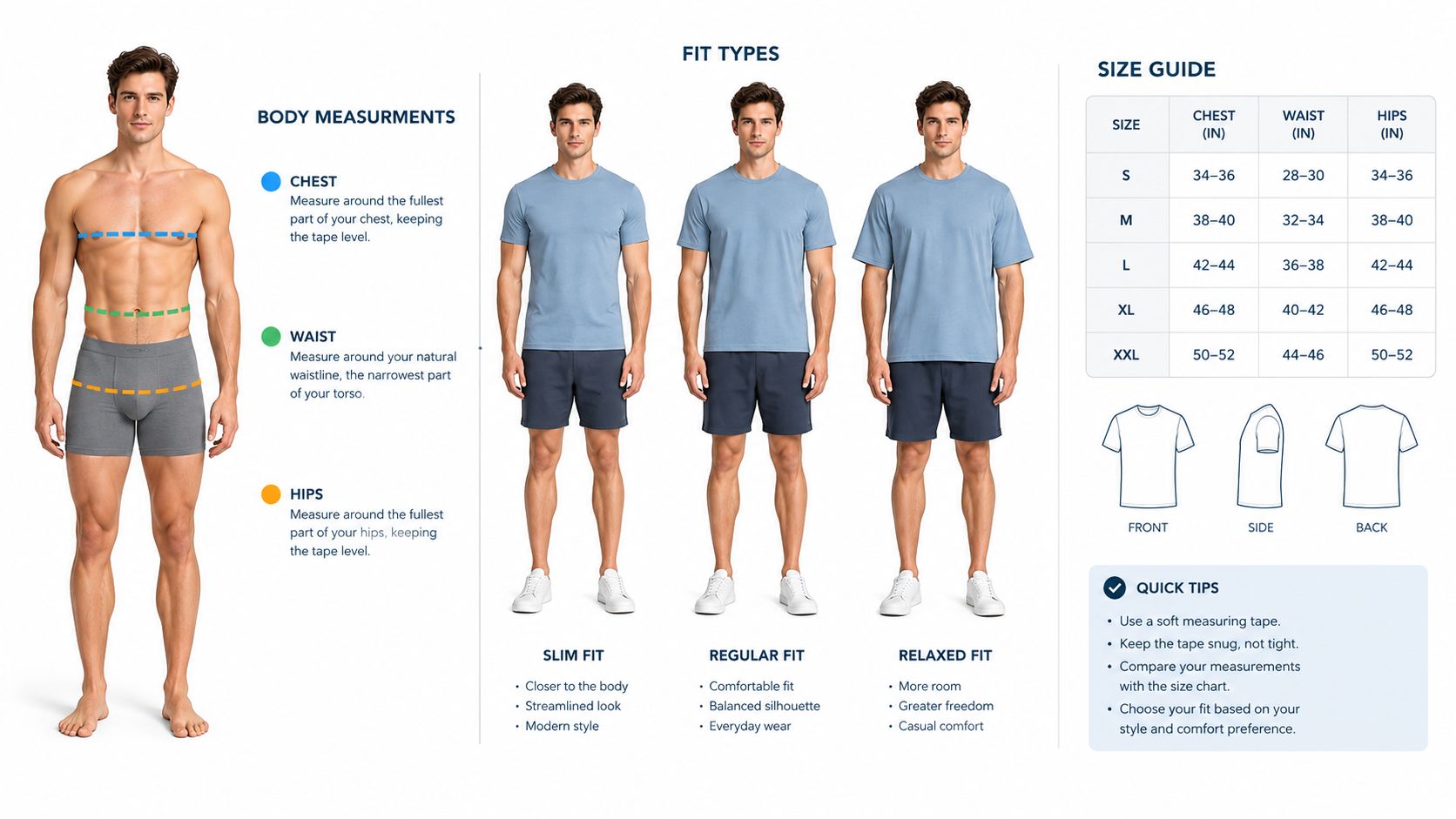
A robe shouldn't be sized like a fitted jacket. The wearer needs room to sit, bend, layer over sleepwear, and wrap the front without pulling at the seams. Start with body measurements, choose a height proportion, then check the finished garment for enough ease.
ASTM D6240/D6240M-24 provides adult-male measurements for chest sizes 34–52 in Short, Regular, and Tall proportions to help manufacturers account for fabric, movement ease, styling, and fit (ASTM's adult-male body measurement standard). Use a recognized baseline rather than assuming a generic S/M/L label guarantees the right proportions.
Measure the wearer, then check the garment
Take measurements over light clothing, keeping the tape level and comfortably snug. Record the chest, shoulder width, sleeve length, and height. Add waist measurement if the robe's cut or belt placement makes it useful for checking how the front will overlap.
- Chest: Measure around the fullest part. Compare the body measurement with the finished-garment chest to confirm room for wrapping and movement.
- Shoulders and sleeves: Check shoulder width and sleeve length together. A sleeve that's too short becomes more noticeable when reaching; one that's too long can get in the way.
- Height and hem: Select Short, Regular, or Tall proportions before adjusting the robe's overall length. Extending a Regular block indiscriminately can leave sleeves too long, while shortening it may crowd the torso.
For a clear explanation of how apparel sizing guides can organize body measurements, consult the Dirt Cheap Product sizing guide. Use it as a measurement reference, then request the robe's own finished dimensions. The guide to big and tall robes for men can also help buyers think through proportions when a standard size range doesn't cover the wearer comfortably.
Test movement before approving a block
A sample should pass a simple movement check. Have the wearer reach forward, sit down, bend, wrap the front, and tie the belt. Watch for pulling at the chest, restricted shoulders, sleeves that ride up, and a hem that shifts uncomfortably when seated. Decide whether the desired result is custom, standard, or oversized, then make sure the garment measurements match that intention.
Monogramming and Branding Without Compromising Comfort
A monogram should make the robe feel personal, not turn a soft garment into a scratchy one. Placement, thread density, and contrast matter because embroidery sits against or near the body, and its backing can affect how a robe feels in use.
Choose placement for the wearer
Chest embroidery is easy to see and conventional for gifts. A cuff or hem placement is quieter and less likely to sit directly against the torso. An inside-yoke mark keeps branding discreet, which often suits a robe intended for everyday use rather than display.
For a group gift or hospitality order, consistency matters more than elaborate design. Pick one placement and scale, then apply it across the set. A restrained wordmark or monogram looks more polished than oversized lettering competing with the fabric's texture.
Keep thread and texture in balance
Dense embroidery on high-pile terry can feel stiff or rough against bare skin, and the stitched area may dry differently from the surrounding loops. On waffle fabric, a small tonal monogram tends to blend into the texture with less visual and physical disruption. Ask for a sample or close-up proof when the design is large, high-contrast, or placed near the collar.
Choose thread color with the robe itself in mind. Tonal thread gives a subtle finish on both light and dark fabric, while contrast makes the monogram more visible but draws attention to its placement. For bare-skin comfort, favor a compact design and avoid dense stitching where the wearer's neck or chest will rub.
My buying preference: Keep personal initials small and tonal. Save bolder branding for a sleeve, hem, or group program where visibility has a clear purpose.
Ordering, Lead Times, and Wholesale Considerations
A custom robe order usually moves through a straightforward sequence: choose the fabric and color, provide measurements or select a size block, approve a proof or sample, then allow time for production and shipping. The calendar depends less on the word “custom” than on what the order requires. Stock fabric, a standard monogram, and a familiar fit block are simpler to schedule than a new dye run, complex embroidery, or multiple size adjustments.
Build a realistic ordering calendar
Treat the proof as a decision point, not a formality. Check spelling, placement, thread color, garment color, and size details before approval. If the order is for a gift or event, work backward from the date the robes need to arrive, leaving room to resolve a proof issue or shipping delay.
Rush service is realistic only when the fabric, production capacity, and embroidery queue can support it. Ask what the rush option changes and whether it includes shipping time. Don't assume that paying to expedite one stage shortens every stage.
Retail personalization, group gifting, and wholesale are different buying programs. A single robe may allow a straightforward individual choice, while a coordinated group order requires consistency across sizes and embroidery. Wholesale buyers should confirm minimums, sample approval, reorder availability, and how the supplier handles variations between production runs. The product sourcing guide for retailers offers a useful framework for evaluating sourcing processes, while this guide to choosing a wholesale bathrobe supplier focuses on questions relevant to larger robe programs.
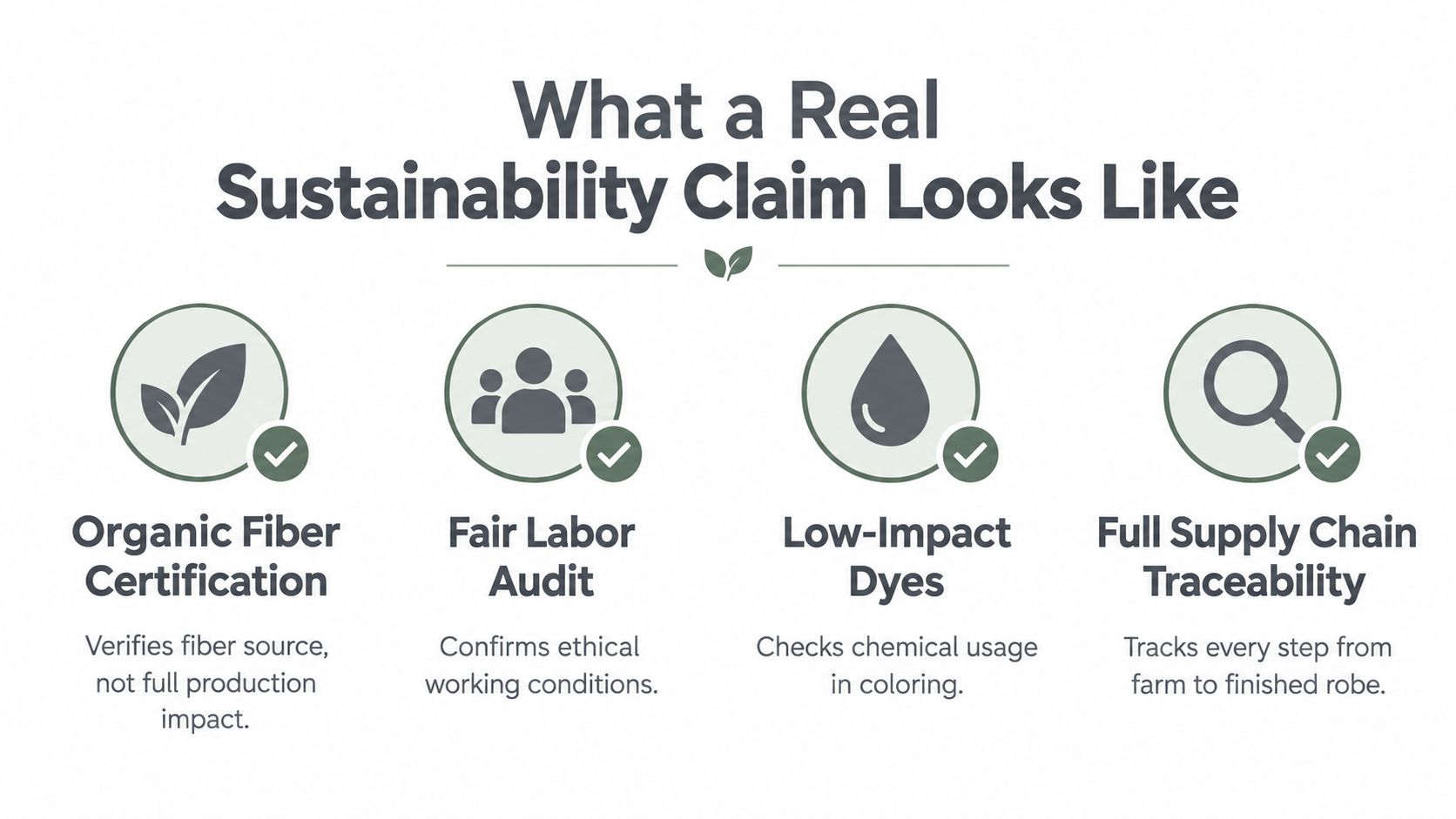
If sustainability matters to the program, ask the supplier to explain the scope of any claim before ordering. A badge may apply to a fiber, a finished product, a production site, or a traceability system, and those are not interchangeable. Get the answer in writing so the person approving the order can explain what the label does and doesn't cover.
What a Real Sustainability Claim Looks Like
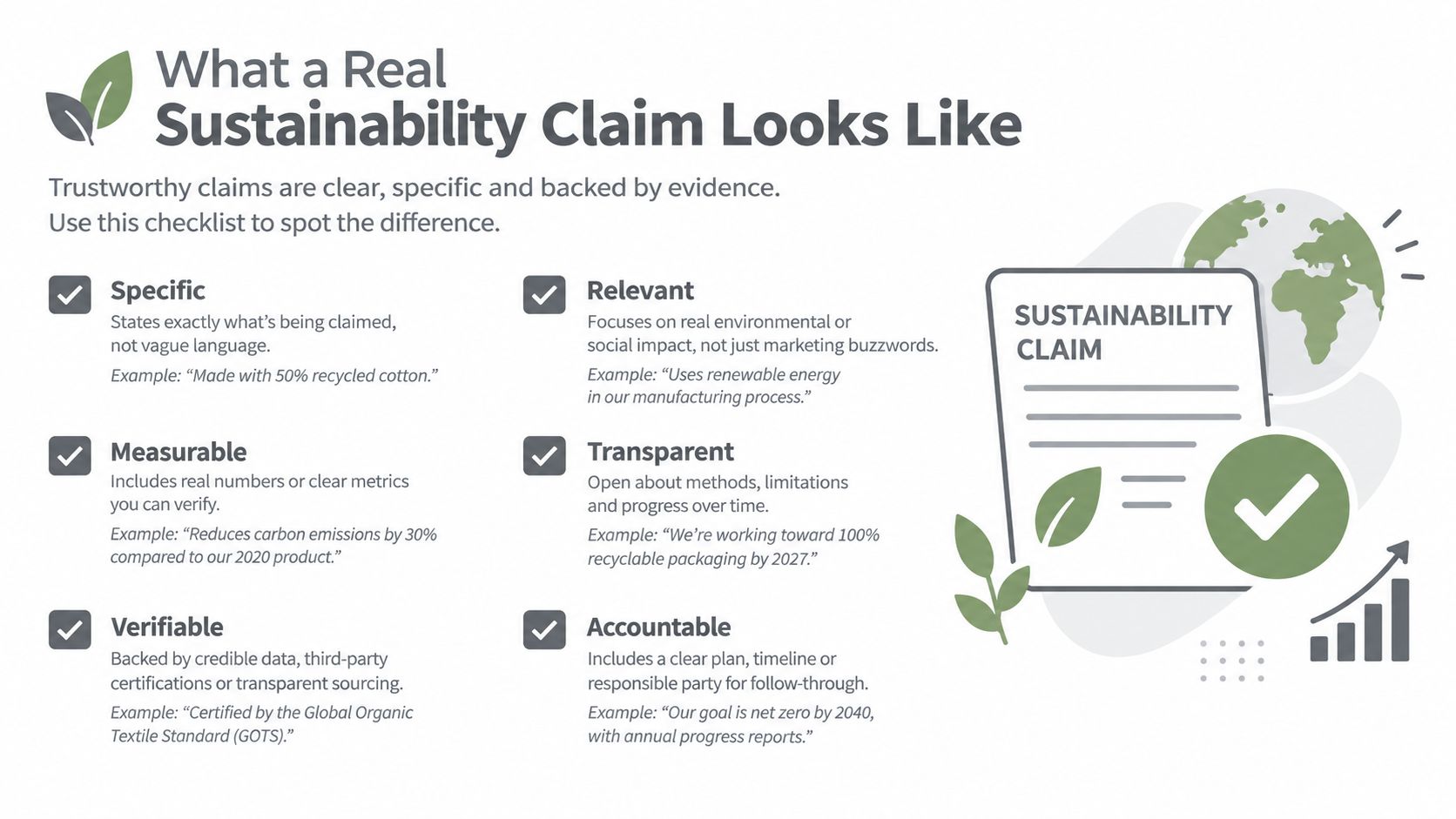
An “organic” or “eco-friendly” label doesn't automatically describe the whole robe. It may refer to the cotton, a production facility, chemical testing, or traceability, and it may not cover embroidery thread, dye, or packaging. A credible buyer asks what the claim applies to before treating a badge as proof of a low-impact purchase.
Supply-chain standards have become a more common requirement in sourcing: the OECD analysis reports that 81% of surveyed brands and retailers require sustainability certifications from suppliers. In the same analysis, GOTS-certified facilities increased 154% and OEKO-TEX SteP-certified facilities increased 242% (OECD forum analysis on garment supply-chain due diligence). These figures describe certification requirements and facility growth, not the environmental impact of any specific robe.
Check what the certification covers
Before you order, ask the seller to identify the exact standard and clarify whether it covers the fiber, the finished robe, the manufacturing site, or the supply chain. Organic-fiber certification and chemical-safety testing address different questions. A manufacturing-site certification doesn't necessarily verify the robe's fiber, and a fiber claim doesn't automatically include the monogram or its thread.
Use this checklist:
- Name the standard: Ask for the full certification name, not only a logo.
- Confirm the scope: Check whether it applies to cotton, the finished garment, or a facility.
- Ask about customization: Find out whether embroidery thread, backing, dye, and packaging are included.
- Look for traceability: Request an explanation of how the product's path is documented.
For shoppers focused on organic cotton, this guide to GOTS-certified organic cotton fabric can help clarify the material claim. The same question still applies at checkout: which parts of this particular robe and its customization does the certification cover?
A clear explanation of scope is more useful than a badge without context.
Pricing Tiers and What Each One Buys You
A robe's price should reflect more than the monogram. Compare fabric weight, construction, sizing options, finishing, and the amount of help you'll receive if the fit isn't right. The market falls into broad entry, mid, and luxury tiers, but labels alone won't tell you whether a robe suits a particular routine.
| Tier | What to expect | Best match |
|---|---|---|
| Entry | Lighter cotton, standard size blocks, and limited personalization choices | A simple personal robe or a group order where cost control matters most |
| Mid-range | More substantial terry or a defined waffle weave, cleaner finishing, and additional embroidery placements | Regular use, gifting, or buyers who want a more considered fit |
| Luxury | Premium material options, consistent fit blocks, careful finishing, and more support around ordering and returns | A long-term personal robe, a special gift, or a boutique hospitality program |
The entry tier works when the wearer needs a basic layer and a standard fit is likely to be comfortable. Don't expect extensive customization or a finely tuned size block. For a gift, limited embroidery choices may be enough if the recipient's preferred style is understated.
The mid-range is where construction details deserve closer attention. Ask for the fabric weight, how the robe is finished, and whether the seller offers a real waffle weave or a lightweight cotton robe. Better finishing and more placement options can be valuable, but only if they match the wearer's routine.
Luxury options make sense when fabric feel, fit consistency, and service matter as much as appearance. SEYANTE offers robes in Turkish cotton terry and lightweight waffle, with some styles described as GOTS-certified organic; its policies include free standard US shipping and 90-day returns. Treat those details as buying considerations, then verify the specific product's material, fit, and certification scope before placing an order. For hotels and group gifts, compare the full program, including sample approval and reorder consistency, rather than judging by the unit price alone.
Care, Longevity, and a Final Ordering Checklist
A robe lasts longer when you follow the care label instead of guessing. Wash terry and waffle robes according to the garment's instructions, use a suitable detergent, and avoid relying on fabric softener if preserving absorbency is a priority. Dry the robe in a way that suits its construction, and avoid excessive heat that can stress fibers and embroidery.
Protect the fabric and monogram
Terry benefits from enough room to rinse and dry fully. Waffle's lighter construction can be easier to air-dry, which is useful when the robe gets frequent wear. For either weave, close fastenings if present, turn the garment inside out when practical, and follow the care instructions for any stitched personalization. If the robe has a dense monogram, avoid rough handling at the embroidered area.
Before checkout, confirm the essentials:
- Routine: Pick terry for drying and warmth, waffle for lighter lounging, or a midweight option for mixed use.
- Proportion: Select the fit block by height and body measurements, then check the finished garment dimensions.
- Personalization: Decide on placement, thread color, and design size with comfort in mind.
- Proof and timing: Confirm the approval step, production window, shipping plan, and any rush charges.
- Certification: Verify what the claim covers, including any custom embroidery.
- Total cost: Review the complete order terms, not just the robe price.
The right robe is the one the recipient will reach for without thinking. Choose for his actual routine, verify fit and fabric details before production, and keep personalization comfortable enough for daily wear.
SEYANTE offers men's robes in Turkish cotton terry and lightweight waffle, with options for everyday comfort, gifting, and hospitality. Explore the collection at SEYANTE and choose a fabric, fit, and finish that suit how he'll wear it.