Long Hooded Bathrobes: A Complete Buyer's Guide
- What Makes a Long Hooded Bathrobe Different
- Terry, Waffle, and How Fabric Geometry Affects Drying
- Why the Hood Matters for Warmth and Comfort
- How to Choose the Right Length and Fit
- Terry vs Waffle at a Glance
- Care and Washing for Lasting Plushness
- Who Long Hooded Robes Work Best For
- How to Verify What You Are Actually Buying
You step out of a hot shower, reach for a towel, and feel the cold settle first around your ankles, then your damp hair and neck. A short robe may cover your torso, but it leaves the lower legs exposed and offers little help once moisture starts cooling your skin. A well-made long hooded bathrobe solves that exact transition, combining the coverage of a full-length garment with the practical function of a towel around your head and neck.
The right choice is not the softest robe on a product page. Fabric geometry, robe weight, hood construction, fit, care requirements, and certification all affect how the garment performs after bathing. This guide gives you a direct way to judge those details, so you can choose a robe that feels warm without becoming oppressive, dries at a reasonable pace, and remains comfortable after repeated washing.
What Makes a Long Hooded Bathrobe Different
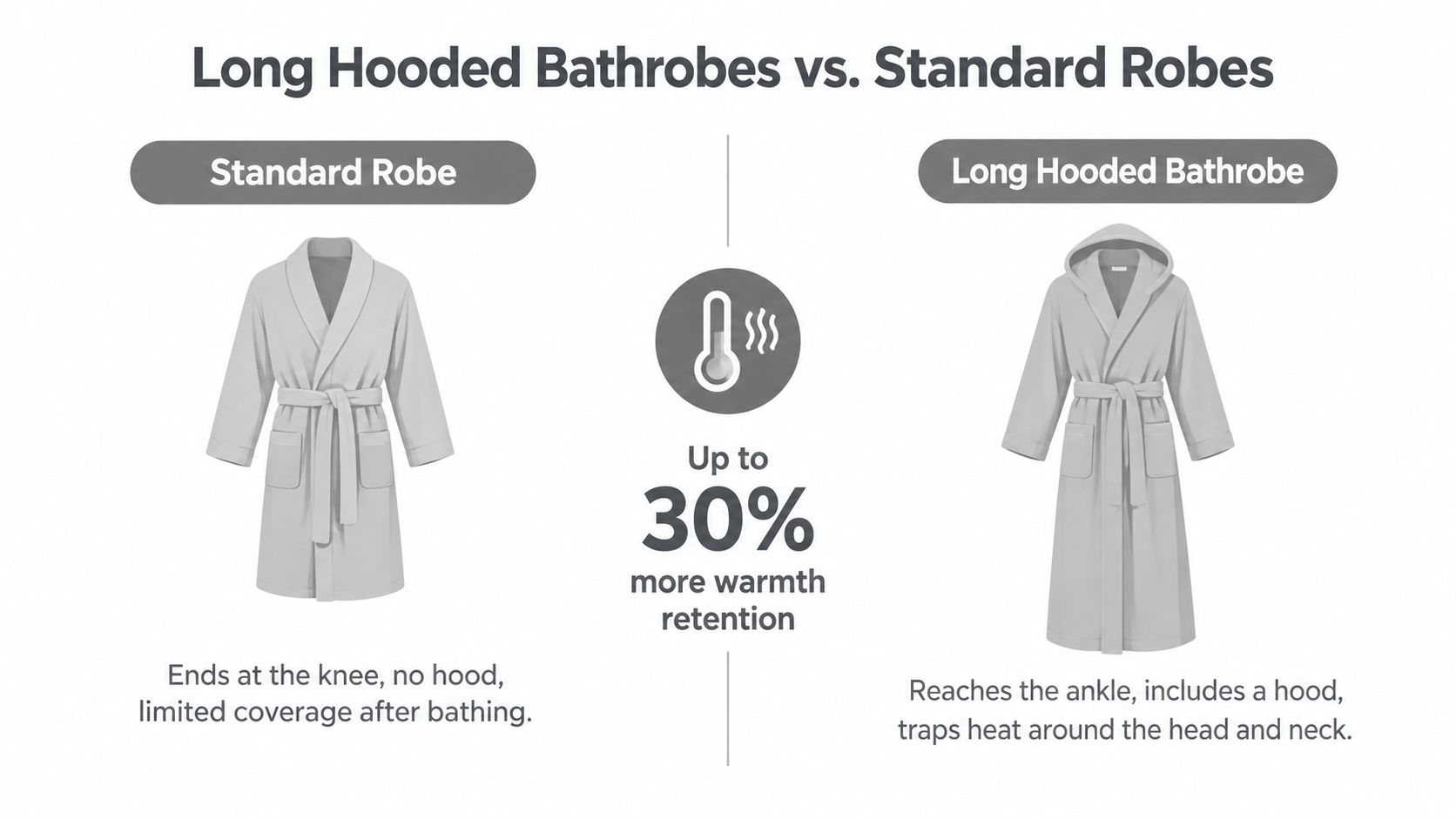
A long hooded bathrobe is designed for the minutes immediately after bathing, not only for lounging on a sofa. Its full-length hem protects more of the legs from cool air, while the integrated hood extends coverage above the shoulders. That combination makes the garment feel closer to a wearable drying layer than a short dressing gown.
A knee-length kimono robe is easier to move around in and often feels lighter. It also leaves the calves exposed and usually relies on a separate towel for damp hair. A long hooded design takes the opposite position. It prioritizes coverage, warmth, and moisture management, even if that means more fabric to wash and a slower drying routine.
The details that define the category
Look for three structural features:
A long hem: It should provide meaningful coverage below the knee without dragging across the floor.
A usable hood: The hood needs enough depth to cover damp hair and the upper neck, but it shouldn't fall over the eyes or seal tightly around the face.
A wrap system that stays closed: A belt, inner tie, or both should keep the front secure while you walk or sit.
Length alone doesn't make a standard robe a superior bathrobe. A long garment with a shallow hood, weak belt loops, or narrow shoulders can feel awkward. The best designs balance coverage with mobility, especially across the back and upper arms.
Style | Length | Hood | Typical Fabric | Best For |
|---|---|---|---|---|
Kimono robe | Short to knee length | Usually absent | Lightweight cotton or waffle | Warm climates and easy movement |
Shawl-collar robe | Knee to calf length | Usually absent | Plush or terry | Lounging and cooler rooms |
Hooded robe | Knee to full length | Integrated hood | Terry, waffle, or plush cotton | Hair coverage and post-bathing comfort |
Long hooded bathrobe | Calf to ankle length | Integrated, deeper hood | Cotton terry or waffle | Maximum coverage after bathing |
A longer robe also works well alongside simple bathing accessories. For a coordinated routine, a Homeliving Beauty Bath Sponge can handle cleansing while the robe takes over after rinsing, when your priority shifts from washing to warming and drying.
The historical context behind premium cotton robes matters too. Cotton cultivation in Turkey's Çukurova region dates back at least to the early nineteenth century, and industrial textile investment expanded substantially during the 1970s, 1980s, and 1990s. By the 2021–2022 season, Turkey produced approximately 827,000 metric tons of cotton, helping establish the industrial foundation behind its globally traded towels and terry textiles (International Cotton Advisory Committee overview).
Terry, Waffle, and How Fabric Geometry Affects Drying
Fiber content tells you what a robe is made from. Fabric geometry tells you how it behaves. Two robes can both use cotton and still differ sharply in absorbency, warmth, weight, and drying time.
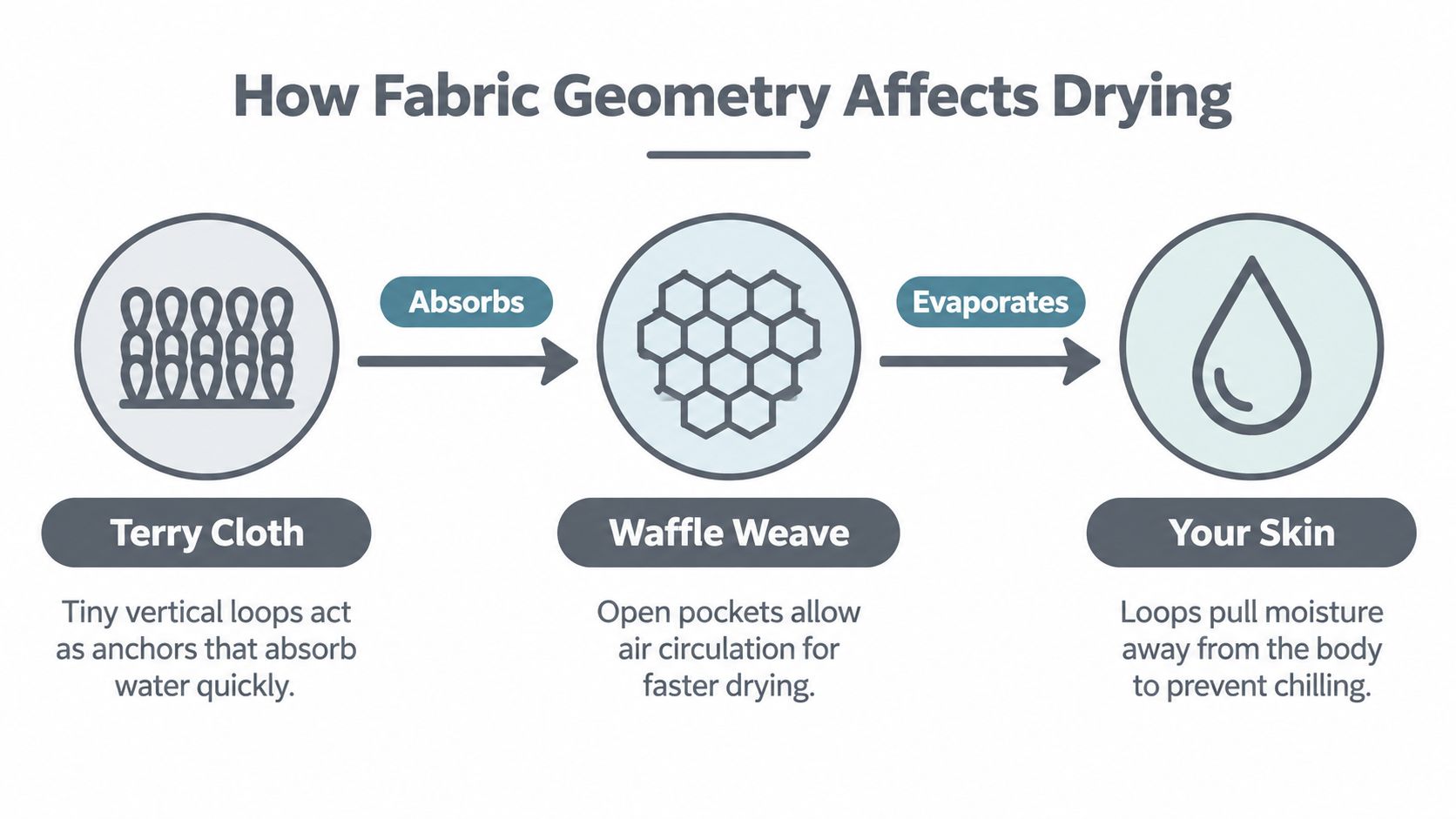
Think of terry as a field of tiny raised anchors. The loops create more surface area and catch water from the skin, much like a sponge. Waffle fabric works more like a lattice. Its recessed pockets hold air and create space for moisture to move away, so the fabric generally feels less bulky and releases water more readily.
Why loops change the first few minutes
A textile study found that terry fabrics absorbed approximately 26–40% of their eventual water volume within the first 10 seconds, exceeded 50% after 30 seconds, and reached about 75% after 100 seconds (terry-fabric absorption study). Those figures describe fabric testing rather than a promise for every robe, but they explain why looped terry feels immediately effective when you put it on damp skin.
The same research identified yarn type as the most influential variable in dynamic absorption, with construction also affecting performance. That means a robe's label saying “100% cotton” isn't enough. You need to consider loop height, density, yarn twist, and how securely the loops are anchored.
Practical rule: Choose terry when the robe must do some of the drying. Choose waffle when the robe's main job is to cover, warm, and release moisture quickly.
What to inspect on a product page
A useful product description should give you more than a fiber percentage. Look for:
Fabric type: Terry indicates raised loops. Waffle indicates a structured, open surface.
Weight information: Heavier fabric usually feels more substantial, but it can retain more water.
Construction details: Reinforced seams and stable loops matter on a garment with a long hem and hood.
Drying expectations: Be suspicious of claims that promise both maximum plushness and instant drying without explaining the construction.
A separate experiment on 100% cotton terry found that weft yarn count and density changed several performance properties, including air permeability, loop-extraction resistance, abrasion, absorption, and drying after repeated washing. For a deeper daily-use comparison, this waffle versus terry robe guide is useful because it keeps the decision tied to routine rather than texture alone.
If you're also comparing towels, the SouthShore towel recommendations offer helpful context on how absorbency and construction affect everyday textile performance. Apply the same thinking to robes. Don't buy on “100% cotton” alone.
Why the Hood Matters for Warmth and Comfort
A hood isn't decorative excess. It changes where the robe manages moisture and heat.
After bathing, damp hair and exposed skin around the ears and neck can make you feel chilled even when your torso is covered. A hood acts like a second towel for the head, with the added benefit of keeping the upper neck enclosed while you move around. It also reduces the exposed area through which warm air escapes.

The trade-off is thermal. A CDC-hosted climatic-chamber study found that hooded protective ensembles had a lower critical wet-bulb globe temperature than comparable non-hooded ensembles. The findings supported applying a 1°C clothing adjustment for hoods, because the hood obstructs evaporative cooling. The study also notes that the head contributes about 7% of total cutaneous evaporation at 35°C.
A bathrobe isn't protective workwear, and you won't wear it at the same activity level. The mechanism still matters. A thick terry hood feels excellent in a cool bathroom, but it can become too warm after a hot bath or in a heated bedroom. A lighter waffle hood suits people who want coverage without the enclosed, towel-like sensation.
Hood specifications worth checking
Opening size: It should frame the face without pressing against the cheeks or restricting vision.
Depth: Enough room should remain for damp hair, but excessive depth makes the hood collapse over the eyes.
Neckline seam: A bulky seam can bunch under the jaw or rub when the hood is down.
Hood weight: Match dense terry to cooler conditions and stronger drying needs. Choose lighter construction for warm or humid rooms.
Flatness when lowered: The hood should lie against the upper back instead of forming a heavy lump behind the neck.
My preference is a hood with generous coverage and a relaxed opening, not a tight drawstring-style fit. You want the hood to retain warmth, not trap heat against your face.
How to Choose the Right Length and Fit
Start with your height, then check the garment's actual length from the shoulder or neck seam to the hem. A robe described as “long” can finish near the calf on one person and near the ankle on another. The hem should cover the legs meaningfully without catching under your heels or brushing the floor.
For a practical fit test, stand naturally and check three points:
Hem clearance: The robe should stop above the floor when you're barefoot. If you plan to wear it over sleepwear, allow room for the extra layer.
Sleeve position: Sleeves should reach the wrist or sit slightly above it. Fingertip-length sleeves become annoying around sinks and can drag through water.
Shoulder and back room: Raise both arms, reach forward, and sit down. Pulling across the shoulder blades means the robe is too narrow, even if the waist closes comfortably.
A long robe with narrow shoulders is a poor bargain. The extra length won't feel luxurious if the upper body restricts movement.
Choosing between sizes
Size up when you want to layer over pajamas, when the robe has a slim cut, or when your measurements fall between sizes. A little extra room improves wrap coverage and reduces stress on the belt and side seams.
Choose your usual size when the garment already has a relaxed cut and you want a cleaner silhouette. Don't size down to avoid excess fabric. Terry can feel restrictive once it absorbs moisture, and a hooded robe needs enough ease for the hood and shoulders to move naturally.
Check sleeve cuffs after washing too. Ribbed or neatly finished cuffs help control the shape, while loose cuffs can stretch and remain damp. A reliable size chart should list garment measurements, not only generic labels such as small, medium, or large.
Terry vs Waffle at a Glance
Terry and waffle aren't competing textures in the abstract. They solve different problems.
Choose terry when you step directly from the bath into the robe and expect the garment to absorb water. Choose waffle when you want a breathable cover-up for a warm bedroom, travel, a spa circuit, or layering over dry clothing.
Attribute | Terry | Waffle |
|---|---|---|
Initial absorbency | Strong, thanks to raised loops | Moderate, depending on construction |
Hand feel | Plush, cushioned, towel-like | Structured, lighter, and more textured |
Warmth | Higher when fabric is dense | Moderate, with more air movement |
Wet weight | Can become substantial | Usually feels less saturated |
Drying speed | Often slower with dense pile | Generally faster with open structure |
Best season | Cooler rooms and winter routines | Warm weather and humid spaces |
Best use | Directly after bathing | Lounging, travel, and layering |
Main drawback | More fabric care and drying time | Less immediate drying power |
Terry isn't automatically superior because it feels heavier. Dense loops can improve water uptake, but they also increase wet mass and may extend drying time. Waffle isn't a lesser version of terry either. In a warm or humid setting, a lighter robe that releases moisture quickly can be more comfortable than a thick robe that stays damp.
My default recommendation
For a cold bathroom, frequent post-shower use, or anyone who dislikes exposed legs and damp hair, choose a medium-weight terry long hooded bathrobe with secure loops and reinforced seams.
For warm bedrooms, travel, spa use, or people who run hot, choose a lightweight waffle robe with a hood that doesn't sit heavily around the neck. The best robe is the one you'll put on immediately and dry properly after each use.
Care and Washing for Lasting Plushness
A long hooded robe contains more fabric, seams, and surface area than a short kimono style. That gives it better coverage, but it also creates more places for shrinkage, trapped moisture, and loop damage to develop.
Read the care label before the first wash. Use the warmest temperature the manufacturer permits, but don't assume hotter is better. High heat can stress cotton fibers, encourage shrinkage, and make terry loops feel harsher over time.
A repeatable routine
Wash with similar fabrics: Keep zippers, hooks, and abrasive garments away from exposed loops.
Use mild detergent: Too much detergent leaves residue that dulls softness and can reduce absorbency.
Skip fabric softener on terry: Softener coats fibers and can interfere with water uptake.
Shake the robe out before drying: This separates compressed loops and helps the hood regain shape.
Tumble dry on low when permitted: Low heat supports softness without the stress of aggressive heat.
Air dry with ventilation: Spread the hood open so the fabric at the back of the neck doesn't remain damp.
The hood deserves special attention. Don't hang the robe with the hood folded tightly over the belt or a narrow hook. Arrange it so air can reach the inside, especially after a shower when the hood has absorbed moisture from hair and skin.
For additional guidance on washing, storage, and preserving shape, use this robe care guide. Store the robe folded on a broad shelf or hung from a sturdy, wide hanger once it's fully dry. Avoid compressing a damp robe in a closed bathroom hamper. That encourages stale odors and makes the next wash work harder.
Who Long Hooded Robes Work Best For
Long hooded bathrobes make the most sense for people who value the transition after bathing as much as the bath itself. The design gives you time to move slowly, dry naturally, and stay covered while your hair and skin finish releasing moisture.
Everyday self-care
For a morning routine, the hood protects damp hair while you make coffee or get dressed. After a workout, the longer hem keeps your legs covered while your body cools down. On a slow weekend, the robe provides enough warmth for reading, breakfast, or skincare without requiring immediate full clothing.
Fabric choice matters most. Pick terry if the robe replaces part of your towel routine. Pick waffle if you plan to wear it for longer stretches after your skin is already mostly dry.
Spas and wellness spaces
A hooded robe works well in a spa setting because guests move between warm treatment rooms, changing areas, and cooler corridors. Full coverage feels more private, and the hood helps people stay comfortable after steam, bathing, or hair treatments.
For commercial use, inspect the robe as a laundry item rather than a personal indulgence. Prioritize stable seams, secure belt loops, colorfast construction, and a fabric weight that your laundry process can dry reliably. An overly dense robe can feel luxurious at first and become a practical burden when a full rotation needs frequent washing.
Hospitality and short-term rentals
A long robe can make a guest room feel considered, but only when the sizing and care system are clear. Provide more than one size where possible, use neutral colors that tolerate regular laundering, and choose construction that keeps its shape after repeated cycles.
The hood is especially useful for guests who want to move from a bathroom to a bedroom without carrying a separate towel. It also adds a recognizable feature that differentiates a functional guest robe from a generic cover-up.
Bridal parties and gifts
For gifting, coordination matters more than novelty. Choose a consistent color palette, confirm measurements before ordering, and decide whether every recipient needs the same length. A long hooded robe makes a strong gift for someone who enjoys self-care, but it can be excessive for a person who prefers lightweight clothing and quick movement.
Personalization should never replace fit. A beautiful monogram won't fix sleeves that are too long, a hood that collapses over the face, or a hem that drags. Buy for the recipient's routine first, then add visual details.
How to Verify What You Are Actually Buying
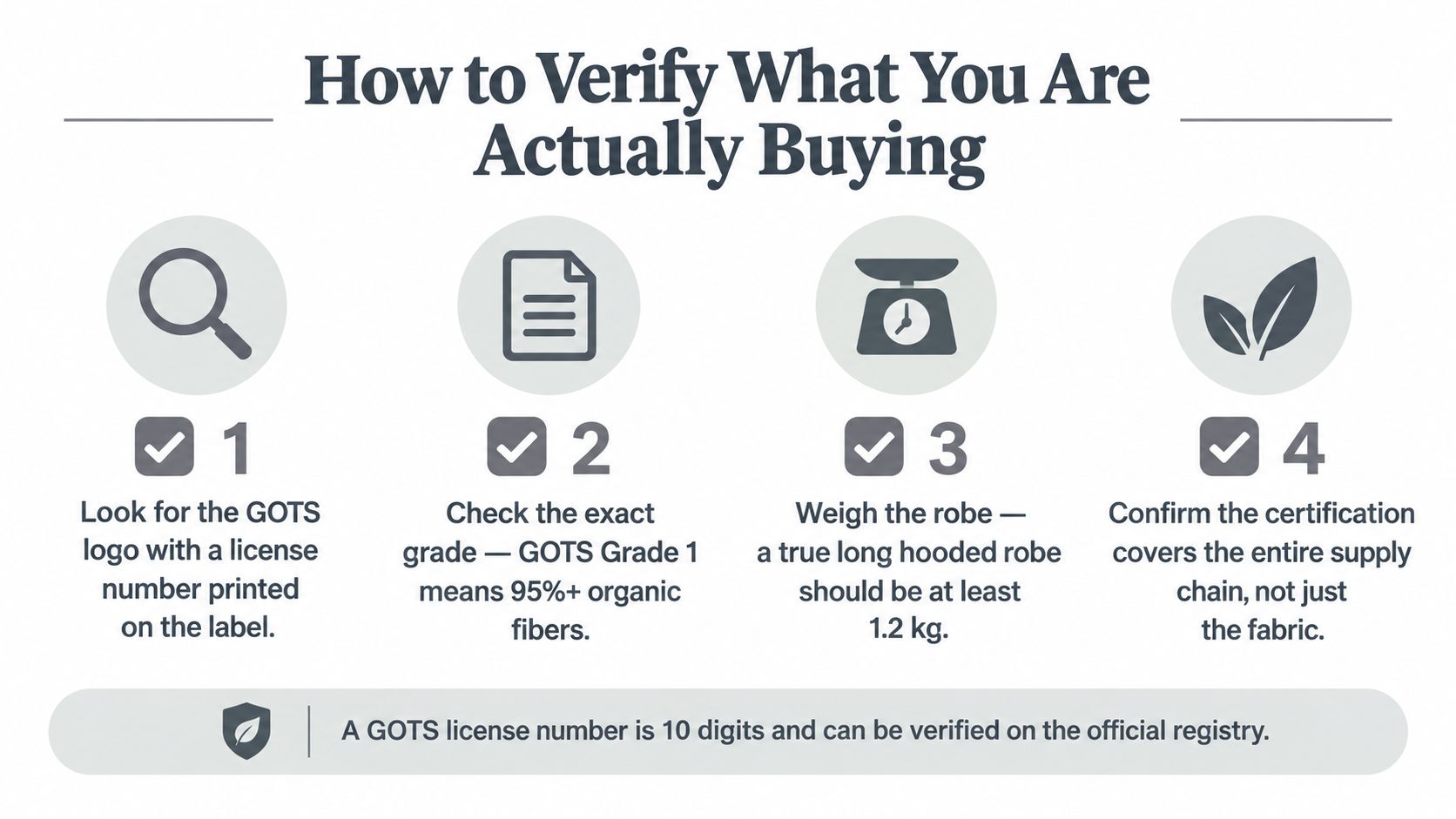
Marketing language becomes vague exactly where buyers need precision. “Organic cotton” describes fiber origin. GOTS-certified finished textile describes a broader certification scope that can include processing, manufacturing, packaging, labeling, trading, and distribution.
GOTS certification is voluntary and requires independent third-party certification of the supply chain. It doesn't mean the robe contains no chemicals. Instead, the standard restricts inputs, sets residue requirements, and addresses environmental and social criteria (GOTS certification overview).
Check the label grade
The grade changes the claim. Products labeled “organic” require at least 95% certified organic fibers, while products labeled “made with organic” require at least 70%. Those are not interchangeable descriptions.
Look for the exact label wording, the certifier, and the license number. Then check whether the certification applies to the finished robe or only to the cotton used in the fabric. A robe contains more than fiber. Dyes, sewing thread, labels, trims, and finishing processes all affect what reaches your skin.
Use a four-part buying check
Fabric: Decide whether terry or waffle suits your drying and climate needs.
Construction: Inspect the hood opening, belt attachment, seams, loops, sleeve cuffs, and hem.
Certification: Verify the exact GOTS grade, certifier, license number, and finished-product scope.
Ownership: Confirm washing instructions, return terms, shipping details, and whether the robe can dry properly in your home.
The guide to GOTS-certified organic cotton fabric can help you distinguish a verified certification claim from a generic sustainability phrase. Treat the license information as a buying detail, not a decorative badge.
A current market estimate valued the worldwide bathrobe market at approximately $4.2 billion and projected $6.5 billion by 2034, with the source estimating a 4.89% compound annual growth rate from 2026 through 2034. The same estimate identified North America as the largest regional market at about 34% of global bathrobe revenue, while a separate estimate placed hooded bathrobes at 24.3% of the bathrobe market. These figures use different market boundaries and forecasting assumptions, so treat them as directional rather than definitive (bathrobe market overview).
The buying conclusion is simple. Choose terry for direct post-shower drying, waffle for breathable coverage, and a hood whose weight matches your climate. Verify certification instead of trusting the word “organic,” then confirm the robe's fit and care routine before you commit.
SEYANTE offers long hooded bathrobes in Turkish cotton terry and lightweight waffle constructions, including GOTS-certified organic options for shoppers who want verified textile standards. Visit SEYANTE to compare fabrics, fits, and coverage for your own bathing routine or hospitality needs.