Embroidered Bridal Party Robes: The Complete Guide
- The Getting-Ready Moment and Why the Robe Choice Matters
- Terry vs Waffle and Other Fabrics Worth Considering
- Embroidery Types, Thread Choices, and Placement That Flatters
- Personalization Options From Monograms to Role Labels
- Sizing and Fit Across a Real Bridal Party
- Ordering Timeline, Minimums, and How to Avoid the Group-Order Trap
- Care Instructions and How to Make Embroidery Last
- Making the Final Decision Without Second-Guessing
You're three tabs deep in robe listings, someone in the group chat just asked if blush washes her out, and your photographer wants a final getting-ready plan. That's the actual decision point for embroidered bridal party robes, not a flat product photo. Pick for the room, the bodies in it, and the mornings after the wedding, in that order.
The Getting-Ready Moment and Why the Robe Choice Matters
The suite is already warm by nine. Hair dryers are running, makeup lights are on, someone's hunting for a phone charger, and eight people are rotating between mirror, couch, and window light. Your robes are in every frame, whether you planned that or not.
You're not buying a uniform for one posed shot. You're buying coverage while seated, a neckline that slips off finished hair without a fight, sleeves that don't drag through foundation, and fabric that doesn't turn shiny and creased the moment someone sits down. If a robe only works while everyone stands still and holds a pose, it's the wrong robe.
The Six Calls You Actually Have to Make
Settle these before you fall for a color swatch. Fabric controls heat and drape. Color controls contrast against different skin tones and hair colors. Personalization format decides whether the robe gets worn again. Sizing approach decides whether people relax or spend the morning tugging at a belt.
Embroidery placement decides whether lettering reads as refined or dominates the garment. Timeline decides whether you have exchange options or you're steaming a panic purchase the night before. Write down your top two priorities now, for example flattering group photos and post-wedding wear, and judge every later option against them.
That discipline matters because this is a group purchase, not a single gift. Bridal apparel has real commercial scale, and attendants' clothing is a meaningful part of it, so you'll see plenty of marketing aimed at multipiece orders. For broader inspiration on coordinating the party without cloning everyone, review these bridal party looks that coordinate without matching exactly before you lock a palette.
Choose the robe your party can wear comfortably before the photographer arrives, not just the one that reflects the most light when she does.
Ask one blunt question about every candidate. Would each person still reach for this on a Sunday morning, at a hotel, or after a bath? If the answer is no, you've designed a costume. Keep going until the answer changes.
Terry vs Waffle and Other Fabrics Worth Considering
Fabric decides everything downstream. It controls how embroidery sits, how the robe moves on camera, and whether your party overheats by the second makeup appointment. Start with climate and room temperature, not with a mood board.
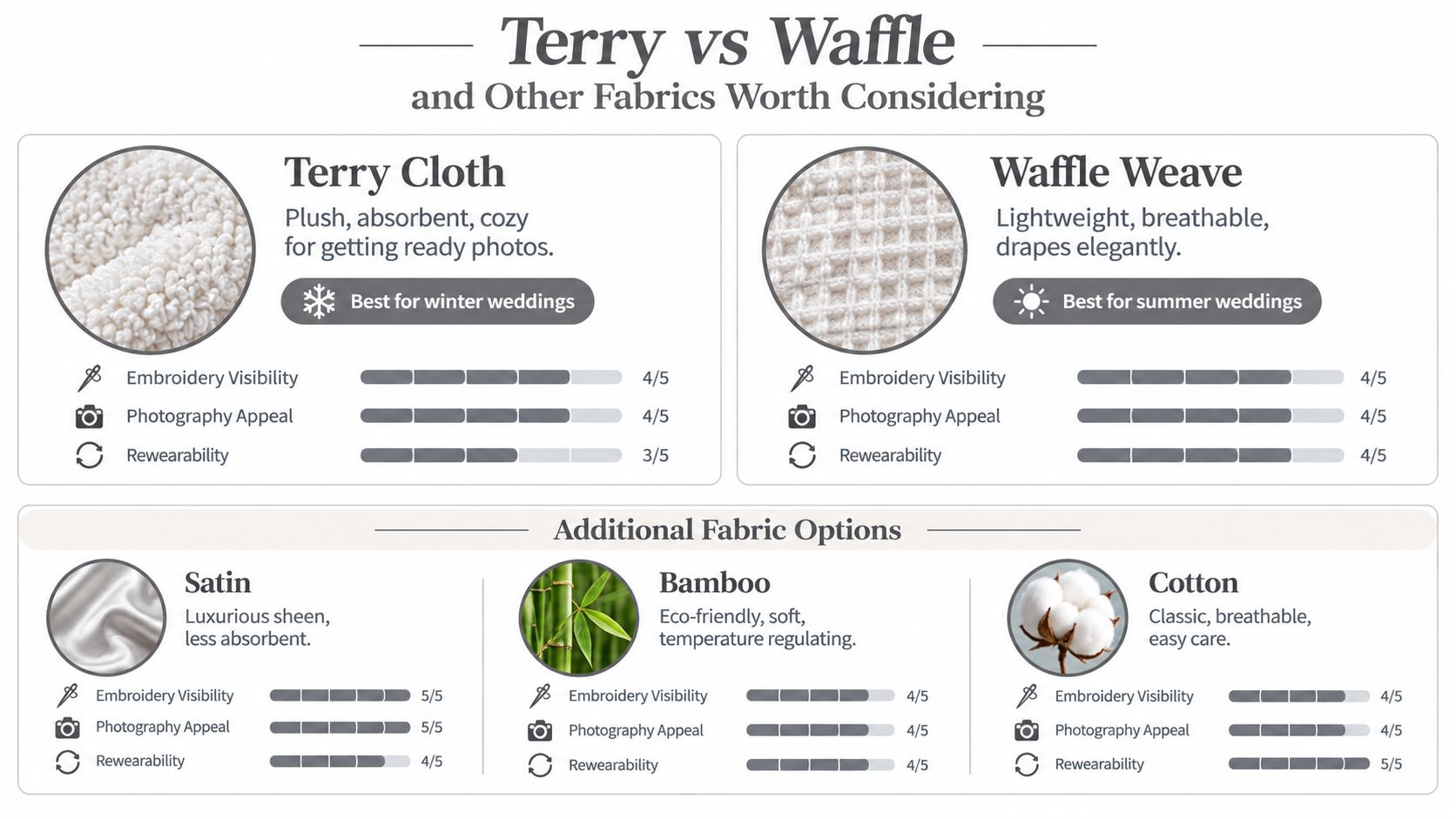
Terry cloth, especially 100% Turkish cotton terry, is plush, absorbent, and forgiving in photos. The looped surface hides the bulk of stabilizer behind embroidery and gives you a genuine post-shower robe afterward. Its weakness is heat. In a crowded summer suite, terry can feel heavy fast.
Waffle weave is the opposite trade. It's lighter, breathes better, packs flatter in a gift box, and its grid texture shows fine stitching cleanly. It drapes rather than envelops, which many parties prefer for photos. It won't replace a towel after a shower, so don't sell it to your party as one.
Bridal Fabric Comparison at a Glance
| Fabric | Warmth | Photo Texture | Embroidery Look | Best Season | Long-Term Wear |
|---|---|---|---|---|---|
| Terry cotton | High | Plush, matte | Subtle, nestled in loops | Cool months | Post-bath, home |
| Waffle cotton | Low to medium | Structured, light | Crisp and visible | Warm months | Travel, lounging, spa |
| Satin | Medium, traps heat | Shiny, crease-prone | Can pucker if thin | Indoor, short wear | Limited |
| Silk | Low | Fluid, elegant | Delicate, needs care | Mild weather | Occasional, careful care |
| Lightweight cotton | Low | Soft, natural | Clean and flat | Warm months | Everyday mornings |
Satin is where I'll be direct. Cheap satin photographs exactly as cheap as it looks, it doesn't breathe, and every bunch at the belt shows. Silk is lovely but high-maintenance and unforgiving of wrinkles. If you want the detailed head-to-head on the two cotton workhorses, read this comparison of waffle and terry cloth robes for daily use before ordering samples.
Ask suppliers specific questions before you commit a group order.
- Weight and finish: Ask about fabric weight and whether the robe is pre-shrunk, because shrinkage after embroidery ruins fit and lettering alignment.
- Fiber disclosure: Confirm exact fiber content rather than accepting words like premium or eco on their own.
- Sample in your color: Judge texture and thread contrast on the actual shade, not on white.
Pick the fabric your climate demands. Everything else is styling.
Embroidery Types, Thread Choices, and Placement That Flatters
Embroidery turns a robe into a gift, but bad digitizing turns it into a puckered regret. The stitch has to suit the fabric first and the design second. If you're new to the terminology, this primer on what is embroidery covers the basic methods before you talk to a monogram shop.
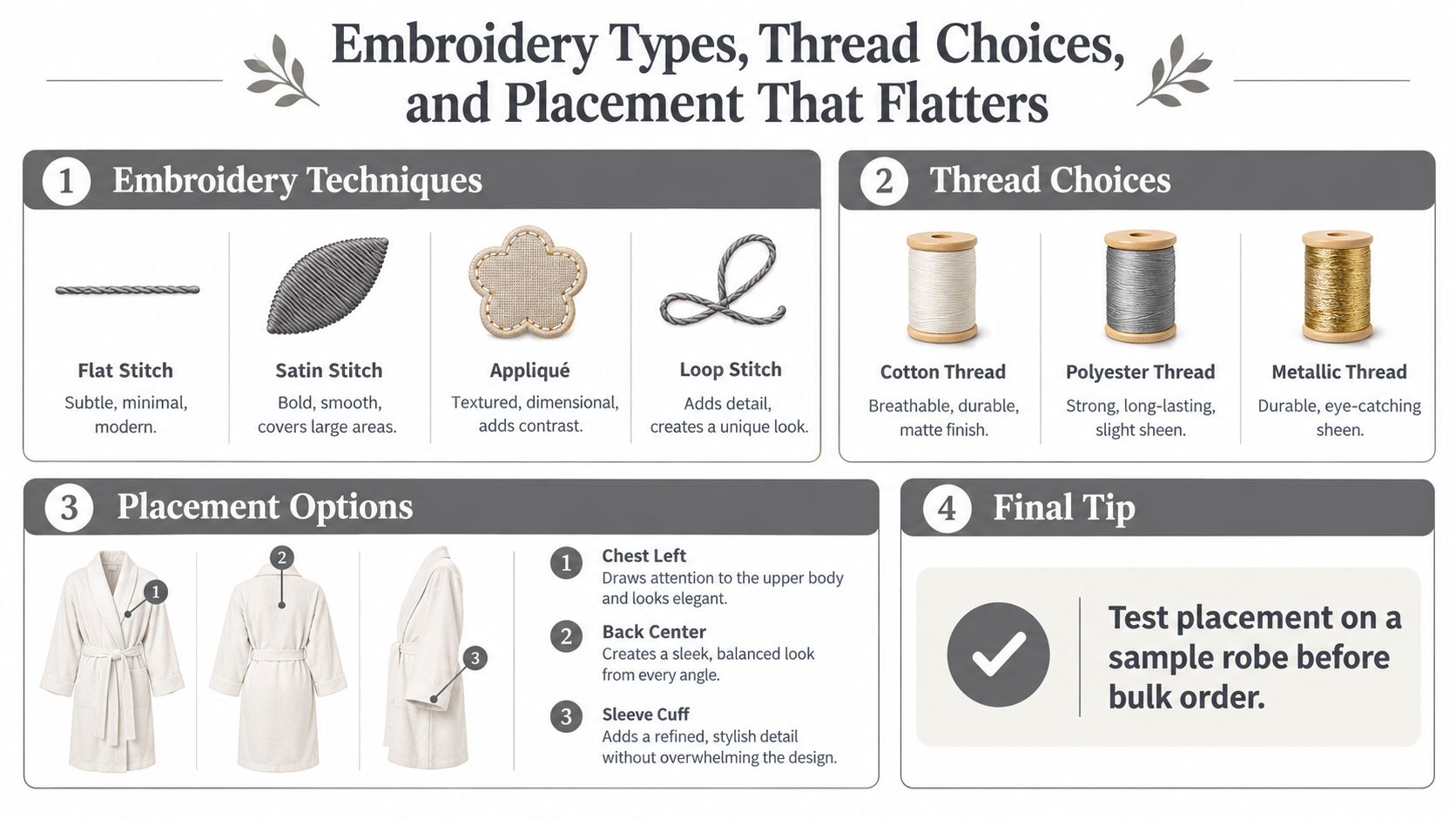
Satin stitch creates smooth, filled lettering and is the right default for initials and short names on waffle and flat cotton. Flat or run stitch gives you a lighter, more minimal line that suits small cuff details. Appliqué adds a fabric patch for contrast and texture, but it's bulkier and reads more casual, so use it deliberately, not by default.
On terry, lettering needs enough density and a suitable topping so stitches don't sink into the loops and disappear. On thin satin, dense stitching pulls and puckers. The fabric and the stitch plan are one decision, not two.
Placement That Reads Well on Camera
Left chest is the classic for a reason. It photographs in close portraits, identifies each person's robe in a busy suite, and stays discreet afterward. A cuff placement is quieter and the most wearable long term. A back placement reads in group shots from behind, but large back lettering is the fastest route to a robe nobody wears again.
Pocket embroidery is charming and often crooked in practice, because pockets move and sit at different heights on different bodies. Skip it for a group order unless you've seen a sewn sample on your exact robe.
For thread, choose tone-on-tone on white, champagne, sage, and blush if you want the robes to age gracefully in photos. Use contrast on navy or black where tone-on-tone would vanish. Metallic thread looks festive and behaves badly, it's stiffer and less forgiving in laundering, so reserve it for small accents.
Hand your embroiderer a written spec, not a verbal brief.
- Exact spelling for every name or initial set, checked by the recipient.
- Placement measured from a fixed point, for example from the shoulder seam.
- Thread color and letter height approved on a sewn sample, not a screen proof alone.
Personalization Options From Monograms to Role Labels
Personalization is not a new wedding invention, and that history should guide your choice. Decorative initials appeared for centuries on coins, seals, manuscripts, textiles, jewelry, and household objects, and monogramming became linked to cultivated taste and domestic status in the eighteenth and nineteenth centuries, as traced in this history of the monogram and its uses. Nineteenth-century brides marked linen trousseaux, including towels, sheets, napkins, and handkerchiefs, to identify possessions in shared laundering systems and to signal a new household identity.
Your robes are the modern version of that trousseau marking. The format you choose decides whether the robe stays in rotation or goes straight to the back of a closet.
Rank the Formats by Wearability
Initials or a three-letter monogram win. They're personal, they don't announce an event, and they work on a cuff or chest for years. First names come next, useful in the suite and still normal at home. They're friendly without being costume-like.
Role labels like Maid of Honor or Mother of the Bride photograph clearly and then expire. Nobody wears a job title to make coffee. Full name plus wedding date across the back is the worst offender. It's legible in exactly one photo and unwearable everywhere else, and it makes the robe hard to gift on, share, or resell.
The wearability test: If the recipient wouldn't wear the lettering to answer the door, shrink it, move it to the cuff, or cut it.
That test matters more as shoppers pay attention to certifications and seals when judging whether clothing is environmentally responsible, a factor tracked in Cotton Incorporated's 2025 global consumer research. A robe that's worn for years is the lower-waste choice regardless of label claims. Visible personalization that blocks reuse works against you.
Consider interchangeable options when you want the photo moment without permanent lettering. A stitched monogram on the robe plus role wording on a hang tag, sash, or gift card gives you both. For attendants changing or hyphenating a surname, use first-name or single-initial formats and confirm the preferred form privately. Don't guess at someone's future initials.
Sizing and Fit Across a Real Bridal Party
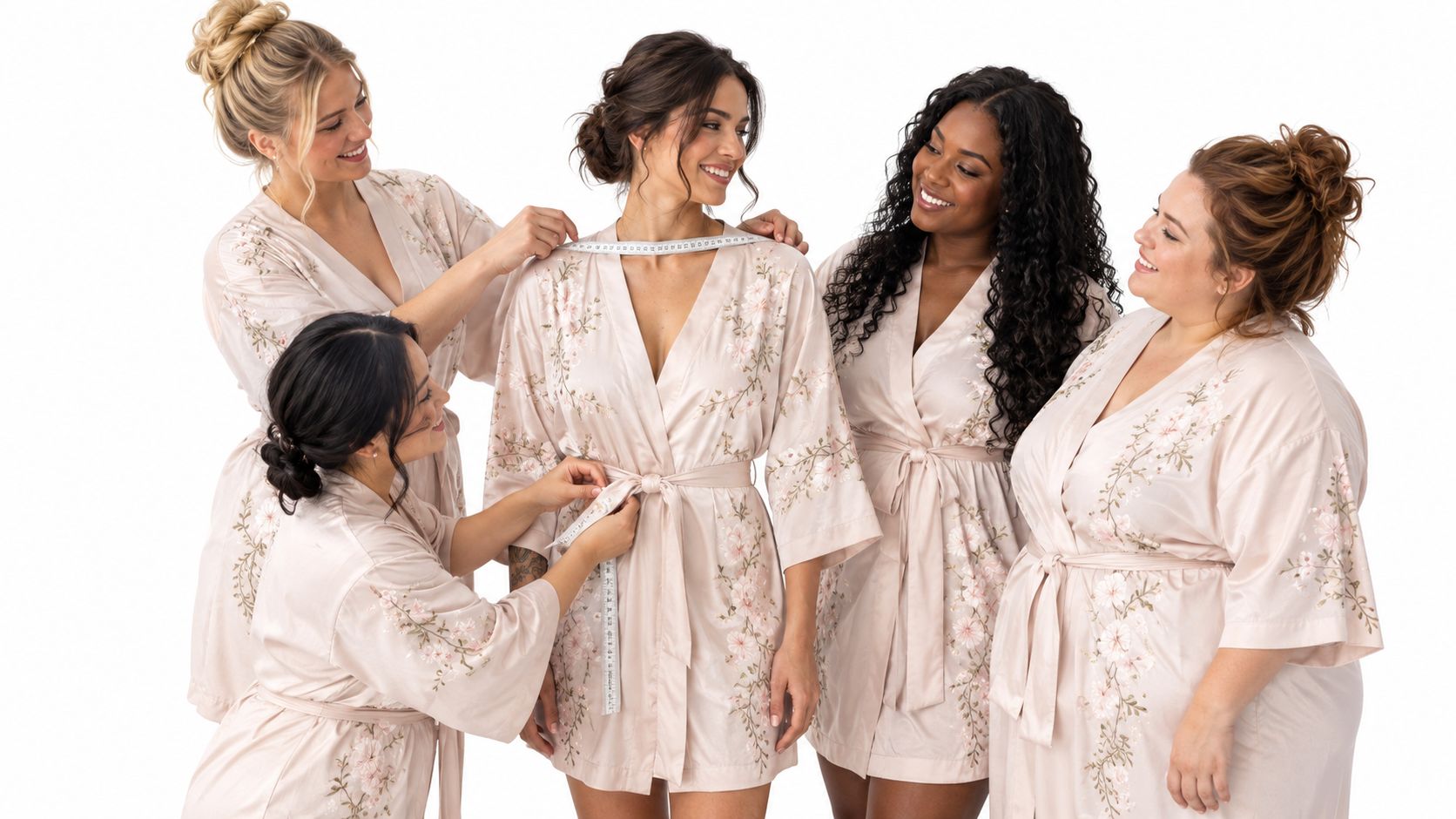
Order everyone a medium and you'll spend the morning watching people manage their robes instead of enjoying it. Your party has different heights, busts, hips, and coverage preferences. Plan for that instead of pretending a group photo requires identical construction, a gap explored in this practical guide to coordinating a bridal party in robes.
Collect Measurements Privately
Send a simple form or individual message, never a group chat request. Ask for the measurements the maker's chart uses, typically bust, hip, sleeve length, and preferred garment length, plus height. Dress size alone misleads because labels vary between brands.
Record each person's measurements, selected size, and cut in one document. You'll need it when boxes arrive and when someone asks which robe is hers. Personalized pieces make exchanges harder, so accuracy now is cheaper than apologies later.
Run Real Fit Checkpoints
Have each person test the robe the way the morning will test it. Sit down and check front overlap and hem coverage. Raise both arms as if for hair styling and check sleeve pull and gaping. Tie the belt, walk, and confirm it stays secure without cutting in.
Use these adjustments without apology:
- Petite attendants: Shorter length and sleeve so cuffs don't swallow hands or dip into makeup.
- Tall attendants: Extra length for seated coverage, checked while sitting, not standing.
- Plus-size attendants: Generous wrap overlap and an inner tie matter more than the letter on the label.
- Pregnant or postpartum attendants: A forgiving kimono or wrap cut with a higher, adjustable tie beats a fixed shawl silhouette.
Hold the line on same fabric and same color. Let go of same exact silhouette when a different cut gives someone real coverage. Coordinated lettering, palette, and texture unify the group in photos. Forcing one pattern onto every body doesn't create uniformity, it creates visible discomfort.
Ordering Timeline, Minimums, and How to Avoid the Group-Order Trap
Most group-order disasters are timing failures. Design gets approved late, one measurement never arrives, and suddenly embroidery, shipping, and exchanges are stacked into the final fortnight. Work backward from the wedding date and protect a buffer.
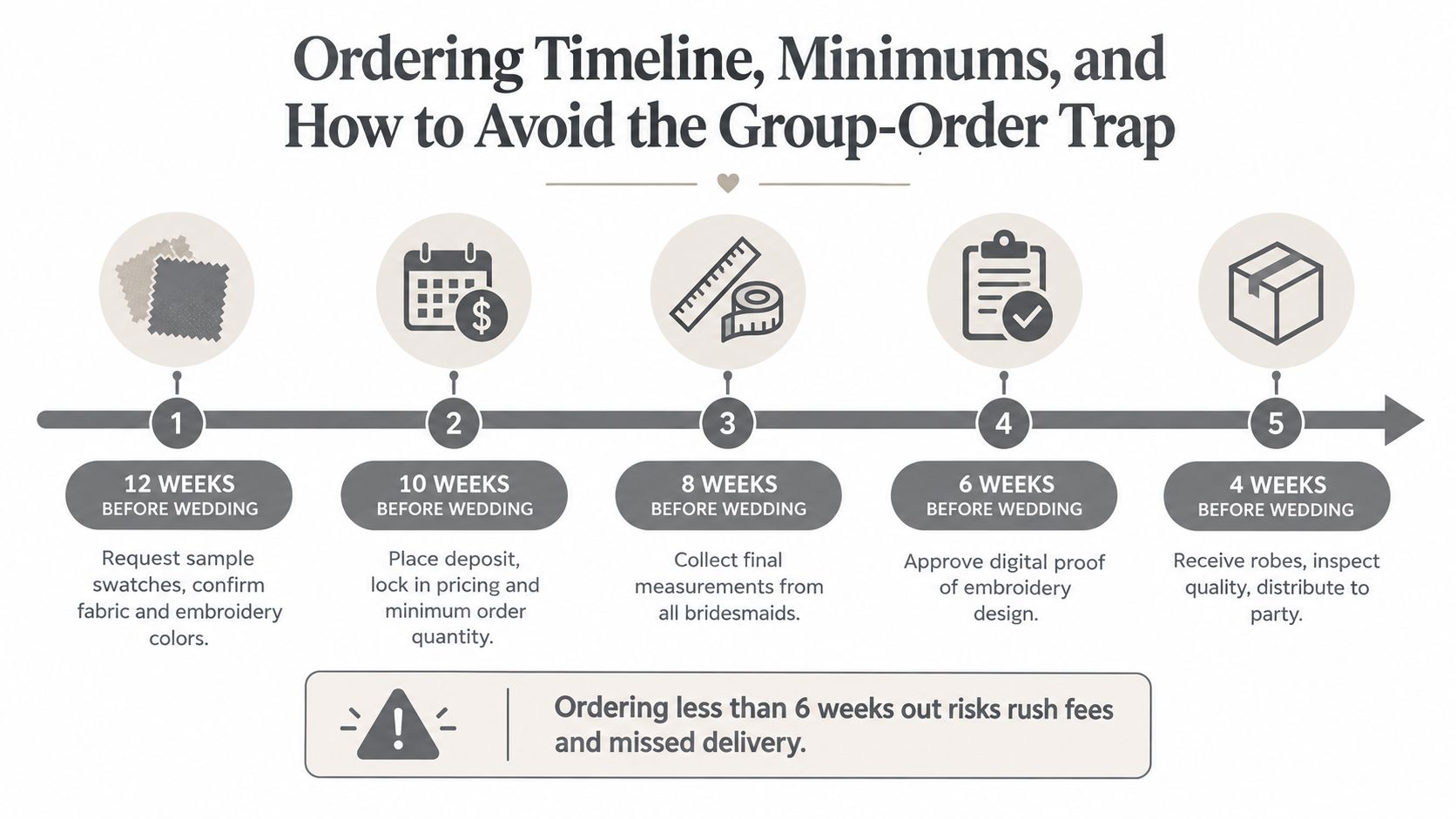
Start with samples. Order one robe in your fabric and color, with your actual embroidery, before you commit the group. Wash it once. Check shrinkage, lettering flatness, and thread color in daylight. A screen proof can't tell you any of that.
Then lock the sequence. Confirm the full recipient list, including mothers and anyone joining for photos. Collect measurements and spellings with a hard deadline. Approve the sewn sample, place the group order, and keep one person as the single contact with the embroiderer so instructions don't fork.
Minimums and Setup Fees
Embroiderers set minimums because digitizing and machine setup cost the same whether you stitch four pieces or ten. To understand how minimums work in custom embroidery generally, including how shops think about quantities like how many hats for custom embroidery, read the logic before you negotiate. The principle transfers directly to robes, even though the garment differs.
If your party falls below a minimum, you have honest options. Pay the setup fee across fewer robes, simplify to a stock lettering style that needs no new digitizing, or add a robe for a mother or officiant you'd really like to include. Don't pad the order with robes nobody wants.
The market context explains why suppliers court group orders. One analysis estimated global wedding apparel revenue at $60.5 billion in 2024 and projected $80.2 billion by 2033, a 3.7% compound annual growth rate from 2026 to 2033, according to the global wedding apparel market analysis. Those figures cover gowns and suits, not robes specifically, but multipiece attendant orders are exactly where customization demand concentrates.
When boxes arrive, open everything. Match each name, size, and color against your document that day, while a correction is still possible.
Care Instructions and How to Make Embroidery Last
A robe can look perfect on the wedding morning and pucker by the third wash. Embroidery combines base fabric, thread, and stabilizer, and those layers shrink and react to chemicals at different rates. Judge durability by a tested standard, not by how pretty the first sample looks on a hanger.
AATCC TM61 evaluates colorfastness under accelerated laundering, where test option 2A approximates five home launderings at 38 ± 3°C, the more vigorous 3A approximates five machine launderings at 60 ± 3°C, and 4A adds chlorine bleach at 63 ± 3°C, per the AATCC TM61 accelerated laundering method. You don't need to run a lab. You need to ask your supplier for wash-test results on the actual robe and embroidery combination, then write your care card from that result.
The Care Card Every Recipient Should Get
Print it. Don't rely on a verbal reminder during a busy morning.
- Wash cool and gentle: Use the temperature the tested cycle supports, turn the robe inside out, and wash with similar colors.
- Skip chlorine bleach: It attacks thread color and fiber strength, and the test conditions show it's a separate, harsher exposure.
- Dry with restraint: Reshape waffle texture, avoid excessive heat, and never store the robe damp.
- Iron around lettering: Press from the reverse side or steam, rather than dragging a hot plate across raised stitches.
For the full routine on washing and storing cotton robes without wrecking texture, follow this guide to washing, storing, and caring for your robe and copy the parts that match your fabric onto the recipient card.
Verify Material Claims Properly
Don't let the word organic do unverified work. GOTS certification covers fiber processing, spinning, wet processing, manufacturing, and trading, requires at least 70% certified organic fiber for eligibility, and involves chemical-input controls, wastewater management, traceability, and annual on-site audits, as set out in the GOTS standard and certification requirements. A robe cut from organic cotton doesn't automatically certify the embroidery thread, dyes, or finishing.
Ask for the certification scope and transaction documentation for the finished article. Separately, check the label disclosures you'd expect on any serious garment, fiber content by percentage, country of origin, and care instructions that won't harm the robe. That paperwork lets you compare terry and waffle options on construction you can verify instead of adjectives you can't. SEYANTE, for example, offers Turkish cotton terry and waffle robes including GOTS-certified organic options, which makes that documentation conversation a concrete one rather than a hypothetical.
Presentation That Earns the Reveal
Care for the garment starts with how you hand it over. Fold each robe so the embroidery faces outward without a crease through the lettering, or hang robes on matching hangers the night before so folds relax and the photographer gets a clean first shot. A ribbon-tied bundle with a named hang tag beats a plastic shipping bag every time.
Keep accessories restrained. A coordinating sleep mask, scrunchie, or pair of slippers in the same palette reads intentional. Five matching items reads costume. Add a short handwritten note that names why you chose that person, and include the care card inside the box, not loose in a tote where it'll vanish.
On the morning itself, stage robes away from makeup, food, and hot tools. Hand them out before styling begins, let people keep street clothes on until their hair and makeup are done, then change into robes for portraits. That sequence protects the fabric, protects the embroidery, and keeps foundation off a blush collar.
The robe is the gift. The handoff, done calmly and in the right order, is what makes it feel like one.
Making the Final Decision Without Second-Guessing
You don't need more options. You need a ranking. Every remaining choice is a trade between photo impact and post-wedding wearability, between permanent embroidery and flexible personalization, and between a tight budget and a longer lead time. Decide which side of each trade matters more to your party and stop reopening settled questions.
The Four-Step Lock-In
First, name your two priorities in writing. Second, pick the fabric that serves both, which for most warm suites means waffle or lightweight cotton and for cool venues means terry. Third, choose the personalization format that passes the wearability test, initials or first names in a discreet placement for almost every party. Fourth, set the order date with a buffer week you refuse to spend.
Before you pay a deposit, get direct answers from your supplier:
- Lead time: How long from approved sewn sample to delivered group order, and what happens if one robe arrives late or wrong?
- Exchange policy: What's possible once a robe is personalized, and who pays for a spelling error on their side?
- Documentation: Can they show fiber content, care labeling, and any certification scope for the finished embroidered article?
- Wash evidence: Has this robe and thread combination been wash-tested, and at what temperature?
Print a one-page checklist with recipient names, measurements, sizes, spellings, placements, and delivery dates. Keep it with the robes, not buried in email. When doubt creeps in at midnight, that page is your decision already made.
Here's my honest closing position as someone who has watched these mornings work and fail. Skip the giant back lettering. Skip the one-size order. Skip the shiny robe that only behaves when nobody moves. Choose a breathable fabric in a color that flatters the whole group, stitch initials where they'll still make sense in five years, and order early enough to fix the one thing that will go sideways. The best embroidered bridal party robes are the ones still hanging in your friends' bathrooms long after the album is printed.
Start with fabric and fit, then personalize with restraint, and choose robes your party will keep wearing long after the wedding morning. Explore Turkish cotton terry and lightweight waffle options, including organic styles suited to coordinated bridal gifting, at SEYANTE and build your group order around the measurements, placement, and timeline you've now settled.