




- Waffle Robes
- Terry Cloth Robes
- Microfiber Robes
- Turkish Cotton Robes
- Towel Robes
- View All Robes by Material
Hair Turban for Sleeping: A Practical Buying Guide - Seyante
You wash your face, brush your teeth, and catch your reflection one last time before bed. Your hair looks fine standing at the sink. Then morning comes, and one side is flat, the ends feel rough, and there's that fuzzy halo around the crown that makes it seem like you slept in a wind tunnel.
That's the moment a hair turban for sleeping starts to make sense.
Not as a miracle product. More like a small textile choice that changes what your hair rubs against for hours every night. If you've ever tucked your hair into a loose bun, only to wake up with bent ends or a sore scalp, you already know that “putting it up” and “protecting it” are not always the same thing.
Why a Sleeping Hair Turban Earns Its Place on Your Nightstand
A sleeping turban works best when you treat it like a repeatable bedtime habit, not a rescue treatment. You put it on for the same reason you switch off a bright lamp before bed or choose cooler bedding when you sleep hot. It removes a small problem before it has hours to build.
Historically, this idea isn't new. Nightcaps and sleeping caps were widely used in Europe and America long before modern sleep bonnets. Victorian women commonly wore cotton or wool nightcaps to help keep hair tangle-free, and silk versions were associated with making hair look glossier. They faded around the turn of the 20th century, then returned in the early 1920s alongside Marcel waves and flapper styles, showing that sleep hair coverings have followed beauty habits for centuries, not just social media trends (historical overview of nightcaps and hair care).
What it changes by morning
At night, your hair does a lot of unwanted traveling. It catches under your neck, slides across the pillow, bunches under your shoulder, and wraps around itself. A turban gathers that movement into one contained space.
That matters most for:
- Loose ends: They stop scraping across the pillow every time you turn over.
- Styled hair: Blowouts, stretched curls, and smoother roots stay neater.
- Long hair: Fewer strands end up under your back, across your face, or in your mouth.
- Fragile hair: Color-treated, dry, or easily snagged lengths get a gentler surface.
A sleeping turban won't fix damaged hair overnight. It can stop you from adding the same overnight wear and tear again and again.
Better than a loose bun, in some cases
A loose bun can help, but it often shifts the pressure to one spot. You wake up with a bent section where the tie sat, or tension at the crown. A turban spreads that control more evenly. It contains hair without asking one elastic band to do all the work.
If your bedroom also runs warm, comfort matters just as much as hair care. Sleep setup has to work as a whole. If overheating wakes you up and makes you ditch any head covering halfway through the night, it helps to also find a comforter for night sweats so the rest of your sleep environment isn't fighting you.
How Hair Turbans Actually Protect Hair Overnight
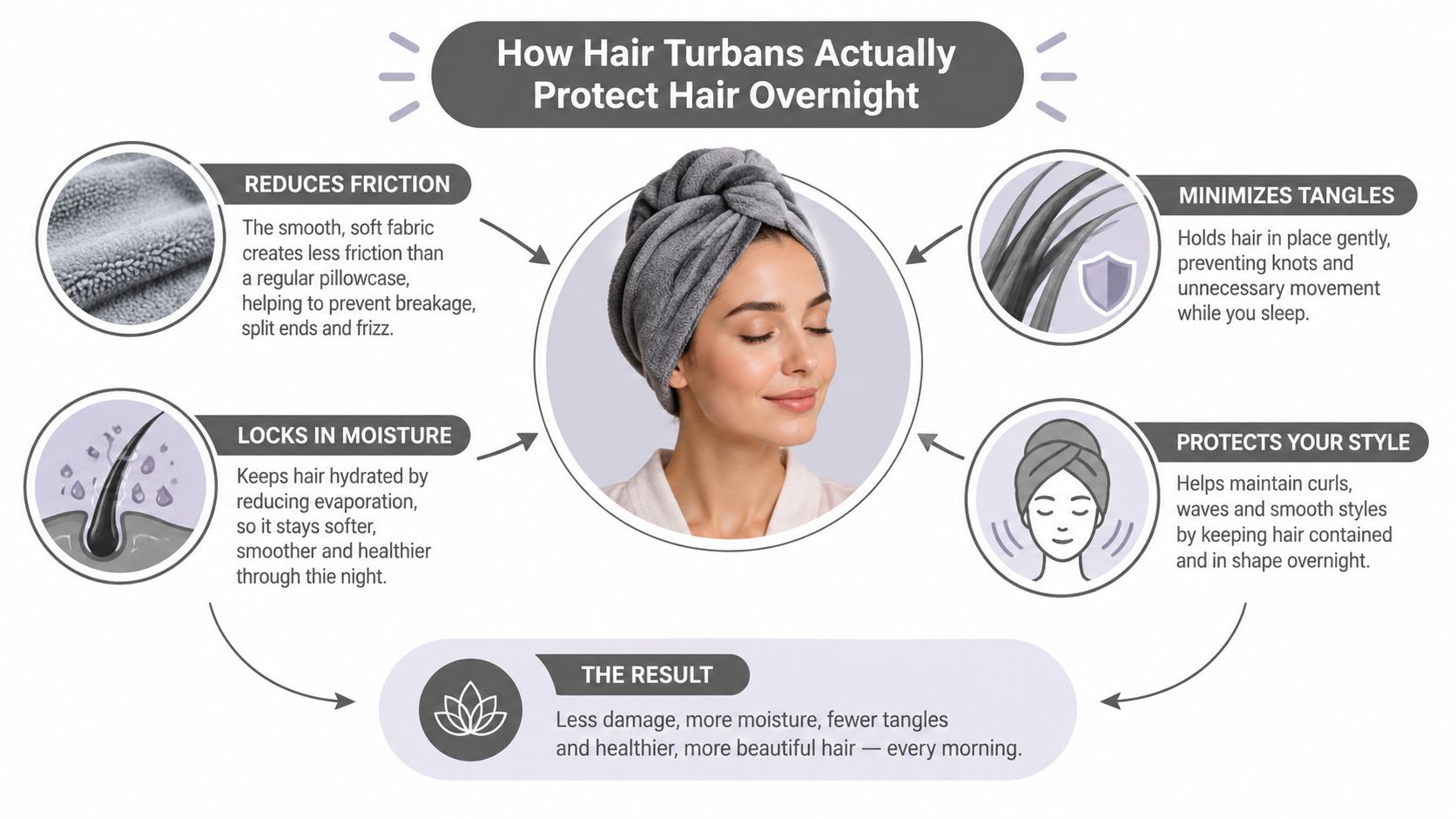
The simple answer is that turbans help with friction and moisture loss. Those are the two big overnight stress points for hair.
Friction is the first problem
Think about walking across a wood floor in socks versus walking across a rough carpet. On wood, you glide. On carpet, there's drag. Hair reacts the same way to fabric.
A hair turban or sleep cap works best when the inside surface keeps friction low, because lower friction reduces cuticle abrasion, shear stress, frizz, and breakage during long contact. Smoother, silk-like surfaces are widely described as low-friction, while rougher and more absorbent fabrics can increase roughness under repeated pillow contact (textile-focused explanation of friction and overnight breakage).
When your head turns, your hair doesn't move as one tidy sheet. Individual strands catch at different times. That's why morning tangles often feel worst at the nape, around the temples, and at the ends.
Moisture loss is the second problem
Hair can also feel worse by morning because it has dried out. Some bedding fabrics pull moisture away faster than others. That doesn't mean your hair was “wet.” It means the surface condition changes overnight, and dry ends get rougher.
A smoother, less absorbent lining helps hold onto the moisture and product already on the hair. That's useful if you apply a leave-in cream, serum, or a small amount of oil before bed. Instead of rubbing that treatment into the pillow, you keep more of it where you intended.
Practical rule: If your hair feels softer when you put it away than when you wake up, friction and absorbency are usually involved.
Heat can help or annoy
Some wraps feel cozy in winter and stuffy in summer. That's not your imagination. Fabric choice changes warmth and airflow, and fit changes whether heat gets trapped around the scalp.
This matters even more if you're also trying to preserve hair extension bonds at night. Anything that reduces rough rubbing can be useful, but only if the wrap stays comfortable enough to leave on until morning.
Silk Satin Cotton or Microfiber Comparing the Main Materials
Material names get mixed up all the time, so it helps to separate fiber from surface feel. Silk is a fiber. Satin is a weave. A satin turban is often made from synthetic fibers, while a silk turban is silk fiber with a smooth surface. They can feel similar at first touch, but they don't behave exactly the same.
Hair Turban Materials at a Glance
| Material | Feel & Friction | Absorbency | Breathability | Best For | Care | Price |
|---|---|---|---|---|---|---|
| Silk | Very smooth, low friction | Low | Good | Dry, delicate, frizz-prone, color-treated hair | Gentle washing | Higher |
| Satin | Smooth and slippery | Lower than cotton | Varies, often less airy than silk | Frizz control on a budget, style preservation | Usually easier than silk | Lower to mid |
| Cotton | Soft but more grabby against hair | High | Good | Short wear after washing, people who prioritize airflow | Easy care | Lower to mid |
| Microfiber | Soft but can feel clingy once hair is drier | Very high | Moderate | Post-shower wrapping, reducing drip while hair dries | Easy care, watch for pilling | Lower to mid |
Silk and satin for sleeping
If your main goal is reducing overnight roughness, silk and satin usually make the most sense. The reason is mechanical, not mystical. Smooth surfaces slide more easily against hair.
Silk tends to feel less plasticky and often handles temperature more gently. Satin gives you much of that slip at a lower cost. Some people love the slickness. Others feel like it slides around too much, especially if the turban shape isn't right.
Cotton and microfiber for different jobs
Cotton is breathable and familiar. But for overnight use on already dry hair, it can work against your goal because it's more absorbent and usually creates more drag. Cotton often suits people who need airflow more than maximum slip, or who use a wrap briefly after washing rather than all night.
Microfiber is a different tool. It shines after a shower, when hair is damp and you want to remove excess water without rough rubbing. Once hair is mostly dry, though, some microfiber fabrics can feel a bit grabby. For many people, that makes microfiber a strong drying wrap and a less ideal sleep wrap.
If you're already comparing absorbent fabrics for post-bath routines, this guide on microfiber vs Turkish cotton robes fast-drying or classic luxury helps explain why different textiles feel so different on the body and hair.
Match fabric to the job
Use this shortcut:
- Choose silk or satin if your top concern is frizz, tangling, or preserving a finished style.
- Choose cotton if you want breathability and don't mind some absorbency.
- Choose microfiber if your hair is fresh from the shower and still holding excess water.
The global market also shows that overnight hair protection is no longer a tiny niche. One report values the global curly hair sleep bonnet market at $580 million in 2024 and projects $1.05 billion by 2033, with 81.0% growth over the forecast period and a 6.8% CAGR. A separate report estimates the broader hair towel wrap industry at $315.56 million in 2022, rising to $453.88 million by 2028 at a 6.2% CAGR, pointing to broader demand for these products across regions.
How to Choose the Right Style Size and Closure
A sleeping turban can have lovely fabric and still fail by morning if the shape is wrong. The job is simple. It needs to hold your hair in place without pressing on your hairline, flattening the crown, or leaving your scalp annoyed before sunrise.
That fit-versus-tightness question gets missed all the time.
Start with bulk, spring, and length
Hair length matters, but hair volume matters more. A chin-length bob with thick waves can need more room than long, fine hair. Coils, curls, braids, and twists also take up space differently because they spring outward instead of lying flat.
A turban works a bit like a pillowcase. If there is just enough room, what is inside can rest. If the space is too small, everything gets squashed against the edges.
Short or cropped hair usually does well in a close beanie-style shape. Shoulder-length hair often needs some depth in the back so it can sit inside the turban instead of being bent awkwardly. Long, thick, curly, or coily hair usually needs a roomy pouch or a bonnet-style turban so the hair can gather softly rather than being compressed at the crown.
Matching Turban Size and Closure to Hair Type
| Hair Type | Recommended Size | Best Closure | Fit Check |
|---|---|---|---|
| Short or cropped | Compact, close fit | Soft elastic or simple pull-on | Should stay put without riding up |
| Fine, shoulder-length | Medium pouch | Adjustable tie or gentle snap | No flattening at the crown |
| Long straight hair | Long pouch or extended wrap | Button loop or adjustable closure | Ends fully enclosed without folding sharply |
| Thick, curly, or coily | Oversized pouch or roomy bonnet-style turban | Adjustable closure with low pressure | Hairline feels calm, not tight |
| Protective styles or bulky twists | Extra roomy option | Loose, adjustable fastening | No pressing into partings or roots |
Closure choice changes the feel overnight
Closure is not a small detail. It decides where pressure lands.
Elastic is easy, but it behaves the same all the way around. If the size is even a little off, that pressure often shows up at the temples, forehead, or nape. Adjustable ties, snaps, or button loops give you more control because you can set the hold where you need it instead of relying on one firm band to do all the work.
Seams matter too. A thick seam at the forehead can feel minor while you are standing in the bathroom, then feel like a pebble in your shoe once your head rests on the pillow.
A secure sleep fit feels contained and quiet, not clamped down.
Use a simple fit test before you keep it
Try the turban with your hair arranged the way you sleep. If you pineapple your curls, tuck in braids, or gather long hair low, test it that way.
Then check four things:
- Stay-put test: Walk around and tip your head forward. The turban should stay in place without sliding toward your eyes.
- Hairline test: Run a finger along your edges and temples. You should feel contact, not strain.
- Crown test: Notice whether the top of your style feels gently held or obviously squashed.
- Pillow test: Lie down for a minute on your usual side or back. Any bulky seam or hard closure will make itself known quickly.
One more point helps people avoid buying the wrong style. If your hair is still damp enough that you need absorbency, size alone will not solve the problem. A roomy silk or satin sleep turban protects dry or nearly dry hair well, but it is the wrong tool if your main need is soaking up leftover water. In that case, choose based on the job first, then fit.
When to Wear It and When to Skip It
You wash your hair at night, twist it up, pull on a turban, and hope you will wake up with smoother strands and less frizz. Sometimes that works. Sometimes you wake up with a warm scalp, flattened roots, or hair that still feels damp in the center. The difference is usually not the idea of a sleep turban itself. It is whether the turban matches the condition of your hair that night.
Start with the hair, not the turban
A sleep turban protects best when your hair is dry or very close to dry. Its main job is reducing rubbing, helping styles stay put, and keeping product off the pillow. It is not built to act like a bath towel.
That damp-versus-dry line trips people up, so use a simple test. If your scalp still feels cool, the fabric would get noticeably wet, or your hair feels heavy once tucked in, wait. Let it air-dry longer or use a short-term drying wrap first.
Slightly damp hair can be fine for some people. Wet hair sealed into a sleep turban usually is not.
Good times to wear it
A sleeping turban makes sense when the goal is protection rather than drying.
- Hair is dry or nearly dry: The fabric can reduce friction instead of holding extra moisture.
- You want to preserve a style: Curls, stretched hair, smoother roots, and laid edges often last better overnight.
- You used leave-in products or oils: More of the product stays on the hair instead of transferring to the pillowcase.
- Your hair roughs up easily: Fine hair, bleached ends, curls, coils, and weathered lengths often benefit from a gentler surface.
It also helps to connect this habit to the rest of your bedtime routine. A wrap used inconsistently often ends up blamed for problems it did not cause. Pairing it with steady sleep hygiene tips for a better night's rest can make the whole routine easier to stick with.
When to skip it
Some nights, a turban is the wrong tool.
- Hair is very wet: Too much trapped moisture can leave the scalp warm and the hair slower to dry.
- Your style is bulky: Large braids, twists, rollers, or clips can create pressure points and make the turban sit unevenly.
- You are sensitive to pressure while sleeping: Even a soft wrap can bother the temples, ears, or nape if you sleep on one side.
- Your hair is very short and low-maintenance overnight: If it does not snag, flatten, or lose moisture easily, extra covering may not add much.
This is also where fit and tightness get separated. A turban can fit your head and still be too tight for sleeping. Good sleep fit feels settled, like a fitted sheet that stays in place without pulling at the corners. Tightness feels like the fabric is doing too much work, pressing on the hairline or compressing the style just to avoid slipping.
Turban, bonnet, scarf, or pillowcase?
These are not interchangeable.
A sleep turban encloses the hair and can feel neat and contained. A bonnet often gives more interior room. A scarf can work well for flattening and anchoring specific areas, but it takes more skill to tie comfortably. A low-friction pillowcase helps whether you wear a covering or not, and it may be the better choice if anything on your head tends to bother you at night.
Winter often makes people notice friction more because indoor air is drier and fabrics get less forgiving. That does not mean everyone needs the same solution. It means the right tool depends on your hair, your sleep position, and whether the problem is rubbing, moisture loss, leftover dampness, or pressure.
Putting It On Sleeping in It and Caring for It
Good results usually come from a simple routine done the same way each night.
The bedtime routine
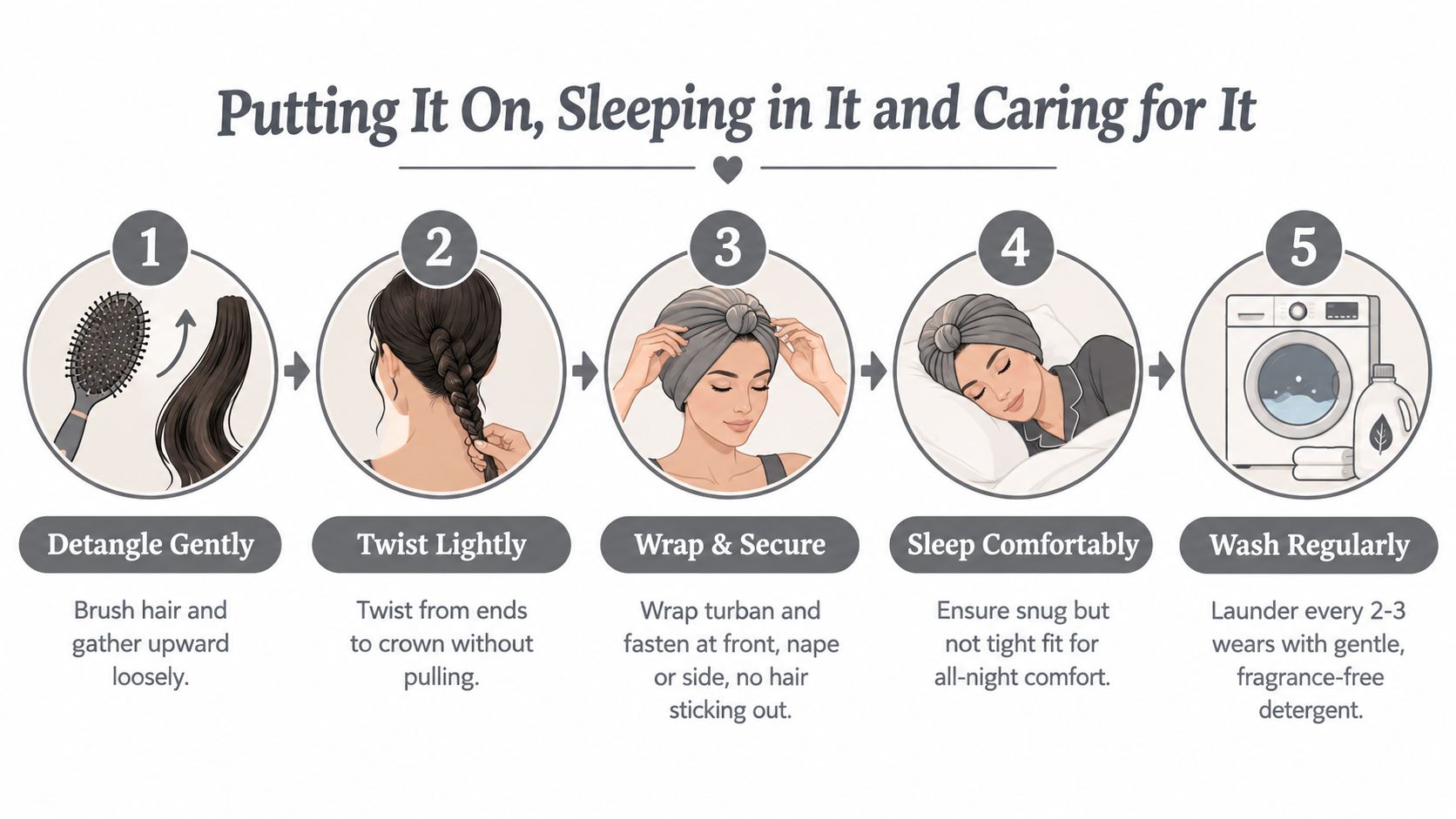
Start with detangled hair. Gather it upward or back, depending on the shape of the turban, and twist very lightly if your length needs help fitting inside. Then tuck the ends in so nothing hangs loose and fasten the closure where it sits comfortably on your head.
The wrap should feel steady when you move, but it shouldn't make your forehead, temples, or nape aware of its presence. If you feel pressure right away, you'll feel much more of it at 3 a.m.
A sleep turban should disappear once it's on. If you keep noticing it, adjust it before you turn out the light.
Overnight comfort checks
Before bed, do a short check:
- Lie on your usual side: Make sure the seam doesn't dig in.
- Tilt your chin down: If the back edge creeps upward, it may be too small.
- Run a finger around the hairline: You want contact, not squeeze.
If you use wraps as part of a broader at-home reset, this guide to towel wraps for women and hair turbans simple spa routine at home shows how different wrap styles fit into post-shower and bedtime routines.
Washing and lifespan
Wash the turban gently, either by hand or on a delicate cycle in cool water. Mild detergent is usually enough. Skip fabric softener if you can, because coated fibers often don't behave the same way afterward.
Air drying helps the shape last longer. Replace the wrap when the elastic goes slack, the inside surface starts to pill heavily, or the seams no longer sit flat.
If you want a simple post-shower option before bed, SEYANTE's towel wraps and hair turbans are designed for that bath-to-bed transition, especially when you want something easy to wash and simple to manage at home.
Your Quick Checklist Before You Buy
Buying a hair turban for sleeping gets easier when you reduce it to a few yes-or-no checks.

Ask yourself:
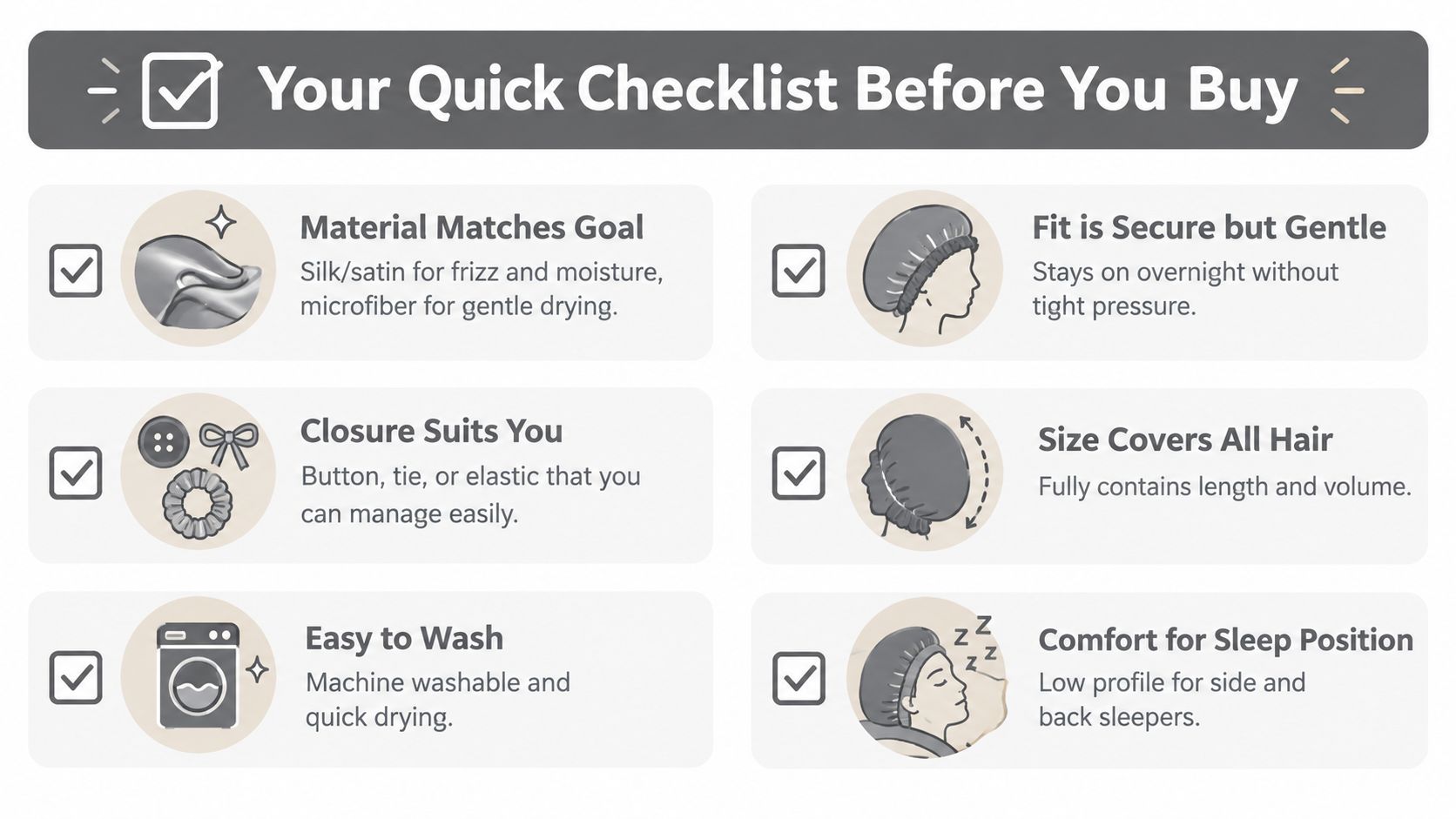
- Does the material match the job? Silk or satin usually suit overnight friction control. Microfiber usually suits post-shower drying.
- Can it hold all your hair without cramming it? If your ends have to fold sharply or the crown gets squashed, size up.
- Is the closure adjustable or at least gentle? You want hold, not pressure.
- Will you sleep in it? Side sleepers often need a lower-profile shape and softer seams.
- Will you use it on dry or almost-dry hair only? If you plan to put it on soaking wet hair, it's the wrong sleep tool.
- Is care realistic for your routine? If you won't hand wash delicate fabric, choose something you'll maintain properly.
Bottom line: The right turban should solve one clear problem. Frizz, tangling, style preservation, or keeping damp hair contained for a short time. Once you know the job, the fabric and fit become much easier to choose.
If your top priority is smooth overnight protection, start by looking at silk-like or satin-lined options with a roomy shape. If your priority is post-shower absorbency before bed, start with a dedicated drying wrap instead of a true sleep turban.
SEYANTE offers towel wraps, hair turbans, and comfort-focused bath essentials for people who care about how fabric behaves against skin and hair, not just how it looks on a shelf. If you want to build a calmer post-shower or bedtime routine around better textiles, visit SEYANTE and browse the options that fit your hair routine and sleep habits.
Related Posts
Featured Products


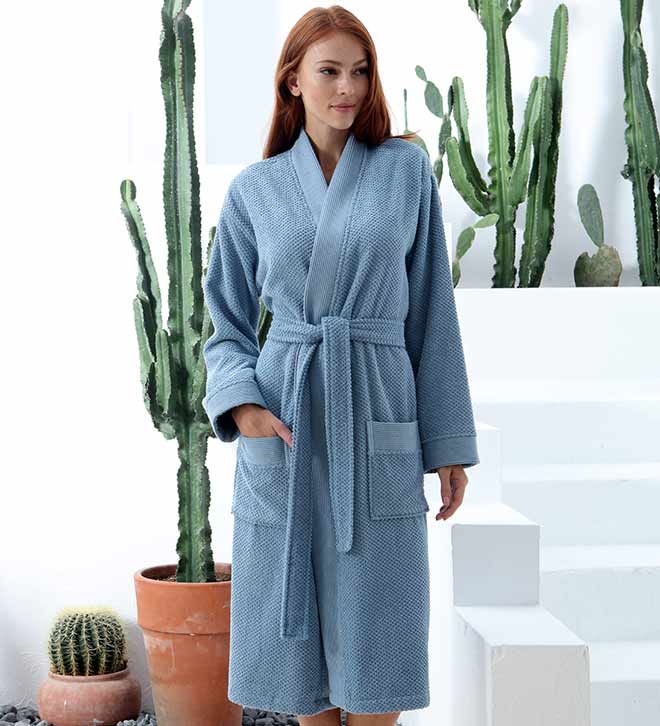

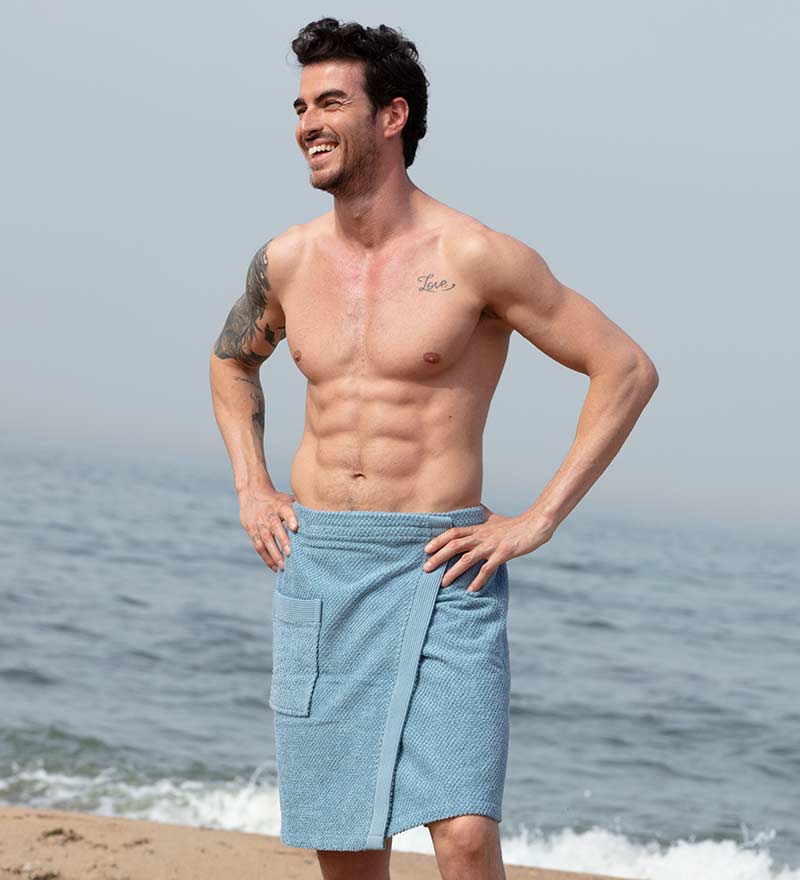
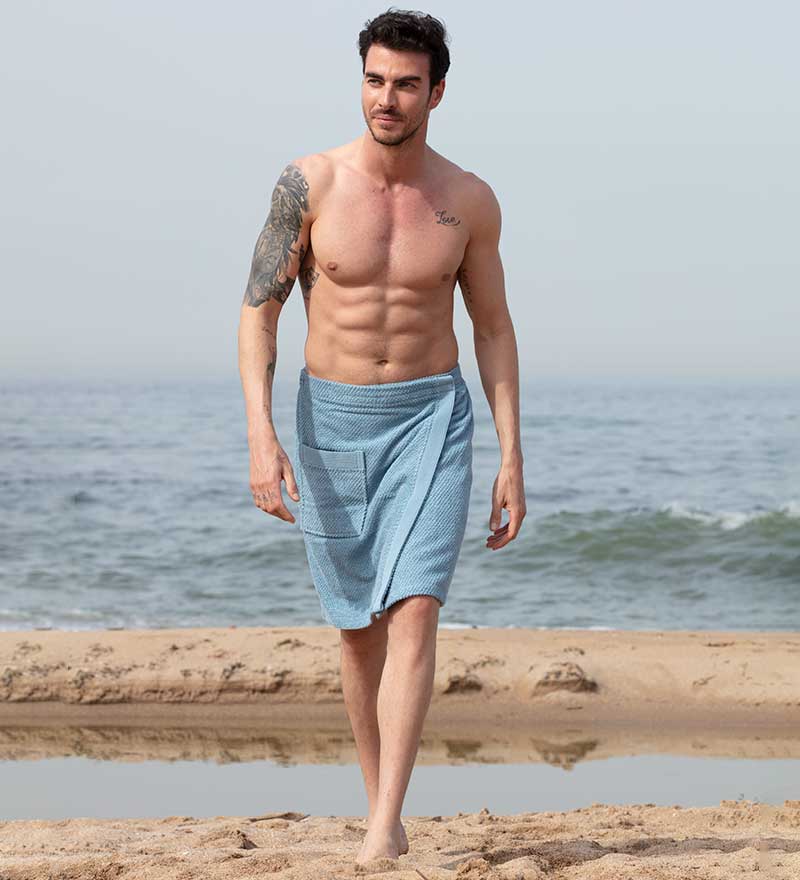
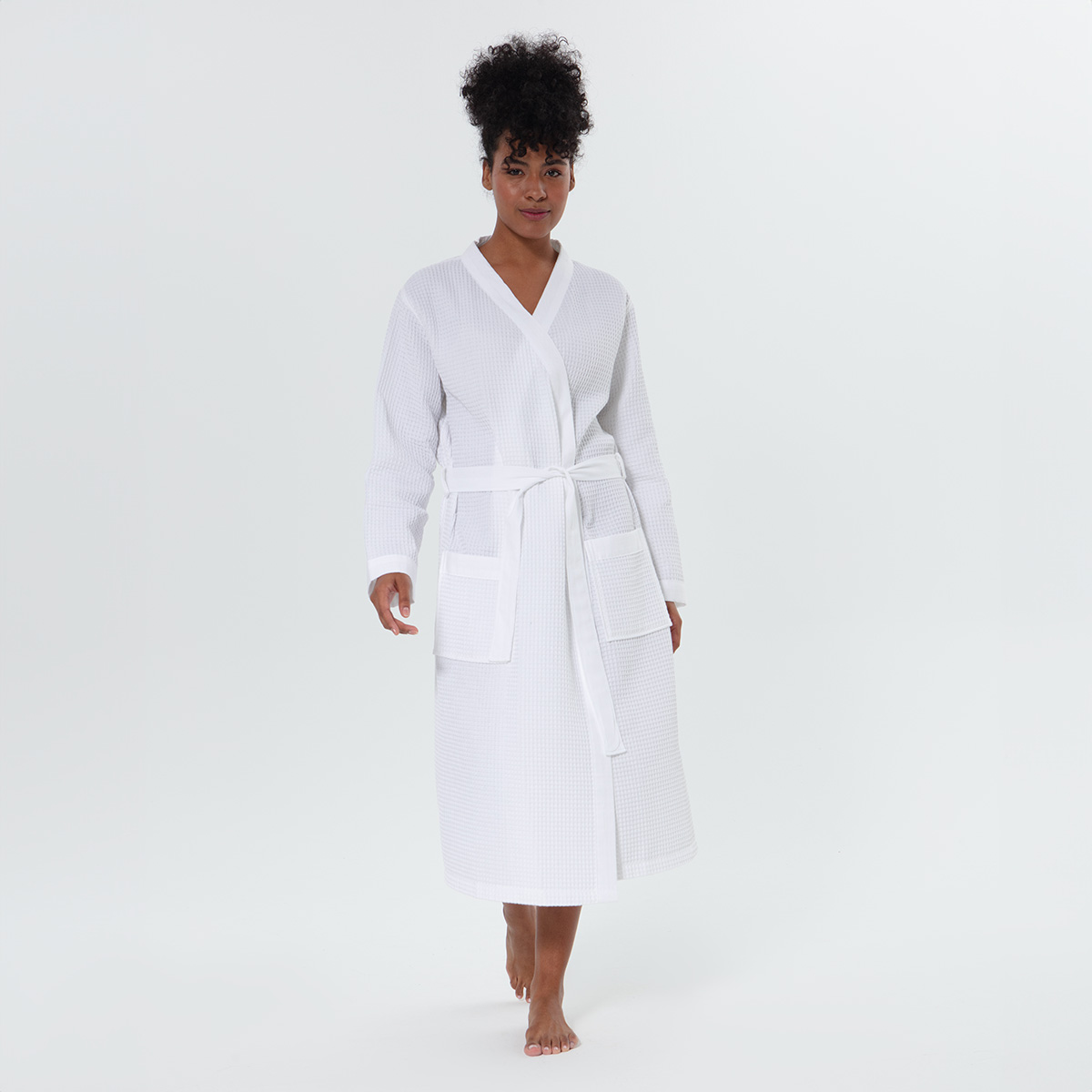

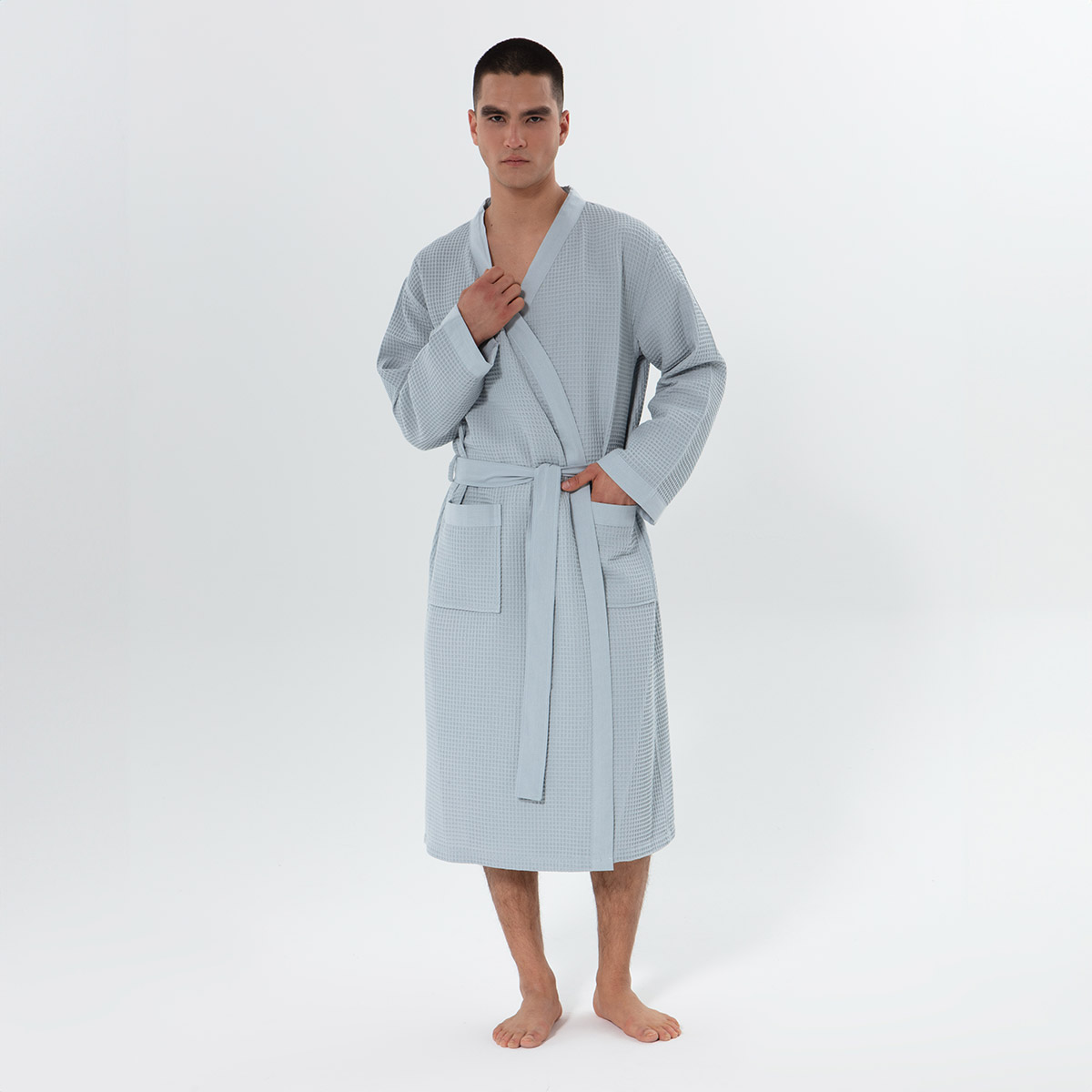
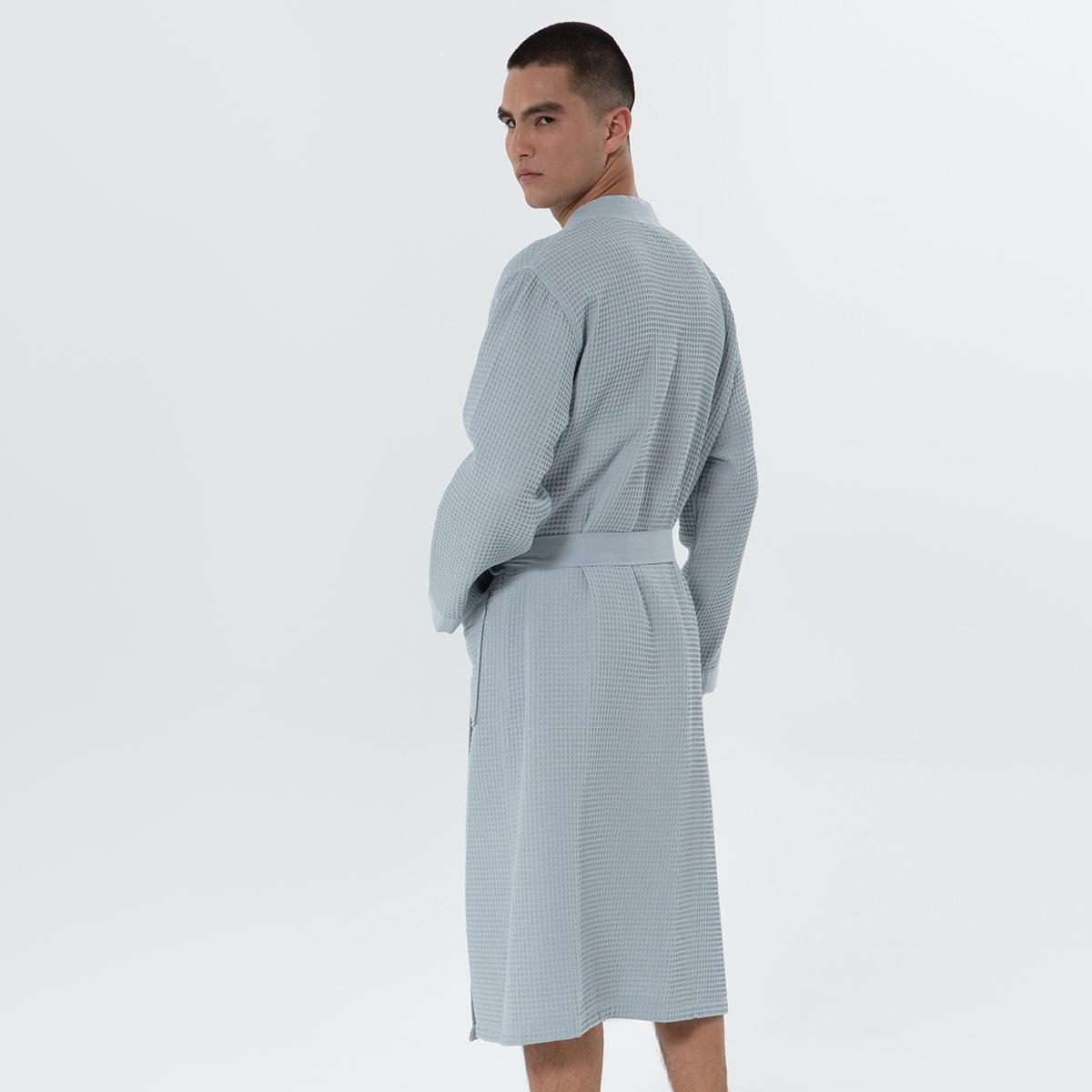
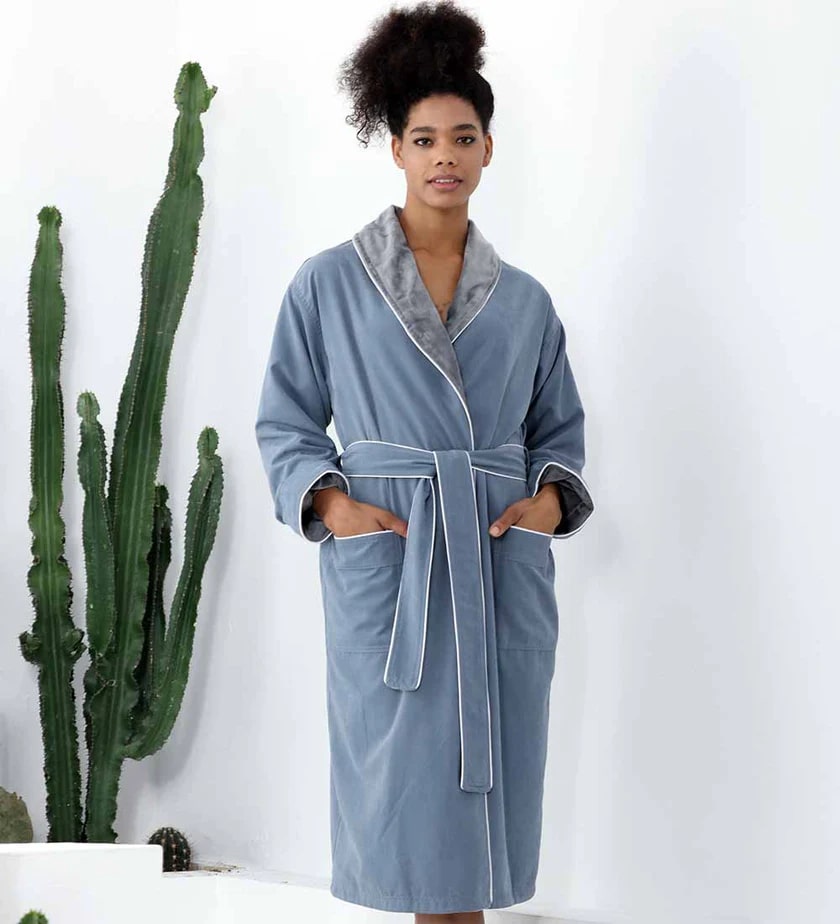

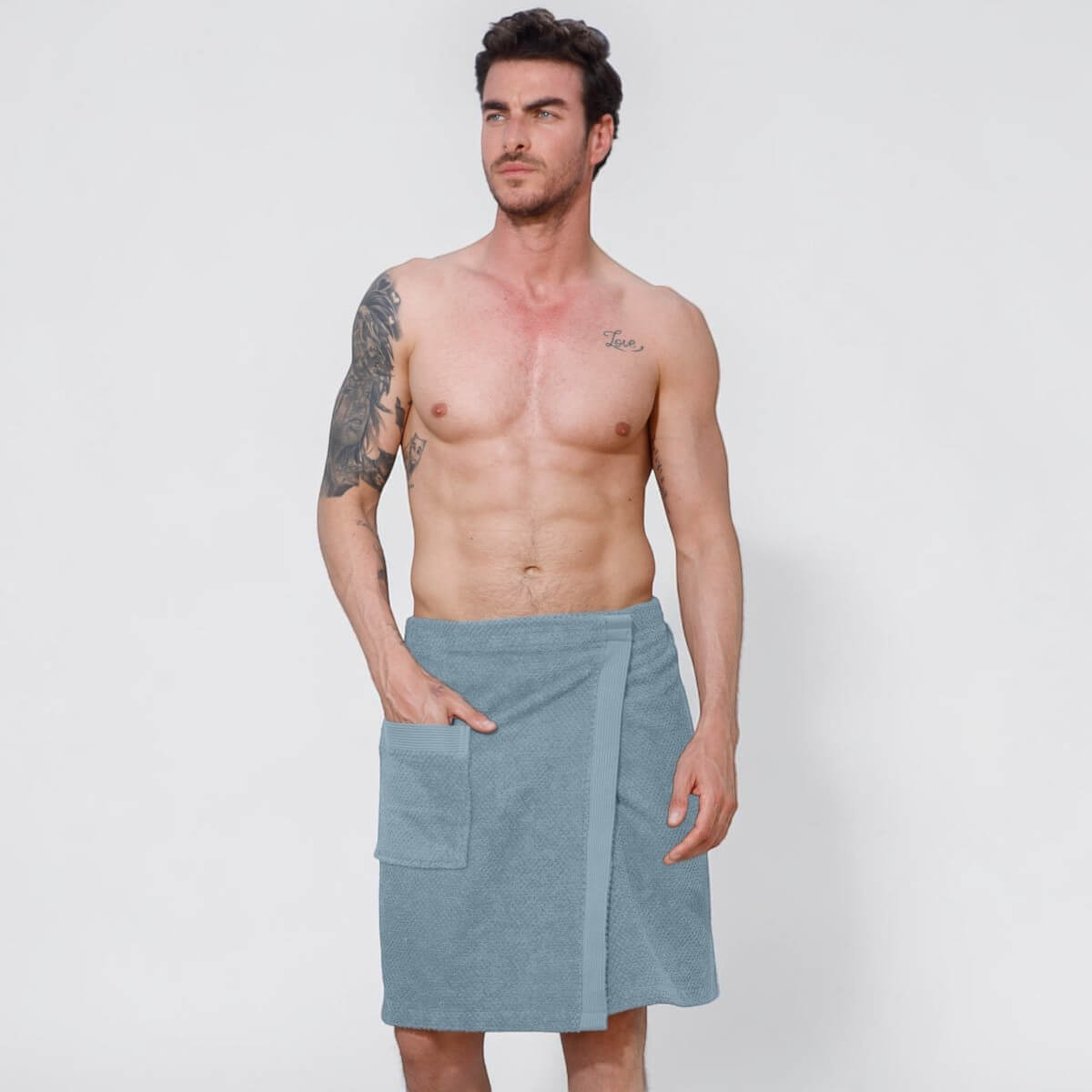


Offering high-quality bathrobes for both women and men with GOTS certification
Our commitment to excellence is reflected in our use of the Global Organic Textile Standard (GOTS) certification for our products. GOTS is a benchmark for organic textiles, ensuring environmentally friendly and socially responsible manufacturing processes.


FREE STANDART DELIVERY
STRESS-FREE SHOPPING
ONLINE CUSTOMER SERVICE