Hooded Spa Bathrobe: Terry vs Waffle Guide
- The Evolution of the Hooded Spa Bathrobe
- Comparing Terry Cloth and Waffle Weave Constructions
- Benefits and Use Cases Across Different Environments
- Sizing, Fit, and Dimensional Stability After Washing
- Understanding Textile Certifications and First-Wash Care
- Choosing the Right Hooded Robe for Your Climate and Routine
- Final Thoughts on Elevating Your Daily Self-Care Ritual
You've just stepped out of a warm shower, your hair is damp, and the bathroom feels cooler than expected. A towel handles the first few seconds, but it slips, leaves your shoulders exposed, and does nothing for your head. A hooded spa bathrobe has a more demanding job: it should cover you, manage moisture, preserve warmth, and remain comfortable long enough for skincare, breakfast, or a quiet pause before the day begins.
The difficulty is choosing the right construction. A dense terry robe may feel wonderfully cocooning, while a waffle robe can be lighter, more breathable, and easier to dry. The best choice depends less on the word “luxury” and more on your climate, bathing routine, preferred warmth, fit, and willingness to manage laundry.
The Evolution of the Hooded Spa Bathrobe
The modern hooded spa bathrobe didn't emerge from a single invention. It developed from older forms of hooded clothing, dressing robes, hammam textiles, and practical bathing garments. Hooded clothing appears in Assyrian sources as far back as at least the 13th century BCE, while robe-like dressing garments became familiar in Europe during the 19th century. The hood's basic purpose was straightforward, coverage for the head and neck when the surrounding air felt cold or exposed.
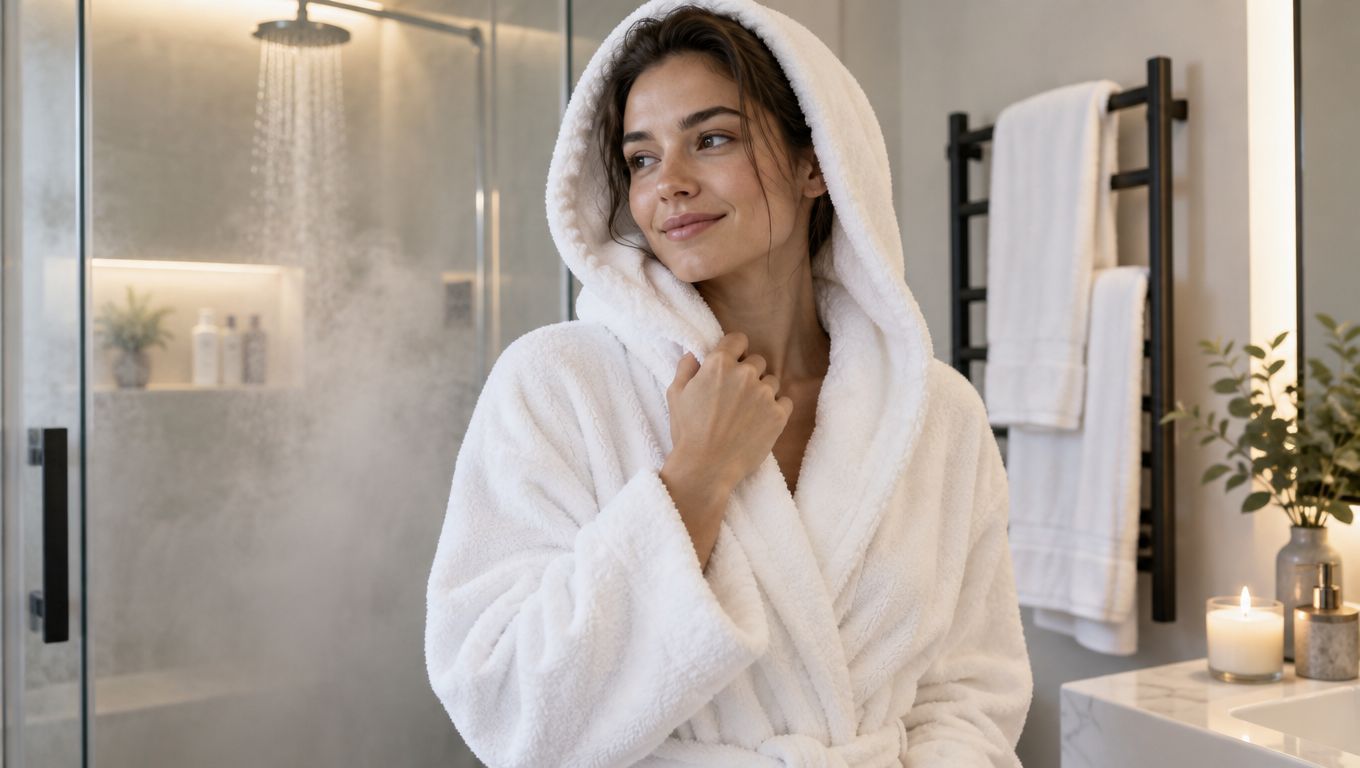
A bathrobe changed significantly once manufacturers could produce looped-pile terry cloth more widely. In the 1840s, English towel manufacturer Henry Christy observed Turkish looped textiles associated with hammam bathing in Istanbul. By 1850, the Christy company was producing “Royal Turkish Towels” industrially in England, helping terry become a mainstream absorbent textile. The history is outlined in this account of the development of robes with hoods.
From ceremonial wrapping to practical comfort
Earlier robes could serve decorative, modesty-related, or warmth-focused purposes. Terry gave the garment a more specific task after bathing. Its raised loops created a surface that could pick up moisture, turning the robe into something closer to a wearable towel with sleeves, a belt, and a hood.
That combination explains the lasting appeal of the silhouette. The hood extends coverage to wet hair and the neck, while the terry body helps manage moisture across the torso and limbs. A robe with a hood therefore joins two functional traditions rather than adding a purely decorative detail.
Practical rule: Treat the hood as part of the robe's performance system. Its depth, lining, loop height, and drying time matter just as much as its appearance.
The connection with hammam culture also helps explain why terry robes became common in hotels, spas, pools, and homes. The garment supports the transition between water and dry clothing, while its enveloping shape gives a short period of privacy and warmth. That's why a well-designed hooded robe feels useful even when you aren't actively drying yourself. It creates a comfortable layer for moving from a treatment room to a lounge, from a pool to a changing area, or from the bathroom to the rest of the home.
Comparing Terry Cloth and Waffle Weave Constructions
Fabric construction determines how a hooded robe handles water, air, warmth, and weight. Terry cloth uses raised loops, which increase the exposed surface area and support moisture absorption. Waffle weave uses a recessed honeycomb texture that creates a lighter structure with more airflow and less overall bulk.
For terry, loop geometry matters more than surface softness alone. Experimental work found that increasing weft density, warp density, and pile height increased water absorption, with pile height producing the strongest effect. One tested cotton terry fabric at approximately 398.91 GSM achieved about 70% absorbency, as reported in this terry fabric pile-density experiment. That result belongs to the tested construction and shouldn't be treated as a universal performance promise for every cotton robe.
What the two constructions do differently
A higher-pile terry hood and body can feel warmer and collect more water after a shower. The trade-off is greater garment mass, longer drying, and potentially more demanding laundering. GSM, or grams per square meter, is useful, but it shouldn't be used alone as a quality shortcut. Compare it with pile height, loop density, garment weight, and care requirements.
Waffle weave approaches the problem from another direction. Its textured cells can support airflow and help moisture disperse, making the robe feel less enveloping in warm or humid conditions. It usually won't provide the same towel-like water pickup as substantial terry, but that may be an advantage when you need quick drying, compact storage, or lighter movement.
| Feature | Terry Cloth, Loop-Pile | Waffle Weave, Honeycomb |
|---|---|---|
| Moisture handling | Strong water pickup from raised loops | Lighter moisture management with more airflow |
| Thermal feel | Warmer and more cocooning | Cooler and more breathable |
| Weight | Can become substantial as pile and density rise | Usually lighter and easier to wear for longer periods |
| Drying | Often slower, especially with dense hoods | Generally easier to air out and dry |
| Best fit | Post-shower drying, cool rooms, pool transitions | Warm climates, travel, lounging, and frequent use |
Read the specification, not just the product name
“Plush” describes hand feel, not a complete performance profile. A soft robe may absorb well but dry slowly. A lightweight robe may be comfortable in humidity but leave you reaching for a towel after bathing. Ask what the robe must do most often, then judge the weave against that task.
A heavier robe isn't automatically better. It's better only when its warmth and moisture pickup justify the extra weight and drying time.
Benefits and Use Cases Across Different Environments
A hooded robe behaves differently in a steam room, a cold bedroom, a warm home, and a busy hospitality setting. The same dense terry that feels reassuring after a winter bath may feel cumbersome in a humid climate. The right construction depends on whether the robe's main task is drying, warming, breathing, or surviving repeated turnover.
Terry remains a natural choice for settings where wet skin meets cool air. Its loop-pile surface increases exposed area and supports moisture absorption, which is why cotton terry became closely associated with hotels, spas, pools, and household bathing. Turkish cotton also carries a textile history extending more than 700 years, with organized development in Turkey traced to the end of the 13th century, as described in this history of Turkish cotton terry robes.
Match the robe to the transition
For a boutique spa or hotel pool, a substantial terry hood can offer immediate warmth and coverage. Guests may move from water to a treatment room or lounge, so the hood protects damp hair and the neck while the body manages moisture. A hospitality buyer should still consider drying capacity, storage space, laundering routines, and the comfort of different body shapes before choosing a dense construction.
A warm-climate home calls for more restraint. A lighter waffle hooded robe can feel easier during morning routines, especially when the wearer wants coverage without trapping heat around the shoulders. It also makes sense for travel, post-sauna cooling, or households where the robe needs to air out between uses.
For post-workout recovery, the decision depends on the workout environment. After swimming, terry may reduce the need for a separate drying layer. After indoor exercise in a warm room, waffle may be more comfortable because it allows the body to release heat rather than adding a heavy insulating shell.
| Setting | Useful priority | Construction to consider |
|---|---|---|
| Cool bathroom or winter routine | Warmth and moisture pickup | Terry with a well-shaped, full-coverage hood |
| Humid home | Breathability and drying speed | Lightweight waffle with a ventilated hood |
| Pool or wet changing area | Towel-like absorption | Terry, balanced against laundering capacity |
| Travel | Lower bulk and easier airing | Lightweight waffle |
| Spa or hotel use | Guest comfort plus operational care | Choose based on room temperature, drying workflow, and expected wear |
A robe also shapes the atmosphere around the ritual. Soft lighting, a clean towel, and hand-poured spa bathroom candles can make the transition from bathing to rest feel deliberate rather than rushed. The robe doesn't need to perform every job at once. It needs to suit the particular sequence you repeat.
Sizing, Fit, and Dimensional Stability After Washing
A robe can feel perfect in the fitting room and disappointing after laundering. Cotton fabric may change in length and width, affecting sleeve length, body length, hood depth, neck coverage, belt position, and front overlap. For a hooded style, small vertical changes matter because a shallower hood may no longer sit comfortably over damp hair or protect the back of the neck.
A Cotton Incorporated study evaluated seven cotton fabric types through home-laundering and accelerated-washing methods, measuring dimensional change in both length and width. The study found statistically significant differences between washing procedures and concluded that image-based shrinkage measurement was efficient and highly repeatable. Its findings support treating post-wash measurements as a product-development requirement, not an afterthought. You can review the cotton laundering and dimensional-change study for the testing context.
Why the pattern can move
Independent textile research reports that shrinkage occurs across tested fabrics and is generally greater in the warp direction. Weave structure and cover factors also influence dimensional change. In practical terms, a robe's final fit depends on more than the fiber label. The fabric must be relaxed, tested, cut, sewn, washed, and measured as a complete system.
For shoppers, useful questions include:
- Has the fabric been pre-washed? Pre-washing can reduce surprises, but the seller should explain what that means.
- Are post-laundering measurements available? Check sleeve, body, and hood dimensions when possible.
- Does the care label match your routine? A robe requiring delicate handling may not suit frequent household use.
- Will the wrap still overlap comfortably? Belt placement and front coverage can change if the body narrows.
Before buying, compare your chest, sleeve, and preferred robe length with the brand's measurements rather than relying only on a letter size. This robe size chart guide can help you approach that comparison more systematically.
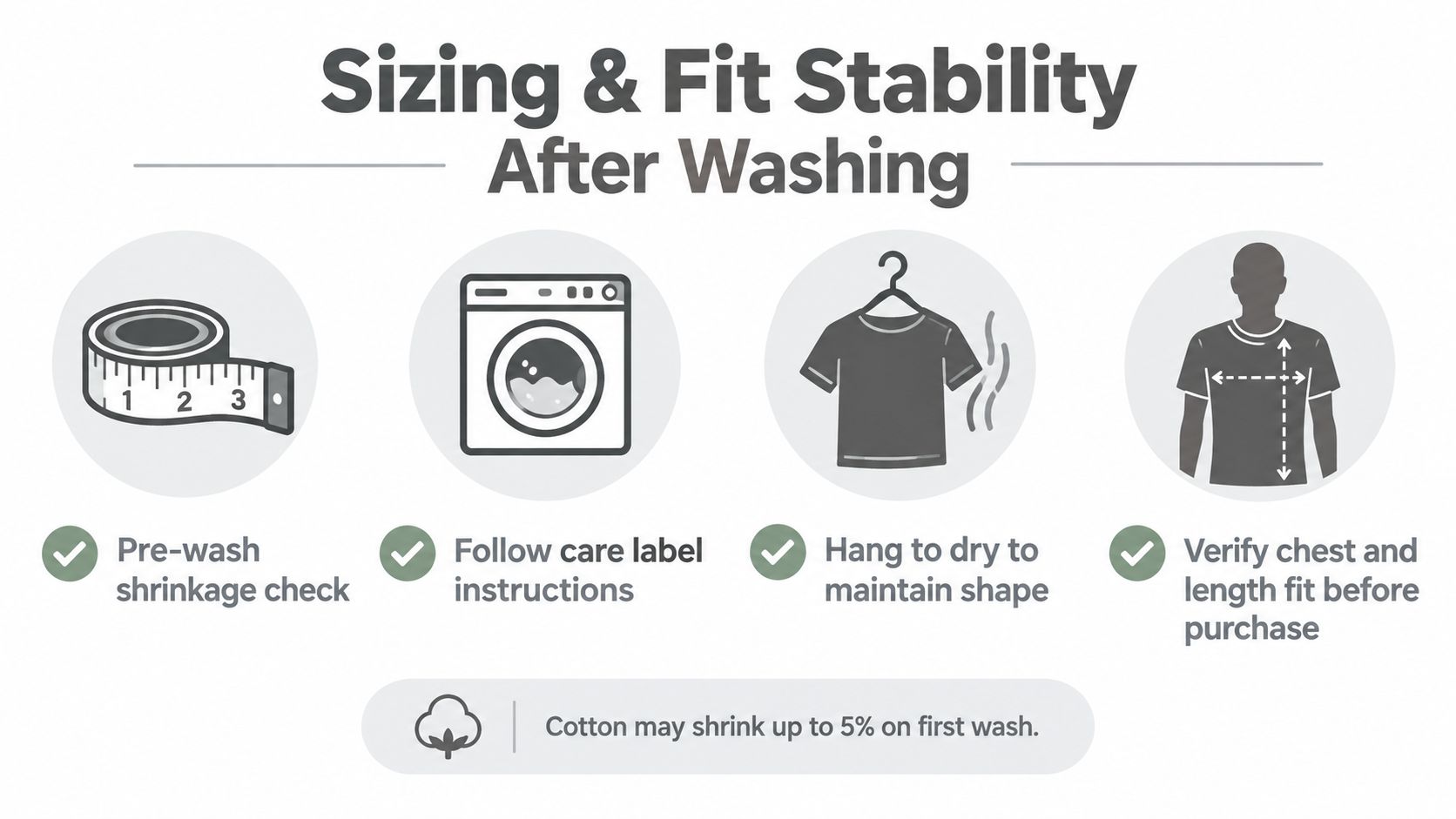
Wash according to the care label, avoid assuming that more heat means better hygiene, and use a drying method that preserves the garment's shape. Hang drying can reduce mechanical stress and help you monitor how the hood, sleeves, and belt settle. If you use a machine dryer, follow the stated temperature and cycle guidance rather than applying a generic towel routine.
Understanding Textile Certifications and First-Wash Care
Certification language can sound more complete than it is. GOTS addresses the supply chain, including organic fiber requirements and restrictions on dyes and processing chemicals. OEKO-TEX Standard 100 focuses on testing the finished textile for harmful substances. These systems answer different questions, so one label shouldn't be treated as a substitute for the other.
That distinction matters in a hooded robe because the skin may contact the hood, trim, thread, labels, belt, and dyed areas for an extended period. A certificate covering the fabric may not automatically explain every component of the finished garment. Shoppers should check whether the claim applies to the complete robe, a particular fabric, or only part of the production chain.
A practical certification checklist
- Check the scope: Find out whether the certificate covers the finished robe or only the fiber and fabric.
- Verify traceability: Look for a current certificate identifier or verification route rather than relying on a badge alone.
- Ask about components: Confirm whether dyed trims, labels, thread, and other skin-contact elements fall within the stated claim.
- Separate claims: “Organic,” “non-toxic,” and “skin-safe” aren't identical promises.
- Wash before wearing: Even certified organic textiles may retain detectable sizing or processing residues within permitted limits, so a first wash is sensible.
People with eczema, fragrance sensitivity, or reactive skin may prefer washing the robe separately with an unscented detergent. Avoid adding fragrance boosters during the first wash, and stop using the garment if it causes irritation. Certification can reduce uncertainty, but it can't guarantee that every person will tolerate every finish, dye, or fiber equally.
For delicate garments or situations where home care isn't practical, professional dry cleaning in Singapore can be a useful option for specialized textile handling. For ordinary cotton terry or waffle robes, however, the care label should remain the first reference. This guide to washing, storing, and caring for a robe can help you build a routine that protects texture and fit.
Choosing the Right Hooded Robe for Your Climate and Routine
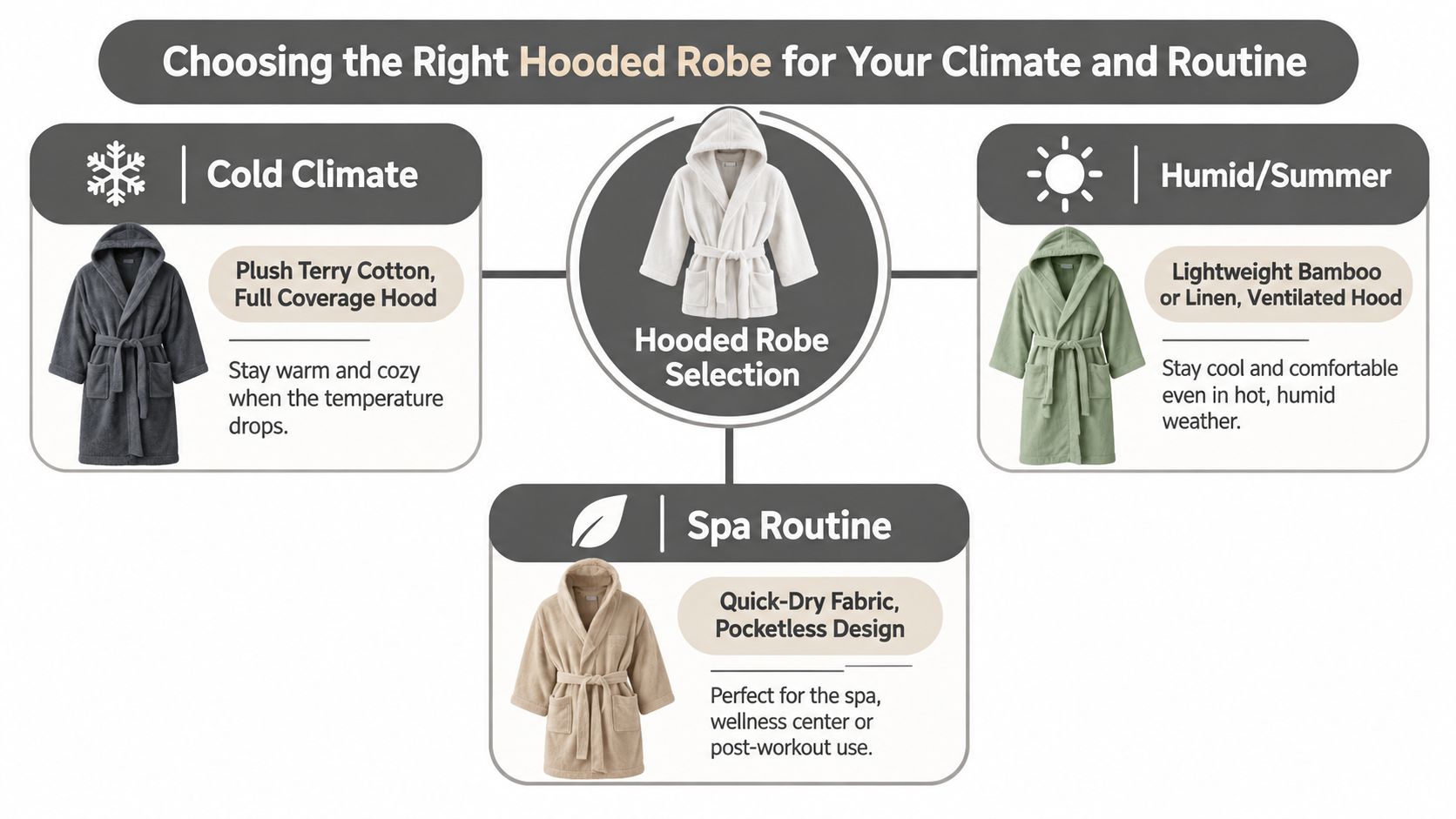
Climate changes what comfort means. In a cool bedroom, the hood may be the part that makes a robe feel complete. In humid weather, the same hood may retain warmth around the neck and leave damp fabric slower to dry. Evaluate absorbency, breathability, thermal regulation, drying speed, and maintenance as separate attributes instead of treating “spa-quality” as one universal standard.
Start with your most common transition. If you step from a hot shower into a chilly room, prioritize warmth and moisture pickup. If you wear the robe for coffee, skincare, or lounging in a warm home, breathability and lower weight may matter more than maximum absorption.
Use the decision points
Choose denser terry when:
- Your bathroom is cool: The added looped surface can create a warmer, more enveloping layer.
- You put the robe on while damp: Terry is designed to manage more moisture than a smooth or airy weave.
- You move from pool to lounge: The hood and body provide coverage while you dry.
Choose lightweight waffle when:
- Your climate is warm or humid: A less bulky structure can feel easier around the neck and shoulders.
- You need frequent drying: Lighter fabric is usually more manageable between uses.
- You travel often: Lower bulk helps when storage and packing space are limited.
A full hood isn't always the answer. In cold weather, a deeper hood can protect wet hair and retain warmth. In humidity, a shallower or more ventilated hood may feel less restrictive. Look for a hood that sits securely without pulling at the neckline, and check whether its seams add unnecessary thickness.
Think in routines, not seasons alone
A person in a cold climate may still prefer waffle after a sauna because the body needs to cool down. Someone in a warm climate may want terry for a short post-shower window in an air-conditioned bathroom. Your daily sequence matters as much as the weather outside.
Use this seasonal bathrobe fabric and thickness guide alongside the garment's actual construction details. If you're comparing specific options, SEYANTE offers hooded robes in Turkish cotton terry and lightweight waffle constructions, allowing shoppers to assess warmth, absorbency, and drying needs against their own routine.
Final Thoughts on Elevating Your Daily Self-Care Ritual
The right hooded spa bathrobe isn't defined by maximum thickness or the softest first impression. It's defined by how well the garment performs in your actual bathroom, climate, and laundry routine. Terry suits shoppers who prioritize moisture pickup and enveloping warmth. Waffle suits those who value airflow, lower weight, and easier drying.
Before buying, check four things:
- Construction: Look beyond “plush” and identify the weave, loop structure, pile, and approximate weight.
- Climate fit: Decide whether you need insulation, breathability, or a compromise between the two.
- Dimensional stability: Look for pre-washed fabric or documented measurements after laundering.
- Certification scope: Confirm what the certification covers, then wash the robe before first use.
The hood deserves equal attention. It should protect damp hair and the neck without creating an uncomfortable pocket of heat or moisture. Once the fabric, fit, and care requirements match your routine, the robe becomes more than post-shower clothing. It gives an ordinary transition a dependable rhythm, from water to warmth, from busyness to a few quiet minutes of self-care.
SEYANTE offers hooded Turkish cotton terry and lightweight waffle robes for men and women, with options suited to post-shower comfort, lounging, gifting, and spa-inspired routines. Visit SEYANTE to compare constructions, review sizing and material guidance, and choose a robe that fits your climate and daily ritual.