Maternity Delivery Robes: The Essential Guide
- Why Your Delivery Robe Matters More Than You Expect
- What Maternity Delivery Robes Actually Are
- Key Features That Make a Delivery Robe Truly Useful
- How Different Robe Styles Support Labor and Recovery
- Sizing, Fit Tips, and Care Advice You Should Know
- How SEYANTE Robes Meet Maternity Delivery Needs
- What to Pack and How to Use Your Delivery Robe
Yes, maternity delivery robes are practical garments for dignified comfort during labor and recovery, not merely pretty robes for hospital photos. Hospital-gown research found that 67% of patients said their gown didn't fit and 72% felt exposed, which shows why coverage, adjustability, and clinical access matter.
You arrive at the hospital with a carefully packed bag, a birth plan, and probably more uncertainty than you'd like. A robe might seem like a small detail beside monitoring, examinations, contractions, and recovery, but clothing can either remove friction from those moments or add to it. The right design gives you coverage when you want it, opens quickly when staff need access, and supports feeding and rest after birth.
Why Your Delivery Robe Matters More Than You Expect
At admission, you may need to change clothes, walk between rooms, answer questions, and settle into monitoring before labor follows a predictable pattern. A conventional hospital gown can shift at the back, feel difficult to fasten, or leave you asking for help with something as basic as getting dressed. A well-designed maternity delivery robe gives you more control over those ordinary movements.
That control matters during a vulnerable medical event. A robe that stays closed while you walk can reduce unwanted exposure. A wrap front can open for monitoring or an examination without requiring you to remove the entire garment. Soft, breathable construction can also make sitting, standing, resting, and changing positions feel less distracting.

The problem with a one-size hospital gown
Traditional hospital gowns were created for clinical access, not personal dignity. In a medical-design report discussing hospital-gown research, 61% of surveyed patients struggled to put the gown on or needed assistance, while 57% reported discomfort. The same report found that 60% felt self-conscious, making the garment's design relevant to independence and emotional ease, not just appearance. Read the patient-experience discussion of hospital gowns.
A maternity delivery robe can't control every part of a hospital experience, and it isn't a substitute for medical care. It can, however, help you handle common transitions with fewer clothing adjustments. If you also have a maternity nurse or postpartum support person involved, resources on maternity nurse placement can help you plan practical support beyond the delivery room.
Before buying, test four things: whether you can open it with one hand, whether it stays secure when you walk, whether it gives staff the access they need, and whether it remains comfortable when you're sitting or lying down. Those checks turn a robe from a decorative extra into a deliberate comfort decision.
What Maternity Delivery Robes Actually Are
A maternity delivery robe is a purpose-built garment for labor, hospital care, and early recovery. It usually combines the comfort of loungewear with features that ordinary robes often lack, such as an adjustable wrap closure, a generous front overlap, nursing access, and openings that allow clinical monitoring without complete undressing.
The category developed in response to the limitations of the standard hospital gown. The open-back gown is generally traced to approximately the early twentieth century, when hospitals needed rapid access to the body during surgery while protecting personal clothing from blood and other bodily fluids. That history explains why the familiar gown prioritizes access from the back, often at the expense of coverage and personal control. Learn more about the history and alternatives to the traditional patient gown.
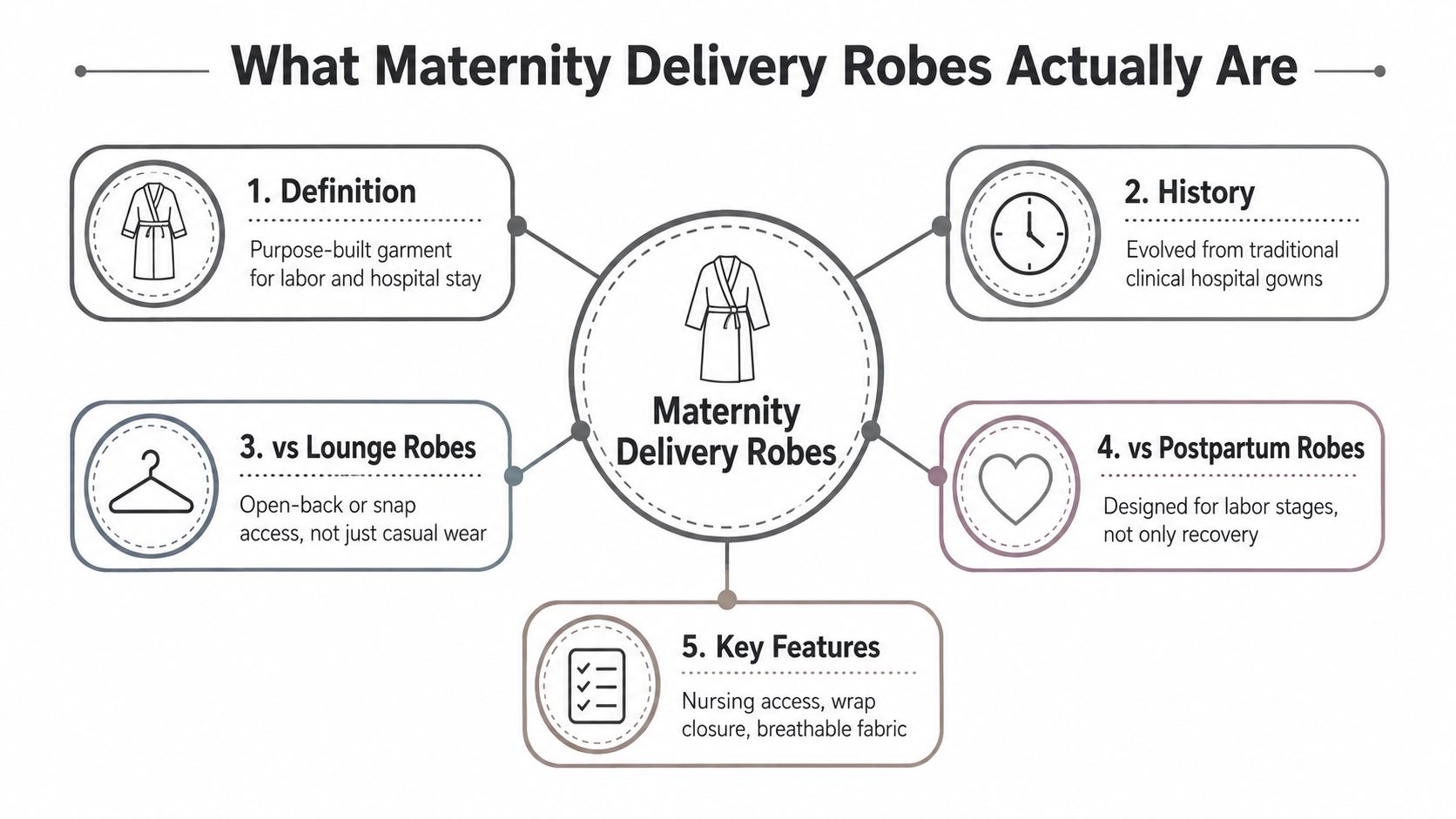
From clinical access to maternity usability
A North Carolina State University research team developed a two-piece maternity gown with an adjustable waistband, a built-in nursing-bra insert, and features intended to support breastfeeding after birth. Wear trials and an online survey reported improved comfort across labor and postpartum stages. The importance of that work isn't that every commercial robe copies the prototype. It shows that fit, modesty, mobility, monitoring access, and feeding access can be treated as design requirements.
That distinction separates a delivery robe from an oversized bathrobe. A regular bathrobe may feel soft, but its collar, belt, sleeves, or heavy fabric may make examinations and skin-to-skin contact less convenient. A postpartum robe may prioritize lounging and nursing, while a labor garment must also accommodate monitoring, examinations, movement, and rapid changes in coverage.
Look for a robe that answers practical questions:
- Can it open quickly? Staff should be able to reach the chest, abdomen, or back when necessary.
- Can it close securely? You should be able to walk or receive visitors without constantly holding the garment together.
- Can it adapt to your body? Ties, overlapping panels, and flexible sizing are more useful than excessive volume alone.
- Can you use it after birth? Nursing access and washable construction extend its value into recovery.
A robe is therefore best understood as functional maternity apparel. Luxury can improve the sensory experience, but useful construction determines whether the garment works when your body, schedule, and care needs keep changing.
Key Features That Make a Delivery Robe Truly Useful
Start with access, not color or trim. During labor, staff may need to monitor you, perform examinations, place or manage equipment, assess recovery, or support skin-to-skin contact. A robe should make those tasks straightforward while giving you as much coverage as the clinical situation allows.
Choose the closure for the moments that matter
A wrap or kimono front is often practical because you can adjust the overlap as your body changes. Multiple tie positions allow you to loosen the waist during movement and secure it when you want more coverage. Wide front panels are preferable to a narrow overlap that opens whenever you sit, lean forward, or turn in bed.
Avoid closures that are difficult to operate with one hand. Snaps, broad ties, or carefully positioned fasteners are easier to manage than a long row of small buttons. Keep bulky hardware away from the abdomen and lower back, where pressure can become uncomfortable during prolonged sitting, labor positions, or postpartum tenderness.
Evaluate coverage and movement together
A hip-length or longer cut can provide more privacy when you walk or lie down, but extra fabric shouldn't restrict your stride. Check the armholes and shoulders by raising your arms, reaching forward, and turning from side to side. You need enough mobility for repositioning without creating a loose sleeve that interferes with equipment.
A full back isn't automatically the right answer if it prevents clinicians from working efficiently. The better target is controlled coverage with fast clinical access. That may mean a secure back panel, side openings, shoulder access, or a front design that staff can adjust without removing the robe.
Practical rule: Choose the least complicated garment that gives you the most useful control over coverage and access.
Fabric affects comfort, but softness alone isn't a performance specification. Prefer washable materials, colorfast trim, durable stitching, and clear laundering instructions. Avoid decorative absorbent details that could retain fluids, and inspect seams for rough edges or bulky finishes.
Understand hygiene limits
A personal robe is a clean comfort layer, not a sterile surgical gown or an impermeable isolation gown. CDC guidance recommends gowns when contact with blood, body fluids, secretions, or excretions is anticipated, and it advises handling used textiles with minimal agitation to limit contamination. Review CDC guidance on gowns and reusable textiles.
Healthcare-gown research identifies cuffs, forearms, thighs, chest, and abdomen as areas vulnerable to liquid strike-through. That makes sleeve length, front overlap, and overall coverage worth considering, but no soft robe should be treated as a fluid barrier unless it has been specifically designed and labeled for that purpose. Ask your facility whether you may wear a personal robe during labor, and follow staff instructions if exposure is possible.
For a practical look at storage features and pocket placement, see this guide to a maternity robe with pockets. Pockets can hold small personal items, but they shouldn't make the garment heavy or pull the front out of alignment.
How Different Robe Styles Support Labor and Recovery
Different robe configurations solve different problems. A wrap style may suit someone who values adjustable coverage, while a front-opening style may be more convenient for frequent monitoring or breastfeeding. The right choice depends on how quickly you need access, how much warmth you prefer, and whether you expect the garment to remain useful after delivery.
Compare the main configurations
| Robe style | Useful for | Potential limitation |
|---|---|---|
| Wrap or kimono front | Adjustable coverage, walking, examinations, and general labor movement | The tie can loosen if it isn't positioned securely |
| Broad front opening | Monitoring, skin-to-skin preparation, and fast changes | It may expose more of the body when open |
| Nursing-access front | Breastfeeding and postpartum use without removing the robe | Small openings can be frustrating if snaps are stiff or poorly placed |
| Longer overlapping cut | Recovery, visitors, hallway walks, and additional coverage | Excess fabric can interfere with movement or become warm |
| Lightweight short-sleeve design | Variable hospital temperatures and active movement | It may provide less warmth during rest |
A wrap front usually offers the most flexible balance. You can keep the panels closed while moving through the hospital, then open the upper section for monitoring or feeding. Look for broad panels rather than a narrow tie-only front, especially if privacy is a major concern.
Plan for birth and recovery separately
For a vaginal birth, quick access and comfortable movement may be your main priorities. You might spend time standing, leaning, walking, or changing positions, so a robe with flexible shoulders and a secure but adjustable waist can be useful.
A planned or unplanned C-section creates different clothing considerations. A longer, softer cut can provide coverage while avoiding a rigid waistband over a tender abdomen. The robe shouldn't press against an incision area or require you to bend far down to fasten it. Staff may also need rapid access to the surgical and recovery areas, so follow their directions rather than treating the robe as a fixed layer.
Breastfeeding access should be simple enough to use when you're tired. A front-opening panel or discreet nursing access can reduce unnecessary undressing, but it shouldn't place snaps, zippers, or thick edges near the baby's face. The garment must open widely enough for comfortable positioning, not merely reveal a small section of the chest.
A robe that supports labor may not be the same robe you want for sleeping. Choose one that can adapt, but judge each feature by the moment when you'll need it most.
Sizing, Fit Tips, and Care Advice You Should Know
Robe sizing is less about the label than the available ease. Your body may change during pregnancy and after birth, while swelling, monitoring equipment, breast fullness, and recovery tenderness can all affect how a garment feels. A generous fit is helpful, but an excessively oversized robe can drag, slip from the shoulders, or obstruct movement.
Check the shoulder line first. You should be able to lift your arms, turn in bed, and reach toward your baby without the neckline pulling backward. Then test the armholes. Tight openings can make monitoring and feeding awkward, while very wide openings may reduce coverage when you move.
Use a practical fitting test
Try the robe over the undergarment or nursing layer you expect to wear. Close it while standing, sit down, walk several steps, and lie on your side if the garment allows. Ask yourself:
- Does the front stay overlapped? A robe that falls open during ordinary movement won't feel secure during labor.
- Can you adjust it without assistance? One-handed operation is useful when you're connected to equipment or holding your baby.
- Does the hem stay clear of your feet? Length should provide coverage without creating a trip hazard.
- Do the seams sit comfortably? Avoid thick seams across the abdomen, lower back, or shoulders.
For more help measuring yourself and interpreting garment measurements, use this robe size chart guide. If you're between sizes, prioritize room for movement and closure overlap rather than choosing the smallest size that technically fits.
Care determines whether the robe remains pleasant after repeated use. Follow the manufacturer's laundering instructions, close fasteners before washing, and inspect ties and seams after each cycle. Washable fabric matters because a hospital garment may encounter sweat, skin products, food, or bodily fluids even when it isn't used during a high-exposure procedure.
Pack the robe only when it's clean and fully dry. A breathable storage bag helps keep it separate from shoes, toiletries, and used clothing inside your hospital bag.
How SEYANTE Robes Meet Maternity Delivery Needs
A luxury robe can support maternity use when its construction answers the same practical questions as any other delivery garment. The fabric should feel comfortable against sensitive skin, the closure should adjust without strain, and the cut should allow movement and access. A polished finish is useful only when it doesn't compromise those functions.
SEYANTE offers maternity robe options made from Turkish cotton, including terry and lighter waffle-weave styles. Terry fabric can provide warmth and absorbency for early labor or postpartum rest, while a waffle weave may feel more suitable when a hospital room is warm or when you prefer a lighter layer. These are comfort and wear considerations, not evidence that either fabric provides clinical protection.
Match the textile to the stage
A substantial terry robe may be reassuring after delivery, during visitors, or while resting. It can also feel too warm or bulky during active labor, especially if you need to open the front quickly. A lightweight kimono-style robe may offer faster adjustment and easier packing, but you might want an additional layer if you become cold.
Examine the finishing details before purchase. Durable stitching, clean hems, secure ties, and straightforward washing instructions matter more than a thick pile alone. A maternity robe should remain functional after laundering and comfortable through repeated use at home.
The brand also lists customer-friendly purchase policies, including free standard shipping within the United States and a 90-day return window. Check the current terms before ordering because policies can change, and confirm that the selected size leaves enough room for pregnancy and postpartum use.

Use the same evaluation process for any robe you consider. Does it open where staff need access? Does it stay closed when you want coverage? Does it feel manageable over a nursing layer? If the answer is yes, the robe can serve as functional maternity wear while still giving the hospital stay a more personal, comfortable feel.
What to Pack and How to Use Your Delivery Robe
Test the robe before it goes into your bag. Open the front with one hand, secure the waist while seated, walk in it, and check how easily the nursing access works. Pack it near the top rather than at the bottom of a tightly organized suitcase, since you may want it soon after arrival or immediately after changing out of the hospital gown.
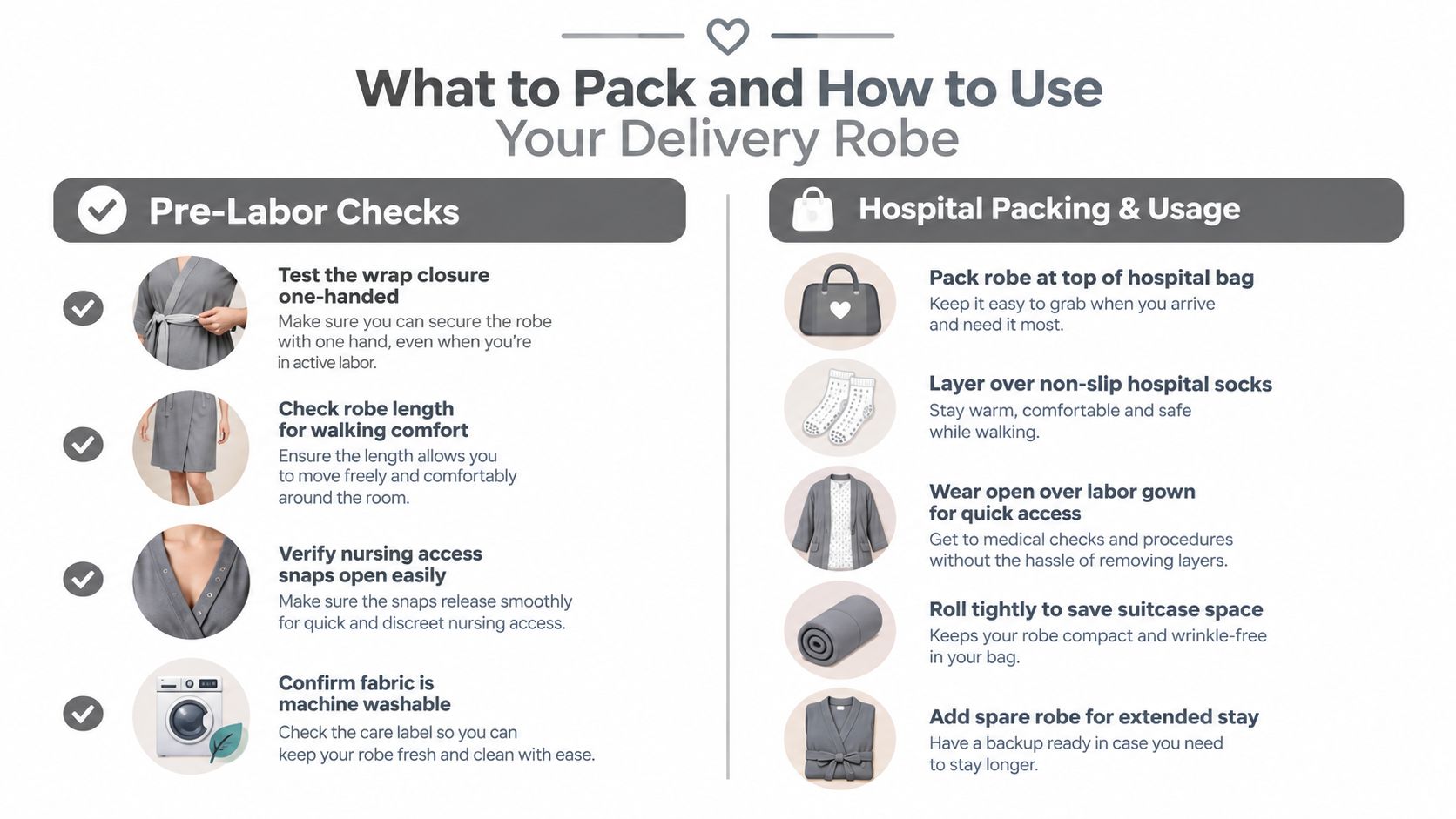
Keep the packing plan simple
- Pack for access: Place the robe where you can reach it without unpacking everything.
- Layer thoughtfully: Wear it over approved underwear, a nursing layer, or the hospital gown according to staff instructions.
- Protect your feet: Pair it with non-slip hospital socks or footwear suitable for walking.
- Plan for laundry: Bring a washable bag for separating the robe if it becomes soiled.
- Consider a spare: An additional clean layer may be useful if your stay extends or the first robe needs washing.
A robe can be open during labor when staff need access and closed during walks, rest, or visits. Don't assume you'll wear it continuously. The clinical team may ask you to remove or reposition it for monitoring, procedures, surgery, or other care.
Skin-to-skin contact requires especially careful planning. CDC guidance recommends placing a medically stable newborn directly on the birthing parent's bare chest immediately after birth, continuing until the first feed is complete or for at least one hour when breastfeeding isn't planned. No clothing should separate the baby from the parent's chest during skin-to-skin, so a thick robe may need to open completely or move away from the chest. Read the CDC guidance on skin-to-skin and breastfeeding in maternity care.
Staff may place warmed blankets over you and your baby. Avoid bulky collars, tight armholes, restrictive belts, or fasteners near the baby's face. For broader planning help, this what to pack for delivery guide can complement your robe checklist, while maternity pajamas for the hospital may help you plan what to wear during the recovery period.
SEYANTE offers maternity-friendly robes in Turkish cotton terry and lightweight waffle styles, with options suited to warmth, breathability, and adjustable coverage. Visit SEYANTE to compare robe construction, review sizing guidance, and choose a washable layer that supports dignity and comfort from hospital admission through early recovery.