January White Sale: What It Is and How to Shop It
Is a discounted towel really a bargain if you'll need to replace it sooner, or if it's too small to use comfortably? A January white sale can be a useful time to replace household textiles, but the percentage off tells you less than the fabric, fit, care requirements, and likely years of use.
The sensible approach starts in your linen closet, not on a sale page. Know what needs replacing, measure what must fit, and judge the purchase by what it will cost to own.
What a January White Sale Actually Is
A January white sale is a post-holiday promotion on bed linens, towels, and other home textiles, named after the white fabrics these sales originally featured. It's a seasonal shopping tradition, not a requirement to buy white.
The event is generally traced to January 1878, when Philadelphia department-store pioneer John Wanamaker promoted bed linens during the quiet weeks after Christmas, according to the historical account of the white sale. Sheets and basic linens were commonly sold only in white, so the name described the merchandise quite directly.
Wanamaker had a practical problem: customers had finished their holiday shopping, but his store still needed business. Discounted linens gave households a reason to return for something useful rather than another gift.
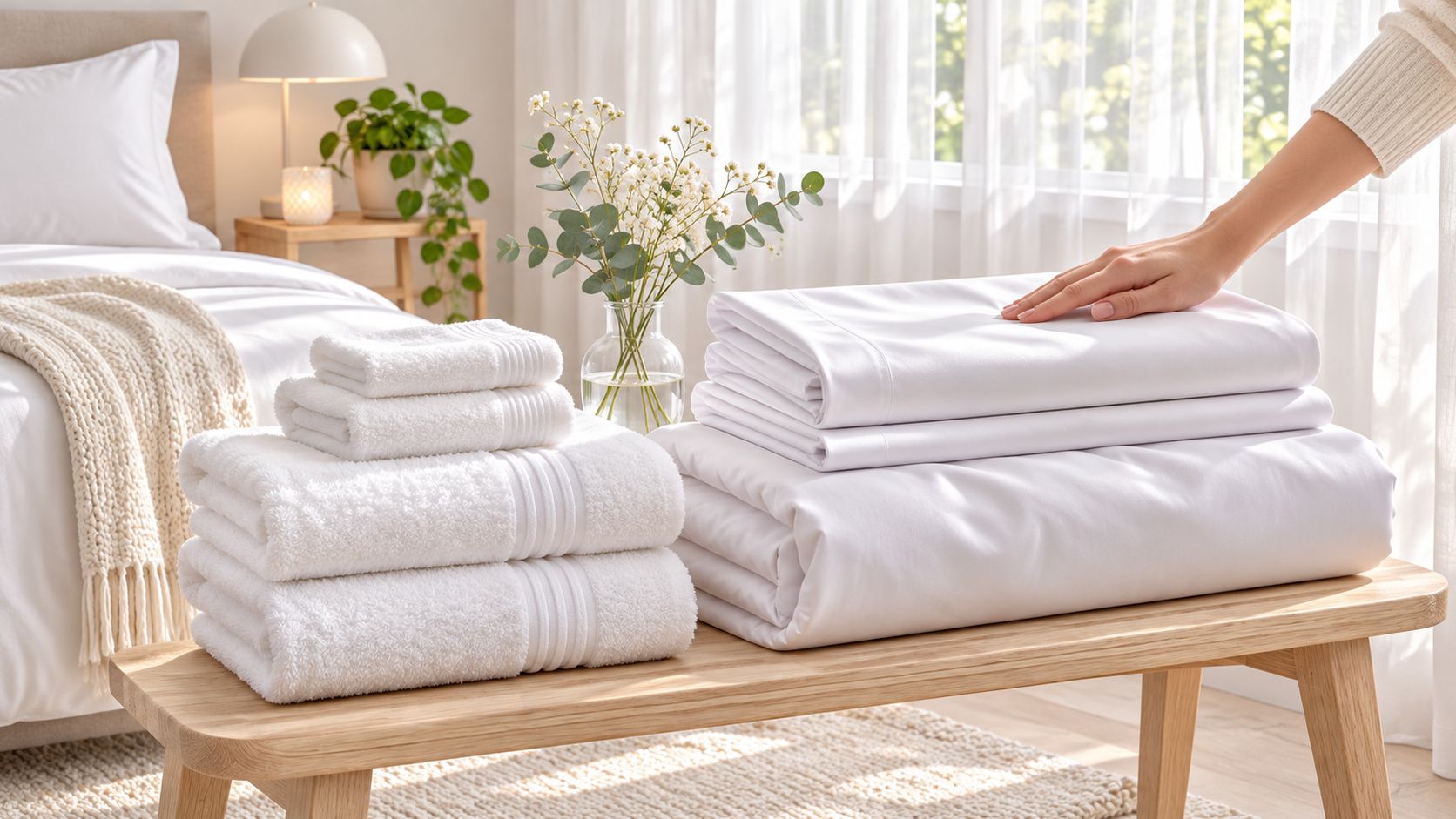
More than a clearance rack
The promotion connected several needs. Retailers could move stock, textile producers could keep working, and store employees had customers to serve during a slower period. Historical accounts also describe Wanamaker ordering linens for delivery during the sale and advertising them at cost, rather than marking down unwanted leftovers.
Think of it as a retailer's annual linen-closet reset. A household sorts worn sheets and mismatched towels; a retailer reviews stock and creates a reason for customers to refresh those same essentials.
The assortment eventually expanded to colored bedding, towels, drapes, and bath goods. The color restriction disappeared, but the seasonal name remained.
Practical test: A January promotion focused on linens fits the white-sale tradition. A generic storewide clearance banner doesn't tell you whether any household textile is good value.
For your own reset, separate necessary replacements from purchases that merely look appealing. If household purchases are hard to track, Compass+ offers a resource for examining where your money actually goes, useful context before adding discretionary textiles to your budget.
The tradition explains why retailers run these promotions. It doesn't establish that January is automatically the cheapest time for every item, or that everything included deserves a place in your home.
The Linens Usually Included and What to Check
A January white sale can include bedding, bath textiles, table linens, and related home essentials. Treat the category name as a starting point, then read the product description for fiber, weave, weight, measurements, and care. That habit matters because two towels labeled “cotton” can feel quite different after drying, and two robes in the same size can fit very differently.
Common January white sale categories and what to check
| Category | Typical fabric or construction | What to check |
|---|---|---|
| Bath towels and bath sheets | Cotton terry | Pile density, loop length, and shedding after the first wash |
| Robes and wraps | Cotton terry or cotton waffle weave | Weight, hood and belt design, and length for your height |
| Bath mats | Cotton terry or microfiber | Non-slip backing, floor compatibility, and weight |
| Sheet sets | Cotton percale or cotton sateen | Fitted-sheet depth, pocket size, and pilling |
| Duvet covers | Cotton percale or cotton sateen | Closure type and whether the cover fits your insert |
| Pillowcases | Cotton percale or cotton sateen | Envelope closure and compatibility with the sheet set |
| Blankets and throws | Cotton, wool blend, or acrylic | Weight, edge stitching, and care label |
| Table linens and napkins | Cotton or linen blend | Hem quality and expected shrinkage |
| Shower curtains | Polyester or cotton-polyester blend | Whether a liner is included and fabric weight |
Fabric structure is a better guide than a single marketing word. Percale usually feels crisp and looks matte. Sateen has a smoother surface and more sheen. Thread count cannot tell you whether sheets feel comfortable or hold up well, so read the fiber, weave, seam finish, and care instructions as a group.
Match the construction to the job
For towels, look beyond a plush product photograph. Examine the loops, edge binding, and stated weight, then consider whether you want a substantial towel or something easier to wash and dry. Our guide to bath towel absorbency explains which qualities matter after a shower, including how material and construction shape the feel.
Robes deserve the same use-first approach. SEYANTE's Women's White Luxury Turkish Cotton Terry Kimono Bathrobe is a Turkish cotton terry option. Check its listed certifications, measurements, and care instructions against how you plan to use it. A terry robe is worth comparing with a waffle robe in the same way you would compare a thick winter towel with a lightweight travel towel: both can be useful, but they solve different comfort problems.
The same practical filter applies to bedding. If sheets are on your list because the whole bed setup feels worn, protective layers deserve separate attention. Stahl Home Center's guide to choosing the right mattress protector can help you evaluate that layer alongside sheets.
A white-sale discount only becomes value when the item fits the job. Choose the categories you need before browsing. Replacing one hand towel, adding a robe after workouts, and rebuilding a guest-room linen supply are three different lists. Each one gets cleaner when you compare construction, fit, and likely use before looking at the percentage off.
Bed and Bath Sizes to Match Your List
Write the item and its required fit on your replacement list. Size names are a starting point, not a substitute for measurements: brands can use different finished dimensions under familiar labels.
Use this lookup table to decide what to measure rather than relying on an assumed standard.
| Item | Size to look for | Measurement or fit check |
|---|---|---|
| Twin sheet set | Twin matched to the mattress | Mattress length, width, and depth |
| Full sheet set | Full matched to the mattress | Fitted-sheet dimensions and pocket depth |
| Queen sheet set | Queen matched to the mattress | Depth including any topper |
| King sheet set | The exact king format you own | Mattress dimensions, not the name alone |
| Bath towel | Everyday drying size | Compare length and width with a towel you like |
| Bath sheet | Larger wraparound format | Check coverage and laundry capacity |
| Hand towel | Hand-drying size | Check towel-ring or rail clearance |
| Washcloth | Small washing cloth | Check finished dimensions and thickness |
Measure the item it must fit
For sheets, use a tape measure across the mattress and down its side, including any topper you'll keep. A queen label doesn't guarantee that the fitted sheet will reach comfortably around a deep mattress.
Match a duvet cover to the insert's measurements, not just the bed name. Check pillowcases against your pillows, including whether they're standard or king format.
For towels, lay a favorite towel flat and measure it. A bath sheet offers more wrap coverage, while a regular bath towel may be easier to store and wash.
Buy to a known measurement, not an imagined fit.
For a gift, ask the recipient's bed size or request the dimensions of an item they already enjoy using. A brief question is more useful than a confident guess.
Judging Whether the Discount Is Real Value
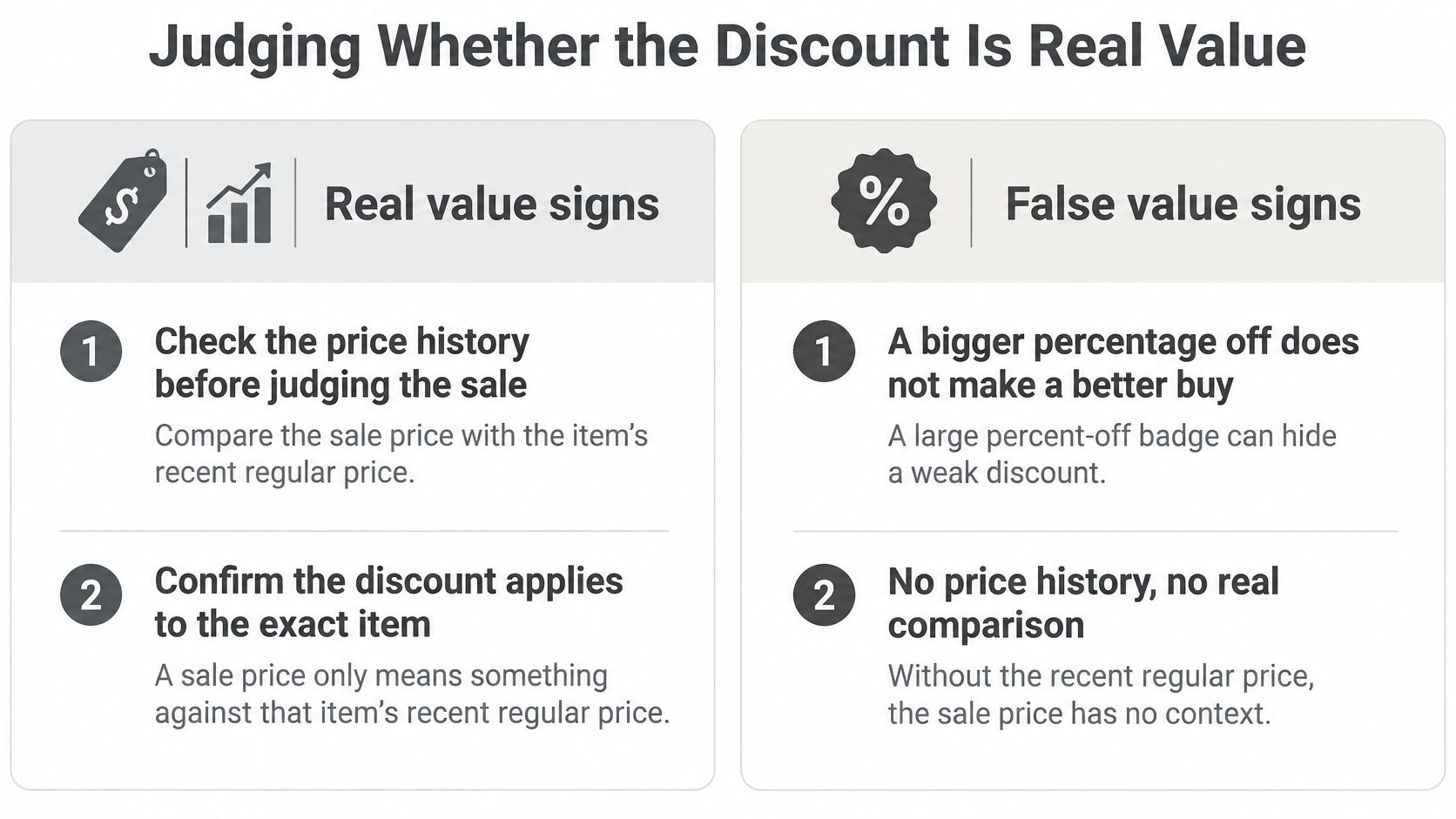
A bigger percentage off doesn't make a better buy. Value depends on the price of the exact item, its fit for your needs, and how long you can reasonably expect to use it.
The U.S. Census Bureau's January 2026 advance retail report recorded retail sales up 3.2% year over year while falling 0.2% from December. These broad sales figures describe retail activity; they cannot establish whether a particular robe or sheet set offers a meaningful saving.
Establish a reliable comparison price
Compare the selected item with its recent selling price where that history is available. Keep material, dimensions, quantity, and color consistent. A smaller towel at a lower price changes what you receive, so it cannot establish a saving on the towel you wanted.
Treat a crossed-out reference price as a starting point. If its basis is unclear, compare the current price with similar alternatives and judge what your money buys.
Estimate the cost of useful service
Spread the purchase price across the years you expect to use the item:
Cost per year of use = purchase price divided by expected useful years.
Lifespan is an estimate. An inexpensive towel set may serve your needs well; a more substantial set earns its higher price when the additional useful service justifies the additional cost. Size fit belongs in this judgment too: an item that cannot do its intended job offers little useful service.
Check what supports your estimate:
- Fiber and certification: Read the composition and stated certification. Certification alone cannot establish lifespan.
- Fabric weight: Compare disclosed GSM, meaning grams per square meter, alongside weave and intended use.
- Construction: Look for secure, even hems, seams, belt loops, and closures.
- Care requirements: Match the textile to your washing and drying routine.
- Ownership costs: Account for delivery, special cleaning, and potential return costs where applicable.
The discussion of bringing hotel comfort home through quality bedding provides further context for assessing materials beyond appearance.
Weight and price are clues, not proof of durability. Look for construction suited to the job, then Buy when the likely cost per useful year beats the alternative. The markdown is only one part of that decision.
Shop the Sale Step by Step and Confirm the Buy
Keep your measurements and purchase criteria beside you while shopping. This makes it easier to reject unsuitable options without getting distracted by an attractive color or a large sale badge.
Build a shortlist you can defend
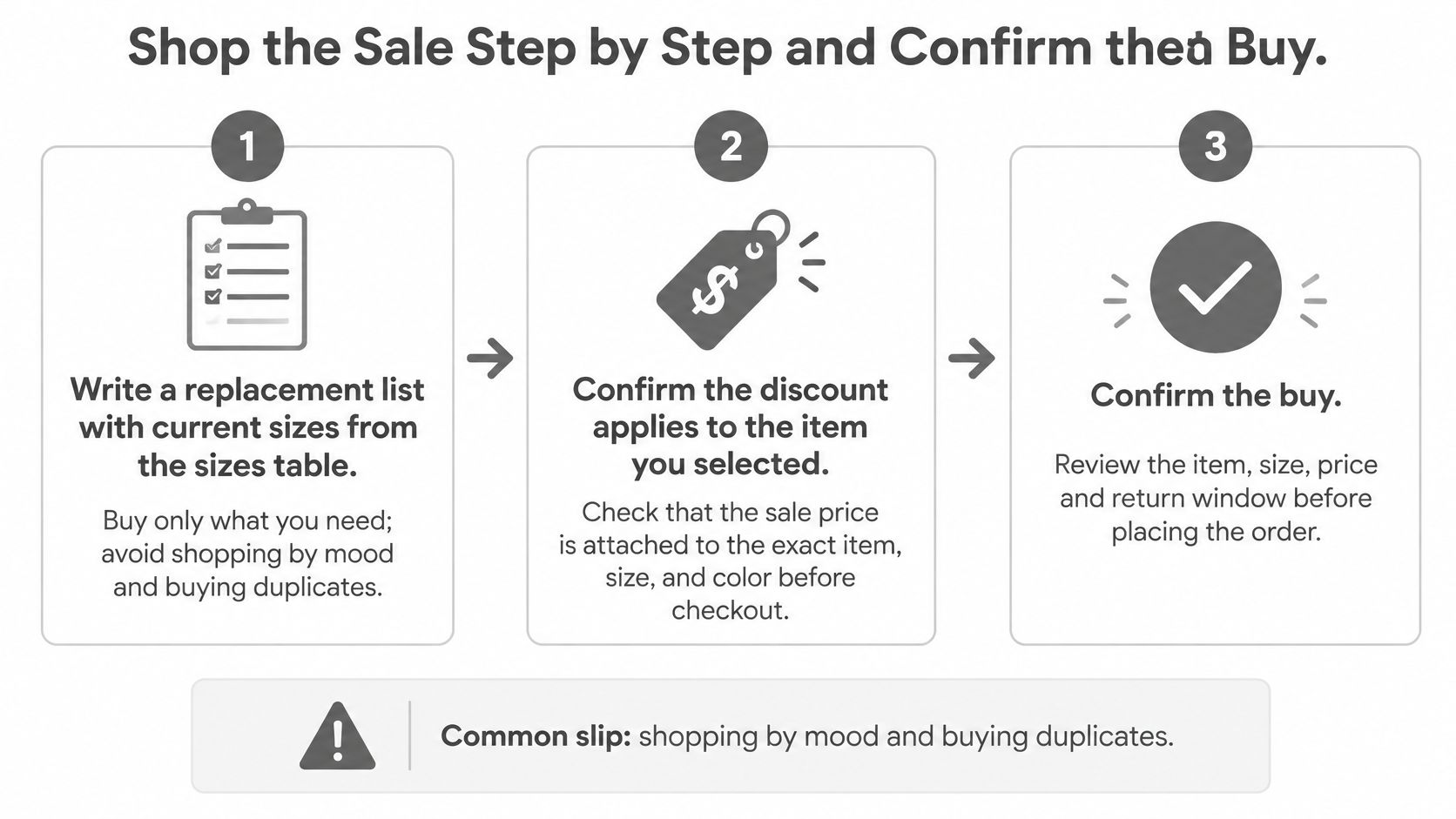
Write a replacement list. Open the linen closet and identify what's worn, missing, or uncomfortable. Record the measurements you need beside each item, and note whether it's for everyday use, guests, or a gift. The common slip is shopping by mood and buying another usable item while leaving the actual replacement need unresolved.
Select the exact sale variant. Choose the size and color before recording the price. Promotional banners can cover selected lines or options rather than everything shown beneath them. Check the basket as well as the product page so you're evaluating the item you'll receive.
Record a defensible comparison. Save the current listing and any available recent-price evidence. When comparing different products, keep the contents consistent: a sheet set with pillowcases shouldn't be treated as equivalent to a fitted sheet sold alone. If a seller provides no useful price history, leave the claimed saving out of your decision.
Read the specification before judging the photograph. Look for fiber content, weave, disclosed weight, measurements, and finishing details. For towels, don't let an impression of softness replace a check of the pile and hems. For robes, inspect the description of the belt, pockets, sleeves, and overall cut.
Check the purchase conditions
Apply your ownership estimate. Put the shortlisted options through the cost-per-year calculation. Use a cautious lifespan assumption, especially if you haven't used that construction before. If the result depends on an unusually optimistic estimate, you haven't established a strong value case.
Read the promotion and return conditions before paying. Check the promotion's end date, exclusions, and any special treatment of clearance merchandise. Our promotional and discount codes are active only for their designated promotional period and can't be applied to purchases outside that period. Since January 25, 2024, products bought directly from the SEYANTE website qualify for free returns, subject to the exclusions described in our return policy.
Buy coordinated pieces only when you need them. Matching pillowcases can make sense with a replacement duvet cover, but a bundle isn't economical if part of it will sit unused. For guest rooms or shared bathrooms, consider how pieces will be laundered and replaced separately, not just how they look together when new.
Before submitting the order, read the basket line by line. Confirm the item name, selected option, quantity, final price, and delivery details. Keep the order confirmation so you can compare it with the contents when the package arrives.
The best January white sale purchase is one you can justify after considering washing, wearing, and eventual replacement. A large discount on the wrong item is still the wrong purchase.
Returns, Sizing and Gift Buying After the Holidays
January is also a correction period for holiday purchases. According to Digital Commerce 360's holiday returns reporting, Salesforce found that consumers returned 12.2% of online orders globally from January 1–14, 2026, while Adobe found that one in seven seasonal returns occurred from December 26–31.
Those findings make a practical point for gift buyers: suitability deserves attention before checkout, not only after delivery. A recipient may like the fabric but still find the sleeves awkward or the robe too short.

Make fit less of a guess
For a robe, compare chest and length measurements with the size chart. Check whether the chart describes body measurements or finished garment measurements, because those aren't interchangeable.
An adjustable belt can help accommodate fit preferences, but it can't fix every mismatch. Shoulder room, sleeve length, and coverage still matter. A forgiving silhouette is useful for gifting only when the underlying measurements are suitable.
- Before wrapping: Confirm that the recipient can use the item's care routine and that the gift timing works with the return window.
- On arrival: Inspect terry for pulled loops, open hems, or uneven seams. Check waffle fabric for snags and examine belt loops and pockets.
- Before washing: Confirm size and condition while the item is still eligible for return under the applicable terms.
Distinguish free returns from return eligibility
Our refund policy is the place to check the conditions before buying a gift. Items tagged final sale cannot be returned or exchanged and cannot be included in promotional offers.
Products listed under Last Chance Savings clearance and discontinued products are excluded from free returns. An exclusion from free return shipping and a prohibition on returning an item are different conditions, so read the designation attached to your selection.
A gift is lower risk when the recipient's measurements and the item's return conditions are both known.
Returns protect shoppers, but additional shipping, packaging, and handling still require resources. Accurate measurements and clear material choices are preferable to routinely ordering several sizes with the intention of returning most of them.
SEYANTE offers men's and women's bathrobes in Turkish cotton terry and lightweight waffle weaves, including many GOTS-certified organic options. Visit SEYANTE with your replacement list and measurements, then compare materials, fit, and care requirements before deciding whether a January purchase offers lasting value.