Hair Plopping: How to Do It and Which Hair Types Benefit
The most repeated advice about hair plopping is also the one that causes the most disappointment: wrap wet curls in a T-shirt, leave the wrap on as long as you can stand it, and unwrap perfect hair. Long, tight wraps flatten roots, stretch clumps, and leave the scalp damp for hours. The curls that come out are often worse than if you'd left the bathroom with wet hair and a wide-tooth comb.
Plopping earns its place in a curly routine when you treat it as a short, deliberate step: five to thirty minutes of gentle water removal and pattern setting, followed by air-drying or a diffuser. It isn't a drying method on its own, and it isn't a styling shortcut.
What follows is the version I give friends who ask. Which fabric, how long by hair type, how to handle an overnight wrap without wrecking your scalp, and how to test the whole thing on your own hair over two weeks so you're working from evidence instead of someone's before-and-after photo.
What Hair Plopping Does and Doesn't Do
Hair plopping means laying wet, product-treated curls onto a flat cotton T-shirt or microfiber towel, then wrapping the fabric so the curls stay gathered on top of the head while excess water wicks away. A 2024 explainer on how hair plopping works describes the mechanics plainly: the fabric supports the curl pattern close to the scalp, and nothing gets twisted or rubbed the way it does inside a towel turban. Pantene senior scientist Atiya Jordan Brown is quoted in that same piece saying the technique can speed drying without heat and help define curls while limiting frizz when it's done correctly.
That word "can" carries a lot of weight. Plopping is a curl-positioning and water-removal step, not a complete drying method. Hair comes out damp and still needs air-drying or a diffuser to finish, and how much you get from the step depends on your curl pattern, density, porosity, the products you used, the fabric, and how long you left it wrapped.
The evidence behind the claims is thinner than the confidence of the advice. Plopping grew out of curly-hair forums and the Curly Girl Method associated with Lorraine Massey rather than out of a laboratory, as one history of the technique sets out, and no peer-reviewed study has directly tested hair plopping itself. Claims about universal damage reduction or guaranteed definition are practical observation, not clinical outcome.
What one session actually gives you: less frizz because nothing rubbed the cuticle, clumps that held their shape while they started to set, and hair that's damp and manageable instead of dripping on your shoulders.
Fabric gets most of the attention, but what's already on the hair matters too. If your routine includes a gloss or shine service, the coating left on the cuticle changes how wet hair behaves in a wrap, and the Boost Beauty Lounge gloss treatment guide covers the timing and aftercare those treatments need before you put hair into any towel.
How to Plop Your Hair Step by Step
Choose your fabric and your starting wrap time before you begin, and keep both within reach so you're not searching for a towel with a dripping head. The order below is what protects the clumps. The specific products matter far less than the handling.
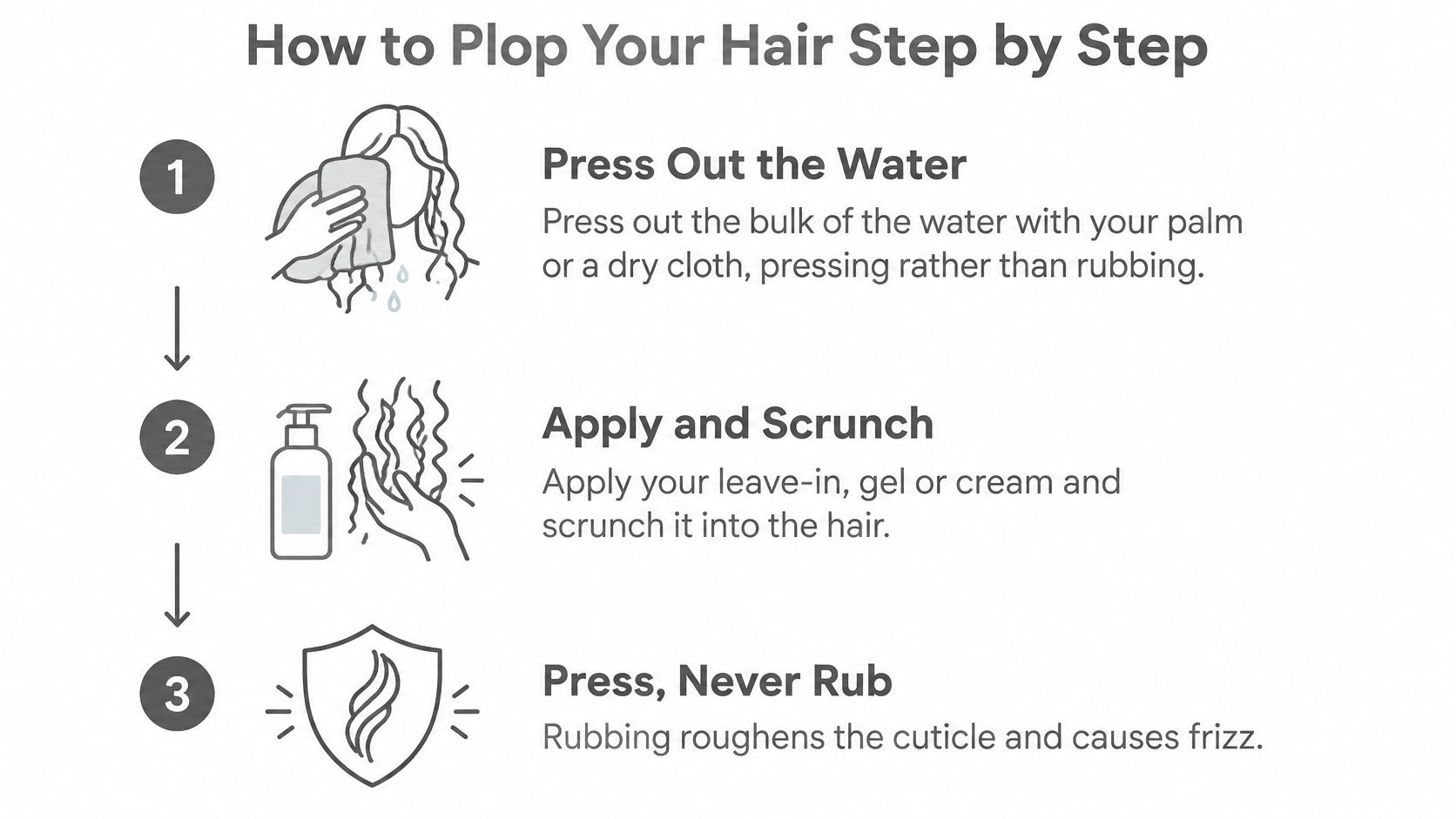
Press the water out first. Cup a section of hair and squeeze gently, or lay a dry cloth over it and press with your palm. Rubbing at this stage roughens the cuticle, and that's the frizz you spend the rest of the routine fighting.
Apply leave-in, cream, or gel, then scrunch. Work product through in sections and scrunch each one upward toward the scalp so the curls form clumps. The most common mistake here is raking product through and then wrapping without scrunching, which leaves the clumps broken before they've had a chance to set.
Lay the fabric flat with the collar or long edge toward you. A T-shirt works because the shape gives you something to fold and tie. Keep the surface smooth, with no bunched corners under the hair.
Lower your head slowly into the fabric. Bend forward and let the curls settle into the center rather than dropping your head fast and stretching them. The slow drop is the whole trick for keeping clumps intact, and it's the step people rush.
Wrap snug, not tight. Bring the fabric up around the head and secure it at the nape with the sleeves or a soft band. Tight wrapping presses the roots flat and leaves a crease across the crown. If you can feel pressure at your temples, it's too tight.
Wait for your time, then check for dripping. Unwrap at the stop point rather than at a fixed number on the clock. If the ends are still running with water, rewrap for a few more minutes. Unwrapping too early is the reason people conclude plopping "doesn't work" on their hair.
Unwrap gently, then lift the roots. Slide the fabric away instead of pulling it off over the top of the head, then use your fingertips to lift hair at the scalp. Finish with air-drying or a diffuser on low heat and no touching until the cast forms.
A good result looks like defined clumps, no frizzy halo at the crown, and ends that are nearly dry while the roots are still cool and damp. If the hair comes out stretched or the curl direction has collapsed, the problem is usually step 4 or step 5, not your products.
How Long to Plop for Each Hair Type
Most of the "how long" advice online gives a single number and moves on. That number is always wrong for somebody. Use the starting points below, then adjust from what your own hair does in the first five minutes.
| Hair type | Start wrap time | Extend if |
|---|---|---|
| Fine or easily flattened hair | 5-10 minutes | still dripping at 10 minutes |
| Loose waves | 10-20 minutes | hair still wet at the ends |
| Tight curls and coils | 15-30 minutes | clumps still wet after 20 minutes |
| Thick or dense hair | 15-30 minutes | water still runs from the lengths |
| Product-heavy routine | 15-30 minutes | product still wet at the roots after 20 minutes |
The working benchmark for most textures is a 15 to 30 minute wrap to pull out bulk moisture, followed by hands-off air-drying or low-heat diffusion, as this professional guide to drying hair without heat sets out. That guidance is a practical benchmark rather than a tested standard, so judge your own results on clump definition, frizz, drying time, and breakage across several washes instead of one.
Fine hair is the category that needs a short leash. Start at five to ten minutes and extend only while the hair is still dripping, because past that point the wrap starts pressing the pattern flat. Loose waves sit in the middle. Tight curls and coils can take the full half hour without losing shape, and thick hair often needs the upper end to stop the dripping that soaks your collar.
Length changes the math too. Hair past the shoulders usually belongs at the top of its row, because water keeps running down the lengths and re-wetting the ends long after the roots have stopped dripping.
The honest caveat for dense hair: a wrap mostly buys you convenience, not speed. One user reported that air-drying still took more than eight hours despite plopping, which the Hair Roundup guide to plopping notes alongside its timing advice.
Test your numbers this way. Begin at the shortest time for your type, check at five minutes, extend in five-minute blocks while hair still drips, and stop the moment it stops. Never wrap hair you would normally leave to dry flat against the head, because you'll set the flatness in. If you'd rather work with a turban than a flat cloth, our guide to using a hair wrap after a shower covers how to keep the fabric off the roots while the lengths dry.
T-Shirt, Microfiber or Terry
The fabric decides how much friction the hair meets and how much water leaves in the time you're willing to stand there. Compare the options on those two criteria before you buy anything.
| Fabric | Friction on curls | Absorbency | Best for |
|---|---|---|---|
| Flat cotton T-shirt | Low when pressed, not rubbed | Moderate | Most curl types on a budget |
| Microfiber towel | Low | High | Thick hair or heavy dripping |
| Standard terry towel | High, loops snag curls | Very high | Blotting before the plop, not the wrap |
| Satin or silk | Lowest | Low | Keeping shape; expect longer drying |
| Smooth Turkish cotton hair turban | Low | High | Gentle, portable wrap for everyday use |
A flat cotton T-shirt is the sensible default. It's soft, smooth, and cheap enough that you can dedicate one to the bathroom shelf. Its weakness is capacity: it holds less water than a purpose-made towel, so heavy drippers may need a second pass or a longer wrap.
Microfiber earns its reputation for pulling water fast, which suits thick hair and anyone who leaves the shower with water running down their back. On fine hair it can feel stiff, and on very porous hair it can strip moisture faster than the styling products have time to distribute. A standard terry towel, the looped kind most bathrooms are stocked with, snags curls on those loops. Keep it for blotting your body, or for pressing water out before the wrap goes on.
Satin and silk are the gentlest surfaces on this list and the least absorbent. They're useful when shape retention matters more than speed, and you should expect the hair to still be wet when you unwrap. A smooth Turkish cotton hair turban sits in the practical middle: more absorbent than a T-shirt, gentler than terry, and shaped to stay on your head while you get dressed.
SEYANTE sells towel wraps for men and women and hair turbans, including a White Cotton Hair Drying Towel Wrap made from soft, absorbent Turkish cotton, if you want a dedicated wrap rather than borrowing a shirt. Our hair turbans for women guide covers fit and fabric care.
The rule I'd give anyone starting out: begin with a clean cotton T-shirt, move to microfiber if your hair is still dripping when the timer goes, and keep the plopping fabric separate from the rest of the laundry so it stays free of conditioner residue.
Overnight Plopping, Scalp Safety and Fixes
An overnight wrap promises two things at once, better definition and a faster morning, and it delivers on neither often enough to be a default. Hours of wet fabric against a damp scalp, plus the compression of lying on a wrapped head, is a different situation from a fifteen-minute plop.

The concerns raised in curly-hair communities are split between styling problems and scalp problems. Users report that extended wraps can leave hair flat, frizzy, or shaped oddly in the morning, and some ask whether a warm, moist scalp under a wrap invites microbial trouble. That second idea is anecdotal concern, not a clinical finding; a curly hair community discussion on plopping times shows the worry being raised, not proven.
The rules I'd apply to any overnight attempt
- Never sleep in a saturated turban. If you can wring water from the fabric, the wrap is too wet to wear for eight hours.
- Get the hair to damp, not wet. A short plop first, then a fresh dry wrap, removes enough bulk that the scalp isn't sitting in a puddle.
- Skip tight compression. A soft band at the nape holds the fabric without pressing a crease into the crown or pulling at the hairline.
- Treat it as one experiment, not a routine. Try a single night, then compare morning shape and scalp comfort before you repeat it.
When to stop entirely
Stop overnight wrapping if you notice itching, odor, scaling, or irritation at the scalp, and don't try to solve recurring symptoms with a different fabric. Prolonged wetness and mechanical compression are the two things hair-care guidance warns about, and no direct clinical research appears to establish an ideal overnight duration for plopping. People with recurring scalp symptoms should see a clinician rather than experiment further.
Hygiene decides more outcomes than technique does. A damp textile holds moisture and product residue against your head, so dry the wrap fully between uses, wash it regularly, and never store it folded wet in a cabinet.
Fix the symptom, not the whole routine
Most disappointing plops trace back to one variable: time, tension, handling, or a fabric that's past its useful state. Find your symptom below and change one thing at the next wash day.
| Symptom | Likely cause | Fix |
|---|---|---|
| Flat roots | wrap ran too long or too tight | cut the wrap to 5-10 minutes and loosen the tie |
| Frizz at the crown | rubbing or squeezing the wrap | press instead of rubbing, keep the fabric smooth |
| Stretched or misdirected curls | hair dropped while loose | scrunch each section before wrapping and lower the head slowly |
| Still dripping after 30 minutes | thick hair or heavy product | extend in 10-minute blocks or add a second dry cloth |
| Itch or odor after wrapping | damp fabric or scalp left wet | dry the fabric fully, wash it, and stop overnight wraps |
If you do want to protect curls overnight, a dry wrap on dry hair is the safer version of the idea, and our guide to wearing a hair turban for sleeping covers how to keep it loose enough to avoid a crease. The short plop plus a proper dry remains the recommendation I'd stand behind for most textures.
Run a Two-Week Plopping Test on Your Hair
You can't judge a technique from one wash day, because humidity, product buildup, and how much water you left in the hair all move the result. Run the routine on at least four wash days across two weeks and log three things each time: drying time to the point hair stops dripping, clump definition at the first check, and frizz or breakage after 24 hours. Same fabric, same wrap time, same products for the whole test.
Keep the fabric dedicated to plopping, rinse product buildup out of the hair once a week so the wrap isn't fighting a coating, and never wrap hair you would normally leave to dry flat against the head.
At the end of two weeks, apply a decision rule instead of a feeling:
- Clumps hold and frizz drops. Keep the routine and tune the timing in five-minute steps.
- Roots flatten or the scalp itches. Shorten the wrap, loosen the tie, and drop overnight use entirely.
- Results are mixed. Change one variable at a time, starting with wrap duration, then fabric, then product amount.
That test tells you whether hair plopping earns a place in your routine. It's a heat-free way to shape curls and pull out bulk water, not a shortcut to dry hair, and the two-week log is the only thing that separates a real result from a good hair day.
SEYANTE makes hair turbans and towel wraps in soft, absorbent Turkish cotton, shaped to hold wet curls gently instead of twisting them into a towel turban, and designed for the post-shower routine you repeat several times a week. If you're ready to retire the bath towel you've been pressing against your curls, browse the wraps and robes at SEYANTE and start your own two-week test.