Hair Wrap After Shower: A Practical Routine That Works
- What a Hair Wrap Actually Does for Wet Hair
- Why Wet Hair Needs a Gentler Drying Method
- The Right Way to Wrap Hair After a Shower
- Adapting the Wrap for Different Hair Types
- Choosing the Best Fabric for Your Wrap
- Common Wrap Mistakes That Cause Frizz and Breakage
- Caring for Your Hair Wrap and Finishing the Routine
You've just stepped out of the shower with water running down your neck, and the nearest towel is within reach. The instinct is familiar: rub, twist, and pin everything on top of your head while you get dressed. A hair wrap after shower can make that routine gentler, but only if the fabric, tension, and timing match your hair.
A wrap is more than just a towel thrown over wet hair. It's a way to remove excess water while limiting friction, root tension, and unnecessary handling. The right routine changes for fine strands, curls, coils, and very long hair, and sometimes a wrap isn't the right tool at all.
What a Hair Wrap Actually Does for Wet Hair
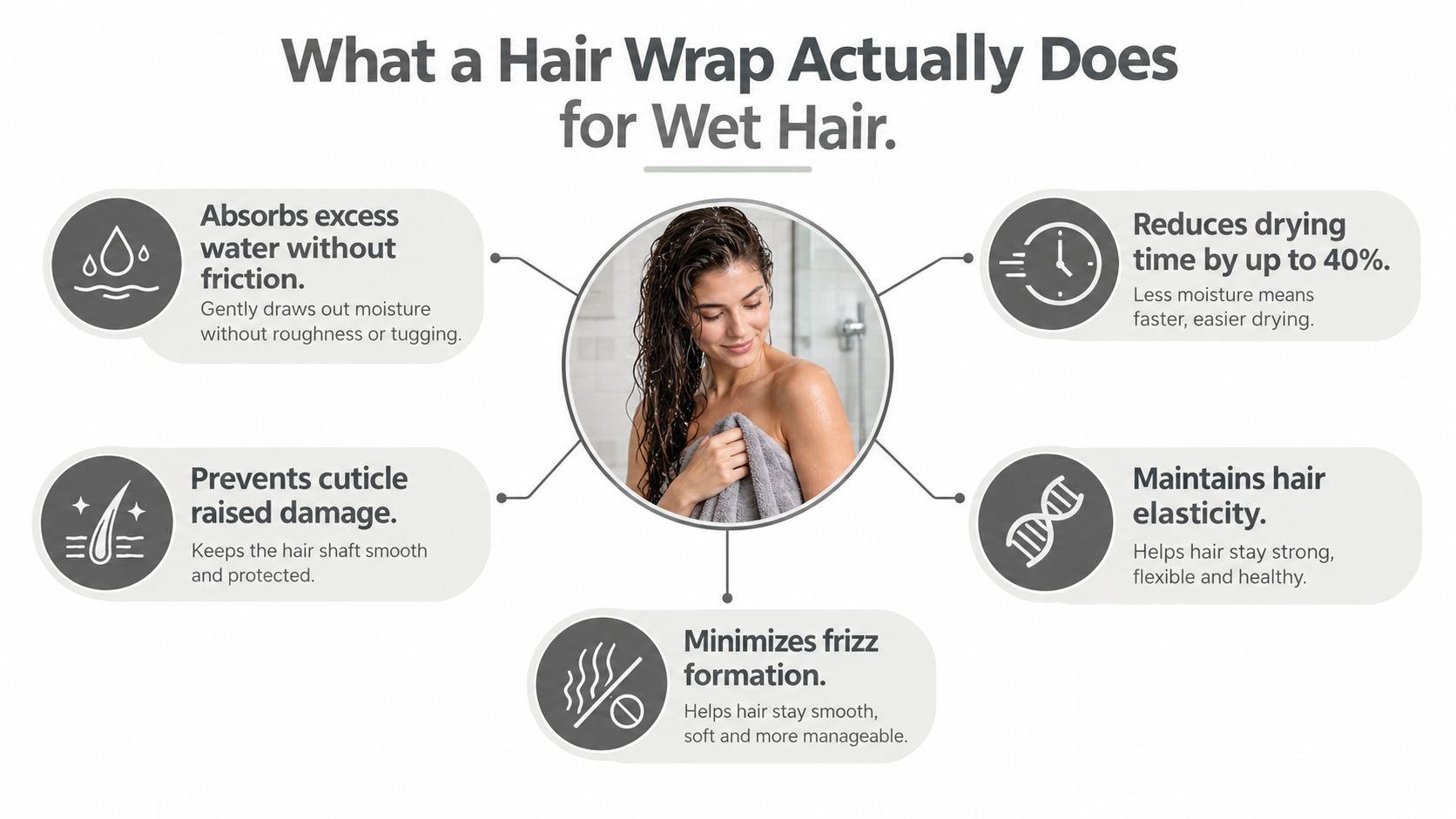
A good wrap performs three jobs at once. It absorbs surface water, keeps the lengths contained, and reduces the need to rub or repeatedly squeeze the hair while it dries. That matters because wet hair is easier to stretch, tangle, and roughen than dry hair.
The fabric draws water away through contact with the hair shaft. A loose shape also supports the lengths instead of letting them hang heavily against the neck or shoulders. For waves and curls, that containment can help the pattern settle without constant touching. For straight hair, it creates a calmer drying period with less towel friction across the cuticle.
A wrap can also reduce the amount of heat needed later. One hair-drying guide reports that switching from a standard cotton towel to a microfiber hair towel may reduce drying time by 30% to 40%. That figure applies to the guide's comparison, not every towel or hair type, but it explains why fabric choice influences the whole routine, not just the first few minutes. (hair-drying guidance on towel efficiency)
The wrap should remove water, not create pressure
The most useful distinction is between absorption and compression. A wrap should sit securely enough to stay in place, but it shouldn't squeeze the scalp or pull the hairline backward. Tight twisting creates tension at the roots, while rough fabric creates movement against the cuticle.
That's why a short, loose wrap often works better than a heavy towel left on the head until the hair feels almost dry. The wrap removes the water that makes hair difficult to handle, then you finish with air-drying, diffusing, or controlled blow-drying.
Practical rule: If removing the wrap leaves a tender hairline, flattened roots, or sharply dented curls, the wrap is doing too much mechanically.
The sections that follow focus on what wet fibers can tolerate, how to position the wrap, and why one fabric won't suit every texture. The useful question isn't “Which towel is universally best?” It's “How much water, friction, and tension does this hair need right now?”
Why Wet Hair Needs a Gentler Drying Method
Wet hair needs a lighter touch because water changes how the fiber behaves. The outside layer becomes more vulnerable to rough contact, and saturated strands can stretch under their own weight or under the force of a towel. Rubbing adds movement at exactly the moment when the surface is least forgiving.
A 2023 laboratory study on hair keratin compared drying methods after washing. Under its test conditions, wrapping in a 100% cotton towel for 7 minutes produced 17% mechanical wear resistance, while a microfiber towel made from 80% polyester and 20% nylon produced 45% resistance. Blow-drying scored 10% under the same conditions. The researchers concluded that drying method plays a significant role in preserving hair-fiber integrity after repeated shampooing. (2023 hair-keratin drying study)
Those results don't mean every person will experience the same outcome, and they don't make air-drying or towel-wrapping automatically harmless. They do show why the first handling decision deserves attention. The wrap should reduce mechanical wear, not turn wet hair into a tightly wound bundle.
Three forces to control
Friction occurs when hair slides against the towel or against itself. Vigorous rubbing increases that contact, particularly around the crown, hairline, and ends.
Tension comes from lifting a wet mass of hair, twisting it at the nape, or fastening it too tightly. Long or thick hair places more weight on the attachment point, so a small twist can feel much stronger at the roots.
Prolonged dampness is a separate concern. A saturated wrap stops absorbing efficiently once its contact surface becomes wet, while the hair remains enclosed. The answer isn't always a longer wrap. Removing it once the hair is damp allows the strands to finish drying without continued compression.
| Property | Dry Hair | Wet Hair |
|---|---|---|
| Surface condition | More stable and less easily disturbed | More vulnerable to rough contact |
| Handling tolerance | Better able to withstand ordinary brushing and movement | Needs slower squeezing, pressing, and detangling |
| Weight | Lighter | Heavier because of retained water |
| Main drying risk | Heat and repeated friction | Rubbing, twisting, tension, and extended dampness |
| Useful wrap goal | Maintain shape and limit flyaways | Remove excess water without mechanical wear |
The best post-shower routine manages all three forces together. Fabric controls friction, placement controls tension, and timing controls how long the hair remains compressed and damp.
The Right Way to Wrap Hair After a Shower
Start before the towel touches your head. After the final rinse, let the water run off, then use both hands to squeeze the lengths gently from mid-shaft toward the ends. Don't wring the hair into a rope. Your goal is to remove standing water so the wrap absorbs moisture instead of carrying a fully saturated mass.
Place the towel against the scalp and press with open palms. Work around the crown and sides with slow compressive movements, especially if your hair is thick or curly. A back-and-forth scrub may feel efficient, but it creates friction without improving control.
Position the wrap around the head
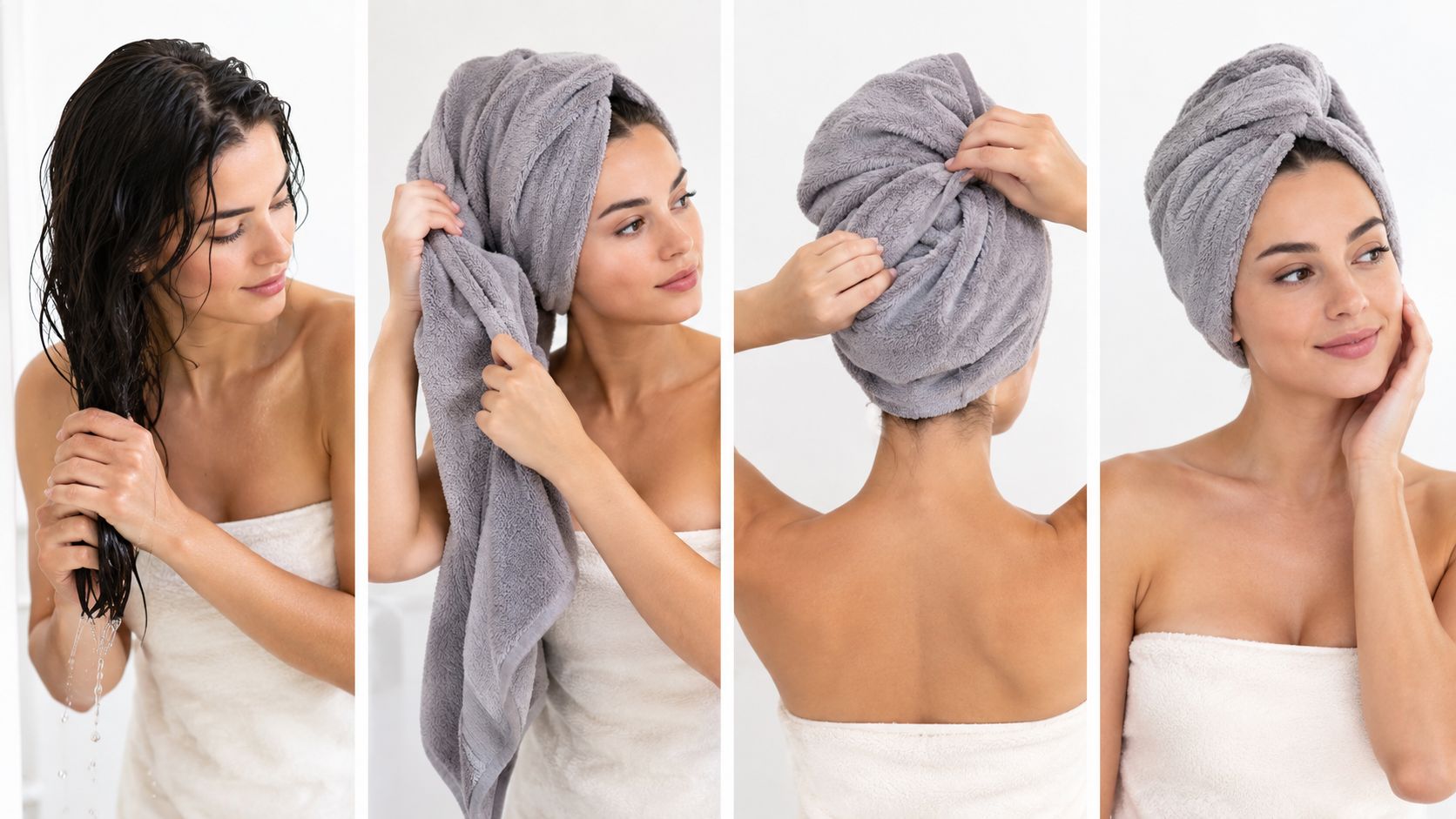
Lay the wrap flat behind your head, with the wider portion supporting the lengths and the label or fastening end near the nape. Bring the front edge toward the hairline without pushing the hair backward. The fabric should catch the hair rather than drag across it.
Gather the lengths into the wrap and guide them toward the front. If you need to twist, make a single loose turn from front to back, using the fabric to hold the hair rather than winding the hair tightly around itself. A loop-and-tuck closure should anchor the wrap without a hard knot.
The elastic or fastening point should rest near the forehead or front hairline, not on the crown. That placement spreads pressure and avoids pulling directly upward on the roots. If your hair is very long, divide the lengths inside the wrap so the weight doesn't hang from one narrow point.
Check the hair before and after securing it
Hair should feel damp rather than dripping when the wrap goes on. If water is still running down your neck, squeeze the lengths again before fastening. If the wrap feels heavy immediately, the hair is carrying more water than the fabric can comfortably manage.
Keep the tension snug enough to prevent slipping, but loose enough to slide one finger beneath the edge. A detailed hair turban tutorial can help you compare fastening and placement styles, but the mechanical principle remains simple: support the hair evenly and avoid a tight twist at the nape.
Remove the wrap when the hair is damp, then finish according to your texture. Apply curl product while curls still have enough moisture to clump, or use a heat protectant before diffusing or blow-drying. Don't brush aggressively just because the wrap has contained the hair. The strands are still wet and need the same measured handling.
Adapting the Wrap for Different Hair Types
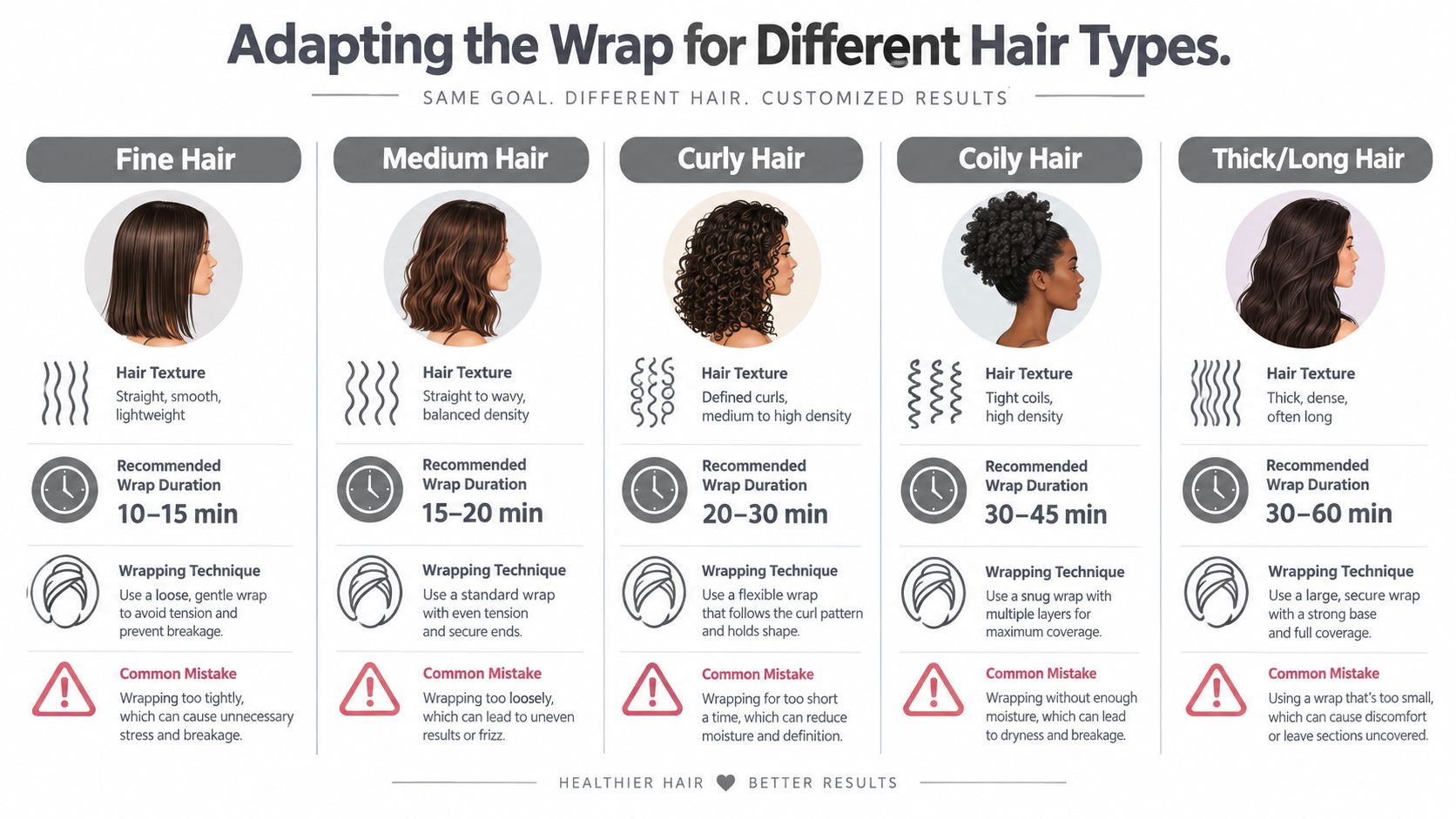
A universal duration doesn't exist because hair density, length, porosity, and pattern change how quickly moisture moves. The useful benchmark is whether the hair feels damp and supported, not whether a timer has reached a fixed number. Most wraps reach peak moisture absorption in 10 to 20 minutes, and leaving them on longer may not add drying benefit once the fabric is saturated. (hair-wrap timing guidance)
Fine and medium hair
Fine hair usually needs a lightweight wrap and careful root placement. Keep the crown supported without compressing it flat, and use less fabric around the ends so the water weight doesn't pull the hair downward. If the roots lose volume easily, position the wrap so it rests around the sides rather than pressing directly over the crown.
Medium-density straight or wavy hair can tolerate a more conventional loose turban. Check the lengths before fastening, because medium hair can still become a damp pile if the wrap gathers it too tightly. Remove the wrap when the surface feels damp and smooth, then let the hair finish drying with minimal touching.
Curly and coily hair
Curly hair often does better with a loose mid-shaft wrap that preserves curl groups. Avoid pulling the curls straight into the fastening loop. If you use styling product after washing, apply it before a plopping-style wrap so the fabric supports the pattern rather than rearranging it later.
Coily hair may need longer passive absorption because dense sections hold water internally, but a longer wrap isn't automatically better. Watch for a dry outer layer with wet roots or inner sections. If the wrap has stopped feeling absorbent, remove it, separate the sections gently, and let air circulate.
The key difference is shape preservation. Straight hair can usually be gathered with little pattern disruption, while curls and coils need room to remain grouped.
Thick or long hair
Long or dense hair can overload a small turban. Use a larger wrap, distribute the lengths across the fabric, and avoid making the entire mass hang from one twist. A gentle double-fold can spread the weight, but don't pin through wet hair if the pin catches or bends the strands.
For very long locs or hair that needs to dry overnight, a turban may be the wrong tool. A breathable bonnet or smooth pillowcase can reduce friction without suspending a heavy wet mass from the roots. That approach prioritizes freedom of movement and even drying over rapid absorption.
Choosing the Best Fabric for Your Wrap
Fabric changes the result through three practical variables: how quickly it absorbs, how much it drags across wet hair, and how it behaves after repeated washing. A thick cotton terry towel can feel plush, but its loops may create more surface movement than a smooth, lightweight wrap. Microfiber generally feels lighter and moves water efficiently, although some people dislike its synthetic feel.
Waffle weave sits between those options. Its texture creates absorbent channels without the bulk of heavy terry, and its lighter structure can feel more comfortable around the scalp. It may not hold as much water as a dense towel, so it works best when you squeeze out excess water first.
Silk or satin is usually better at limiting friction than absorbing a large amount of water. That makes it useful for preserving a finished style or protecting hair while resting, but it isn't the first choice when hair is dripping after a shower.
| Fabric | Absorbency | Friction vs. Wet Hair | Best For | Care Note |
|---|---|---|---|---|
| Cotton terry | High, especially when dense | Can feel rougher because of looped texture | Straight, sturdy hair and users who prefer a plush towel | Needs thorough drying between uses |
| Microfiber | Efficient surface-water removal | Usually smooth and lightweight | Fine, wavy, curly, and heat-conscious routines | Avoid products that coat the fibers |
| Waffle weave | Moderate to high, depending on weight | Textured but generally lighter than terry | Lightweight wrapping and warm-weather use | Preserve the weave with gentle washing |
| Silk or satin | Low for shower water | Very low friction | Style preservation, sleep, or a secondary cover | Keep separate from heavy wash-day moisture |
The practical trade-off is speed versus moisture control. Microfiber may remove water quickly, while a lighter waffle weave may leave more moisture for curl formation. Cotton can feel substantial and durable, but a rough or heavy version may encourage rubbing or flatten curls.
Material choice also depends on the product's construction. A wrap with smooth edges, stable stitching, and a fastening system that doesn't pull at the hairline can outperform a softer fabric with poor fit. For background on how wrap shapes and materials relate to everyday use, see this guide to hair turbans for women.
Common Wrap Mistakes That Cause Frizz and Breakage
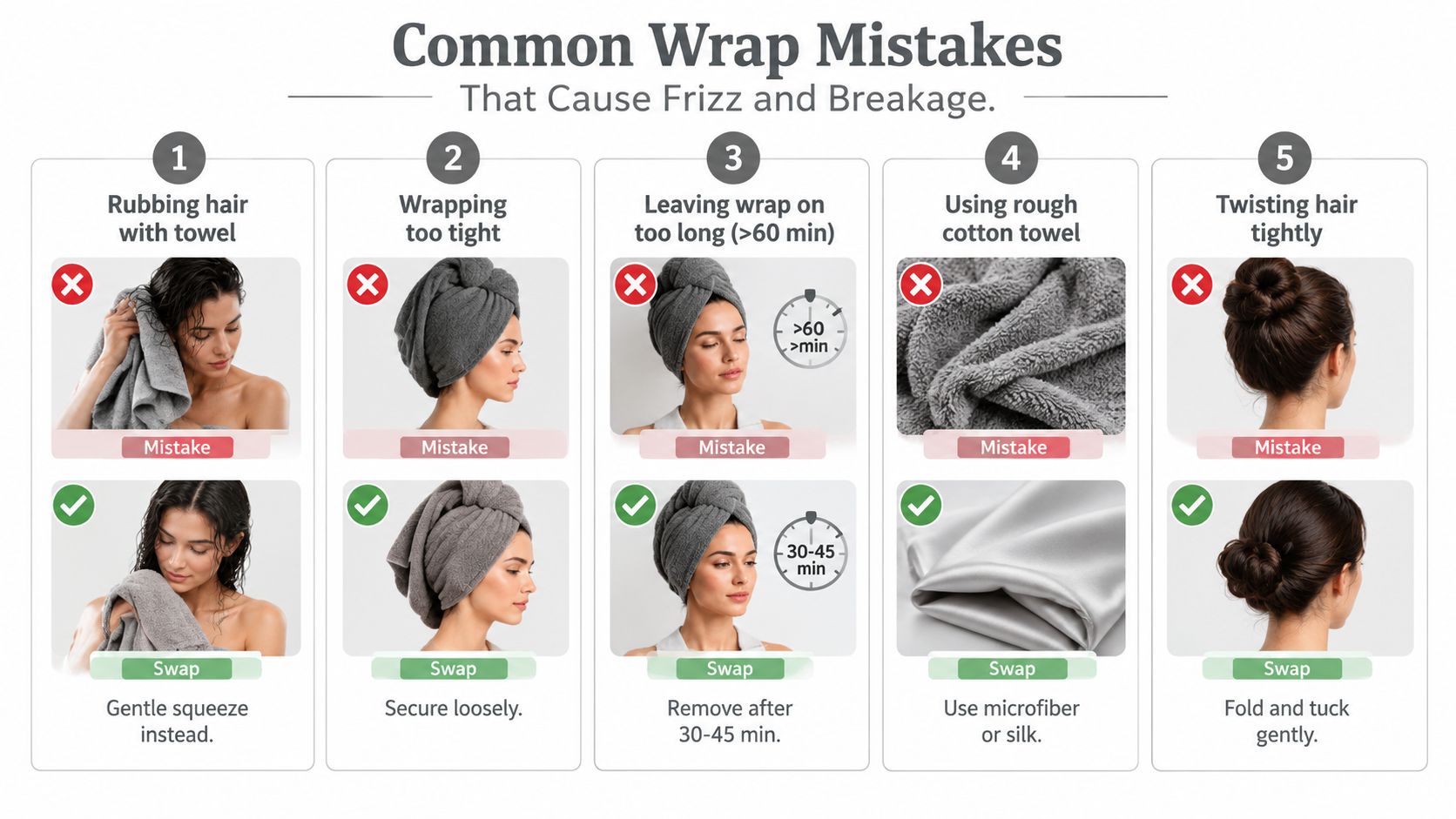
A wrap can reduce damage, but it can't compensate for rough handling underneath it. The most common mistake happens before fastening: rubbing the hair until it feels dry. That action creates friction across wet cuticles and can separate curl groups before they have a chance to settle.
Replace the rub with a squeeze and press. Use your hands to remove standing water, then let the fabric absorb what remains.
Small changes that protect the routine
- Twisting too tightly: A hard twist at the nape concentrates the weight of the hair at the roots. Make a loose turn and tuck the end instead.
- Wrapping while dripping: A fully saturated bundle can make the wrap heavy and slow to dry. Squeeze the lengths first.
- Leaving the wrap on too long: Once the fabric is saturated, extra time may leave curls compressed without improving absorption. Remove it when the hair is damp and finish drying openly.
- Using rough edges or elastic: Snagging seams and tight bands can catch fine strands and stress the hairline. Choose smooth edging and a closure that holds without pulling.
- Reusing a damp wrap: A wrap that hasn't dried fully can feel clammy and lose its absorbency. Hang it open after each use rather than leaving it folded in the bathroom.
A quick self-check catches problems early. Ask whether your roots feel tender, whether the hairline looks pulled backward, and whether the ends feel rougher after drying. If curls emerge stretched or frizzy, loosen the wrap and shorten the enclosed time before changing every product in the routine.
If frizz is also showing up after cleansing and styling, a resource on how to pick Japanese anti-frizz products can help you evaluate formulas separately from towel technique. Keep those decisions distinct. A product can't undo mechanical stress caused by a tight, abrasive wrap.
Caring for Your Hair Wrap and Finishing the Routine
A wrap works only as well as its condition. Wash it every 2 to 3 uses to limit buildup and keep the fabric able to absorb water. Use cool or warm water rather than hot water, choose a fragrance-free detergent, and skip fabric softener because it can coat fibers and reduce absorbency.
After washing, air-dry the wrap flat or hang it fully open. Don't leave it bunched on a hook or folded over itself while damp. Heat from a dryer can also stress elastic seams, so air-drying is the safer default for a wrap with a fastening loop.
A practical towel wash setting guide can help you build a care routine around the fabric you choose. Waffle weave, microfiber, and cotton don't respond identically to washing, so follow the care label rather than treating every wrap as interchangeable.
Remove it without disturbing the hair
Loosen the fastening at the forehead first. Let the twist relax, then lift the wrap away from the nape instead of pulling it forward over the hairline. If the fabric catches, stop and release the snag with your fingers. Don't yank the wrap free.
At this point, the hair should be damp, not soaking. Apply leave-in conditioner or curl product to the mid-lengths and ends if you're air-drying, use a heat protectant before diffusing, or distribute a light smoothing product before blow-drying. Fine hair usually needs less product, while thick or textured hair may need more slip through the ends.
SEYANTE offers towel wraps in lightweight waffle and Turkish cotton styles, so shoppers can choose between a lighter weave and a more substantial absorbent feel for their post-shower routine. Visit SEYANTE to explore those wraps and build a more comfortable, deliberate finish to wash day.