Kimono Dressing Gown Womens: Styles, Fabrics and Fit
What if the robe you love in a photo is wrong for the room you'll wear it in? Most shoppers choose a kimono dressing gown womens style by color, length, or how soft it looks, then discover it's too warm for bed, too light after a bath, or too long for making breakfast. The shape rarely causes the problem. The mismatch between fabric, climate, and routine does.
That shape has a long history behind it. A Tokyo National Museum exhibition record traces the kimono's recognizable design to kosode forms associated with the Muromachi period (1338 to 1573) and later, when the garment became common clothing during the Edo period (1603 to 1868). A Philadelphia Museum of Art exhibition page identifies the 1910s to 1940s as a dynamic period for women's kimono design, before Western clothing largely replaced kimono for everyday use by the 1940s. Today's dressing gown keeps the familiar wrap front and flowing cut, but it's now built for bathing, lounging, and quiet mornings. Choosing well starts with how you'll live in it.
Kimono Dressing Gown Womens Styles at a Glance
Start with one quick rule. If you mostly lounge at home, choose knee-length or mid-calf. If you want spa warmth after a bath, choose full-length terry. If you run warm, choose waffle or satin. That rule won't settle every detail, but it puts you in the right row before you're distracted by color or trim.
Every style below shares the same basic construction, a wrap front, loose sleeves, and a tie belt. You're not choosing between completely different garments. You're choosing length, weight, and fabric for a specific job. A short robe that feels perfect while you dry your hair can feel exposed in a cold kitchen. A floor-length robe that feels generous on a slow Sunday can trail, overheat you, and get in the way on stairs.
| Style | Typical length | Best for |
|---|---|---|
| Short kimono robe | Mid-thigh to knee | Quick dressing, kitchen trips, mornings |
| Knee-length kimono robe | Knee to mid-calf | Everyday lounging, layering over pyjamas |
| Full-length kimono robe | Ankle to floor | Spa days, cold bathrooms, maximum coverage |
| Lightweight waffle kimono | Mid-calf | Warm climates, post-shower wear, travel |
| Heavy terry kimono | Mid-calf to floor | Absorbency and plush warmth in cold homes |
| Satin or silk-look kimono | Knee to ankle | Hosting, warm sleepers, smooth feel |
Reading the table against your week
Say your robe goes on over pyjamas while you make tea, feed a pet, and answer the door. Coverage matters, but so does moving safely. Knee to mid-calf usually gives you enough overlap without fabric pooling around your feet. If your main use is stepping out of the shower in an unheated bathroom, length and absorbency matter more, so a heavier, longer robe makes sense.
If you travel often, weight and drying time move to the top of the list. A lightweight waffle style takes less room in a bag and won't stay damp as long as a dense terry robe. If you want something smooth for getting ready or welcoming guests, satin or a silk-look fabric gives you coverage without much insulation, although it won't dry you after bathing.
Practical rule: Name the coldest, wettest, and busiest moment when you'll wear the robe. Buy for the moment that asks the most of it.
Length also changes how the wrap behaves when you sit. Shorter robes need enough overlap to stay closed across your lap, while longer robes need a belt that stays tied without constant adjusting. If you're still deciding how open or closed you like to wear the front, a guide on how to wear a kimono robe can help you picture the styling options before you commit.
Don't treat "one size" as a promise that every length works on every height. A mid-calf robe on a tall wearer may sit at the knee, while the same robe can reach the ankle on a petite wearer. Find the row that matches your routine first, then check the actual length against your body.
How the Kimono Cut Fits Your Body
A kimono dressing gown has a T-shaped body, an overlapping front, loose sleeves, and a waist tie. It isn't cut like a coat, and that's the point. The front crosses over your body, the belt sets the closure, and the sleeves hang from a broad, relaxed shoulder line. When the proportions are right, you can reach, sit, and bend without the neckline pulling open.
The sleeve explains much of that freedom. A TextileTuts sleeve drafting guide describes a kimono sleeve as an integrated bodice-and-sleeve piece rather than a separate piece joined by a shoulder seam, distributing stress over a broader area and reducing seam pressure. Think of a loose cardigan that moves when you lift a mug to a high shelf. A fitted coat with a tight shoulder seam resists that same movement and pulls across your back.
| Fit point | Target | Why it matters |
|---|---|---|
| Underarm ease | About 5-10% of upper-arm circumference | Allows arm movement without drag or bulk |
| Sleeve length | Reaches the wrist bone with arms hanging | Keeps cuffs clear of cooking and tasks |
| Robe length | Mid-calf for everyday, ankle or floor for spa use | Balances coverage against heat and tripping |
| Wrap overlap | Front overlaps fully with belt closed | Stops gaping when sitting or reaching |
| Belt | Ties twice around the waist without slipping | Keeps the shape and prevents loss of the belt |
Run the five-part home test
Don't judge the robe while standing still in front of a mirror. Put it over what you'll normally wear underneath, tie the belt where it naturally sits, and move through ordinary actions.
- Raise both arms: You should be able to lift them overhead without the underarm binding or the hem riding up so far that the front opens. That same drafting guidance puts underarm ease at approximately 5 to 10% of upper-arm circumference, because too little restricts shoulder flexion and too much creates bulk and fabric drag.
- Let your arms hang: The sleeves should reach about your wrist bone. Much longer and the cuffs dip toward water, food, skincare, and stove tops. Much shorter and the robe may feel unfinished on cold mornings.
- Sit and cross your legs: The overlap should stay across your lap without you holding it shut. A robe can look modest standing up and still gape the moment you settle into a chair.
- Reach forward and bend: Pretend you're loading a washing machine or picking up shoes. The back shouldn't pull tight, and the belt shouldn't slide into an uncomfortable position.
- Cross your arms: This checks room across your shoulders and upper back. If the robe strains here, sizing only by waist or hip won't solve the problem.
Fit notes by body shape
If you're petite, knee-length or mid-calf usually keeps the hem clear of your feet and stops the sleeves from swallowing your hands. Check where the belt loops sit, too. Loops placed too low can drag the closure down and make the neckline gape.
If you're tall, confirm both ends of the garment. The hem may be long enough while the sleeves stop well above your wrists, or the sleeves may work while the wrap loses overlap when you sit. Measure a robe or loose coat you already like from shoulder to hem, then compare that number with the listing instead of trusting words like "long."
If you have a fuller figure, look for a wide overlap and a belt long enough to tie securely without digging in. The front panels should cross comfortably at your fullest point, not just meet at the edge. If you need to pull the panels firmly to close them while standing, they won't stay comfortable when you sit.
If your shoulders are broad, room across the back matters more than adding length. Don't buy a much larger robe just to gain shoulder space. Extra size can leave you with dragging sleeves, excess fabric under your arms, and a belt that has to gather too much material at your waist.
A good kimono fit feels unnoticed. You're not tugging the front closed, pushing cuffs up, or retying the belt every few minutes.
Pay attention to where you tie the belt. At your natural waist, it usually holds the crossover neatly. Lower on your hips, the top can loosen. Higher under your bust, it may feel secure for some bodies and restrictive for others. There's no single correct placement, but the robe should stay closed in the position that feels natural to you.
Waffle, Terry and Beyond
Fabric changes how a robe feels more than its shape does. In plain terms, some fabrics hold a lot of water and dry slowly, while others spread moisture across the surface so it can evaporate and help you cool down. A textile moisture transport review in PMC explains that cotton can absorb substantial water, but absorption alone does not guarantee rapid drying because capillary transport may be limited. That's why the fibre label by itself doesn't tell you enough.
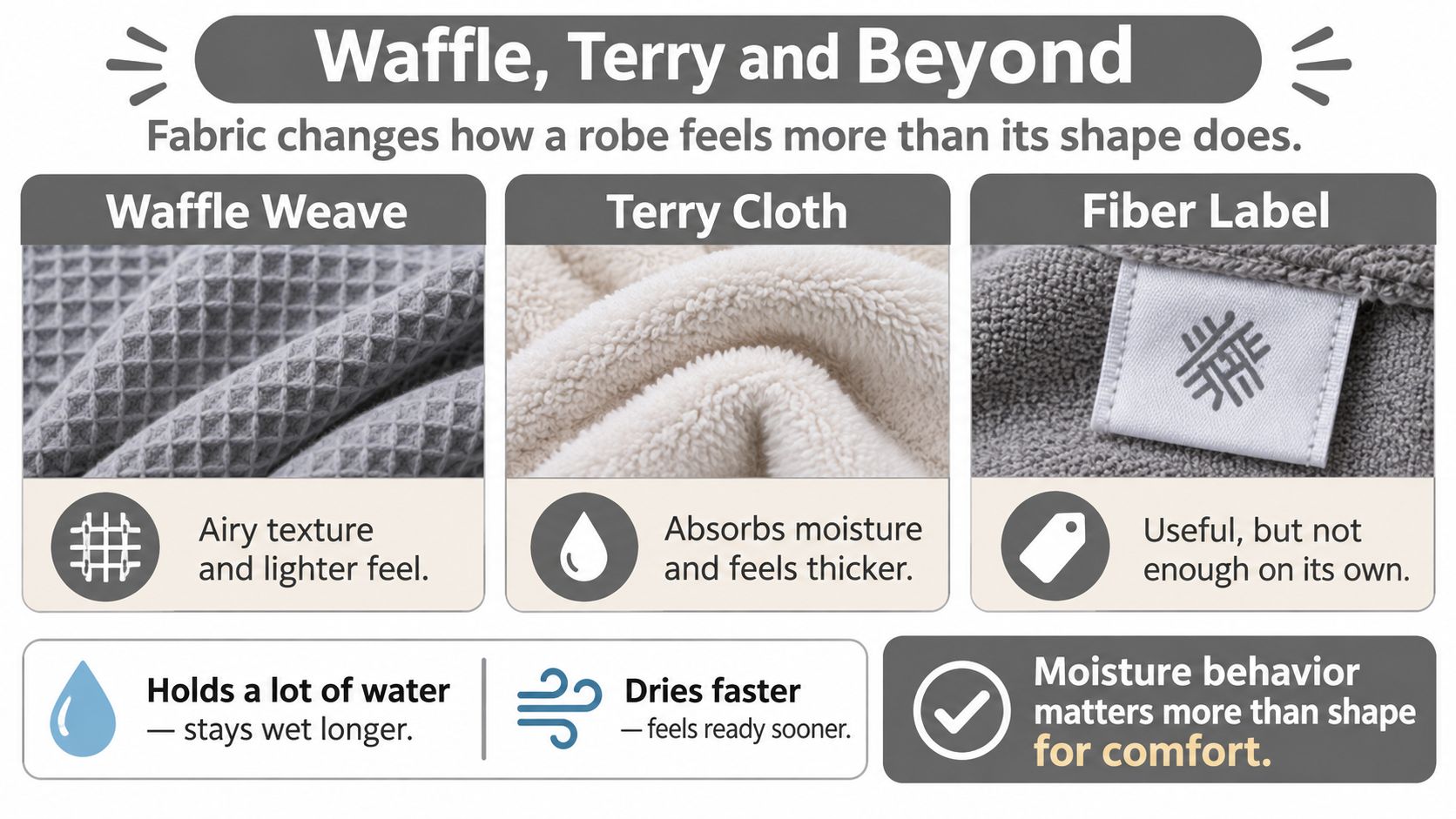
Waffle cotton has a raised grid texture that creates small air pockets. It feels light against your skin, layers comfortably after a shower, and usually dries faster than a dense robe of similar size. Terry cloth uses loops to increase surface area, so it can take up more water and feel plush and insulating. That same density means it can feel heavy and stay damp longer in a humid bathroom.
| Fabric | Typical weight | Absorbency | Drying speed | Best for |
|---|---|---|---|---|
| Waffle cotton | Light | Moderate | Fast | Warm climates, layering after a shower |
| Terry cloth | Medium to heavy | High | Slow | Absorbency and plush warmth in cold homes |
| Flannel-style cotton | Medium | Moderate | Moderate | Cool evenings and winter lounging |
| Microfiber | Light | High | Fast | Travel and easy washing |
| Silk or satin | Light | Low | Fast | Hosting and warm sleepers who want a smooth feel |
How to compare two listings
Read past the headline fibre and compare four details, fabric weight, loop or weave structure, finishing treatments, and care instructions. Two cotton robes can behave very differently if one is a light waffle and the other is dense terry. A detailed comparison of waffle and terry cloth robes for daily use is useful when you're torn between drying speed and absorbency.
- Warm bedroom: Choose waffle, microfiber, or satin if you want coverage without trapping much heat.
- Cold bathroom: Choose terry if you step out wet and want the robe itself to help dry you.
- Shared travel bag: Choose a light, fast-drying weave that won't take over the suitcase.
- Cool evenings on the sofa: Consider flannel-style cotton when you want warmth but don't need bath-level absorbency.
Where environmental standards matter to you, check whether an organic claim is backed by GOTS certification, meaning Global Organic Textile Standard. Our bathrobes are made with GOTS certification. As one concrete example, the Women's Lavender Blue Lightweight Kimono Waffle Spa Robe is crafted from 100% GOTS-certified organic Turkish cotton and is described as lightweight and breathable for everyday use.
Silk or satin needs a separate expectation. It glides over pyjamas and feels cool at first touch, but it absorbs little water. It's a dressing and lounging fabric, not a towel substitute. Microfiber sits at the practical end, light and quick to dry, though its hand feel is different from cotton and some wearers find it less breathable when they're already warm.
Matching Your Robe to Climate, Sleep and Routine
The fabric that feels most comfortable when you first put it on isn't always the one you'll judge best hours later. A pilot study of peri- and postmenopausal women in PMC found that cotton was rated more comfortable before sleep, whereas wool improved reported morning contentedness, while measured sleep differences were not statistically significant. That doesn't crown a winning robe fabric. It shows why you should judge comfort across the full routine, not by a ten-second touch test.
Clothing insulation also shapes the sleep microclimate, the warm layer of air around your body. If a robe is part of your wind-down routine, a heavy style may feel soothing on a cold sofa and then leave you overheated when you get into bed. A lighter robe may feel almost too slight in a chilly hallway but work better while you read, stretch, or prepare for sleep. If sleep itself is the bigger struggle, it helps to build a consistent sleep schedule alongside adjusting layers, light, and room temperature.
Match the robe to the situation
- Humid climate or warm sleeper: Pick a lightweight waffle kimono with sleeves you can push up or keep clear of your wrists.
- Cold home or post-bath use: Pick terry in mid-calf or full length, especially if the bathroom stays cold after a shower.
- Cooking and cleaning: Pick knee-length with a secure wrap and cuffs that won't trail through water or food.
- Spa-style day at home: Pick a longer, heavier robe when you'll mostly sit, soak, and move slowly.
- Hot flushes or shifting temperature: Pick a lighter weave and an adjustable wrap you can open at the front without taking the robe off.
Spa comfort is not everyday practicality
Spa use rewards weight, length, and absorbency. You're wet, you're staying in one place, and a substantial robe is part of the experience. Everyday use rewards different things, freedom of movement, quick drying, and easy washing. A robe that feels luxurious for an hour after a bath can become annoying if you wear it while making lunch every day.
Belt placement is part of temperature control. Tie it firmly and you trap more warm air. Loosen it or open the crossover and heat escapes. Layering works the same way. A light robe over warm pyjamas can feel warmer than a medium robe over bare skin, so don't judge thickness alone.
Think in routines rather than seasons. Say your bedroom is warm but your bathroom is cold. A medium or heavy robe may be right for the first ten minutes after bathing, while a lighter layer would suit the rest of the evening. If you can only buy one, choose for the longer part of the routine and use a towel first to remove most of the water.
Caring for a Kimono Robe So It Lasts
Care belongs in the buying decision because a robe you won't wash correctly won't stay comfortable for long. Start with the routine below, then adjust frequency based on what touches your skin. A robe worn over pyjamas collects less body oil and can often go several wears between washes. A robe worn against bare skin after bathing picks up moisture, skincare, and oils sooner.
| Care step | Recommended | Why |
|---|---|---|
| Wash frequency | Every few wears, sooner if worn against bare skin after bathing | Body oils and moisture build up in the fabric |
| Wash temperature | 30°C or below on a gentle cycle | Reduces wear, shrinkage and laundry emissions (indicative figures) |
| Detergent | Mild, free of harsh chemicals, no bleach or fabric softener | Protects fibres and absorbency |
| Drying | Air dry or tumble on the lowest heat setting | Limits shrinkage and fibre damage |
| Storage | Fully dry, hung on a sturdy hanger | Prevents odour and shoulder distortion |
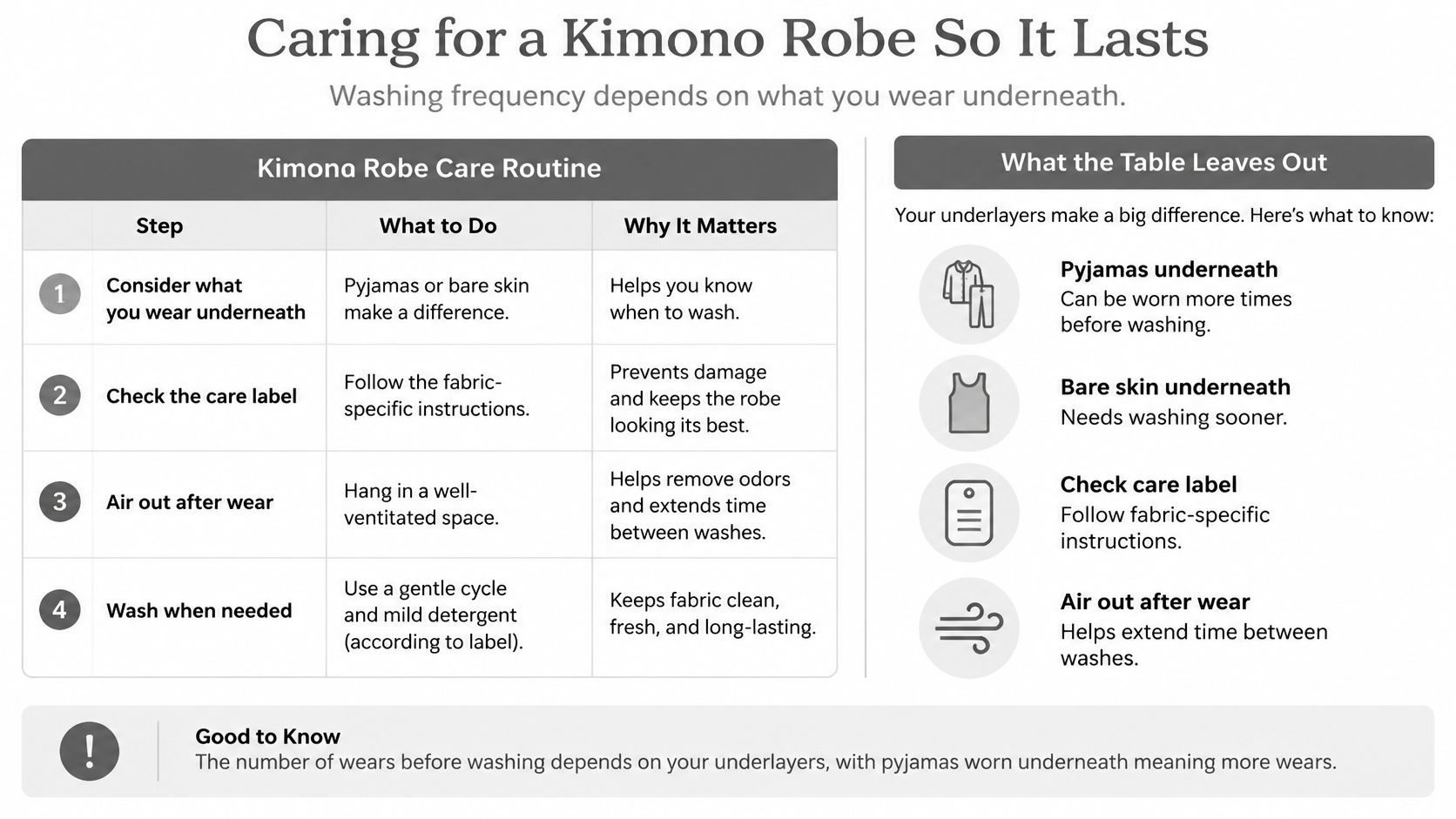
Hang the robe where air can move around it after each wear. Airing lets moisture leave the fabric and helps prevent the stale smell that develops when a damp robe is folded or left on a bathroom floor. We recommend washing our robes on a gentle cycle with cold water and a mild detergent free of harsh chemicals, bleach or fabric softeners, then air-drying or tumble-drying on the lowest heat setting. Hang them on a sturdy hanger and make sure they're fully dry before storing.
A Horn et al. sustainability paper reports that extending a garment's life by nine months can reduce its carbon, water, and waste footprints by 20%, and cites a 2025 source reporting that washing at 30°C or below can increase clothing longevity by 50% and reduce laundry emissions by 25%. Treat those figures as indicative rather than universal, since results vary by textile and washing system. The practical lesson is simpler, frequent hot washing wears fabric out faster.
Common problems and direct fixes
- Shrinkage: Keep heat low in both washing and drying, and remove the robe while it's just dry.
- Pilling and rough loops: Wash inside out, avoid overloading the drum, and keep rougher garments out of the same load.
- Lost belt: Remove it before washing and place it in a mesh bag, or knot it loosely to a belt loop.
- Fading and residue: Use mild detergent in the amount directed, skip bleach, and skip fabric softener so absorbency isn't coated.
If fragrance or dye is a concern for your skin or household, a guide to choosing detergent without dyes or fragrances can help you compare labels. For robe-specific storage details, see our guidance on how to wash, store, and care for your robe. Set one household rule, such as airing after every wear and washing after a set number of uses, and stick to it.
Confirm Your Style, Fabric and Fit Before You Buy
Before you buy, answer three questions in order. Where and when will I wear it? What temperature will the room be? How does this cut fit my body? If you can't answer the first two, the size chart won't rescue the decision.
Use the style comparison to settle length. Short and knee-length robes suit active mornings, mid-calf suits most everyday lounging, and ankle or floor length suits cold rooms and slower spa routines. Then use the fabric comparison to settle weight. Waffle favors warmth-prone wearers and faster drying, terry favors absorbency and insulation, flannel-style cotton suits cool evenings, microfiber suits travel, and satin suits smooth, light coverage.
Run the final check
- Sleeves: They reach near your wrist bone and let you raise both arms without pulling.
- Wrap: The panels overlap fully when you sit, reach, and bend.
- Belt: It ties securely twice, stays where you place it, and doesn't dig in.
- Length: The hem clears your feet on stairs and doesn't pool when the belt is tied.
- Care label: The washing and drying method fits the laundry routine you'll follow.
Price makes more sense when you divide it by expected wears. A robe used every morning can justify a higher purchase price more easily than one kept for occasional guests or rare spa days. That doesn't mean the most expensive robe is the right one. It means durability, comfortable fit, and care you can maintain are part of the value.
Write down three words before you shop, your length, your fabric weight, and your main use. Compare every listing against those words first.
Now choose two candidate robes and score them against the final check. Reject any robe that fails the wrap test, no matter how attractive the fabric looks. Pick the one that fits your coldest room, your usual underlayer, and your laundry habits, then stop second-guessing the rows you didn't choose. They're built for a different week.
Find your length, fabric weight, and fit first, then compare the kimono robe options at SEYANTE, where waffle and terry styles are made for everything from warm post-shower mornings to cold, slow evenings. Choose the robe that matches your room, your routine, and the care you'll give it, and make that first wear the start of a habit you'll keep.