Maternity Robes and Gowns: Fabric, Fit and Nursing Guide
The most repeated piece of maternity robe advice is also the least useful: buy one size up, and wear the same robe from your third trimester through the fourth. That single garment is supposed to survive a belly at its largest, a hospital bed, an incision or a tear, night feeds at 3 a.m., and a body that changes shape again in the weeks after birth. One cut rarely handles all five well.
Robes fail in specific, predictable ways. The belt lands on a tender abdomen. The sleeves bunch at the wrist during skin-to-skin contact. A heavy plush fabric that felt wonderful in a cool hospital room turns unbearable during a July night feed. None of that shows up in a product photo, and none of it is fixed by going up a size.
What follows is a buyer's framework for maternity robes and gowns: which style suits which stage, how the three common fabrics behave, how to read a size chart against your body instead of your due date, and what a nursing opening has to do to be worth paying for.
Which Maternity Robe or Gown Fits Your Need
Start with the situation, not the fabric. Buyers shop for five different jobs under one search term, and the style that handles each job is rarely the same garment.
| Style | Best for | Nursing access | Fit needed |
|---|---|---|---|
| Kimono wrap robe with waist tie | Hospital stay and postpartum recovery | Wide front opening | Adjustable waist that wraps over a changing body |
| Hooded terry robe | Late pregnancy and home lounging | Open front, limited nursing access | Generous length and room over the belly |
| Lightweight waffle robe | Night feeds and warm rooms | Open front | Light, breathable, fits over a loose layer |
| Maternity gown or nightgown | Sleep and hospital delivery | Front-opening nursing panel | Stretch and adjustable waist |
| Gift robe for a mom-to-be | Baby shower or hospital gift | Front opening, confirmed before gifting | Size for the due date, not the current size |
The split that decides it
A robe opens completely and wraps over the body, so you set the waist tension and the front coverage every time you put it on. A gown is pulled on and worn closed, with a nursing panel built into the chest. That structural difference explains most fit complaints: a wrap follows a body that changes weekly, while a pull-on gown only fits the body it was cut for.
The evidence supports the wrap. A 2022 study of 82 maternity patients at Thammasat University Hospital in Thailand tested redesigned delivery gowns and found the highest overall satisfaction score, a mean of 4.25, went to a kimono-style robe with a waist tie, chosen because it was easy to put on, comfortable and practical for breastfeeding. Notice what got scored: comfort, adjustability, nursing access and dressing effort, not fabric softness or styling.
Three questions before you spend
- How soon will you need nursing access? If the robe is going into the hospital bag, a real front opening is essential. If it's for lounging in the last weeks, an open front that falls away when you sit down is enough.
- How warm is the room? A cool hospital and a warm bedroom ask for different fabrics, and you'll spend more nights in the second one.
- Will you still wear it after birth? The most expensive mistake is a robe that only makes sense over a 38-week bump.
Answer those three and your shortlist is usually two styles, not fifteen. The gift row deserves its own warning: a baby-shower robe is the hardest item to buy well, because you're guessing at a size for a body that doesn't exist yet.
Terry, Waffle and Organic Cotton Compared
Fabric decides whether a robe gets worn or stays folded at the bottom of the hospital bag. The three fabrics most maternity robes are sold in behave nothing alike under a sleeping baby, in a hot bedroom, or straight out of the shower.
The comparison below sets them against the criteria that matter most in a hospital room and at 3 a.m.
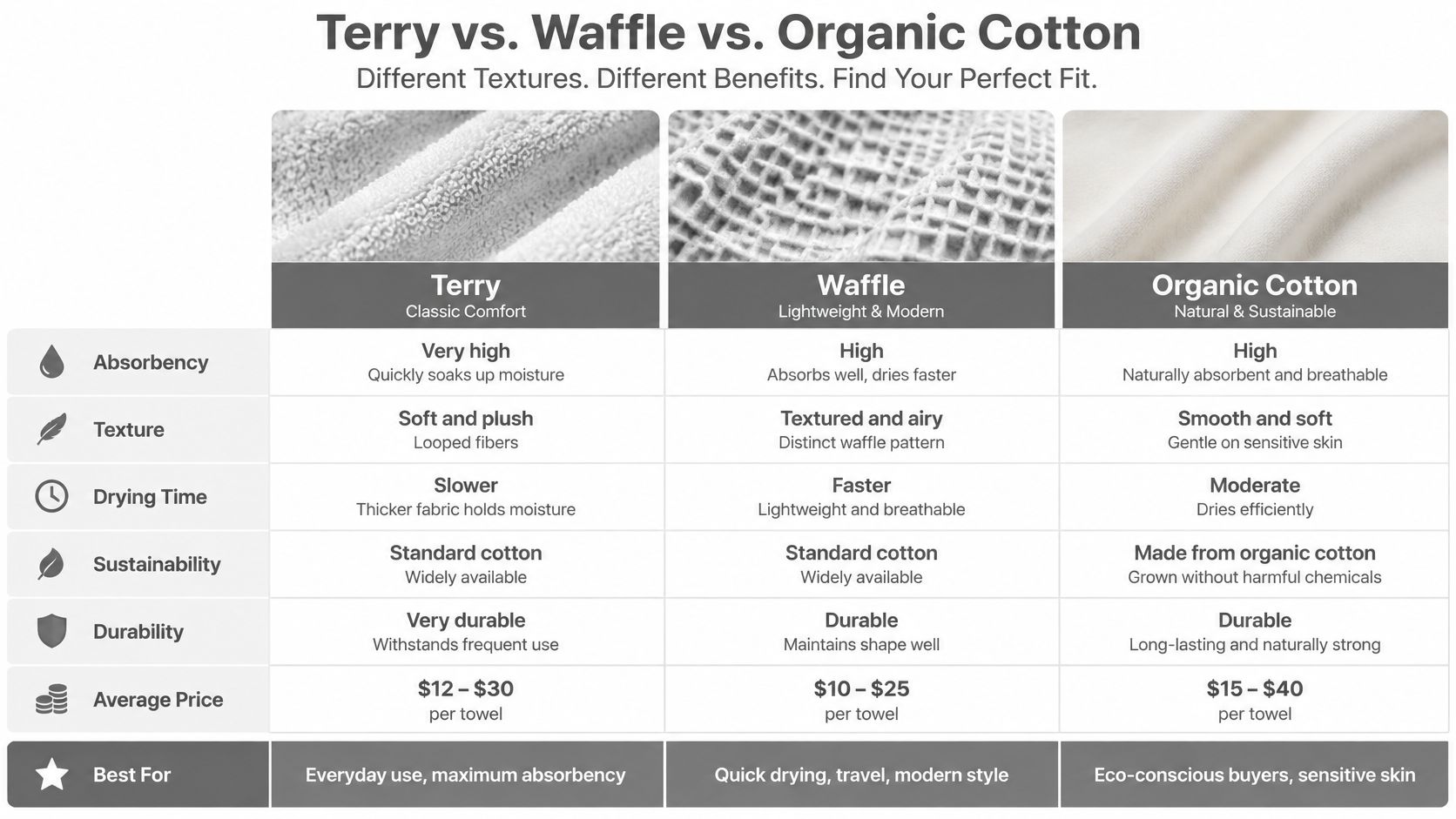
| Fabric | Weight | Absorbency | Warmth | Best for |
|---|---|---|---|---|
| Terry cloth | Heavy | Highest | Warm | Cool hospital rooms and post-shower wear |
| Waffle cotton | Light | Medium | Cool to mild | Warm climates and postpartum overheating |
| Organic cotton (GOTS) | Light to medium | Medium | Mild | Buyers who want certified, low-chemical textiles |
Terry cloth, warm and heavy
Terry is a looped weave, and those loops do two things at once: they hold water and they trap heat. It has the highest absorbency and the heaviest hand of the three, which makes it the right choice for stepping out of a shower in a cold hospital room or for anyone who feels the cold badly after blood loss. The trade-off is bulk. Loop pile takes longer to dry, occupies real space in a bag, and holds warmth against the body, so a night feed in an already-warm bedroom usually ends with the robe pushed off. If you run hot, terry is the fabric you'll regret.
Waffle cotton, light and breathable
The grid structure of waffle traps air rather than water. It's light, it dries quickly, it packs into a fraction of the space terry needs, and it stays comfortable when your temperature swings in the first weeks after birth. For hot climates, summer due dates and anyone who overheats at night, it wins outright. It gives up warmth if you're cold, which is why waffle works best as a layer over a nursing tank or pyjama set rather than as the only thing you wear.
Organic cotton, judged by certification
The word organic on a label means almost nothing on its own. What counts is certification: GOTS, the Global Organic Textile Standard, covers both how the cotton is grown and how the finished textile is processed, including restrictions on the chemicals used along the way. If you're choosing organic because of sensitive skin or chemical exposure, ask for the certificate by name rather than accepting a front-label claim. Texture is secondary here. This is the fabric you pick when the standard matters more than the hand-feel.
What a blend adds
A small percentage of stretch fibre in a waffle or cotton robe buys you elasticity across the trimesters without changing how the fabric looks or washes. Pure cotton wrap robes adjust through the tie instead. Either approach works. What doesn't work is a rigid, unyielding weave with no stretch and a narrow belt, because that combination has only one fit setting.
Practical rule: choose terry for stillness and warmth, waffle for movement and heat, and certified organic cotton when the certification matters more than the texture.
Sizing Through Pregnancy and Postpartum Weeks
One size does not cover late pregnancy, a hospital stay and the postpartum weeks, and the market has started to admit it. 2025 market research on the maternity clothing market describes growing demand for transitional designs usable before, during and after pregnancy, built with hidden nursing features, stretch panels and recovery-oriented construction. The same research also flags a weaker evidence base than shoppers assume, citing a systematic review of postpartum recovery garments that found limited integration between ergonomic analysis and user experience, and noted that many existing studies measure garments over too short a period to guide a real purchase. That gap is exactly why a stage framework beats a size promise.
The body a robe has to fit changes faster than any size chart can track.
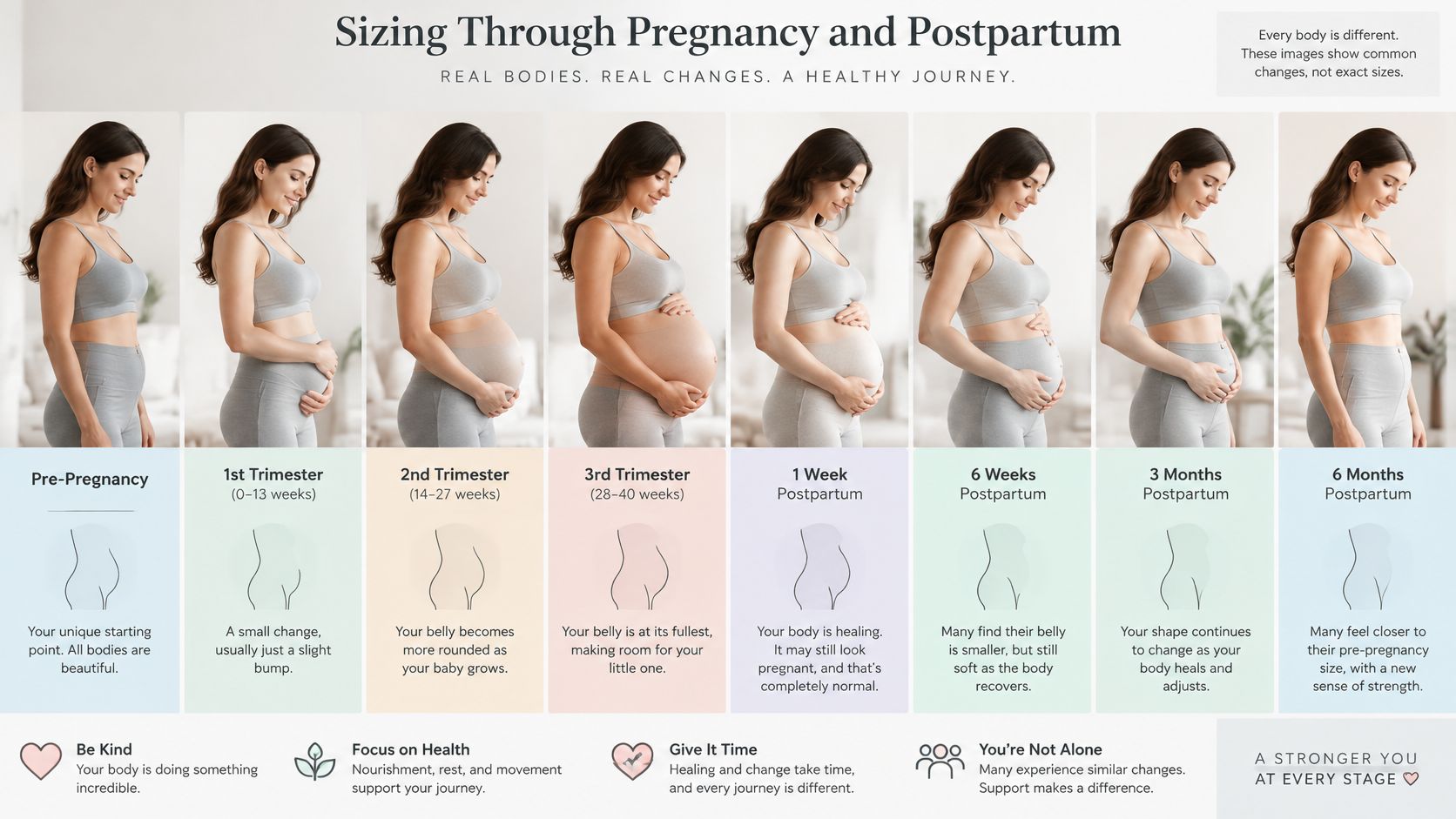
A robe can be generously cut and still fail after birth, because the problem usually isn't width. It's where the pressure lands and how the garment opens.
Where a late-pregnancy robe fails after birth
A deep wrap with a soft, wide tie spreads tension across the back and hips. A narrow belt with a buckle concentrates it at the waist, which after a caesarean is the last place you want hardware pressing. The first two postpartum weeks also demand sleeve clearance: a roomy three-quarter sleeve or one you can push up lets you feed and hold your baby skin to skin without undressing. Later nursing asks for length and a front that still opens after months of washing, when the fabric has relaxed and the ties have stretched. A robe sized only for the third trimester often passes the first test and fails the other two.
| Stage | Fit priority | Check before buying | Common mistake |
|---|---|---|---|
| Third trimester | Room over the belly | Hem reaches the ankle without pulling | Buying a size that tightens at the waist |
| Hospital stay | Easy donning and belt placement | Belt sits away from the abdomen | Choosing a stiff belt that presses on the incision |
| First two postpartum weeks | Soft waist and sleeves | Sleeves allow skin-to-skin contact | Buying for pre-birth size only |
| Later nursing | Front opening and length | Opening exposes the chest but stays modest | Keeping a robe that no longer opens easily |
Measure the body you have, not the due date
Size charts are built on bust, waist and hip measurements, not gestational weeks, so no chart can tell you which size to buy for a date six weeks out. Measure your bust and hip today, add the room you want over the belly, and pick the length for the stage you'll wear the robe most. Ankle length photographs beautifully and drags on hospital floors. Knee length is easier through recovery. Our guide to reading a robe size chart covers where to measure and how much ease to add.
Distributed adjustability is what lets one garment work across stages. A user-centred maternity gown project from Washington State University, drawing on 23 birthing institutions, 25 retailers and a survey of 501 women, produced a two-piece stretchy construction with an adjustable waist and a washable nursing breast-pad insert system. Participants reported better fit, mobility, access to closures, modesty and tactile comfort across labour and postpartum use. The lesson transfers to robes: an expandable waist handles changing abdominal volume, stretch supports movement without pressure, and a washable nursing layer keeps repeated use hygienic.
Front Openings and Nursing Access That Work
Nursing access is a fit requirement, not a design flourish. A 2024 study of postpartum women ranked breastfeeding access and comfort as the highest-priority features in maternity clothing, rated front-opening garments significantly easier to use than closed designs, and found that approximately 90% of participants wanted a chest opening, with about 80% preferring an opening of roughly 15 by 20 cm. Those are measured preferences from the people who wear the garment at 3 a.m.
Two specifications most designs miss
The same study names two requirements that decide whether an opening works in practice. The opening should expose the breast without unnecessarily exposing the lower limbs, and the level of exposure should be adjustable. In garment terms that means a generous nursing panel with a closure you can set, not a loose neckline you have to hold out of the way with one hand while managing a baby with the other.
The infographic below lays out how the common opening styles compare on access, modesty and effort.
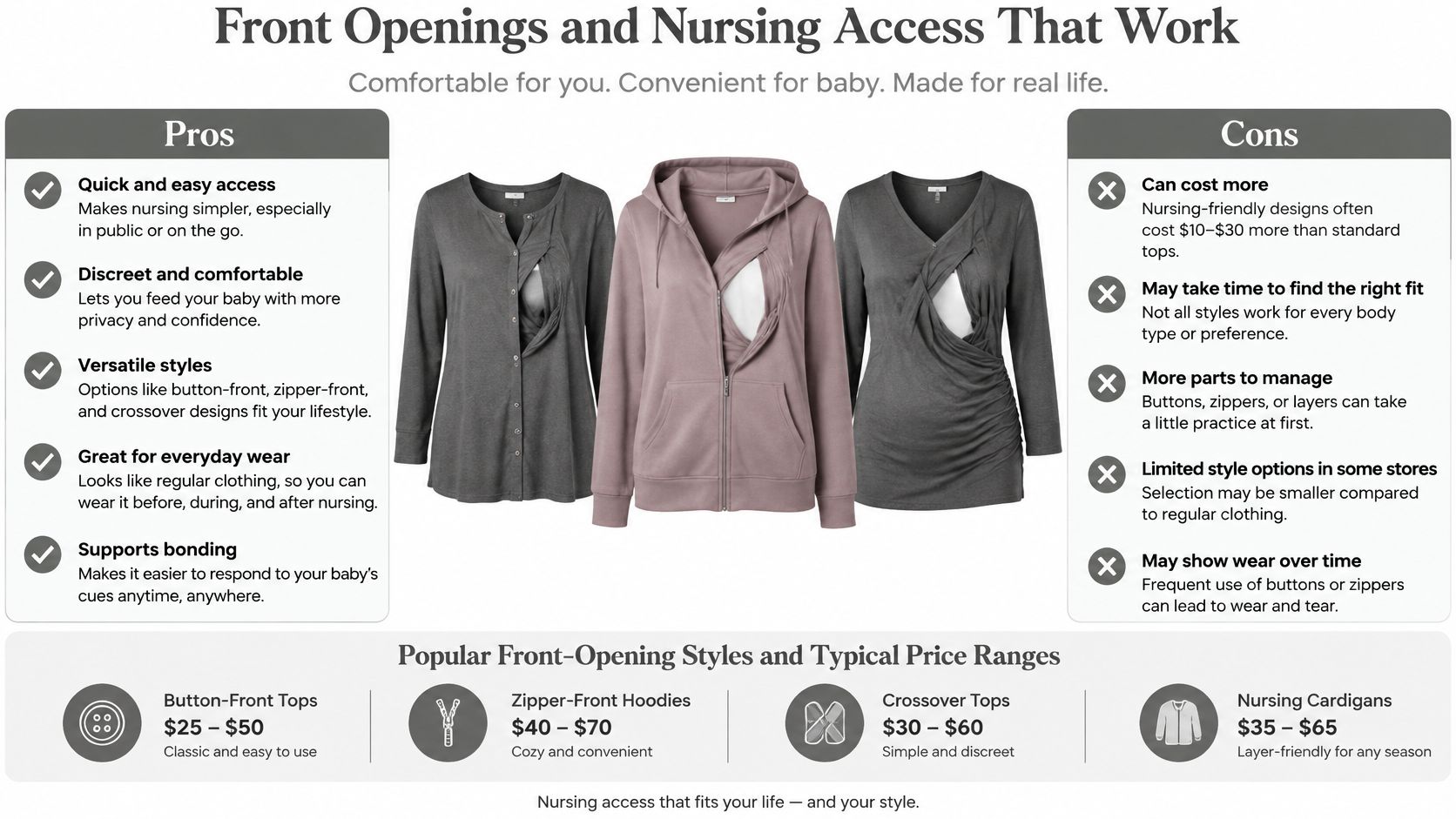
Full front, wrap closure and loose neckline compared
- Full front opening: the strongest option for hospital and the early weeks. You get a wide, adjustable gap and one-handed operation, and it stays useful as a cover-up for pumping later. It costs more to construct, so expect it on better-made robes.
- Wrap closure: good for fit and flattering in photos, but only if the crossing panel is deep enough to open across the chest rather than sitting decorative. A shallow wrap looks like nursing access and isn't.
- Loose neckline: the cheapest option and the weakest. It can work for a quick feed at home, and it fails the modesty requirement the moment you're in front of visitors or a midwife.
Test the opening before you buy
Lift one side. If you're in a store, do it in front of the mirror; if you're shopping online, look for a photo or clip showing the robe open. Then check three things: whether the opening measures up to a usable size across the chest, whether the closure holds securely when closed, and whether the fabric stays opaque when the front is open. Also look at the sleeves and any fixed interior pockets. A sleeve that grips the upper arm restricts skin-to-skin contact, and a stiff patch pocket sits exactly where a baby's legs go.
The first weeks involve swelling, stitches and soreness that make getting dressed a bigger task than it sounds, so it's worth reading about postpartum vaginal discomfort relief alongside your robe decision. If you're packing a hospital bag, our notes on maternity pajamas for hospital stays cover how a robe layers over them.
Design Choices That Separate Robes From Gowns
A robe and a gown can both suit pregnancy, but they solve different fit problems. A robe with a tie or soft internal band can adjust as the abdomen grows; a gown depends more on its cut and may fit well at one stage but feel restrictive later. For one garment to work through late pregnancy, a hospital stay and postpartum weeks, it needs room to adjust rather than rely on a fixed shape.
A historic example makes the distinction clear. The Victoria and Albert Museum's record of a maternity and nursing dress worn by Lady Eustace Cecil describes a garment with no waist seam, an internal buckle-fastened waistband, box pleats and shirring. Those details allowed shape without a rigid fit, while the front opening supported nursing.
Three principles from a nineteenth-century dress
- A waist that adjusts. A tie, buckle or soft internal band can accommodate a changing abdomen. A fixed pull-on shape offers less flexibility as pregnancy progresses.
- A body that moves with you. Look for room through the torso and shaping that does not press across the abdomen. A garment should follow the body rather than hold it in a fixed shape.
- A front that opens usefully. Check that the opening is functional and stays secure when closed. A decorative overlap may add style without offering practical access.
Judge any product page by those three details, then consider how its cut will work at each stage.
Caring for Terry, Waffle and Cotton Robes
A maternity robe gets washed more in eight weeks than most robes get washed in a year. One routine, applied every time, keeps terry looped, waffle square and cotton soft.
- Turn it inside out. The outer face stops rubbing against zips and hooks in the drum, which is what causes pilling on looped terry.
- Wash on a gentle cycle in cold or warm water, up to 40°C. Heat is what shrinks cotton and sets protein stains, and gentle agitation protects the weave.
- Use a mild detergent with no bleach or fabric softener. Softener leaves a waxy film on terry loops that blocks absorbency, and bleach weakens the fibre over repeated washes.
- Dry on low heat or hang in shade. High heat tightens a waffle grid and shortens the garment; direct sun fades colour.
- Hang it on a sturdy hanger once it's fully dry. A damp robe folded into a cupboard smells musty within a day.
| Fabric | Wash | Dry | Avoid |
|---|---|---|---|
| Terry cloth | Warm gentle cycle, washed apart from lint-shedding items | Tumble on low heat or air dry | Bleach and fabric softener |
| Waffle cotton | Cold, gentle cycle | Air dry or low heat | High heat, which shrinks the weave |
| Organic cotton (GOTS) | Cold, gentle cycle with a mild, fragrance-free detergent | Air dry | Harsh chemicals and fabric softener |
Loop pile needs different handling from a flat weave, and our guide to terry cloth robes covers drying and reviving the loop in more depth.
Two habits save a lot of grief. Rinse milk stains in cold water before the main wash, because heat sets the protein and turns a fresh mark into a permanent one. And rotate two robes during night-feed weeks, so there's always a dry one within reach when the other is in the machine.
Checkpoint: a robe that feels stiff or scratchy straight off the line usually carries detergent or softener residue. Run it through a second rinse with no detergent and it comes back soft.
Pick Your Robe Before Your Due Date
A robe chosen for late pregnancy may fit differently during a hospital stay or postpartum recovery. Use this checklist to make the choice with those stages in mind.
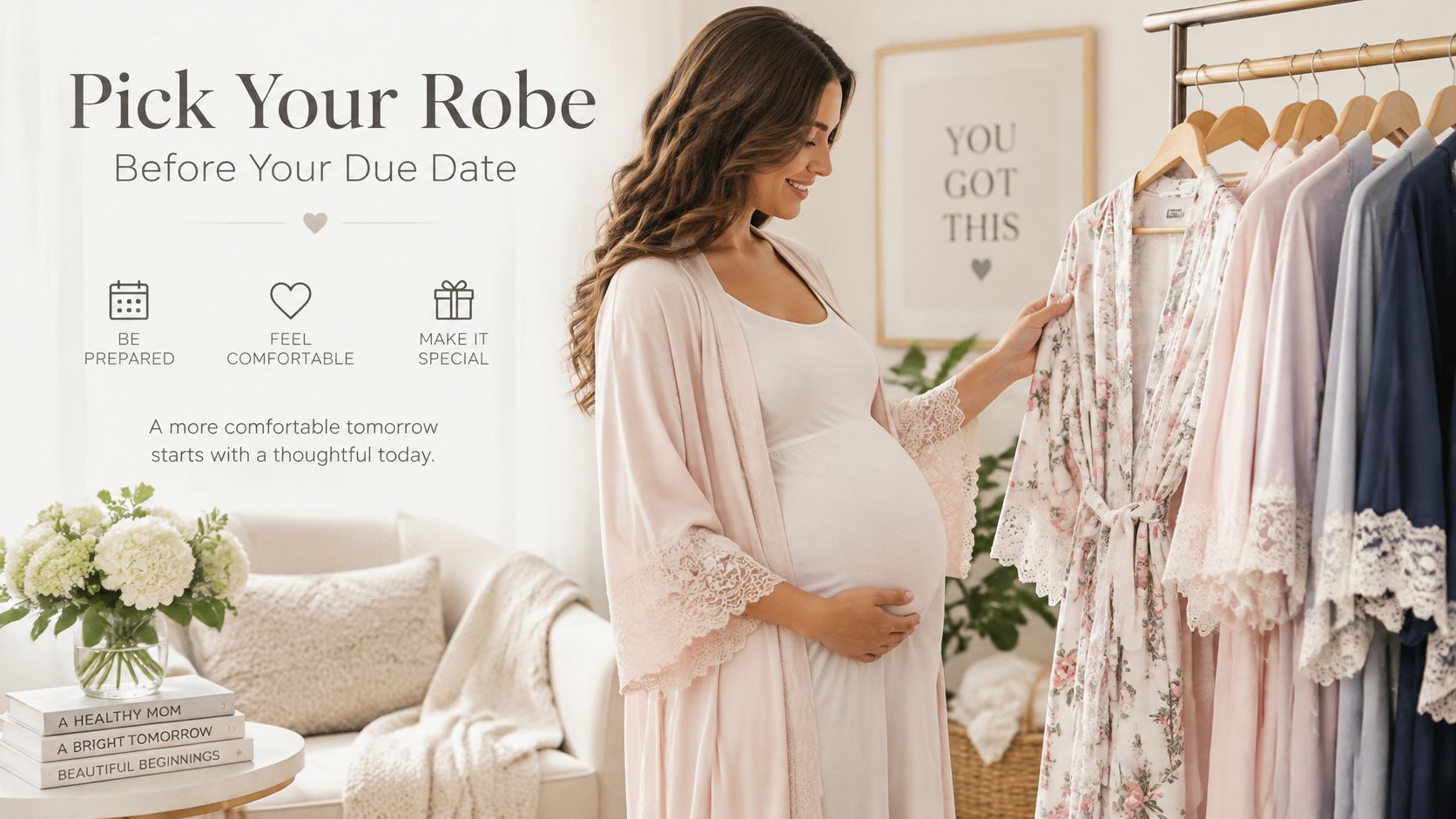
- Check the opening. Confirm it opens far enough for the access you expect, and that you can put it on and take it off comfortably.
- Look for adjustability. A tie, soft band or stretch panels can accommodate changes in shape; a fixed waist offers less flexibility.
- Use current measurements as a starting point. Compare bust and hip measurements with the size chart, then consider how your fit needs may change by the stage you plan to wear it.
- Read the care instructions. Choose a fabric and care routine you can manage during recovery.
- Check certification claims. SEYANTE's bathrobes are made with GOTS certification, and its maternity robes are offered in hooded, kimono and lightweight styles.
For a gift, consider how the robe may fit around the due date and check the exchange window before ordering. A matching set and gift note can make a coordinated baby-shower gift, though sizing still depends on the recipient's measurements and preferences.
SEYANTE makes maternity robes in hooded, kimono and lightweight styles. Visit SEYANTE to compare the maternity collection and choose a robe before your due date.