Women's Shower Wraps: How to Choose the Right Fit
You've stepped out of the shower, tucked a towel around your chest, and reached for your skincare. The towel slips before you've opened the first bottle. A shower wrap should solve that problem without creating another one, such as a tight top edge, a gaping front, or thick fabric that's still damp when you need to pack it.
The best women's shower wraps balance three things: how they handle water, how securely they fit while you move, and how well they tolerate regular washing. Plushness is pleasant, but it isn't a substitute for those basics.
Women's Shower Wrap Materials and Weaves at a Glance
Cotton terry is the starting point for water-holding capacity, waffle weave for lighter handling and faster drying, and microfiber for compact packing, provided the actual garment's weight and dimensions support those priorities.
Terry is a looped-pile cloth whose loops add surface area for absorbing water and create a softer feel than flat-woven cloth. Its usefulness isn't a recent styling invention: Encyclopedia.com's bath-towel history describes softer, more absorbent terry replacing plain linen toweling by the 1890s. A modern wrap puts that drying textile into a wearable shape.
Shower wrap materials and weaves compared
Treat these as shopping directions, not a laboratory ranking. Fabric construction can outweigh the name on the label, and cotton origin alone doesn't establish absorbency.
| Material and weave | Absorbency | Drying speed and weight | Best use |
|---|---|---|---|
| 100% Turkish cotton terry | High water-holding potential with dense looped pile | Slower to dry in heavier constructions; heavier when wet | Post-shower drying and spa use |
| Cotton waffle weave | Useful for light drying; open grid generally holds less water than dense terry | Typically lighter and faster to dry than heavy terry | Warm climates, travel and year-round wear |
| Organic cotton terry certified to GOTS | Assess like conventional cotton terry of comparable construction; certification isn't an absorbency rating | Choose by fabric weight and pile density | Buyers seeking verified organic fibre |
| Cotton-blend terry | Generally lower than all-cotton terry; inspect the fibre mix | Check blend ratio, fabric weight and care requirements | Budget buyers willing to examine the blend |
| Microfiber | Not established by the testing discussed here; check product-specific evidence | Often lightweight and compact; verify garment weight and drying performance | Gym bags and travel packing |
Drying your body and covering your body aren't identical jobs. If you put the wrap straight onto wet skin, you need a textile that takes up water readily. If you towel off first and wear the wrap while dressing, you can give more weight to coverage, low bulk and comfort.
Don't assume that every Turkish cotton wrap is thick, or that every waffle wrap is thin. Ask for the fabric specification rather than relying on a photograph of folded cloth. Our guide to bathrobe materials and fabric types gives useful context for comparing the same textile families in wearable bath products.
Practical rule: If drying speed matters most, start with waffle weave. If coverage and a cushioned feel matter most, start with terry, then check its weight before buying.
How Terry Loops and Waffle Grids Change Performance
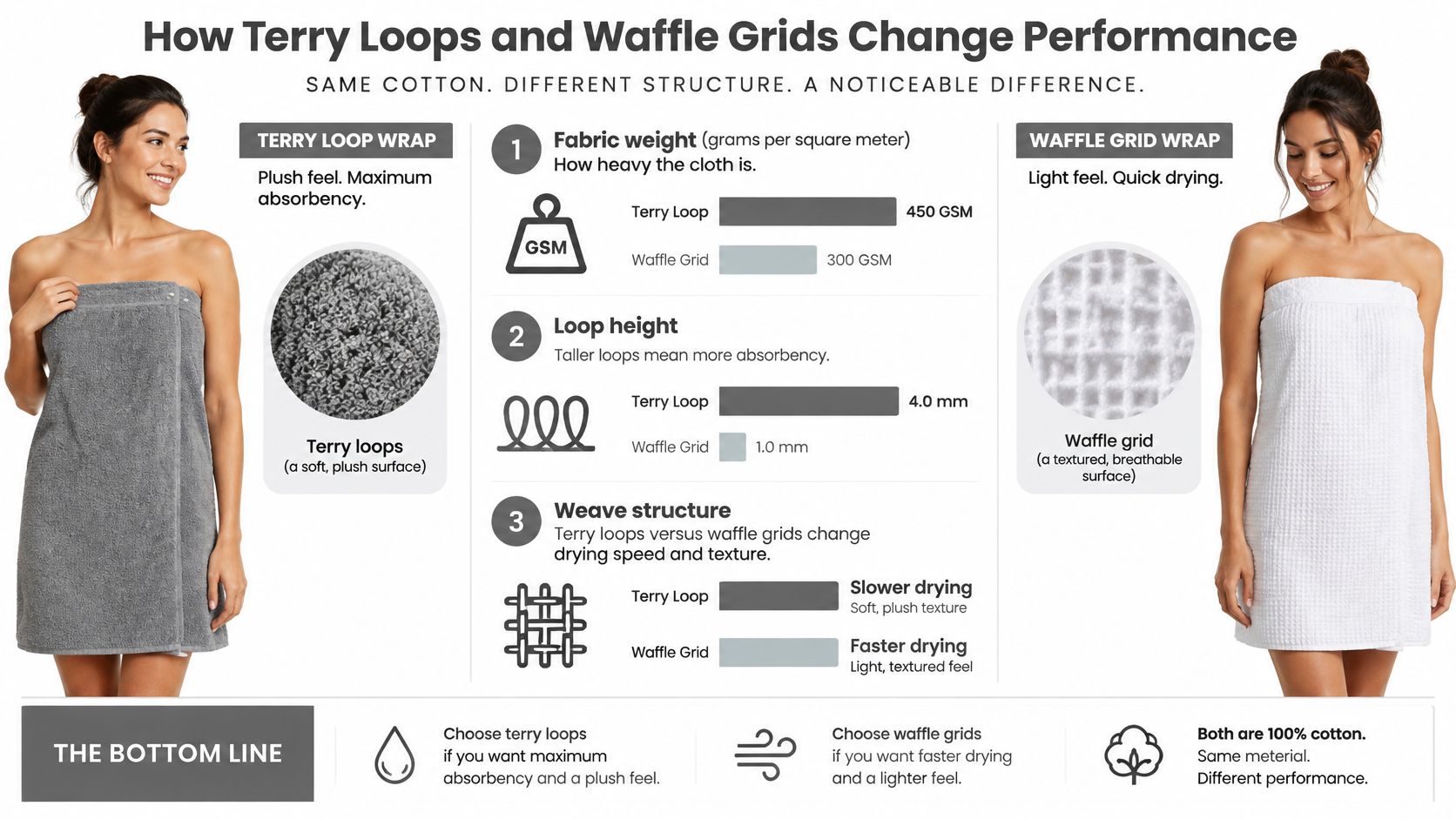
Two wraps made from the same cotton can behave differently after the same shower. The fibre label tells you what the cloth contains, but it doesn't tell you how much water the cloth will retain or how easily air can move through it.
A peer-reviewed terry-fabric study tested nine all-cotton constructions after five washing cycles and found that yarn count and weft density significantly affected static water absorption, air permeability and residual water content, among other properties. That makes construction a buying criterion, not a technical footnote.
Read the fabric specification
Look for these construction details before interpreting words such as luxurious or spa-quality:
- Fabric weight: Grams per square metre, often abbreviated GSM, describes the mass of cloth over a given area. It isn't the total garment weight, because a longer or wider wrap uses more fabric.
- Loop height and density: These describe the raised pile and how closely it's packed. Taller loops aren't automatically better; their anchoring, spacing and yarn construction also matter.
- Weave structure: Looped terry offers a different water-holding surface from a waffle grid. The grid's texture and more open construction change how the fabric feels and releases moisture.
A seller who gives only the fibre name hasn't supplied enough information to compare a dense wrap with a lighter one. Where GSM isn't listed, look for garment weight, close-up fabric photographs and a clear description of the weave. Don't convert marketing terms such as heavyweight into an assumed numerical specification.
What this means after a shower
Say you use a heavy hooded terry wrap and a mid-weight waffle wrap on separate days under similar conditions. The terry may take up more water and feel more cushioned initially, but its dense body, hood and overlapping layers can remain damp longer. The waffle option may feel less enveloping while being easier to handle and hang open.
That's why the plushest wrap isn't automatically the most practical. In a shared bathroom, a wrap that occupies the only drying hook while remaining folded over itself can be inconvenient, however soft it felt in the shop.
Judge absorbency after several washes, not just straight out of the packaging. Notice whether water enters the cloth readily, whether the wrap becomes cumbersome when wet, and whether it dries fully in the place you'll hang it.
Measure Your Body Before You Buy a Size
An S, M or L label can't tell you whether a wrap will close securely across your bust and hips. Start with a flexible measuring tape, a mirror and the brand's size chart, not your usual dress size.
Body proportions differ within the same nominal size. A 3D-anthropometric study of 50 women aged 19–57 recorded bust circumferences of 89–139 cm and hip circumferences of 91–145 cm. Those are measurements from that study group, not recommended wrap sizes, but they illustrate why one circumference cannot describe every wearer.
Body measurements to take before choosing a size
Keep the tape against your body without pulling it tight. Measure twice, and record the units so you don't accidentally compare centimetres with inches.
| Measurement | How to take it | What to compare on the size chart |
|---|---|---|
| Bust | Around the fullest point, bra on, tape level | Finished chest dimensions, closure range and front overlap |
| Waist | Around the narrowest point, standing relaxed | Closure range and whether the front could gap at the waist |
| Hips | Around the fullest point of the hips | Available body width and how the fabric crosses the hips |
| Height | Standing straight, barefoot | Stated wrap length and where the hem will fall on you |
If you won't wear a bra beneath the wrap, also check your upper-torso measurement in that condition. For help keeping measurement posture and reference points consistent, ClothME's guide to photo profiling for accurate apparel sizing offers additional context.
Body measurements and finished garment measurements are not interchangeable. A body-size range tells you who the manufacturer intends to fit. Finished dimensions describe the actual article, which must accommodate your body, comfortable movement and the fabric crossing over at the front.
A flat wrap's full width also isn't its wearable circumference once it overlaps. Our robe size chart guide can help you distinguish chart conventions before comparing dimensions.
Test movement, not just standing fit
Wrap it, cross the front and secure the closure. Raise both arms, reach across your body, sit down and bend forward, checking that the front stays covered and the top edge doesn't concentrate pressure at one point.
Too little overlap creates gaping; excessive fabric creates bulk that can bunch around the closure. Check where the hem lands while seated as well as standing, especially if you'll use the wrap in a locker room.
Choose between sizes by bust fit, usable overlap and closure adjustment first. Height helps you assess length, but it won't tell you whether the wrap stays closed.
Construction and Labels That Signal Quality
Check seams and fastenings first, then the certificate. A wrap needs clean edges, securely attached closures and elastic that supports the fabric without forcing you to overtighten it.
Inspect the inside as carefully as the outside. Skipped stitches, exposed raw edges and puckering around an elastic channel can signal weak construction.
Inspect the parts that take strain
- Seams: Look for even stitching at side seams and closure attachment points. On robe-style garments, inspect shoulders and armholes too; strapless wraps won't have those features.
- Fastening: A tie needs enough usable length to knot comfortably. Adjustable closures should stay secure across your intended fit range without leaving abrasive material against your skin.
- Hem: Check for a neatly enclosed or reinforced edge, with no loose threads that could catch during use or washing.
- Pile: Separate the terry gently and look for loose or snagged loops. Avoid pulling a loop, which can damage an otherwise sound garment.
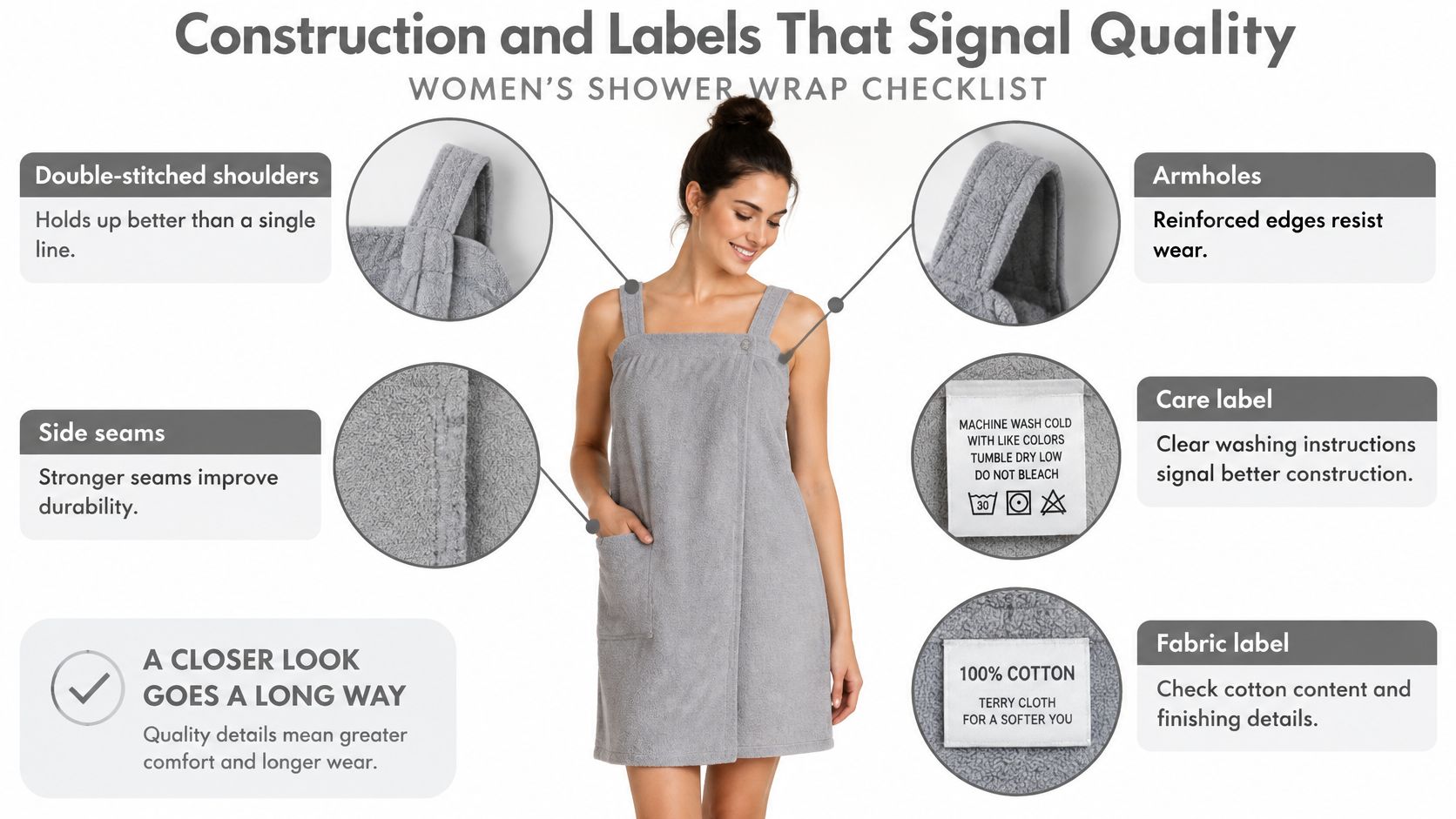
The care label matters too. If the elastic, trim or fastening needs a routine you won't follow, the wrap may be a poor fit for your household, even when the main fabric feels excellent.
Match the certificate to the claim
Fibre origin, processing requirements and product durability are distinct questions. Textile Exchange distinguishes GOTS from OCS: GOTS covers organic fibres alongside environmental processing and social criteria, while OCS focuses on organic material and chain of custody.
Check the certificate name, the product scope and identifying details that let you verify the claim. A general statement about a company's cotton sourcing does not necessarily establish certification for the specific wrap you're considering.
Buying checkpoint: Look for verifiable certification and well-finished construction rather than relying on the word “natural” on a label.
How to Care for a Shower Wrap Step by Step
Care determines whether a wrap remains pleasant to use or develops residue, stiffness and a persistent damp smell. The most useful routine is one you can repeat without special treatment after every shower.
Read the entire care label before the first wash, including instructions for the fastening and elastic. Generic towel advice shouldn't override a garment-specific restriction.
A repeatable washing and drying routine
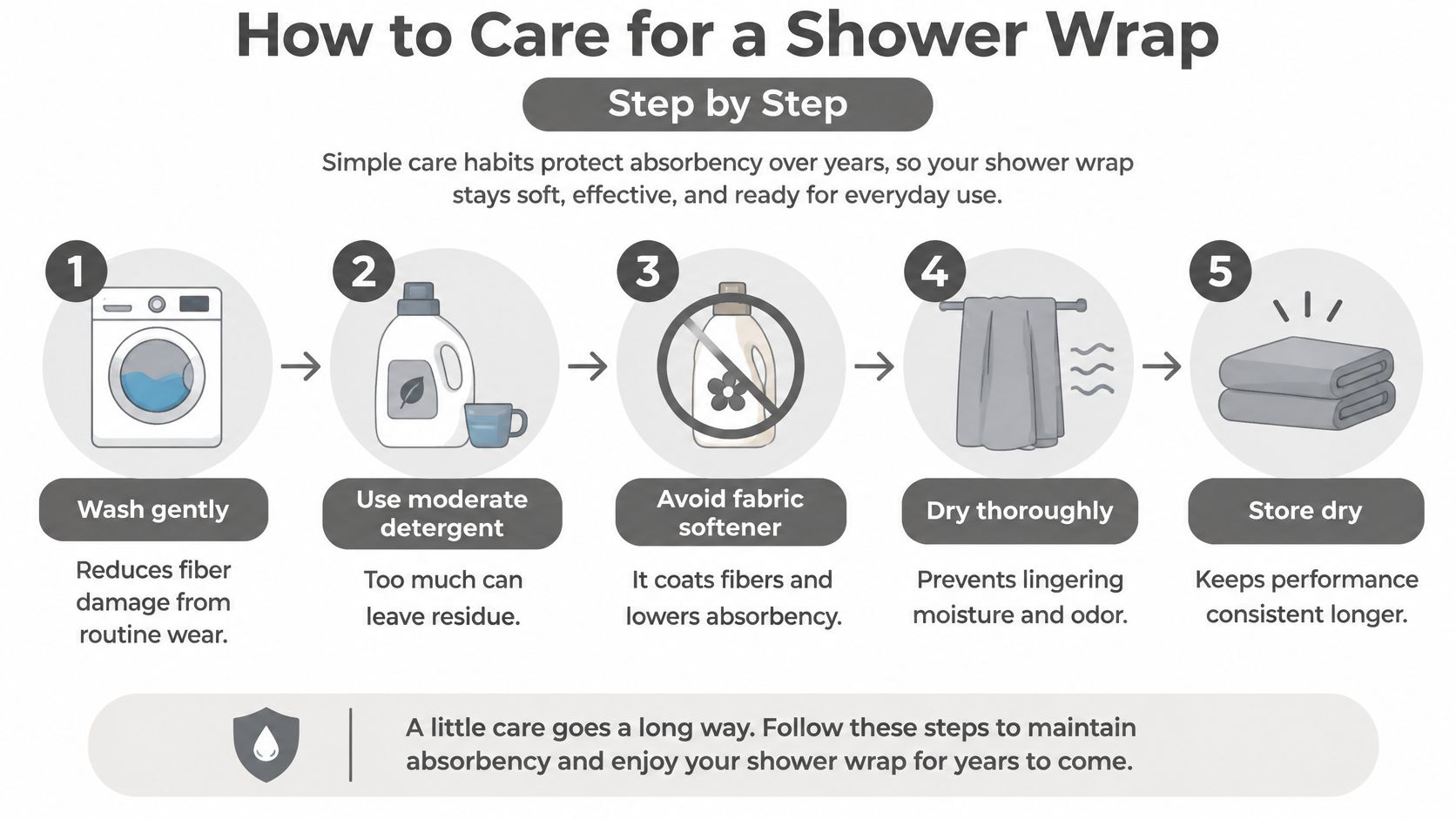
Hang it open immediately after use. Use a sturdy hanger or a rail that lets the fabric spread out, preferably away from lingering bathroom humidity. Leaving terry balled on the floor traps moisture between layers and encourages unpleasant odours.
Choose the permitted wash temperature and a moderate detergent dose. Warm water is an option when the label permits it, but a cold-wash instruction takes priority. Our robe care instructions specify a gentle cycle with cold water and mild detergent; don't apply a warmer generic towel routine to those garments.
Leave out fabric softener and avoid bleach unless explicitly permitted. Softener can leave a coating that interferes with water uptake, while unsuitable bleaching can damage fabric or components. Add detergent for the actual load and water conditions rather than pouring extra in because the wrap feels thick.
Air-dry or use the permitted low-heat setting. Spread the wrap so the overlap and elastic channel aren't trapped inside a bundle. Excessive heat can shrink cotton and stress components, so don't use the hottest setting merely to finish faster.
Store only when completely dry. Check the top edge, seams and doubled fabric, not just the exposed surface. Folding a slightly damp wrap into a drawer prevents those areas from finishing their drying.
For our robes, air-drying or tumble-drying on the lowest heat setting is the recommended approach. Our guide to washing, storing and caring for your robe provides further guidance for robe fabrics and storage.
Check performance before replacing it
Pack a wrap dry whenever possible. If you must transport it damp after the gym, take it out and hang it open as soon as you reach your destination rather than leaving it enclosed in the bag.
If water sits on the surface instead of entering the cloth, or the wrap feels stiff after laundering, try washing it without softener and with an appropriate detergent dose. Check that it rinses thoroughly before deciding the fabric has worn out.
Replacement makes more sense when cleaning no longer restores useful performance, or when failing elastic, damaged closures or thinning fabric prevent secure wear. A soft surface alone doesn't justify keeping a wrap that no longer does its job.
Match the Wrap to Your Routine and Buy
Choose a wrap for the place you'll use it most. Post-shower wear calls for good water uptake and a secure closure; travel favours low bulk and manageable drying; gym use puts repeated laundering and durable seams in focus. The heaviest terry may feel substantial, but it can be inconvenient to pack or dry in a shared bathroom.
Which wrap construction fits each use case
| Use case | Top priority | Look for | Avoid |
|---|---|---|---|
| Post-shower drying | Fast absorbency | Mid-weight cotton terry with a secure tie or adjustable closure | Very heavy terry that stays damp in your drying space |
| Spa or hotel visits | Coverage and feel | Suitable length and clean finishing | Thin cloth with insufficient bust overlap |
| Travel and shared bathrooms | Packability and quick drying | Lightweight waffle or microfiber with clear weight information | Thick terry that is difficult to dry before packing |
| Gym and locker room | Washability and durability | Reinforced seams and lightweight cloth | Loose hems that can catch on locker hardware |
At home, if you dress soon after bathing, prioritize water uptake and a closure that stays in place. Extra length and decorative details matter less if they don't improve coverage or fit.
For a weekend away, lightweight waffle is a practical starting point. Check that you'll have room to hang it open between uses, especially when sharing a bathroom.
If you're planning a bathroom, decide where wet textiles will hang before choosing fittings. You can explore architectural shower fixtures while planning the shower area, then reserve an accessible drying spot outside the direct spray.
Apply the buying filters in order
Check fabric and weave first, measured fit second, then construction and care. A wrap needs to pass all four checks; colour cannot make up for poor coverage or a closure that slips.
Before ordering:
- Record your measurements: Note bust, waist, hips and height, with units.
- Read the chart precisely: Check whether it lists body ranges or finished garment dimensions, then assess the usable overlap.
- Check certification details: If organic certification matters to you, confirm what the claim covers rather than relying on natural-fibre wording.
- Match the care instructions to your routine: Consider the wash method and how you'll dry the wrap.
SEYANTE's Women's Navy Turkish Cotton Towel Wrap is one cotton option to assess against those criteria. Review its fit and care details alongside the fabric description.
Choose for the conditions in which you'll wear, wash and dry the wrap. Before buying, check your measurements, closure and available drying space, then hang the wrap open the same day it arrives to assess how it dries.
SEYANTE sells towel wraps for women and men, as well as hair turbans. Visit SEYANTE with your measurements and preferred fabric in mind, then compare product details and care instructions before choosing.