Womens Purple Robe Guide: Shades, Fabrics and Care
You're standing in a cold bathroom after a shower, scrolling through purple robes that all look the same on screen. One says lavender, another says violet, a third looks almost black in the photo. You want the color you saw online, but you also need a robe that dries you, doesn't stay damp on the hook, and won't fade to grey after a month of washing.
That's the key decision behind a women's purple robe. Shade matters, but fabric construction determines whether you'll reach for it daily, and dye care ensures the purple lasts. I would start with use, then fabric, then shade, and only then check size. That order prevents the most common mistake, buying a beautiful color in the wrong weight for your bathroom.
Quick Picks by Use, Fabric and Shade
| Use | Fabric | Shade | Why it works |
|---|---|---|---|
| Post-bath drying in a cold bathroom | Dense cotton terry | Deep purple or violet | Loops absorb more water and hold warmth |
| Humid climate or travel | Lightweight cotton waffle | Lavender or mauve | Breathes well and packs flat |
| Winter lounging | Fleece | Violet | Warm and soft without the bulk of thick terry |
| Bridal party or boutique group | Turkish cotton terry or waffle | Mauve or deep purple | One shade stays consistent across the group |
Reading the Table as Decisions
Post-bath drying needs loops. Dense terry pulls water off skin instead of smearing it around, and the extra mass holds heat while you're brushing teeth or applying lotion. The trade-off is weight on your shoulders and slower drying on the hook.
Humid climate or travel needs air. Waffle has a grid structure with less surface mass, so it releases moisture faster and folds into a suitcase without dominating it. The trade-off is lower absorbency. You'll still want a towel first if you're dripping wet.
Winter lounging is different work. You're already dry, so fleece wins on immediate warmth and softness. It doesn't absorb like terry, and that's fine if the robe never goes straight onto wet skin. The trade-off is that fleece can feel too warm in a heated apartment.
Bridal or boutique groups need consistency more than peak performance. Turkish cotton in terry or waffle holds dye evenly across a batch, so five robes photographed together read as one color. The trade-off is ordering discipline. You need one shade, one fabric, and no last-minute substitutions.
Pick the job first. Fabric follows the job, and shade comes last, because a perfect color in the wrong fabric still fails every morning.
For price context, L.L.Bean's 2026 women's purple robe listings ranged from $79.99 to $120.00, including a $99.95 winter fleece robe and a $120 Wicked Plush Robe. That range helps you judge mid-range versus premium pricing before you compare construction details.
Use that as a reality check, not a target. A cheaper robe that matches your climate and drying space will outperform an expensive thick robe that never fully dries in your bathroom.
Purple Shades and How They Read in Photos
Purple carries cultural weight most colors don't. The ASU FIDM Museum article on purple notes that Tyrian purple originated in the first millennium B.C. from murex sea snails, and hundreds of thousands of mollusks could be required to color a single garment. That rarity restricted purple to royalty for centuries.
The same source explains that in 1856, British chemist William Henry Perkin accidentally discovered mauveine, the first commercially important synthetic purple dye. Britain's early 20th century suffrage movement later used purple for the "royal blood" believed to run through suffragettes' veins. That history is why purple still reads as luxury and self-expression, not just decoration.
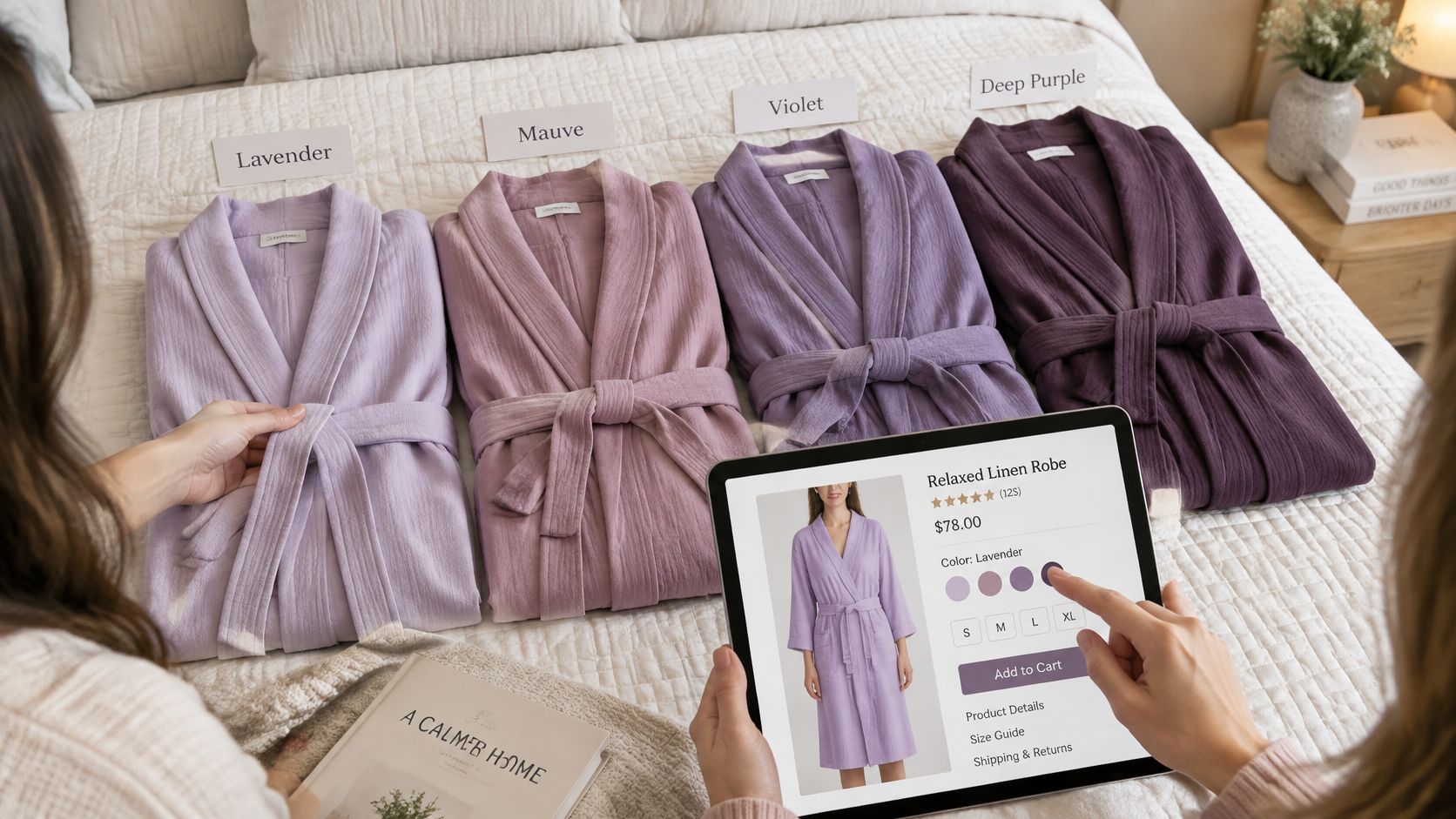
| Shade | Character | How it reads in photos | Best setting |
|---|---|---|---|
| Lavender | Pale, soft and cool | Washes out under flash and can look grey in dim light | Spa days and soft lounging |
| Mauve | Dusty and warm-leaning | Keeps its tone across skin tones and backgrounds | Bridal groups and everyday wear |
| Violet | Clear and bright | Can look bluer on cool-toned screens | Winter lounging and statement looks |
| Deep purple | Saturated and rich | Folds go dark and detail can disappear in low light | Statement robes and cold rooms |
What Changes Between Screen and Skin
Lavender is the most fragile in photos. Flash strips its color, and warm bathroom bulbs can push it toward grey. If you love lavender, check it near a window first. It also shows body oils and makeup at the collar faster than darker shades.
Mauve is the safest photographic choice. Its dusty warmth holds up against different skin tones and doesn't fight white towels or beige walls. That's why I recommend it when several people need to look coordinated.
Violet looks clean and bright in person, but cool screens add blue. A robe that looks balanced on your phone may arrive more purple than expected, which isn't a defect. It's a screen shift.
Deep purple gives you richness, but cameras lose fold detail in low light. The collar, belt, and pockets can merge into one dark shape. It works best in well-lit rooms where you want a statement, not subtle texture.
A Two Minute Daylight Test
Place two swatches or candidate robes side by side in daylight, not bathroom light. Take a phone photo in the room where you'll wear the robe. Compare the photo to the fabric in your hand. If lavender already looks grey or violet already looks blue, that shift will repeat in every photo you take later.
Fabric Choices for Warmth, Drying and Travel
Two robes can both say 100% cotton and behave completely differently after a shower. Fiber content tells you what it's made from. Construction tells you what it does.
Independent testing described in a terry fabric study from the Technical University of Liberec found that yarn count and weft density influence air permeability, pile-loop extraction resistance, bursting strength, tensile and tear strength, abrasion resistance, static water absorption, and residual water after laundering. The same research notes that surface water absorbency is not determined by fiber composition, while drying time is closely associated with fabric composition.
That distinction matters when you're comparing product pages. Don't stop at fiber. Look for fabric mass, loop density, and any mention of performance after repeated washing.
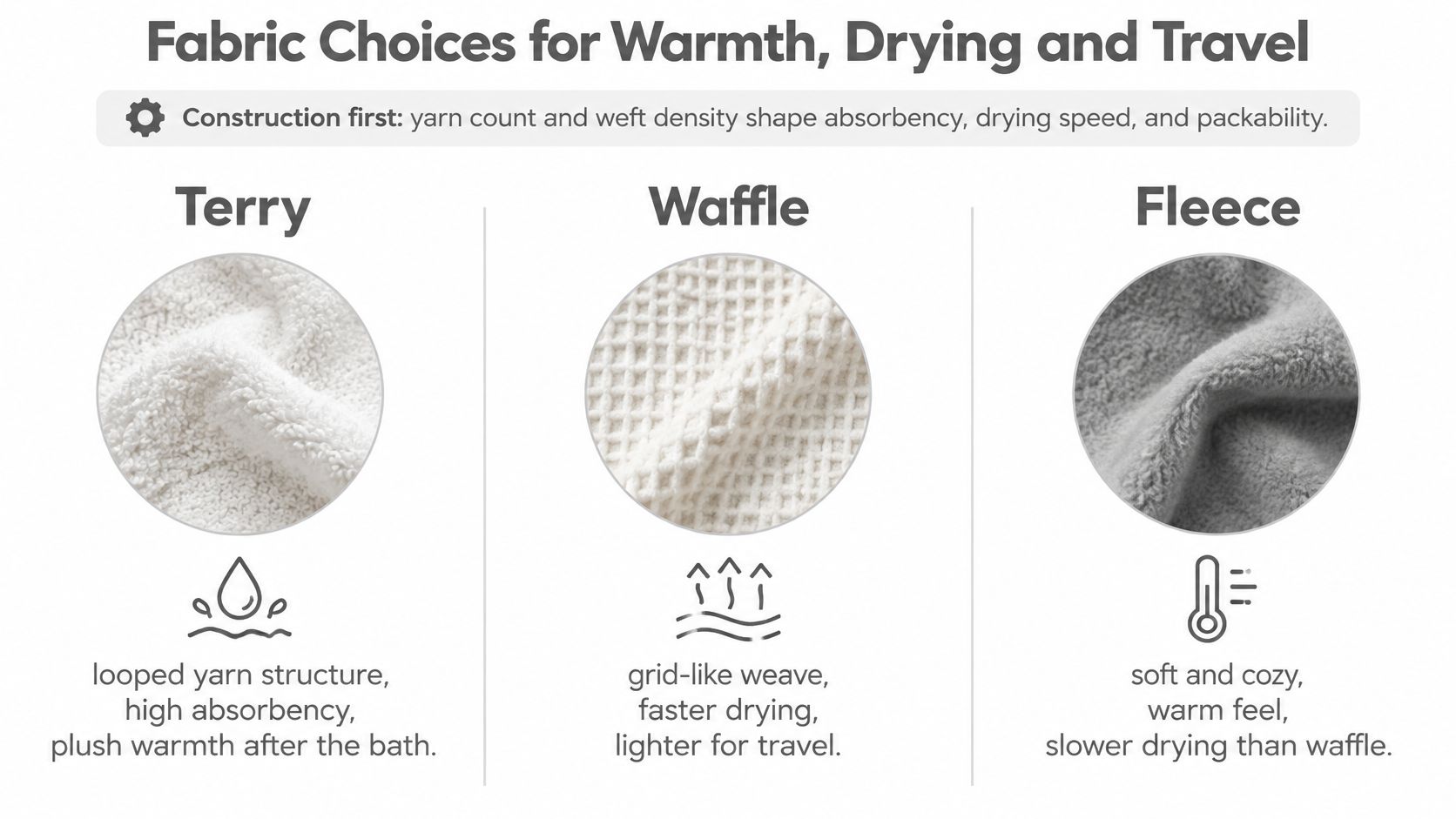
| Fabric | Warmth | Drying time | Absorbency | Best for |
|---|---|---|---|---|
| Dense cotton terry | High | Slower | High | Cold bathrooms and post-shower drying |
| Cotton waffle | Moderate | Fast | Moderate | Humid climates, travel and everyday rotation |
| Fleece | High | Fast | Low | Winter lounging and cold rooms |
Terry for the Bathroom
Terry loops create surface area. More loops mean more contact with wet skin and more water pulled into the fabric. A denser, heavier terry robe provides greater warmth and moisture uptake, but it also retains more residual water after washing and needs airflow to dry.
Check loop pull resistance indirectly before you buy. In person, run your palm firmly across the pile and tug a few loops gently. Loops shouldn't snag easily or feel loose at the base. Online, look for clear close-up photos and a stated weight rather than vague words like plush.
As a concrete example of the construction to inspect, the Womens Hooded Turkish Cotton Terry Cloth Robe is described as made with organic Turkish cotton that's GOTS Certified. Use that kind of listing to check hood construction, loop density, and finishing, even if you choose a different shade.
Waffle and Fleece for Different Jobs
Waffle trades absorbency for speed. Its recessed squares trap some air for light warmth, but the thinner ground fabric dries between uses. That's ideal if your bathroom has poor ventilation, you shower twice a day, or you travel and can't hang a heavy robe for hours.
Fleece traps heat without absorbing much water. Put it on dry skin over pajamas and it feels warm immediately. Put it on wet skin and water sits against you. I would not buy fleece as your only robe if post-shower drying is the main job.
Practical rule: Terry for wet skin, waffle for heat and rotation, fleece for dry lounging. Mixing up those jobs is why good robes feel disappointing.
For a deeper comparison of weights and weaves, our guide to bathrobe materials and fabric types explains how each construction behaves in daily use. Read it with your bathroom in mind, especially ventilation and hook space, because a robe that can't dry fully will smell musty no matter how well it's made.
Bridal Parties and At-Home Spa Days
Robes have marked ceremonies for a long time, not just lazy Sundays. The Metropolitan Museum of Art record for a Turkish robe dated to the late 19th or early 20th century classifies it as women's dress made from silk with metal-wrapped thread and brocade. Museum records also describe Central Asian women's robes associated with weddings, where fabric, color, and pattern communicated age and social status.
That history explains why a coordinated robe still feels meaningful in photos. It's a visible marker that the morning is part of the event, not just preparation for it.
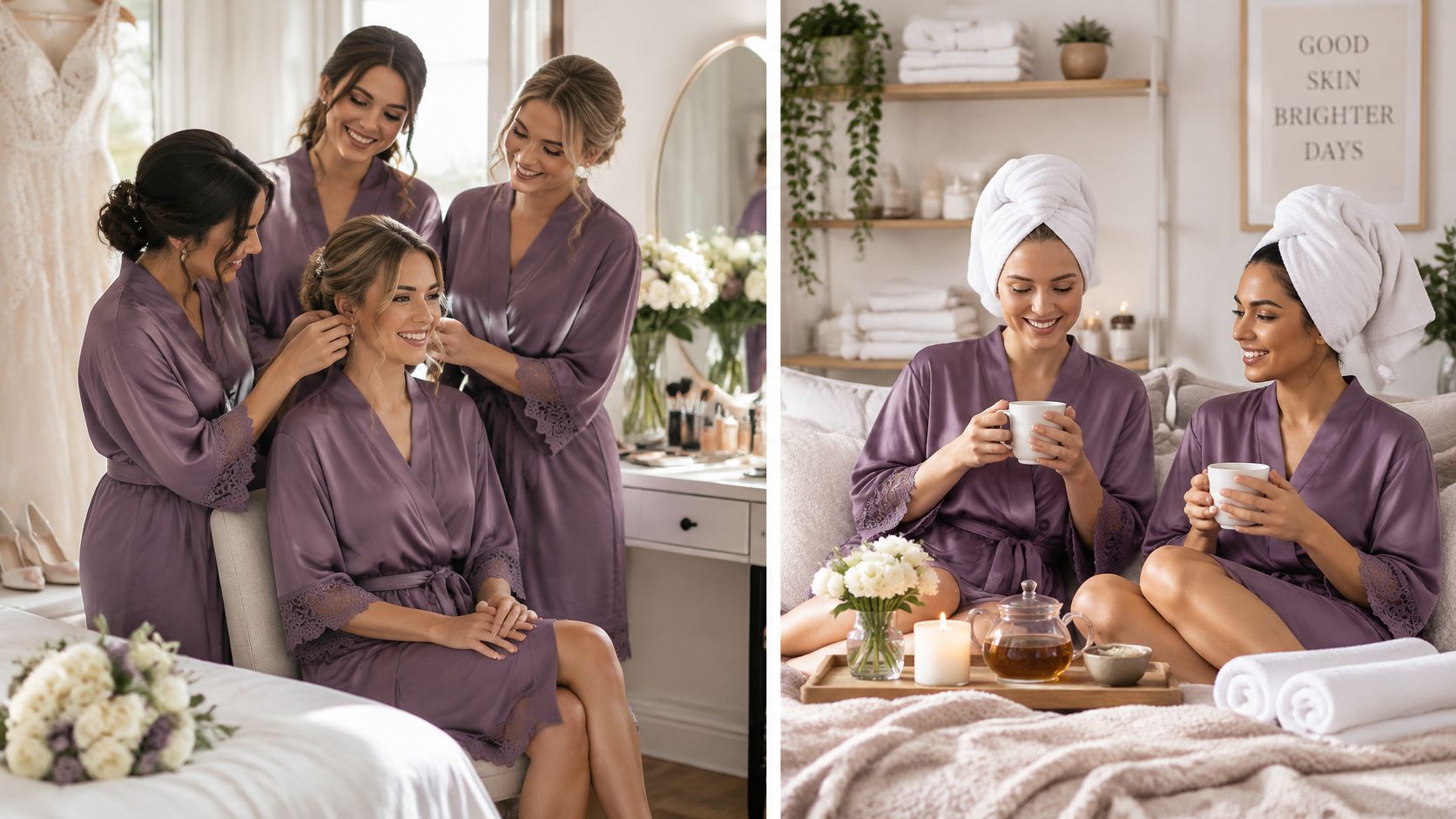
A Worked Bridal Example
Say you have five bridesmaids getting ready in a bright hotel room. Put them in mauve waffle and the bride in deep purple. Waffle won't overheat anyone during hair and makeup, it photographs with visible texture, and mauve stays calm across skin tones. The bride stands out without wearing a completely different style.
Deep purple also holds its own against a white dress hanging nearby and soft neutral walls. Lavender can disappear in that setting, especially if the photographer uses flash.
Before a group order, run this check:
- Order one sample first: Confirm the shade in daylight and in the getting-ready room.
- Measure every person: Don't collect dress sizes and guess the wrap.
- Check belt and hood details: Hoods add bulk behind styled hair, and low belts pull open when seated.
- Confirm length seated: A robe that covers standing may ride up in makeup chairs.
Our bridal robes guide covers coordination and timing for group orders. Use it early, because shade consistency is easier when every robe comes from the same order.
At-Home Spa Days
A spa robe has a different brief. You want plush contact, covered knees when seated, and a belt that stays tied while you move between bath, couch, and kitchen. Lavender suits that calmer mood, and terry or velour gives you the weight that signals you're off duty.
Check three things before you buy for spa use. First, fabric weight in your hands, because too light feels like a cover-up. Second, length from shoulder to below the knee. Third, sleeve width, because wide sleeves dip into sinks and candle flames.
Order the single sample before the group set. One returned robe costs less than five robes in the wrong purple.
How to Wash a Purple Robe Without Fading It
Purple doesn't fade because it's fragile by nature. It fades when heat, light, abrasion, and harsh detergent work on the dye wash after wash, especially on raised terry loops.
Color durability is measured with standardized tests, and a Springer study on dyed textile fabrics reports washing-fastness values from 2–4 and light-fastness values from 3–6 on a gray scale where higher ratings indicate better resistance. The study references ISO 105-C06 for washing and ISO 105-B02 for light exposure. In plain terms, a saturated purple can survive laundering yet still fade faster under prolonged light.
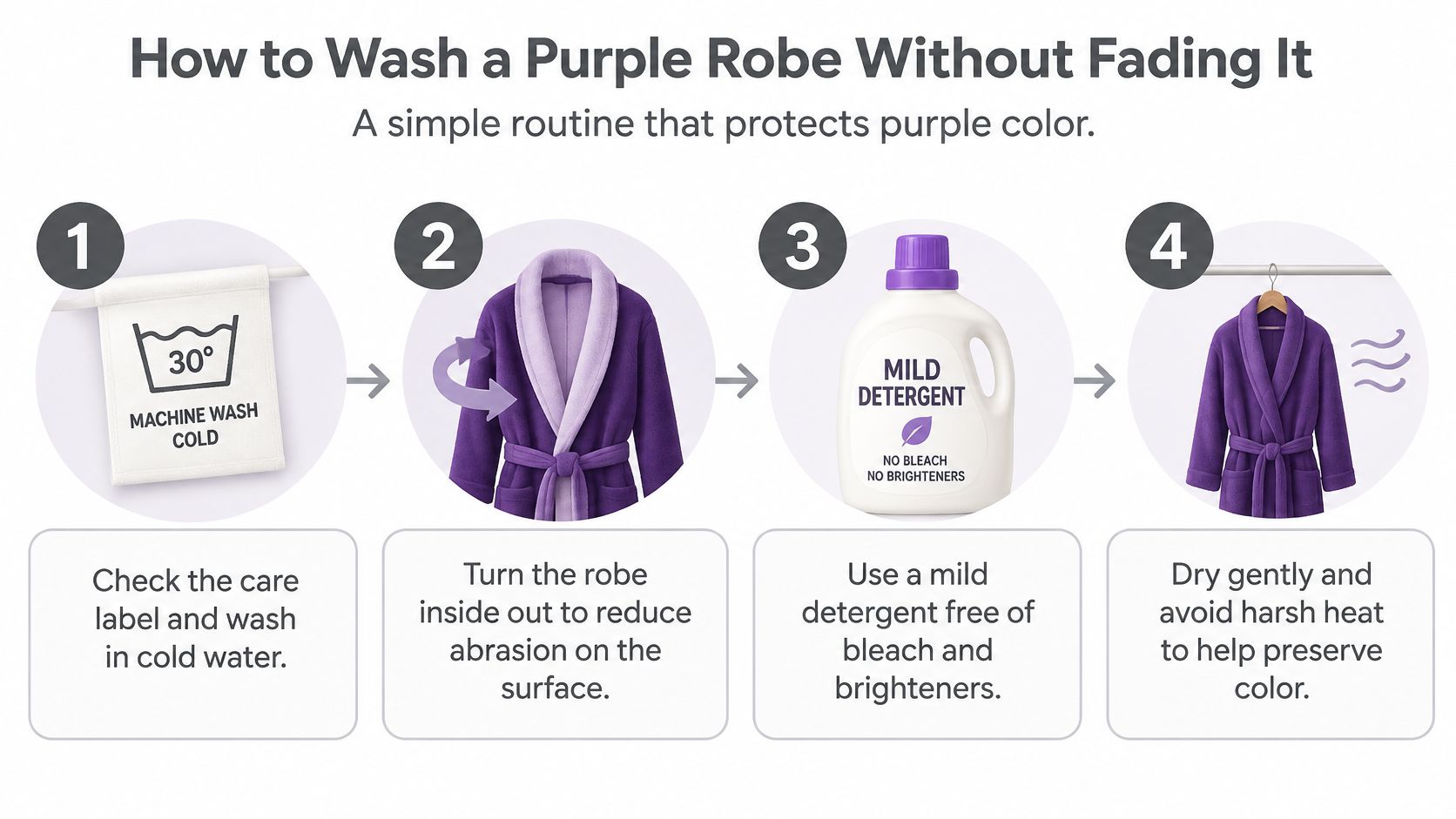
The Routine That Protects Color
- Check the care label and wash cold. Cold water reduces dye loss and limits shrinkage. Wash a new deep purple robe separately the first few times.
- Turn it inside out. The outer loops get less direct abrasion from the drum and other garments. This matters more for terry than smooth fabrics because loops increase surface contact.
- Use mild detergent without bleach or softener. We recommend washing our robes on a gentle cycle with cold water and a mild detergent free of harsh chemicals, bleach or fabric softeners. Softener residue can dull color and coat loops, reducing absorbency.
- Use a gentle cycle and separate lights. Purple can transfer in wet rubbing, especially early on. Keep white towels out of the first washes.
- Dry low or air-dry out of direct sun. Robes can be air-dried or tumble-dried on the lowest heat setting. Direct sunlight is the quiet problem, because light fastness is the weaker side for many saturated shades.
- Hang and store fully dry. Hang robes on a sturdy hanger and make sure they are fully dry before storing. A damp folded robe develops odor and fold-line fading looks worse once it sets.
First Wash Test and Fixes
Before the first full wash, rub a damp white cloth firmly on an inner hem. If purple transfers, wash the robe alone again and retest. Don't put it against light upholstery or bedding until the cloth comes away clean.
Expect some terry lint early and slight shrinkage, especially if you use heat. That's normal loop settling, not necessarily poor quality. Shake the robe outdoors after drying and clean the lint filter.
If fading appears at folds or on one shoulder, change storage first. Move the robe away from windows, fold it differently each time, and cut dryer heat. Our robe washing, storage and care guide gives the full routine for keeping loops absorbent while you protect dye.
Dark purple can also show detergent residue as pale streaks. Use less detergent, add an extra rinse, and don't pour detergent directly onto dry terry.
Measuring for Fit and Choosing Before You Buy
Dress size is a weak predictor for a wrap robe. Your bust, hips, sleeve reach, and desired overlap decide whether the robe stays closed when you bend, sit, or reach for a towel. If size labels confuse you across brands, size labels explained by Robosize is a useful primer on why the same letter size doesn't mean the same garment measurements.
Five Measurements That Control Fit
- Bust at the fullest point. This sets how the front panels meet. Measure over the underlayer you'll wear, which may be nothing after a shower.
- Hips at the widest point. Hips decide whether the robe still closes when you walk and sit. If hips are wider than bust, size to hips and accept extra room at the chest.
- Arm length from shoulder to wrist. Your sleeve should clear the wrist when you reach forward. Too long dips into water. Too short leaves forearms cold and pulls the shoulder seam.
- Desired front overlap. Decide how much one panel should cross the other at the waist. More overlap means better modesty and warmth, but also more bulk at the belt.
- Shoulder to desired hem. Measure to mid-calf, knee, or ankle based on use. Check stairs and petite proportions here, because hem drag is both annoying and unsafe.
Compare those numbers to the brand's garment chart, not just the suggested size. If the chart only lists body size ranges, ask how much wrap allowance is built in or choose the size that protects hip closure first.
Body Shape and Room Conditions
Petite wearers often need a shorter hem and higher belt placement, otherwise the belt sits on the hips and the front gapes. Pregnant or nursing wearers need generous overlap or shaping that opens at the chest without pulling. Test that movement mentally. Will the belt stay above a bump, and can you untie it one-handed?
Check hood bulk if you have thick hair or wear the robe while drying it. A hood adds warmth, but it also adds weight behind your neck when it's down. Check pocket height with your hands at rest. Pockets placed too low swing, and pockets placed too high are useless when seated.
Room conditions change the right thickness. A steamy bathroom with no fan punishes dense terry, because the robe goes back on the hook damp. A cold, well-ventilated bathroom rewards that same density. Match fit and fabric to the room, not to a hotel photo.
If the robe doesn't stay closed while you bend and reach, it's the wrong size no matter what the label says.
Final Pre-Order Check
Confirm the shade in daylight, measure against the size chart, read the care label, and order a sample when the robe is for a group. We sell matching bridal robes for bridal parties, and we have a Bridal Robes section and a Couples' Savings section on our site for coordinated orders.
Make one decision in order. Choose the use, then the fabric, then the shade, and buy only after fit and care checks pass. That sequence keeps a women's purple robe from becoming a color purchase you tolerate instead of a daily tool you trust.
Ready to choose with those checks in hand? Visit SEYANTE to compare Turkish cotton terry and lightweight waffle robes by fabric, fit, and use, including coordinated options for bridal parties and everyday spa routines at home.