Hooded Waffle Bathrobe Guide: Fabric, Fit and Care
You step out of the shower, pull on a robe, and find yourself either overheating or reaching for another layer. A hooded waffle bathrobe looks like the sensible middle ground, but photographs don't tell you how dense the fabric feels, whether the hood tugs at your neck, or what happens after washing.
Waffle describes a construction, not a performance guarantee. The useful checks are more specific: how open the weave is, how much fabric surrounds you, how the robe fits, and what its certification covers.
Matching a Hooded Waffle Robe to Your Climate and Routine
Choose a lightweight, open waffle with a single-layer hood for warm rooms, humid bathrooms, and post-workout use. For cool rooms and winter lounging, start with a denser waffle and a lined hood, accepting that the additional fabric can take longer to dry.
Hooded waffle robe choice by climate and use case
| Climate or use case | Suggested weave | Hood choice | Warmth and drying |
|---|---|---|---|
| Warm or humid climate, after showers | Lightweight open waffle | Single-layer hood | Generally faster drying, lighter warmth |
| Cool apartment, winter lounging | Denser waffle | Lined hood | Warmer, dries more slowly |
| Spa, sauna or post-gym use | Lightweight waffle, kimono or hooded cut | Single-layer hood if hooded | Supports wicking without bulky layering |
| Travel and packing | Lightweight waffle | Single-layer hood | Packs small; compare the complete garment's listed weight |
| Hotel or boutique guest use | Durable waffle with stable seams | Hood optional | Prioritise laundering durability |
These are starting points, not product test results. Textile comfort research published in IOP Conference Series identifies air permeability, density, thickness, and moisture regain as important influences on heat and moisture transfer. That's why lightweight shouldn't be read as less absorbent, and breathable shouldn't be read as incapable of providing warmth.
Find the routine that sounds like yours
In a humid flat, you might leave a steamy shower and remain in the bathroom while getting ready. Look for open fabric and minimal hood bulk rather than a thick robe that feels reassuring on the hanger but uncomfortable against damp skin.
After a sauna or spa visit, easy wrapping and unrestricted movement matter. A light waffle robe can cover swimwear without adding a heavy outer layer; choose a hood only if you want head and neck coverage.
For travel, examine the whole garment rather than the fabric description alone. A long robe with generous sleeves, deep pockets, and a bulky hood may occupy more suitcase space than expected, even when it's labelled lightweight.
In a cold bedroom, the priorities change. A denser body fabric and lined hood make sense if you'll spend the morning reading or drinking coffee rather than dressing immediately.
For seasonal changes and regional differences, our guide to bathrobe fabrics and thicknesses for different US climate zones helps distinguish outdoor climate from the conditions inside your home. The room where you wear the robe should guide the choice.
Our Women's Lavender Blue Turkish Cotton Waffle Hooded Robe is described as lightweight and breathable, made from 100% GOTS-certified organic Turkish cotton. Those details provide a useful starting description, while fit and construction still deserve attention.
Check comfort before committing
For hotel and guest use, put stable seams, secure belt loops, and repeatable laundering ahead of low weight alone.
At a fitting, or during an at-home try-on within the return conditions, check:
- Hood balance: It rests on your head without pulling your neck forward.
- Sleeve position: Sleeves end around your wrists with your arms relaxed.
- Room comfort: Wear it long enough in your usual room to notice overheating, chill, or irritating seams.
Waffle, Terry and Fleece Compared for Hooded Robes
Waffle, terry and fleece hooded robes compared
| Feature | Waffle weave | Terry cloth | Fleece, usually polyester |
|---|---|---|---|
| Breathability | Often high in open constructions | Moderate in typical dense constructions | Often lower in heat-trapping constructions |
| Warmth | Light to moderate | Moderate to high | High in plush constructions |
| Drying speed | Often faster in lightweight builds | Often slower in thick, absorbent builds | Often fast because synthetic fibres retain less water |
| Absorbency after a shower | Good, construction-specific | Typically very high | Limited fibre absorption; surface wicking differs |
| Best season | Warm weather, humid rooms, travel | Year-round post-shower use | Cold-month lounging |
| Care focus | Protect texture and dimensions | Rinse thoroughly and dry completely | Follow heat limits and protect the surface pile |
These are typical fabric tendencies, and construction can reverse them. A dense waffle can feel warmer than a thin terry, and a fleece robe's ability to move surface moisture differs from cotton's ability to hold water.
Read each fabric by its job
Waffle uses raised ridges and recessed cells to create texture without relying on a deep towel-like pile. The weave name describes geometry, so two waffle robes can behave very differently. A loose, open grid breathes and packs flat, while a tighter, heavier knit insulates more. Check fabric weight and construction before assuming waffle automatically means cool and quick-drying.
Terry uses loops that provide substantial contact area for taking up water. Choose it when drying wet skin matters more than compact packing, and allow enough space for the damp robe to dry.
Fleece works better as insulating loungewear. Many fleece robes use polyester rather than cotton, so check the fibre statement before treating one as an alternative to an absorbent bathrobe.
A cotton-origin claim tells you where the fibre was grown, and that supply exists at real scale: the US Department of Agriculture projects Turkey's cotton production at 3.05 million 480-pound bales for the 2025/2026 marketing year. Origin describes the raw fibre. Yarn selection, weaving and finishing still decide whether the finished robe matches the tendencies in the table, so read a country claim as sourcing information rather than a performance grade.
Buying rule: Compare the fibre line first, then fabric weight and construction. A familiar weave name can't replace those details.
Separate drying comfort from textile hygiene
A robe that absorbs water well still needs somewhere to dry. WipesBlog.com makes a related point about the hidden risks of reusable kitchen towels: an absorbent textile left crumpled and wet between uses develops problems that no fibre choice fixes.
Kitchen towels and bathrobes have different uses, so the comparison stays narrow. The laundering cycle that decides how a weave holds up over time gets a closer look in the washing and drying section.
Fit, Hood and Layering for Different Wearers
Start with the shoulder line and hem before you look at the size letter. On a conventional set-in sleeve, the shoulder seam should sit near the edge of your shoulder; for lounging, a hem at mid-calf or above usually leaves useful walking clearance. A dropped-shoulder design will sit differently, so judge the intended cut rather than forcing every robe into the same outline.
Then move in it. Sit down, reach forward, and climb a step to check that the front stays comfortably overlapped. A robe that gaps open when you change position will keep doing so every time you bend or sit.
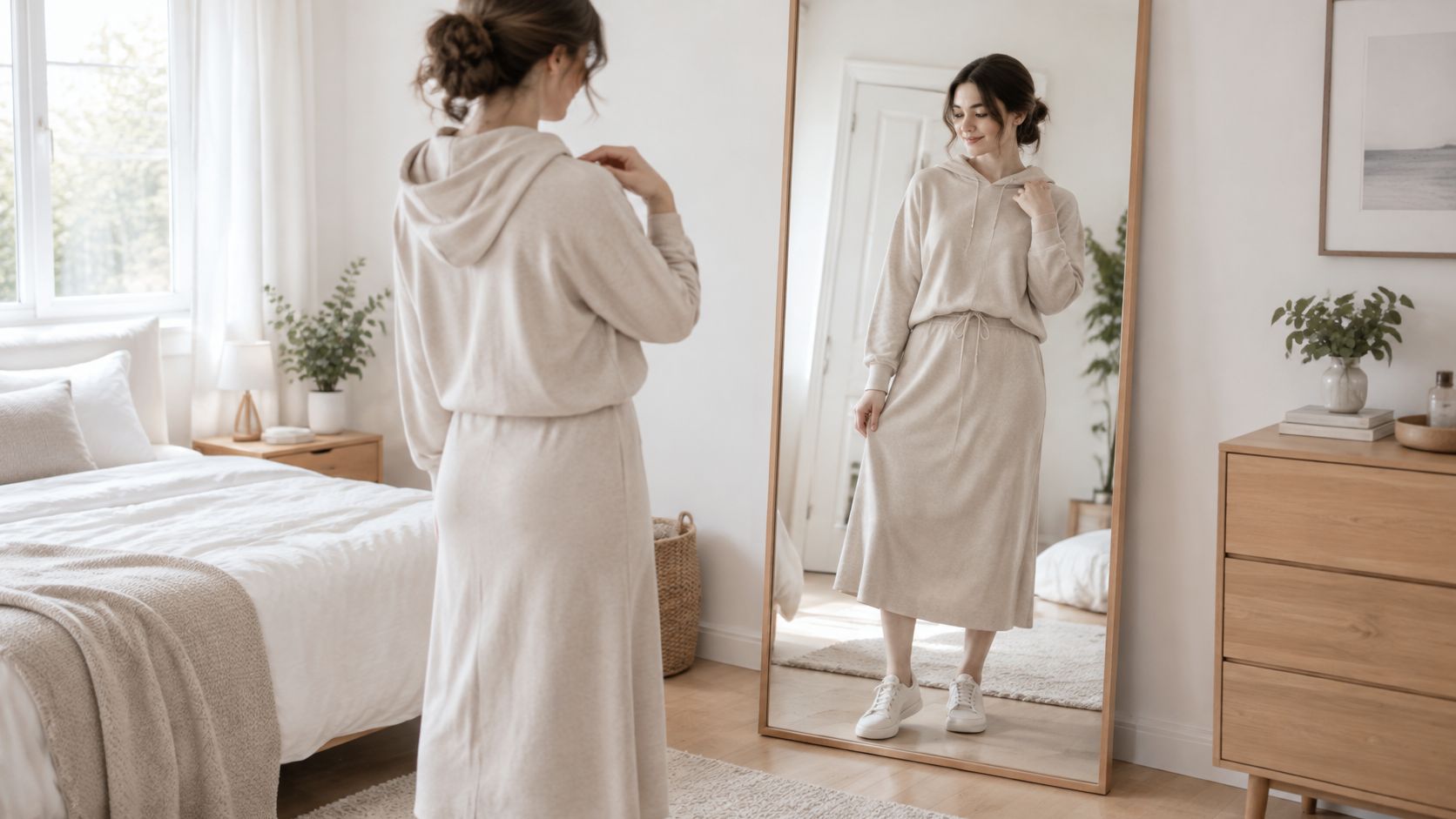
Fit the person and the activity
A man choosing an everyday gym robe needs room to move without carrying unnecessary folds of fabric. He can test the fit by reaching into the pockets and lifting his arms, then choose a close but free silhouette with an uncomplicated hood.
A woman seeking spa-style loungewear may prefer a kimono-style wrap body with broad, comfortable sleeves. A kimono collar normally means an unhooded neckline, though a robe can combine a kimono-inspired body with a hood, so inspect the actual design rather than relying on the category name.
For maternity wear, extra circumference alone may not be enough. Allow room through the body and check whether the front length keeps the hem comfortable as the body changes; the belt should secure the wrap without needing a tight knot.
A bridal party needs coordinated proportions across whichever size labels the wearers happen to need. Record each wearer's body measurements and preferred robe length, then work from a single garment size chart while letting individuals choose different sizes.
A coordinated group looks comfortable when everyone has enough front overlap and usable sleeve length, whatever number is sewn into each collar.
Treat hood lining as a separate choice
The hood's attachment seam shouldn't press against your neck when the hood is lowered. Raised, it should let you turn your head without dragging the robe body sideways.
A lined hood works like a second small garment sewn inside the first. Liquid wicking and vapour diffusion are separate mechanisms, and extra thickness where layers meet at the neck can slow how moisture moves through them. Read a lined hood as its own fabric assembly: check the lining fibre, the seam joining the layers, and whether the added bulk still lets the hood lie flat.
Try the robe over what you'll wear:
- Pool or spa: Check front overlap over swimwear; the House of Wellness visitor outfit guide provides useful context for planning a day-spa outfit.
- Cool mornings: Wear your thermal top during the fitting so the sleeves don't bind.
- Home lounging: Sit in your usual pyjamas or lounge trousers before deciding whether to size up.
Choose enough ease for those layers, then stop there. An oversized robe gives you more fabric to manage when it's wet, and spare width at the shoulders lets the whole garment slide backwards off your neck.
Washing and Drying Without Losing the Weave
A waffle robe's texture can change after laundering, so record how it fits before the first wash. Lay it flat and note the body length, sleeve length, and front overlap; photographs beside a measuring tape make later comparisons easier.
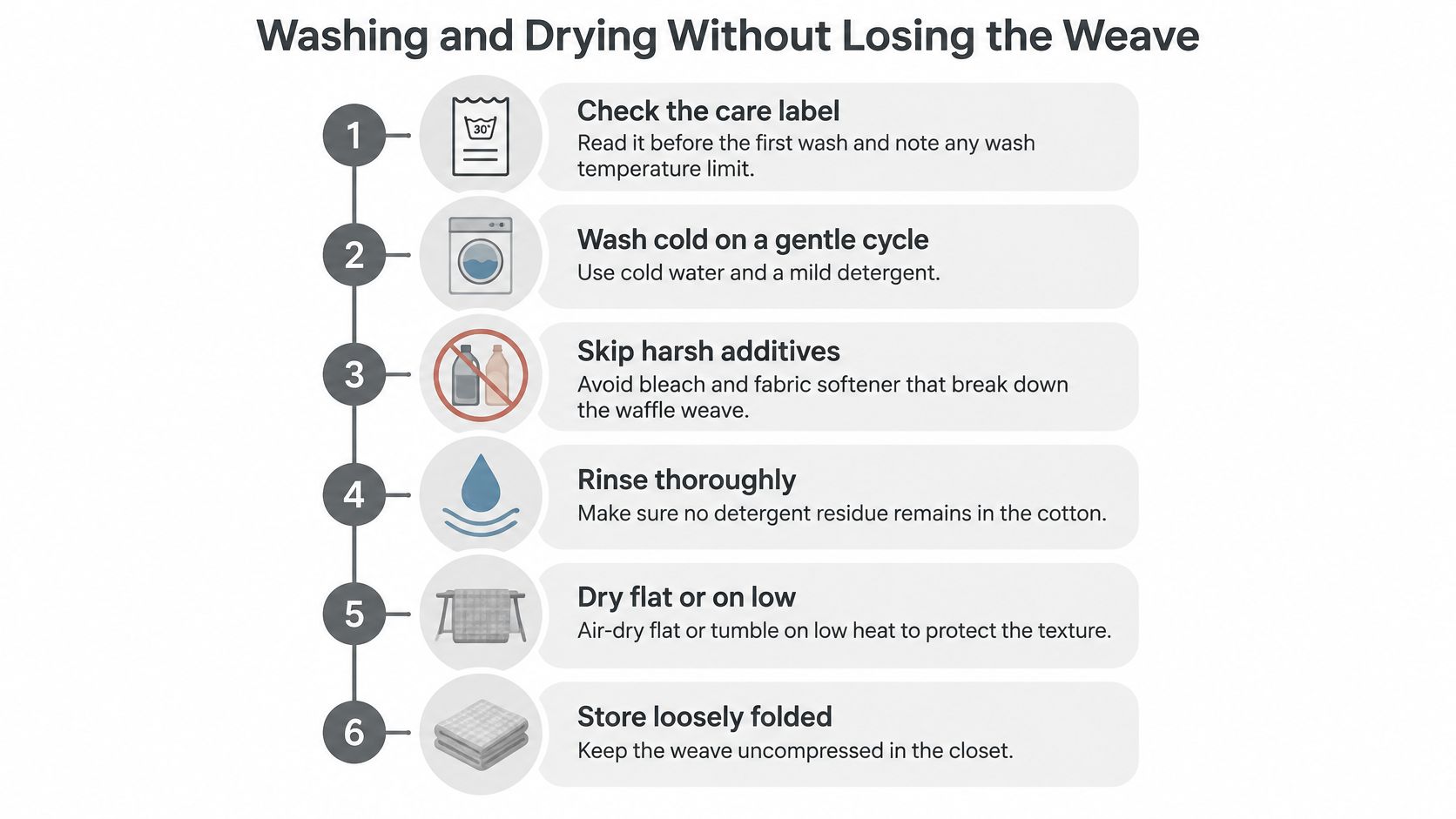
The care label takes priority over a generic cotton routine. Our robe washing, storage and care guide provides additional guidance for maintaining a regular care routine.
A practical wash-to-storage routine
- Read the care label first. Note the permitted washing temperature, drying method, and any restrictions so you don't mistake a general recommendation for the garment's instructions.
- Wash gently in cold water. For our robes, use a gentle cycle and a mild detergent free of harsh chemicals, bleach, or fabric softeners to protect the fabric during routine cleaning.
- Leave out unnecessary additives. Fabric softener can leave a coating that interferes with wetting, so don't use it to chase a softer feel.
- Rinse thoroughly. Use an appropriate detergent dose and check for persistent suds or a slippery feel; excess residue isn't a sign of better cleaning.
- Air-dry or use the lowest tumble heat. Our robes can be dried either way; avoid aggressive heat that can change the cotton fabric's dimensions and feel.
- Hang and store only when fully dry. Use a sturdy hanger for our robes, open the hood to air, and check thick seams before putting the garment away.
Track what changes after washing
In the waffle samples discussed in Jenni Moberg's textile thesis, measured absorbency ranged from 310% to 468% after five wash-and-dry cycles. Those figures come from specific test samples, so read them as a reminder that the weave name alone can't predict how a given robe will perform after washing.
You can feel the difference between taking up water and releasing it at home. Straight out of the wash, a fabric that has absorbed a lot of water feels heavy and saturated. Hung to dry, a fabric releasing that moisture slowly still feels cool and damp at the hood seam long after the body has dried.
For a useful home comparison, keep the routine reasonably consistent. After a similar shower, hang the robe in the same place with the hood open, and note when the body, cuffs, and hood seam feel dry.
Home-test caution: A robe drying beside an open window can't fairly be compared with one drying in a closed, steamy bathroom.
Repeat that check occasionally, especially if the robe starts feeling persistently damp or less comfortable. A change in your own timing is the useful signal here.
Catch damage before it spreads
Avoid packing the washer tightly, since the robe needs room to move and rinse. Separate it from exposed hooks, sharp fasteners, and rough items that can catch the raised texture.
Watch for pulled yarns, loose ridges, opening seams, and stretched belt-loop attachments. Don't yank a snag or cut it flush without inspecting the construction; use a blunt needle to ease a pulled loop back toward the reverse, or have a substantial repair handled professionally.
Checking Organic and Certified Claims Before You Buy
Read the wording in three layers. An organic fibre claim describes the raw material. A certified product carries certification applied to that item. A certified facility is an operation audited for a defined scope. When a listing uses one term, check which layer it names before giving the robe extra credit.
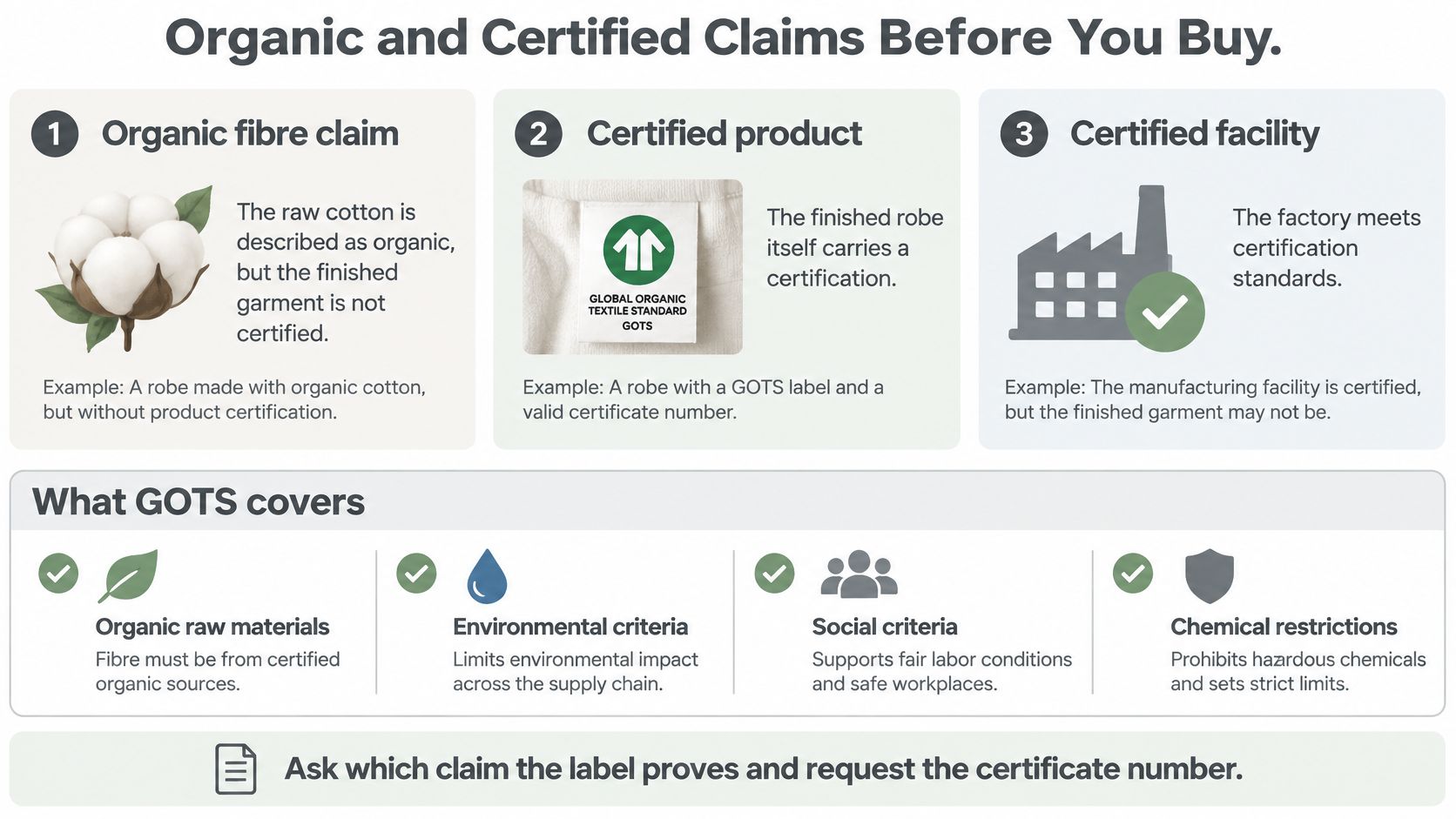
What GOTS covers
GOTS, the Global Organic Textile Standard, addresses organic raw materials alongside environmental and social criteria, chemical management, traceability, and claims integrity. Our guide to GOTS-certified organic cotton fabric explains these distinctions in the context of cotton textiles.
The Global Organic Textile Standard annual report records 17,800 certified facilities across 95 countries as of January 1, 2026. That reach confirms an established framework. The certificate for one robe still needs its own product and scope statement.
Consumer interest makes precise wording important. A PwC survey summarised in Consumer Reports' guide to greenwashing found that 46% of respondents across 31 countries reported buying more sustainable products. A broad environmental label can influence a purchase even when the buyer hasn't established what it proves.
Check the scope rather than trusting the colour of the label
Use the product description and certification information together:
- Identify the certified item: Match the claim to the finished robe, the fabric, or the facility named in the certificate.
- Check the certificate holder: Look for a documented connection to the seller's supply chain. A manufacturer's name may legitimately differ from the retail brand, and the relationship should be explainable.
- Read the scope: Confirm which activities and product categories the certificate covers instead of treating any textile certificate as universal.
- Read the fibre statement: Separate cotton content from the wording of the organic claim, especially for blends and linings.
- Consider useful life: Choose a robe you can maintain and keep wearing, since fit and construction affect how long certification remains useful to you.
Our bathrobes are made with GOTS certification. Even with a clear credential, read the specific product statement before crediting the robe with extra performance.
Certification records which materials, stages, and sites met the standard. Drying speed, fit, and day-to-day comfort still come from construction and care. Organic cotton content leaves processing, durability, laundering, and replacement relevant to overall impact.
Choose the Right Hooded Waffle Robe for Your Routine
Two robes can share the same waffle weave and still suit completely different routines. What separates them is how each one handles the three things you will live with every week: how it is built, how it fits, and how it washes. Rank those before you compare colours or labels.
A checklist for weighing the trade-offs
- Fit first, because it cannot be altered. Sleeve length, shoulder room and belt placement are fixed at purchase. A robe that fits poorly will stay a poor fit no matter how good the fabric is.
- Construction second, matched to your room. An open, lightweight build earns its place in a warm bathroom, a gym bag or a suitcase. A denser, higher-coverage build earns its place where the room is cold and the robe has somewhere to dry between wears.
- Laundering third, weighted by frequency. Care repeats for the life of the robe, so a small inconvenience on the label becomes a large one over a year of washes. Check that the washing and drying instructions are ones you can follow at home.
When two candidates tie on this checklist, choose the one with the simpler care routine. Comfort differences fade with familiarity. A robe that is awkward to wash or slow to dry keeps costing you time every week.
Accept deliberate compromises instead of chasing a perfect score. A little extra bulk is a fair price for winter comfort, and lighter insulation is a fair price for easier packing, as long as the trade-off is one you chose.
At SEYANTE, we offer Turkish-cotton robes in lightweight waffle and terry constructions, including hooded styles for everyday routines. Visit SEYANTE to compare options in your size, and read each robe's fibre description, fit information, and certification wording before you buy.