Waffle Weave Robe Short: Fit, Care and Uses
A waffle weave robe short is a lightweight cotton cover that usually ends between mid-thigh and just above the knee. It earns its place by moving air, not by drinking water. That one distinction separates a robe you'll wear for years from one that ends up bunched on the back of a door.
The popular advice says waffle dries faster than terry, so buy waffle for every job. It's half true, and the half that's wrong costs money. Waffle names a cellular texture, not a performance grade. Two robes with the same honeycomb surface can differ in cell depth, yarn packing, weight and how much water the finished cloth holds.
When a Short Waffle Robe Is the Right Layer
Choose a short waffle robe by where the hem should fall, how much bulk you can carry, and whether you expect it to absorb water. The table narrows the choice to a typical hem, weight preference, and use condition.
| Situation | Typical hem | Choose it when |
|---|---|---|
| Post-shower at home | Mid-thigh, about 90-100 cm (35-39 in) | You towel off first and want a lighter layer than terry |
| Spa or guest robe | Above the knee, about 100-110 cm (39-43 in) | The robe is laundered often and should look neat with less bulk |
| Travel or gym bag | Mid-thigh, about 90-95 cm (35-37 in), in the thinnest cloth you can accept | Packing flat matters more than plush coverage |
| Warm-climate lounging | Mid-thigh to knee | Rooms stay near or above 22°C and terry feels too warm |
| Cold room or towel replacement | A short waffle robe is usually the wrong format | You need high liquid uptake and warmth right after bathing |
Use the table as a starting point, then check the product page for fabric weight. There is no universal GSM band that separates a good short waffle robe from a poor one, so compare stated weights across robes rather than relying on an unsourced benchmark.
For post-shower wear, a mid-thigh robe in a light-to-mid weight can feel comfortable if you towel off first. Put it on while still dripping, though, and a lightweight cloth may feel clammy across your back. A robe can cover you while you dry, but that does not make it a substitute for a towel.
Spa and guest robes face a different demand: frequent laundering and quick turnaround. A shorter cut keeps bulk down, which can make the robe easier to handle and quicker to dry. Warm-climate lounging is similar to post-shower wear, but room temperature matters. In a warm room, terry may feel too heavy for relaxing.
If towel-level uptake matters, choose a mid-weight, deeper-celled waffle and expect it to dry more slowly, or reserve terry for drying and wear waffle afterwards. For a weekender, the lighter band packs more easily but provides thinner coverage. For more context on that packing trade-off, see this lightweight robe comparison.
Fit and Length for a Short Robe
"Short" is not a size. It's a relationship between a garment and a person. On someone around 160 cm, a knee-length robe reads long and enveloping. On someone over about 180 cm, the same cut stops at mid-thigh and the belt sits higher than the pattern intended. Two shoppers order the same robe, one receives a spa piece, the other receives a tunic.
The measurements that decide it
| Check | What to measure | Target for a short robe |
|---|---|---|
| Hem | Shoulder seam to the hem you want | About 90-100 cm for mid-thigh, 100-110 cm for above the knee, 110-115 cm for a true knee |
| Chest or bust | Fullest point, robe open across the shoulders | About 8-15 cm of ease beyond the body so the front overlaps |
| Sleeve | Shoulder to wrist with the arm slightly bent | Cuff at the wrist, not over the hand; kimono sleeves need width more than extra length |
| Belt | Natural waist while standing | Belt holds without lifting the hem more than about 2-3 cm |
| Height mismatch | Your height versus the size-chart model | Judge the hem against the model height; a taller wearer sees a shorter hem |
Start at the hem, because that's the number brands rarely print and the one that decides whether you wear the robe or lend it out. Measure from the shoulder seam down to where you want the cloth to stop, then compare your figure with the length stated in centimetres.
Ease is the second trap. A wrap front needs overlap to stay closed when you sit down or reach across a table, so look for roughly 8-15 cm beyond your fullest chest or bust measurement. Less than that and the belt does all the work, pulling the front edges apart.
Check the sleeve with your arm slightly bent, so the cuff meets the wrist bone without swallowing your hand. A kimono sleeve is a different animal: it hangs from a wide armhole, so width across the upper arm matters more than length, and extra length drapes.
Hooded and kimono cuts fit differently rather than better or worse. A hood adds weight at the shoulders and pulls the collar back, which suits a cool room after a shower. A kimono wrap relies on overlap width and belt placement, which suits a robe you'll wear open while you get ready.
The belt test: tie it at your natural waist and look at the hem. If it rides up more than about 2 to 3 cm, the cut was drafted for a longer torso than yours.
Sizing charts hide the same traps across garment types, and this sizing advice for heavyweight hoodie buyers makes a similar case for reading the drop from shoulder to hem instead of trusting the label. Before ordering, do three things in two minutes: read the model height in the size chart, take one horizontal measurement at your fullest chest or bust, and confirm your preferred hem length. A Women's Lavender Blue Lightweight Kimono Waffle Spa Robe in 100% GOTS-certified organic Turkish cotton is a kimono-cut example where the overlap check matters most, since the front has to close cleanly without a pin.
How the Waffle Cells Change the Cloth
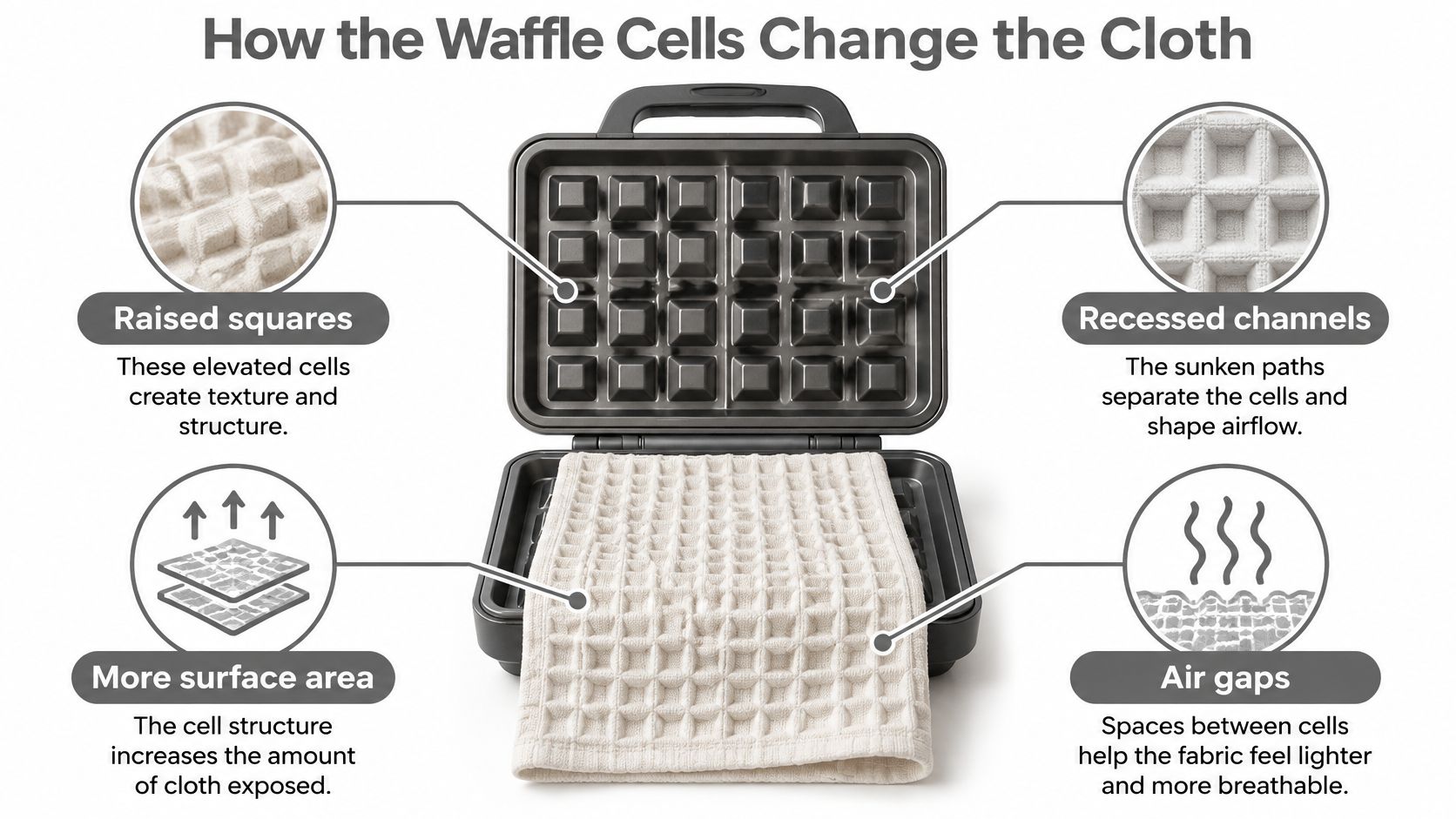
A waffle weave's raised cells and recessed channels give the fabric its three-dimensional surface. Like batter shaped by a waffle iron, yarn forms a grid of peaks and valleys. The texture creates more surface area and small air spaces between the cloth and the body.
That structure helps explain why waffle robes are often chosen as lighter layers. The raised parts touch the skin while the channels leave room for air to move. How well the cloth handles moisture, though, depends on more than the pattern.
Yarn and finishing shape the result
The grid is a familiar textile construction, used in towels, bath linens and robes. Its look alone says little about how a particular garment will feel or perform.
Fibre, yarn and finishing fill in the details. Two cotton robes can share the same honeycomb texture yet differ in softness, thickness and durability. The yarn's quality and the way the fabric is finished affect the hand; the garment's cut affects how the cloth hangs.
The weave gives the fabric its shape. Fibre, yarn and finishing determine how that structure feels in use.
A shorter cut uses less fabric than a full-length robe, which can mean less bulk to wash, store and present in a guest room. For a closer look at how the structure is made, read this guide to waffle robe construction.
Weight Absorbency and the Drying Trade-Off
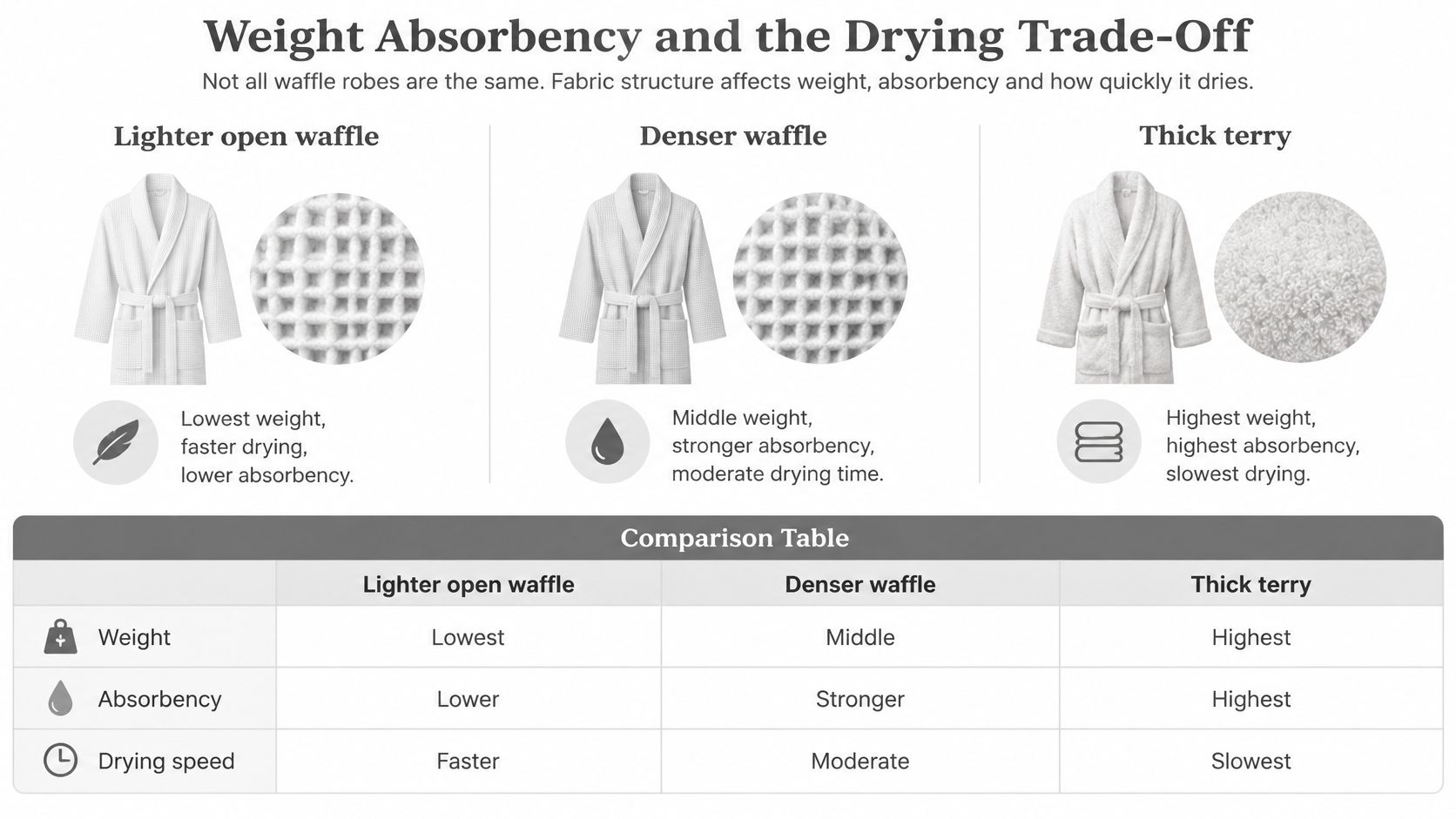
A waffle label does not tell you whether a robe will absorb a shower or dry quickly. Start with the trade-off you want: lower fabric weight usually means less bulk and faster drying, while heavier cloth generally offers more coverage and moisture uptake.
| Spec to compare | Lighter open waffle | Denser waffle | Thick terry |
|---|---|---|---|
| Fabric weight | Lowest stated weight on the page | Middle of the maker's range | Highest, built from pile and mass |
| Best job | Cover-up, travel, warm rooms | Post-shower use with some uptake | Maximum absorbency and warmth |
| Drying | Usually faster if pores stay open | Slower as yarns pack tighter | Slowest because of pile and mass |
| Coverage when wet | Can feel thin or slightly sheer | Better opacity | Highest opacity |
| Laundry bulk | Lowest | Moderate | Highest |
| Claim to verify | Airflow and drop-absorption time | Absorbency and shrinkage after washing | Weight and dry time |
Open cells and lower mass help cloth release moisture and feel dry sooner. Tighter yarn packing can take up more water and improve coverage, but it may also slow drying. Choose according to how you plan to wear the robe: a light cover-up has a different job from a post-shower layer.
The absorbency spread that breaks the shortcut
Comparative testing shows a wide range among textile constructions. In a comparative study of untreated textile samples, absorbency ranged from 59% to 455%. One waffle sample held steady at roughly 360% to 434% across testing, while another waffle sample performed poorly. The results show why the weave name alone is a poor guide to absorbency.
Washing can change how cloth handles moisture. In comparative laundering tests on waffle and twill fabrics, cotton and wool samples were woven in waffle constructions and polyester in twill. After ten warm washes and tumble drying, the washed samples generally showed poorer one-way moisture-management capability as yarns moved closer together and fabric porosity decreased. Damp cloth left in a hamper can also develop a musty smell. These CleanOnline garment care tips Toronto explain ways to treat mustiness rather than mask it.
A “quick-dry” badge without a test behind it is a mood, not a measurement.
The chart below brings the weight, absorbency and drying trade-offs together.
What to demand before trusting a claim
Standardised methods can measure specific parts of performance. ASTM's textile standards list includes AATCC 79, which measures how long a water drop takes to disappear into cloth, and ASTM D7404, which measures how long water takes to dissipate from it. Moisture regain, or the amount of water a fibre holds under set conditions, is measured separately.
Before ordering, check the fibre content, stated fabric weight and shrinkage guidance. Look for at least one result for drop absorption, drying time or air permeability. If those details are missing, you can judge the robe's texture, but not reliably predict its moisture performance.
Certification, Durability and Washing
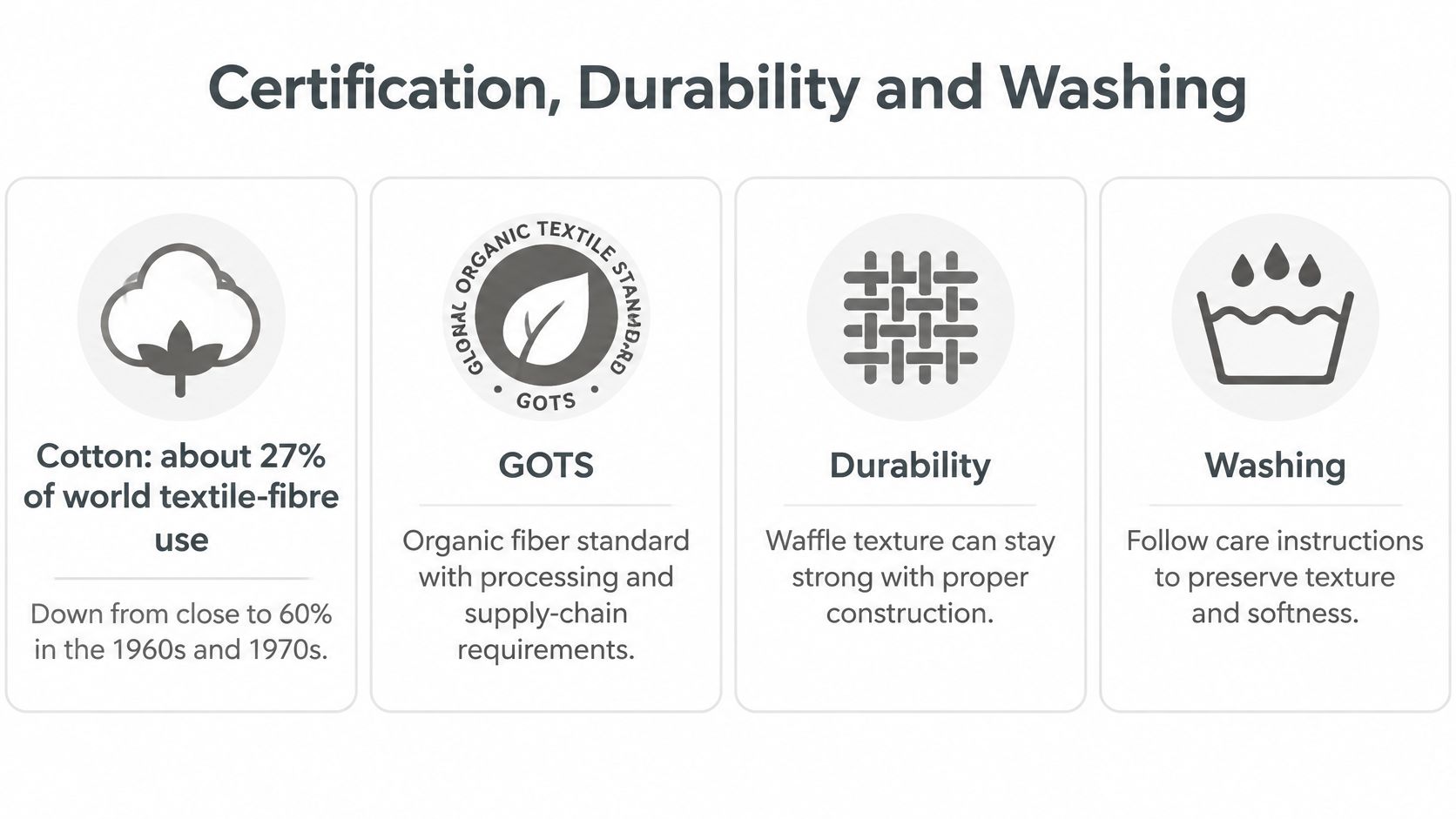
A waffle label describes texture, not performance or durability. Start with the robe's intended use and construction, then check what its fibre certification covers and how its care instructions protect the cloth.
Where a certificate stops
GOTS certification covers organic raw materials and sets environmental, social, chemical-management and traceability criteria. It does not tell you how a robe will feel after repeated washing or how long its seams will last. SEYANTE offers robes made with GOTS certification, including Organic Turkish Terry bathrobes made from 100% Turkish cotton.
Durability is a construction question
A lighter robe uses less fabric and may take less effort to dry, while a thin cloth or weak seam can shorten its useful life. Check the fibre content, stated fabric weight, belt and seam construction, and any guidance about shrinkage after washing. Each detail helps explain how the robe is built and what care it needs.
Shedding depends on the cloth's construction. Shorter fibres can escape more easily as they fragment or slip out of the weave, but the section provides no reliable shedding figure for waffle robes. Ask whether the maker has measured fibre release rather than treating weight alone as a predictor.
A robe's care routine helps preserve its weave.
A wash routine that keeps the cells open
- Prepare the robe. Thread the belt through its loops and empty the pockets so the cloth does not twist around loose items.
- Choose a gentle wash. Use a cold cycle and mild detergent without harsh chemicals, bleach or fabric softener.
- Leave out softener. It can coat cotton fibres and reduce absorbency.
- Give the robe room. A loosely filled drum lets the cloth move and rinse properly.
- Dry gently. Air-dry the robe or tumble-dry it on the lowest heat setting.
- Smooth the fabric. If the cells look crushed, run a hand along the hem and sleeves while the cloth is damp.
- Store it fully dry. Hang the robe on a sturdy hanger, and let it dry completely before putting it away.
A gentle routine helps limit wear from heat and rough handling. Follow the garment's care instructions, and use the robe washing and storage guide for further care guidance.
For hospitality sets, consistent care procedures can support day-to-day operations alongside avoiding housekeeping stockouts and inconsistent shipments.
Check the Robe Before You Order
A waffle label describes texture, not performance. Before ordering, check the hem measurement, fabric weight, fibre content, any stated cell depth or GSM, and the care instructions. For a GOTS claim, confirm which material or product it covers. If the page leaves out a detail you need, ask before buying.
Three ways the choice goes wrong
- Too light and too open. Wet cloth may offer less coverage, which can be uncomfortable when stepping out of a shower in a shared house or hotel corridor. Check the fabric details rather than assuming a waffle texture means a robe will feel opaque.
- Right hem, wrong wearer. A robe that reaches one person's knee may fall lower on a shorter guest. Compare the garment measurements with the wearer's height before ordering matching robes for a bridal morning or a gift set.
- Dense cloth, humid laundry. A heavy waffle can take longer to dry, which may be a poor fit for a warm, busy laundry. Check the care instructions and consider how much drying time you can allow.
For a coordinated group, check each person's measurements and confirm the chosen lengths before ordering. SEYANTE's Women's Beige Turkish Cotton Waffle Hooded Robe is listed at $69.99. Use the product page to verify its current details and compare them with the fit and fabric requirements for your group.
Before checkout, write down the hem measurement and weight you want, then compare them with the product page. Check the fibre and certification wording, cell depth or GSM if listed, and care instructions. That gives you a clear basis for comparing robes without relying on the word “waffle” alone.