Long Terry Cloth Bath Robe: Length, Fabric and Fit
You step out of a hot shower, reach for the robe on the hook, and pull it around yourself. It's a long terry cloth bath robe, so it should wrap from shoulders to ankles in looped cotton and soak the water off your back before you've taken three steps. Most mornings, that's exactly what happens. Then, eight months later, the same robe stops covering your ankles, the hem sits at your shins, and it hangs damp on the hook long after you've dried your hair. Nothing about the label changed. What changed was predictable from the day you bought it.
Terry is a looped weave: thousands of uncut cotton pile loops sit against your skin and pull water across a surface area far larger than flat fabric offers. That's why a terry robe works like a wearable towel, while a waffle weave traps air in a honeycomb grid and dries fast but absorbs less. Terry-cloth bathrobes made up 12.9% of the global bathrobe market in 2025, about USD 1.07 billion of a market valued at USD 8.3 billion, according to Dataintelo's bathrobe market report. For a long style, four variables decide whether that investment works: fabric quality (cotton type and loop stability), absorbency (pile height and weight together, not weight alone), length (shoulder seam to hem, matched to your height), and fit (shoulder width, sleeve, belt placement, room to move).
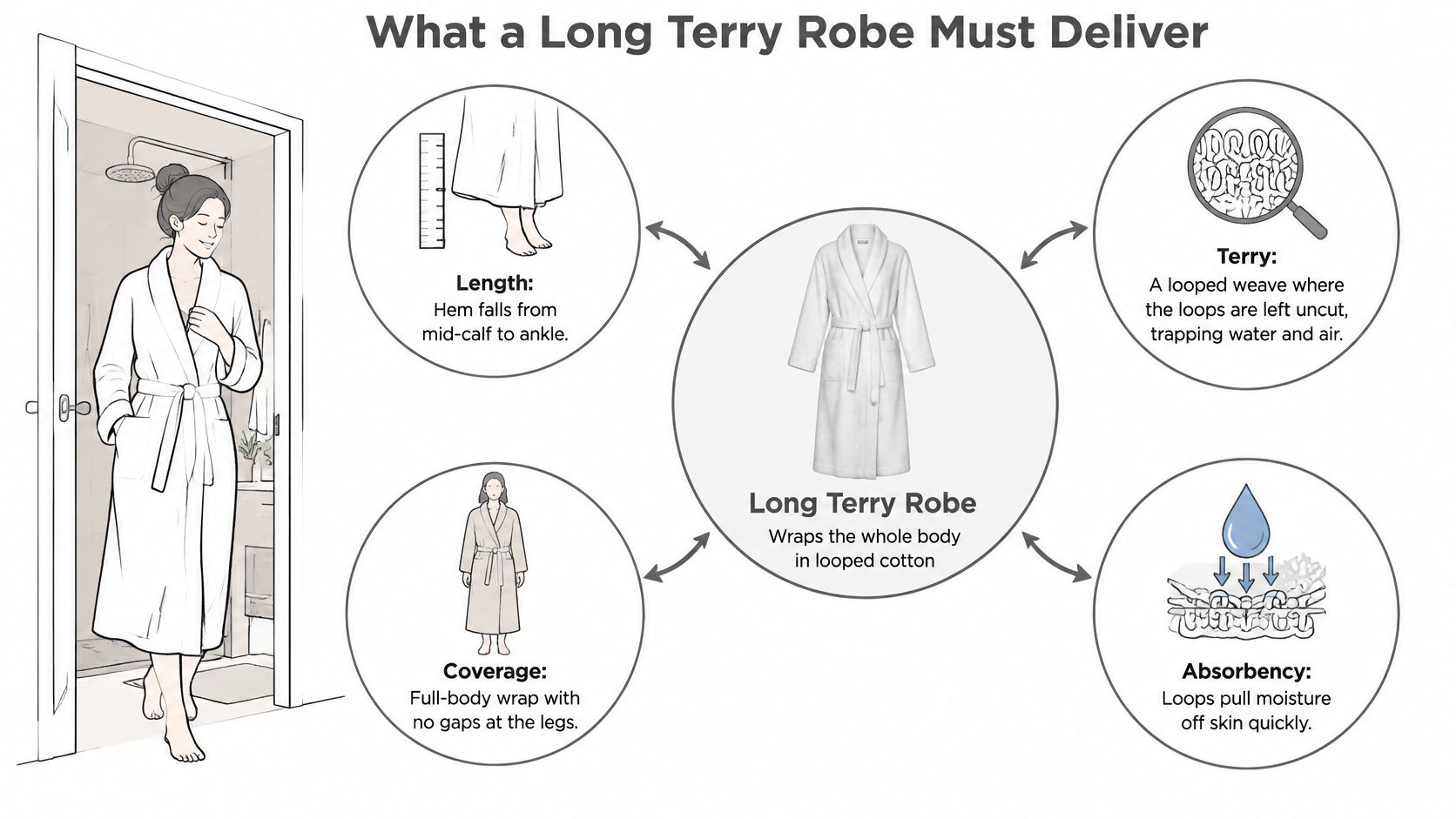
A long robe adds two problems a short robe never has. It holds more water per wear, so it takes longer to dry. And it has more vertical fabric that can shrink, so a small change in length moves the hem by inches. The rest of this guide takes those variables one at a time, with the numbers you need to predict both outcomes before you order.
What a Long Terry Robe Must Deliver
Length is the first decision, because it's the hardest to fix later. Start with the table below, then read the measurement note under it.
| Wearer height | Typical size | Hem lands at |
|---|---|---|
| 5 ft 0 in to 5 ft 3 in | S-M | Mid-calf |
| 5 ft 4 in to 5 ft 7 in | M-L | Lower calf |
| 5 ft 8 in to 5 ft 11 in | L-XL | Ankle |
| 6 ft 0 in and taller | XL-XXL | Ankle with extra overlap |
Measure once and you've solved this: run a tape from the shoulder seam point straight down to the hem, not from the collar, because the collar adds distance that isn't part of the drop. Lay a robe you already own flat, measure the same way, and compare. The letter on the tag is a starting hint, not a guarantee, since sizing bands differ by brand. The measured number outranks the letter every time.
That single number resolves most of the confusion tall and short shoppers run into. A 50 in back length lands at the ankle on a 5 ft 5 in wearer and at the mid-calf on someone 6 ft 1 in. Same robe, two different garments, purely because of where the hem sits. If you're taller and the length table puts you at the top of a size band, check our guide to robes for tall women before you pick a letter size.
Ask before you buy: Is the listed length measured before or after washing? If the seller can't say, assume it's pre-wash and plan for the hem to rise.
That's not a minor detail, and it's where length and fabric connect. A robe that measures 52 in on the page can sit an inch or two higher once it's been through a warm dryer, which is the difference between ankle coverage and lower calf. Cotton terry shrinks along the direction with the most tension in the weave, and on a full-length robe that's the vertical drop you just measured. The heavier and taller the loops, the more water the fabric holds per wash and the more that cycle repeats. So the same loop structure that decides how fast a robe dries you off also decides how much the hem creeps upward over its first year.
The practical move is simple. Compare your shoulder-to-hem measurement against the length the seller states, treat any unstated figure as pre-wash, and leave yourself an inch or two of slack if ankle coverage is the goal. If you like a hooded cut in a longer body, our Women's Hooded Turkish Cotton Terry Cloth Robe is made from GOTS-certified organic Turkish cotton. Whichever robe you choose, run the tape measure check on it the day it arrives, before the first wash, so you know exactly what you're working with.
Get length wrong and nothing downstream can rescue the robe. Get it right, with shrinkage already accounted for, and every other variable becomes a matter of preference rather than repair.
Choosing Weight and Loop Structure
A long terry robe has two jobs after a shower: remove water from skin, then release that water into the room. Weight affects both jobs, but it does not work alone. Length, loop height and shrinkage form one connected decision. The same dense pile that feels plush can add water weight to the hem, stretch the shoulders while wet and slow drying. Start with weight as a practical filter, then look closely at how the loops are built.
| Terry weight | Best use | Trade-off |
|---|---|---|
| 300-350 GSM lightweight | Warm, humid or shared bathrooms and travel | Dries fast but less plush |
| 400-450 GSM midweight | Daily home use, the balanced default | Moderate drying time |
| 500-600 GSM heavyweight | Plush warmth in a ventilated room | Slower to dry, needs airflow |
| 600+ GSM hotel-density | Spa feel in a heated or well-ventilated bathroom | Longest dry time, holds the most water |
The table works like a climate map. A heavier robe in a small, humid bathroom can feel warm in the moment and stay damp for hours, especially if the lower half holds water against the legs. A lighter robe in a cool room may dry quickly but feel thin at the ankle, where full-length fabric moves and loses contact with the body. Match the fabric to the room before judging the hand feel.
Why loops beat weight
Loop geometry explains more of terry performance than the number on the label. Pile height and the yarn used for the pile warp shape how much water the surface can meet and hold. Each loop works like a tiny cup. Taller loops create more surface area, so the robe can absorb water quickly.
That same structure creates the drying penalty. More loop surface holds more water, and more bulk means the robe takes longer to give that water back to the air. Taller loops also catch more often on zippers, door handles and rough furniture. A zipper snag can pull one loop out of line, then leave a small trail of loose pile. This is why the robe that dries you fastest may also be the robe that stays damp longest.
A 2025 terry-fabric study published in the Egyptian Journal of Chemistry found that increasing weft density reduced absorbency, moisture-management capacity, drape, softness and smoothness. In plain terms, a tighter, denser weave can feel heavier and stiffer while performing worse at the job you bought it for. A fabric can look substantial on the shelf and still manage water poorly. Treat exceptional density as a construction detail, not proof of quality.
First-robe rule: Start a long terry robe in the 400-450 GSM band. It's forgiving in most bathrooms and dries within a normal day.
What to check on the listing
- Loop stability: Look for terms like "combed" or "ring-spun" cotton and a description of the pile. Loose loops pill and shed.
- Seam construction: On a long robe, the shoulder and side seams carry more weight than on a short one. Double-stitched or bound seams hold up.
- Pile height description: If the seller describes the pile at all, that tells you more than the GSM number alone.
- Care instructions: A robe that needs hot water and high heat to look right will shrink and mat over time.
Fiber choice changes how those loops age. Longer staple fibers make stronger, softer loops that resist pilling, so the feel after many washes depends on the fiber as much as the first-day pile. Our explainer on cotton fiber length gives the background. For a long robe, stronger loops also help preserve the hem line, because wet fabric is heavier at the bottom and weak construction shows there first.
Fit Checks Before You Buy
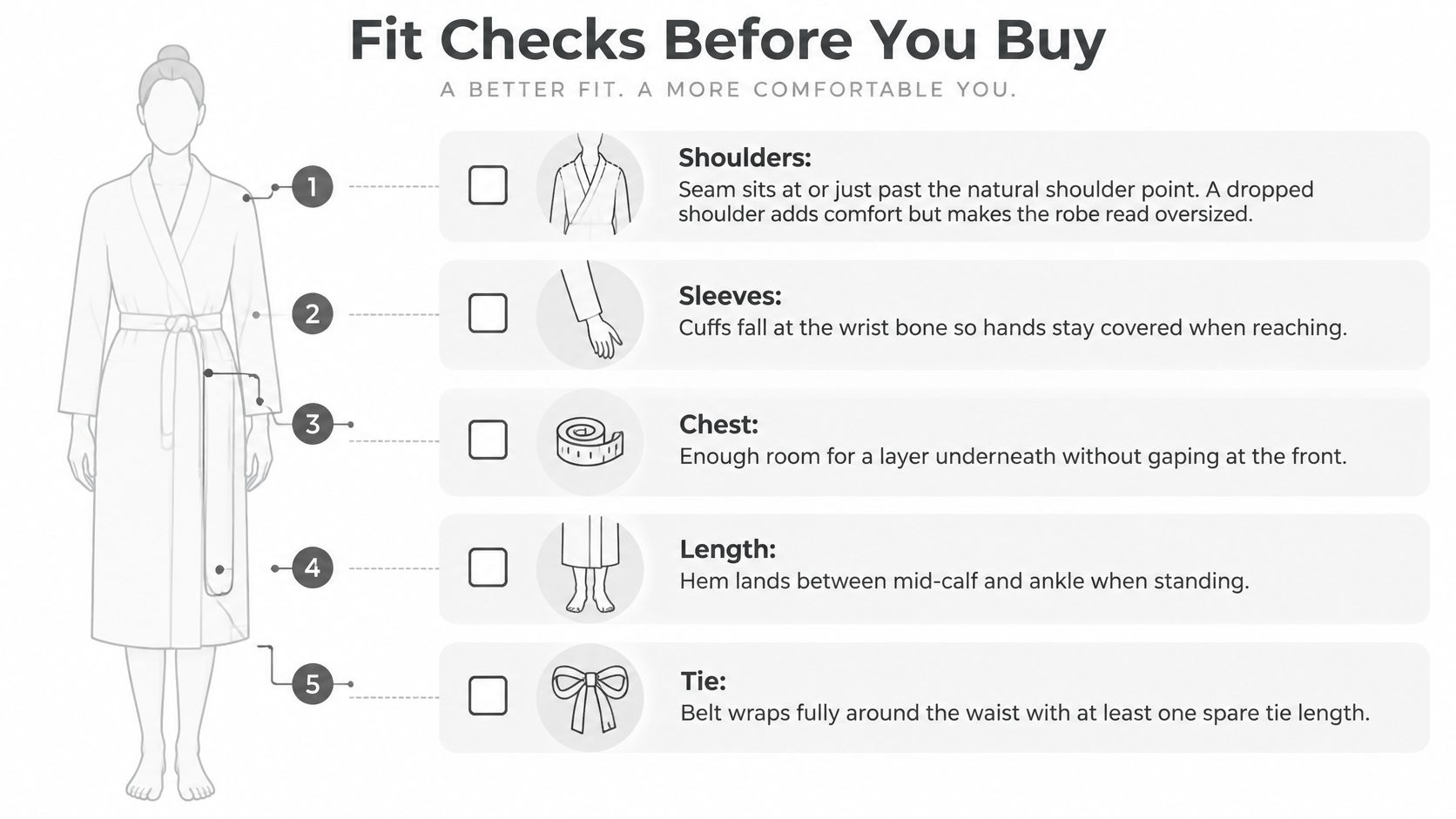
A robe can match your target length and still fit poorly once you move in it. Treat the fit like a chain. The shoulder sets the hang, the sleeve sets comfort, the belt sets coverage, and the hem shows whether the whole length works for your frame.
Shoulders first. The shoulder seam should sit at or just past your natural shoulder point. A dropped shoulder adds room, but it also makes the robe read oversized. Choose that looser cut only if you want the robe to look relaxed when you are standing still.
Sleeves next. Long terry robes often run long in the sleeve because the same body pattern scales up the arm. Check sleeve length against your own arm measurement, not against the product photo. A rolled or pushed cuff is normal in a full-length style and does not count as a defect.
The wrap and belt. The belt should sit at your natural waist, and the front panels should overlap by at least 4 to 6 inches when tied. That overlap keeps the robe closed when you sit down or cross a room. A longer robe needs a dependable overlap because excess length gives the fronts more room to swing apart.
Hem and stride. Barefoot, the hem should clear the floor by an inch or two. Then take a few steps. If the front opens with every stride, the overlap is too narrow or the robe is too long for your frame. The ankle check and the walking check answer different questions. One measures clearance. The other measures whether the robe stays closed.
The number nobody publishes
Whether the length is pre-wash or post-wash matters. Terry cloth changes differently across constructions because yarn structure, finishing, fiber properties, laundering temperature, wash type, and chemicals all affect how the fabric behaves. Two 100% cotton terry robes can therefore change length differently. "100% cotton" alone tells you nothing about how much the hem will rise. For a long robe, even modest vertical shrinkage can move an ankle-length garment toward mid-calf, shift the belt line, and reduce coverage when you sit.
Pre-purchase checklist: shoulder seam position, sleeve length, back length (shoulder to hem), front overlap of 4-6 inches, and belt height.
Hold those five numbers against the product page before you buy. SEYANTE's blog includes a robe size chart guide and a guide to bathrobe materials. Use those guides as the reference point instead of guessing scale from a model photo. This matters most when length, loop weight, and shrinkage are being judged together, because the same choices that make a robe feel substantial can also affect how much water it holds and how the finished length behaves after laundering.
Washing and Drying a Full-Length Terry Robe
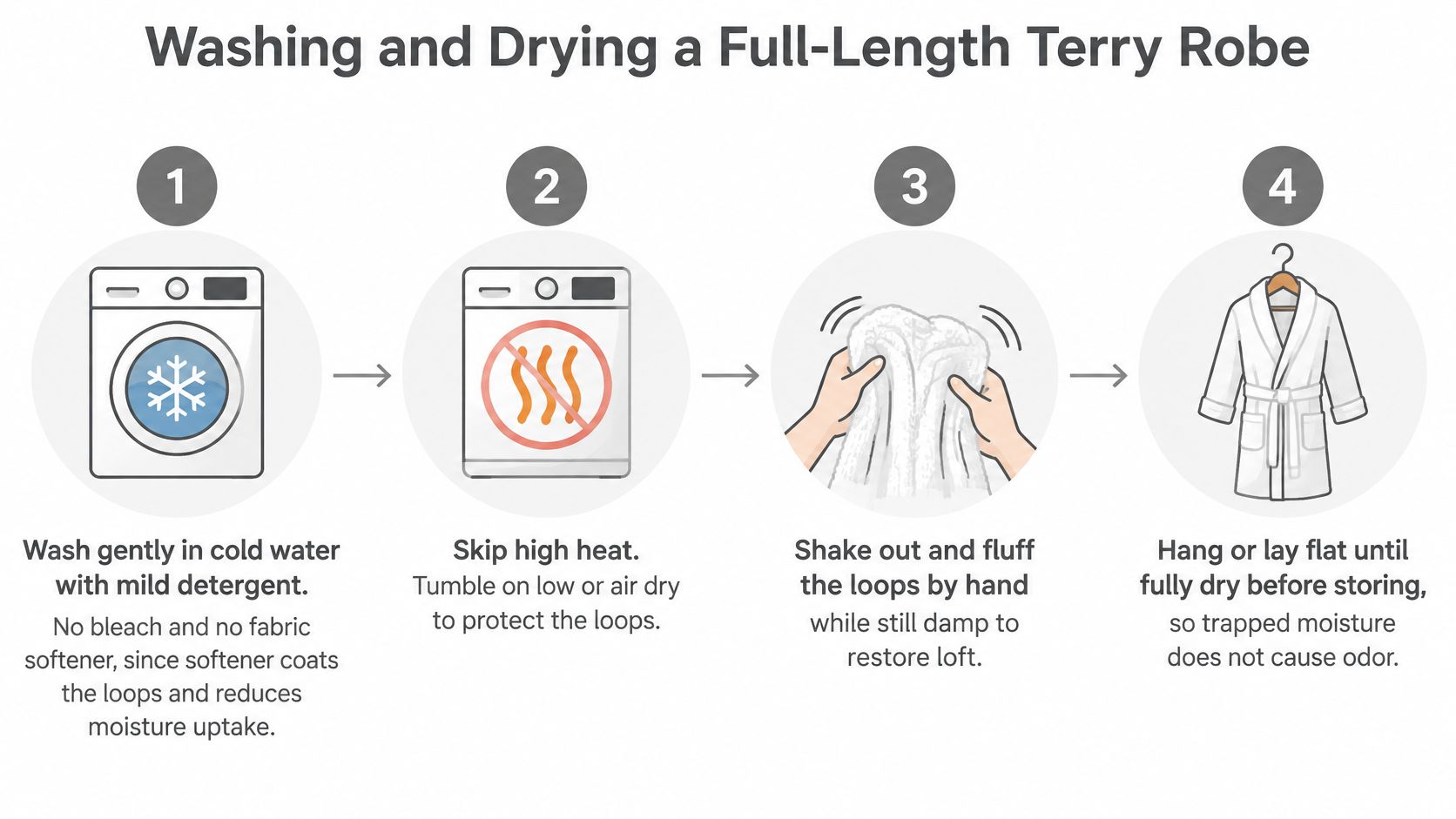
A long terry robe needs a care routine shaped around two facts: heat shortens it, and trapped moisture makes it smell. Here's the sequence that handles both.
- Wash gently in cold water with a mild detergent. Skip bleach and skip fabric softener entirely. Softener coats the loops and blocks the water uptake you bought the robe for.
- Tumble on the lowest heat, or air dry. Heat is what drives the vertical shrinkage that shortens a long robe most.
- Hang on a sturdy hanger and confirm it's fully dry before storing. Pay extra attention to the hem and the belt, where a long robe folds on itself and traps damp.
- Air between wears and wash after roughly three to four uses for home use.
The drying-time reality
More terry surface holds more water. A heavyweight full-length robe can stay damp for hours in a humid bathroom, which is where the musty smell comes from. A fan or an open window solves this faster than extra heat, and it doesn't cost you length.
Absorbency isn't permanent
Most product pages treat absorbency as a fixed attribute. Textile research on cotton terry shows a more honest lifecycle: absorption rate and total absorption generally improve during early laundering, then begin declining after roughly the eighth wash (Indian Journal of Fibre & Textile Research study%20415-420.pdf)). A separate long-running study in the same source found marked improvement through about ten laundering cycles, then smaller gains, with absorption rate passing its maximum after 100 cycles even though ultimate absorption kept increasing.
That gives you a useful read on a robe that dries more slowly than it used to. It may be past its peak absorption rate, not worn out.
Replacement signals: persistent odor after washing, thinning or matted loops, seam separation, or a drying time that has roughly doubled.
For a robe you want to keep for years, our guide to washing, storing and caring for your robe walks through the same steps in more detail.
Misconceptions That Lead to the Wrong Robe
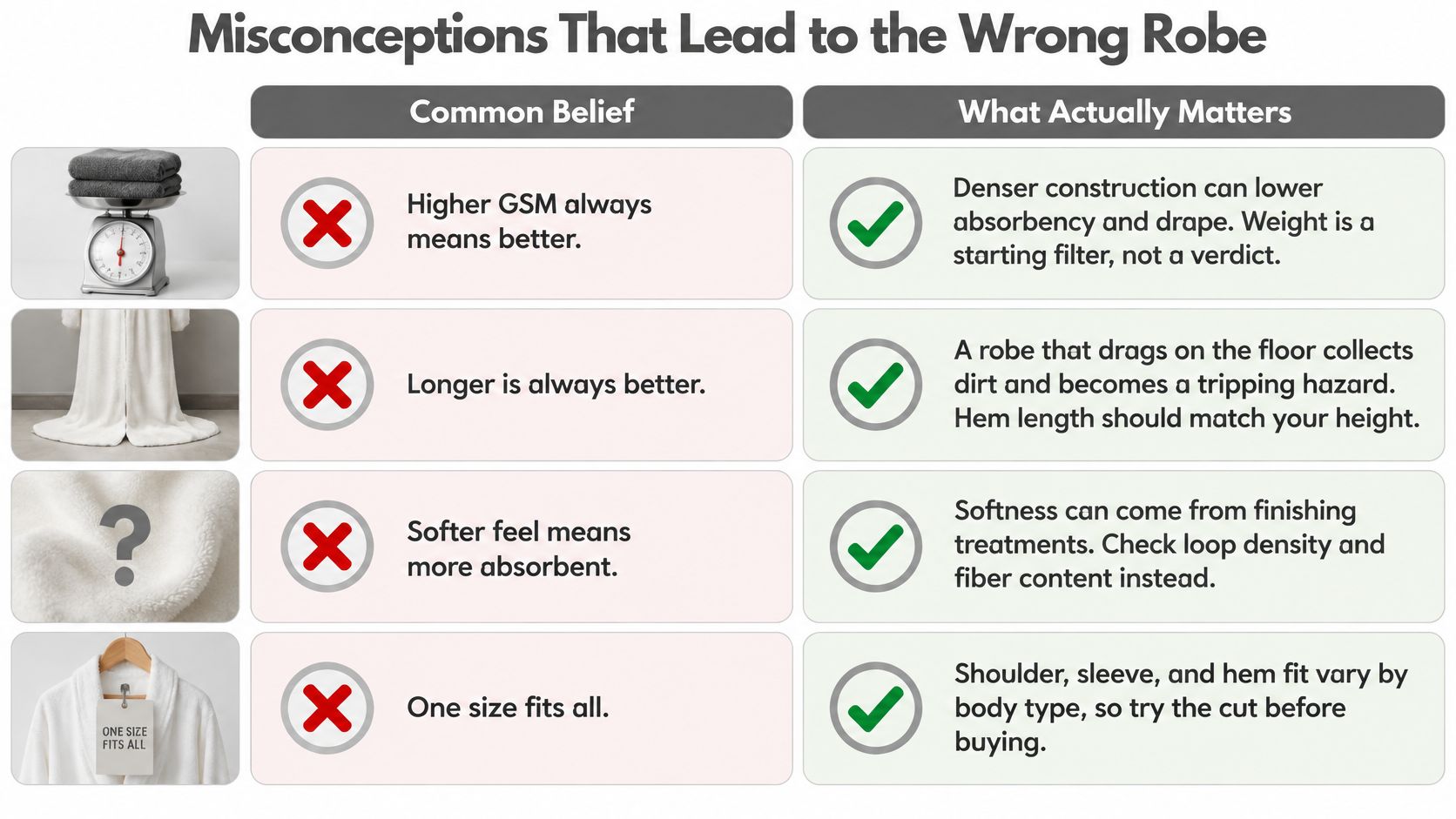
A robe can match every preference on your list and still end up wrong, because a few widely repeated beliefs override the measurements. Most of them share the same root: they treat length, loop weight, and shrinkage as separate questions, when the robe answers all three together.
"Length is a single measurement." A listed length tells you where the hem falls on one particular body, often a fit model or a flat measuring table. Two robes with the same stated length can cover different amounts of leg depending on shoulder width, sleeve cut, and how much overlap the front carries. Treat length as one coordinate in the fit, and measure your own shoulder-to-hem distance before trusting any number on a product page.
"Longer is always better." A robe that drags the floor collects dirt and becomes a tripping hazard, and one that gapes open when you walk performs worse than a lower-calf robe that stays closed. Coverage is about how the robe behaves while you move, and the longest option often behaves the worst once you leave the mirror.
"Only the hem shrinks." The same laundering that raises the hem also shortens the sleeves and lifts the belt line, because the whole garment contracts in the same water and heat. A belt that sat at your waist creeps upward, cuffs retreat toward the forearm, and front overlap narrows at the same time. Plan for a garment-wide change, and the rising hem becomes one symptom of it.
The organic label trap
One more belief deserves its own paragraph, because it comes with a standard attached. Under the Global Organic Textile Standard, products need at least 70% certified organic natural fibers to fall within the standard's scope, while products making the stronger "organic" label claim need at least 95% certified organic fibers, excluding accessories, according to the GOTS Version 6.0 requirements. Certification covers processing, manufacturing, packaging, labeling, trading, and distribution, and it addresses chemical inputs, wastewater treatment, traceability, and transaction documentation.
That scope tells you how the fiber was grown and handled on its way to becoming a robe. It says nothing about how the finished garment behaves. Shrinkage, colorfastness, and seam strength live outside the certificate, so two robes with identical documentation can still perform very differently after the tenth wash. Read the label claim against the percentages above, then judge the robe itself by the same measurements you would apply to any other listing.
Your Buying Decision in Four Steps
You can finish this in five minutes with a tape measure and a product page open.
Step one: measure. Use the length, overlap, and belt measurements from the fit checklist above. The number that matters most is your shoulder-to-hem measurement, because ankle coverage lives or dies on that single figure.
Step two: choose weight by room, not by feel. A humid or shared bathroom points to lightweight at 300-350 GSM. Daily home use in a normal bathroom lands at midweight. Heavyweight and hotel-density only make sense in a warm, ventilated bathroom where air moves. Remember why this connects to step one: the denser the loop pile, the more water it holds after a shower, and the longer it takes to dry. The same heavy cotton that feels luxurious can stay damp until morning in a small bathroom.
Step three: confirm the fabric specifics. Cotton type, loop description, and, if an organic claim matters to you, the certificate scope. That is the difference between a verified claim and a marketing phrase.
Step four: check the return window before ordering. Length is the one thing a photo can't show you. A generous return policy is the safety net for the variable you can't measure from a listing.
One question ties these steps together: is the stated length measured pre-wash or post-wash? Terry cotton shrinks, and shrinkage hits length hardest because there is more fabric along the vertical than across the chest. A robe that covers your ankle on day one can end two inches higher after a season of hot drying, and the denser the loops, the more shrinkage and drying time you should expect. Write down your measured length and the post-wash length you expect. If the difference still fits your frame, order with confidence.
A long terry cloth bath robe should cover your ankles and dry you off for years, not months. Run the four steps above against any listing before you commit, and treat length, loop weight, and shrinkage as one decision rather than three. Browse the full collection at SEYANTE and pick the length, weight, and fit that match your bathroom and your height.