What Is a Kimono Style Robe: Features, Fit and Uses
- What a Kimono-Style Robe Is and How It Differs
- The Five Features That Define the Style
- How the Kimono Shape Evolved Over Time
- How the Cut Affects Fit, Coverage and Comfort
- How to Wear and Tie a Kimono-Style Robe
- Where Kimono-Style Robes Are Worn and Which Fabric Suits Each Use
- Choose the Right Kimono-Style Robe for Your Needs
A kimono-style robe is a relaxed wrap-front robe with straight panels, broad sleeves and a self-tie belt, inspired by the Japanese kimono but never a formal garment. It sits inside a bathrobe market estimated at USD 3.2 billion in 2024, according to Market Survey Analysis.
So what does that mean when you are choosing one? Start with how it works on the body. The front panels cross like a loose wrap jacket, the sleeves give your arms room, and the belt lets you set the fit without buttons or zips. That shape, more than the name, decides whether a robe feels easy for bathing, lounging or getting ready.
Search results can blur the point. One listing may call a terry robe kimono-style, while another uses the same label for waffle, linen or satin robes. A useful way to read those listings is to ignore the fabric word first and look for the cut: straight panels, wide sleeves and a tie closure. Once you see those features, the label becomes much less confusing.
What a Kimono-Style Robe Is and How It Differs
A kimono-style robe is a relaxed wrap-front robe with straight panels, broad sleeves and a self-tie belt. That sentence carries the whole definition, and everything after it is detail about how the shape behaves on a body.
Put one on and the geometry is obvious. The front panels cross your chest like a loose wrap jacket, the sleeves hang wide so your arms move without tugging at a shoulder seam, and a fabric belt closes the robe with no buttons, zips or snaps. Nothing is shaped to a curve. The robe adapts because the panels are generous and the belt sets the fit wherever you want it.
In practice, it looks like this.
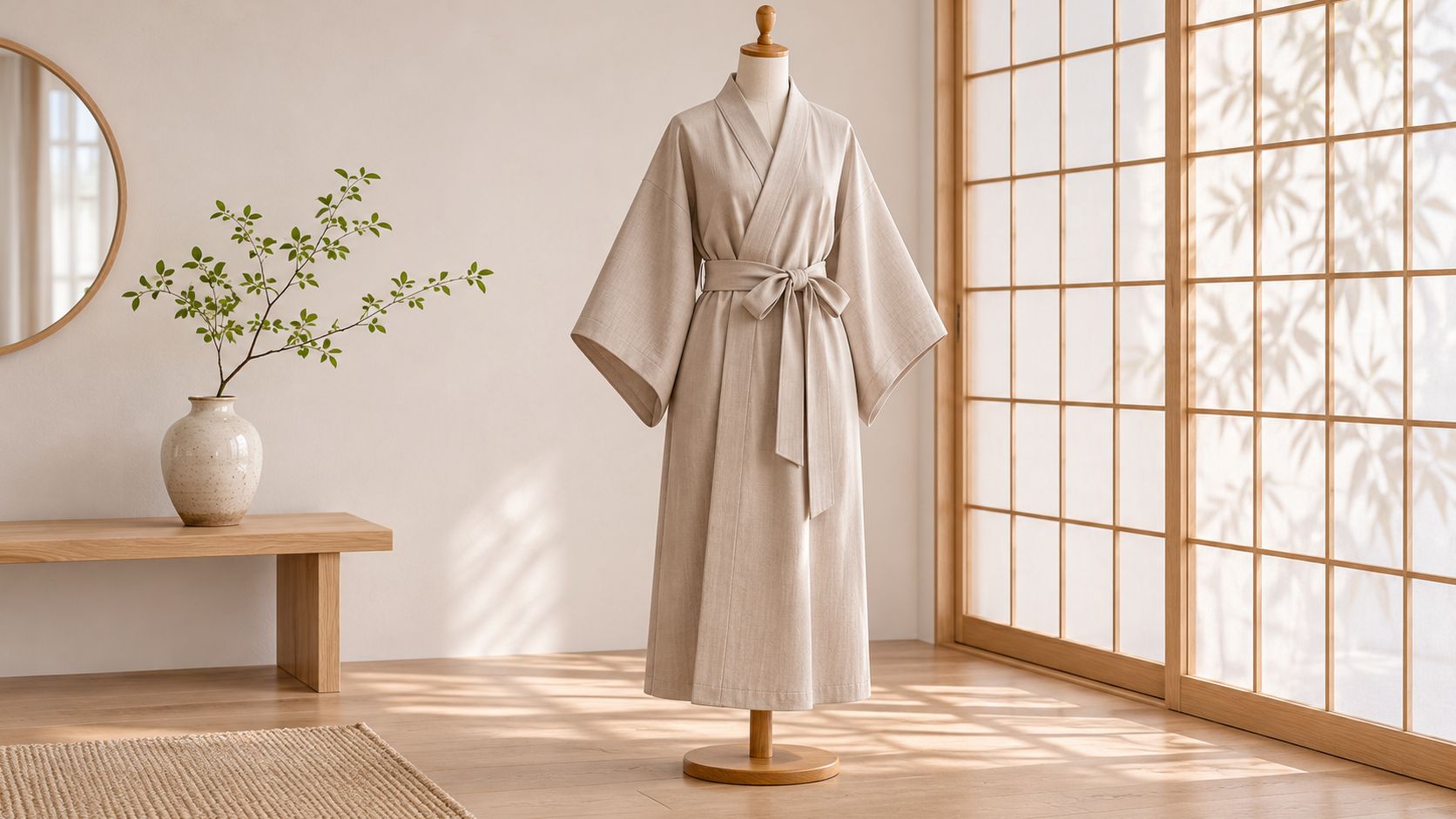
The word "style" is the honest part of the name. The Meaa kimono learning guide explains that a kimono is traditionally a T-shaped garment that wraps across the body and is secured with an obi sash, that the word means "thing to wear," and that its recognizable form developed over centuries, including Japan's Edo period (1603 to 1867). A kimono-style robe borrows the wide sleeves, the straight silhouette and the front tie. It doesn't borrow the rules.
Think cousin rather than twin. Same family resemblance in silhouette, completely different job.
Kimono-style robe compared with an authentic kimono
| Aspect | Kimono-style robe | Authentic kimono |
|---|---|---|
| Main purpose | Bathing, lounging, sleeping and everyday wear | Formal and cultural dress |
| Closure | Self-tie belt or sash, sometimes with a hood | Obi sash tied over layers |
| Fabric | Terry, waffle, flannel, silk or microfiber | Traditional woven textiles chosen for season and occasion |
| Construction | Straight panels adapted to modern fabrics | Straight seams with selvage edges kept |
| Layering | Worn alone | Worn over specialised underlayers |
| Fit approach | Relaxed, adjusted by the belt | Proportions set by convention and occasion |
That table explains the gap. A bathrobe prioritizes absorbency, coverage and easy care. A fashion kimono may use a lightweight decorative fabric with an obi-like belt, and authentic kimono dressing involves specialized layering and proportions that casual robe designs don't reproduce. The word "kimono" alone tells you nothing about which one you're buying.
The Five Features That Define the Style
Strip away the fabric, the color and the brand tag, and five features do the identifying work. You can spot all five on a hanger in about ten seconds.
The University of Huddersfield Press book on the kimono describes the underlying structure as a mostly rectangular garment assembled with straight seams, broad sleeves and an adjustable sash or belt rather than a closely fitted Western-style pattern. That's the blueprint. Here's how each piece shows up on a modern robe.
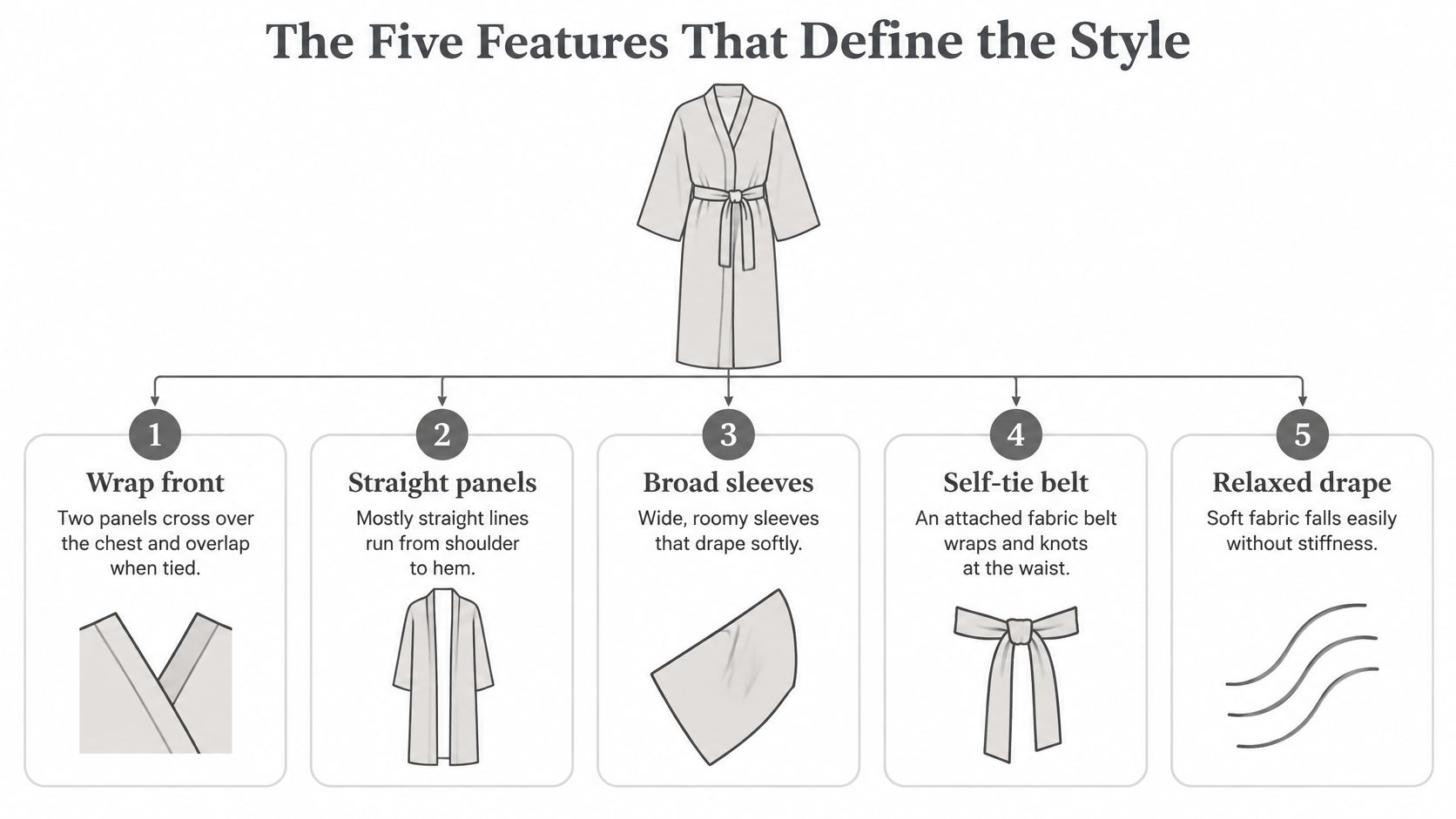
- Wrap front. Two front panels cross over the chest and overlap when the belt is tied. On the hanger, look for a clear left-over-right overlap rather than a center seam. The overlap is what gives you coverage when you sit down.
- Straight panels. The body runs from shoulder to hem in mostly straight lines, with no fitted armhole or waist shaping. This is why one size range can fit a wide spread of bodies.
- Broad sleeves. The sleeves hang wide and open instead of tapering to a cuff. That extra room is why you can reach for a towel rail without the shoulder pulling.
- Self-tie belt. An attached fabric belt wraps and knots at the waist. No fasteners means nothing to break, nothing to unbutton at 2 a.m.
- Relaxed drape. The fabric falls in a soft line rather than holding a stiff shape. Drape is the feature shoppers notice last and feel first.
Brands vary on the extras: a hood, patch pockets, contrast trim, a longer or shorter hem. Those change the use, not the style.
The silhouette defines the style, not the label on the tag.
Run three questions on any robe you're considering. Does it wrap? Does it tie? Do the sleeves hang wide? Three yeses and you're looking at a kimono-style robe, whatever the listing calls it.
How the Kimono Shape Evolved Over Time
The shape didn't arrive fully formed. Each period added a piece that today's robe still uses, and the Britannica history of the kimono traces the sequence clearly.
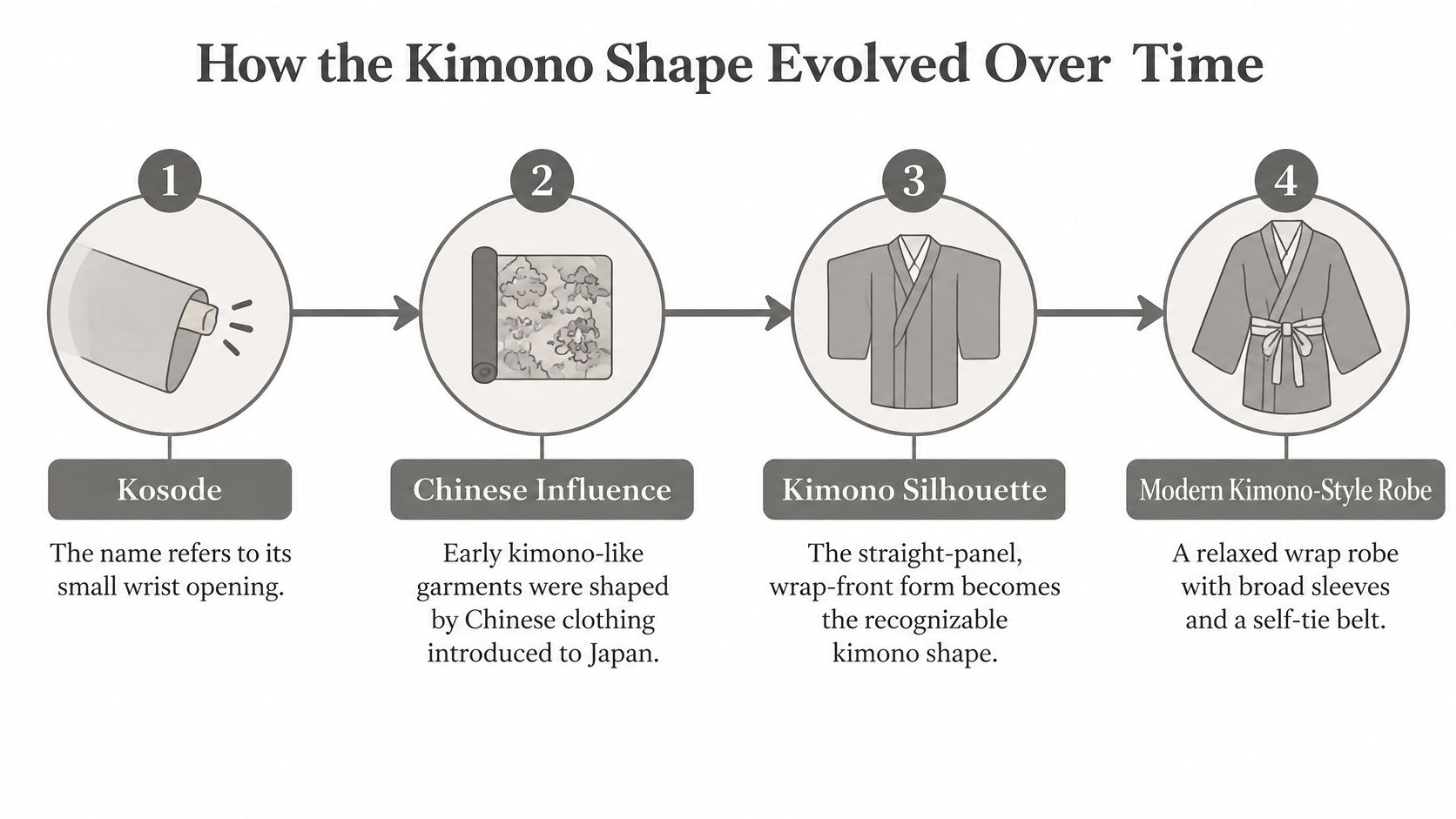
Key periods in the development of the kimono silhouette
| Period | Dates | What changed |
|---|---|---|
| Chinese influence | c. 300 to 538 | Chinese clothing shapes early kimono-like garments |
| Heian period | 794 to 1185 | Sleeves broaden in layered court dress |
| Kamakura period | 1185 to 1333 | Fewer layers; the kosode grows in importance |
| Muromachi period | 1338 to 1573 | Women wear the short-sleeved kosode as an outer garment |
| Edo period | 1603 to 1867 | Modern straight silhouette and coordinated sash take shape |
| 18th century | 18th century | The wide obi sash develops |
| Meiji Restoration | From 1868 | Class-based dress distinctions weaken and the word kimono spreads |
| Modern robes | Today | Wrap, loose sleeves and belt kept; terry and waffle fabrics added |
The starting point is the kosode, a garment whose name refers to its relatively small wrist opening. Early kimono-like garments in Japan were shaped by Chinese clothing introduced between roughly 300 and 538, and the Heian period produced highly layered court dress with broader sleeves. During the Kamakura period people adopted fewer layers and the kosode grew in importance. By the Muromachi period women were wearing the short-sleeved kosode as an outer garment, a real milestone on the way to the recognizable kimono.
What each change explains about your robe
The Edo period gave us the straight, architectural line and the coordinated sash, which is exactly the line you see on a modern waffle robe hanging in a hotel bathroom. Decoration, sleeve proportions and sash styling then carried social meaning: age, status, occasion, season. The wide obi is comparatively recent, developing in the 18th century, which is a useful reminder that even the features people treat as timeless changed over time.
After the Meiji Restoration began in 1868, reforms weakened older class-based dress distinctions and the word kimono spread more widely. Today's version keeps the wrap, the loose sleeves and the belt, then swaps in terry, waffle and organic cotton for bathing and lounging. If you want the wider story of how robes moved from antiquity into the bathroom, this history of the bathrobe from antiquity to the present covers the parallel track.
The form lasted for practical reasons as much as cultural ones. Straight panels use fabric efficiently, accommodate varied bodies, and let a robe open or close in seconds.
How the Cut Affects Fit, Coverage and Comfort
Two robes can share a size label and feel completely different, because the cut controls the wrap, drape and movement. A kimono-style robe is a modern loungewear version of the kimono's linear, T-shaped construction. It has a rectangular body, overlapping front panels, broad sleeves and a waist belt, rather than a fitted Western armhole and sleeve system.
Traditional kimono are assembled mainly from straight seams and keep the fabric's selvage edges, which reduces fraying and allows alterations or resewing. The Portland Art Museum construction guide describes an adult kimono cut from one bolt about 36 cm wide and 11.6 m long into seven straight pieces: two body panels, two sleeve panels, two front sections and a narrow collar strip. In the robes we've inspected, seams are usually overlocked rather than selvage-finished, so the feel and durability come from the seam finish instead of the historical method.
The six-point fit check
Use this check with product photos and the size chart before you pick a size or style.
- Front overlap. When the belt is tied, the panels should cross well past the belt line, not meet at it.
- Sleeve clearance. Raise an arm mentally. If the sleeve opening looks narrow, the shoulder will pull.
- Collar behavior. The collar should lie flat at the neck instead of standing away or digging in.
- Belt length. Long enough to wrap twice is the practical standard for a secure knot.
- Body width. The panels need enough fabric to cross without strain across the chest and hips.
- Hem length. Mid-calf works for lounging and stairs; longer is better for cold rooms and bare legs.
Practical rule: judge the robe by how it wraps and sits, not by a historical measurement. Contemporary kimono style doesn't require traditional dimensions or formal accessories.
The cut matters more than the word on the label. A straight body gives the robe room to fall from the shoulders like a loose wrap jacket, while the overlap decides whether it stays closed during ordinary movement. Wide sleeves add ease, but they only feel comfortable when the armhole leaves enough clearance. A longer hem can feel warmer, yet it should still let you walk without stepping into the fabric.
If a robe passes all six points, the cut is doing its job. If it fails the overlap or sleeve check, a softer fabric may feel pleasant at first and still pull open or bind at the shoulder. Our guide to the most comfortable bathrobe covers how fabric weight interacts with the same fit points.
How to Wear and Tie a Kimono-Style Robe
Tying takes about fifteen seconds once you know the order, and the order is what keeps the front closed when you move.
- Hold the robe by the collar and slip both arms into the sleeves, letting the broad sleeves fall naturally rather than pushing them up.
- Pull the collar closed at the neck, then cross the left front panel over the right. That's the standard wrap for everyday wear and it keeps the opening edge tidy.
- Bring the belt around the waist once, then wrap it a second time if there's enough length.
- Tie a flat knot or a simple bow at the front or side, snug enough that the panels stay crossed but not so tight that the fabric pulls into wrinkles.
- Sit down and reach forward. Check that the front still overlaps and adjust the hem to the length you want.
Two problems come up often, and both have a clear cause. If the front gaps when you move, either the belt is too short or the body is too narrow for the panels to stay crossed. If the sleeves pull at the shoulder when you lift an arm, the armhole is cut too close, so size up or choose a looser cut rather than fighting it.
Hood and pocket placement deserve a quick look too. Pockets should sit where your hands fall naturally, so resting your hands in them doesn't stretch the front panels out of line.
Where Kimono-Style Robes Are Worn and Which Fabric Suits Each Use
One silhouette covers a surprising range of situations, because the wrap, loose sleeves and belt stay constant while fabric and length change. A kimono-style robe works like a loose wrap jacket, so the same cut can feel practical after a shower, calm enough for quiet lounging or composed enough for guests. The setting changes the fabric choice more than the shape does.
- After-bath drying, where absorbency matters most
- Sleeping and quiet lounging, where weight and breathability matter
- Spa and guest use, where the robe has to look composed on a stranger
- Travel, where it has to pack small and dry fast
- Gift sets and bridal mornings, where coordinated color does the work
- Beach cover-ups, where lightness beats warmth
Growth in this category means more shoppers are comparing weaves, not just colors. The global bathrobe market is projected to grow at a 5.3% compound annual growth rate from 2024 through 2030, according to US Data Analytics, and its segmentation already includes kimono collars alongside residential, hotel and beach applications.
Kimono-style robe fabric by use
| Use | Typical fabric | Why it works |
|---|---|---|
| After a bath or shower | Cotton terry | Absorbent loops dry the skin quickly |
| Spa and lounging | Waffle cotton | Lightweight, breathable texture that does not trap heat |
| Warm climate or travel | Lightweight cotton or linen | Light, breathable and packs small |
| Cold rooms and winter | Flannel or fleece | Soft, insulating warmth |
| Sleeping or sensitive skin | Silk or satin | Smooth surface that feels gentle on the skin |
| Hotel guest rooms | Cotton terry | Durable through frequent high-volume washing |
Say a boutique hotel is ordering guest robes for forty rooms. The housekeeping team will wash each robe several times a week, so durability and quick drying outrank softness on day one. Cotton terry wins. A shopper buying a spring robe for a warm apartment has the opposite problem, and a lightweight waffle weave is the better answer because it moves air instead of holding heat.
Climate sets the first filter. Heavy terry suits cold bathrooms. Waffle or linen suits warm weather. Silk or satin suits anyone who wants a smooth surface against the skin. If you want the full comparison of weaves and weights, this guide to the best bathrobe material and fabric types breaks it down by fiber.
A lightweight example of the waffle route is the Women's Lavender Blue Lightweight Kimono Waffle Spa Robe, a lightweight waffle weave in Turkish cotton for breathable everyday wear.
Choose the Right Kimono-Style Robe for Your Needs
Start with the routine, then let the cut solve the fit. A useful shortcut is to treat the robe like a loose wrap jacket: the way it crosses, sleeves and belt sit matters as much as the fabric listed on the product page. Use the fit guidance in section 4 for overlap and mobility, the tying steps in section 5 for belt length and security, and the fabric-by-use table in section 6 for weave and weight. That keeps the choice practical instead of getting stuck on the word "kimono."
One buying check deserves a closer look: compare care labels across two robes with the same fabric type. Two Turkish cotton waffle robes can have different finishing instructions, and the label tells you how much work the robe adds to your week. SEYANTE robes should be washed on a gentle cycle with cold water and a mild detergent free of harsh chemicals, bleach or fabric softeners. They can be air-dried or tumble-dried on the lowest heat setting. Store them on a sturdy hanger only after they are fully dry.
Buying signal: choose the robe that fits the body, ties securely, uses a weave suited to the setting and has care instructions you will actually follow.
If the purchase is for a wedding morning or coordinated getting-ready set, Wedding Studio is a practical resource for planning the schedule and photography around it. For fabric and sizing questions, SEYANTE's robe size chart guide and bathrobe materials guide can help narrow the choice further.